Jul 5, 2012

Physicists Find Elusive Particle Seen as Key to Universe - NYTimes.com


Scientists in Geneva on Wednesday applauded the discovery of a subatomic particle that looks like the Higgs boson. Pool photo by Denis Balibouse

By DENNIS OVERBYE
July4, 2012

ASPEN, Colo. — Signaling a likely end to one of the longest, most expensive searches in the history of science, physicists said Wednesday that they had discovered a new subatomic particle that looks for all the world like the Higgs boson, a key to understanding why there is diversity and life in the universe.

Like Omar Sharif materializing out of the shimmering desert as a man on a camel in “Lawrence of Arabia,” the elusive boson has been coming slowly into view since last winter, as the first signals of its existence grew until they practically jumped off the chart.

“I think we have it,” said Rolf-Dieter Heuer, the director general of CERN, the multinational research center headquartered in Geneva. The agency is home to the Large Hadron Collider, the immense particle accelerator that produced the new data by colliding protons. The findings were announced by two separate teams. Dr. Heuer called the discovery “a historic milestone.”

He and others said that it was too soon to know for sure, however, whether the new particle is the one predicted by the Standard Model, the theory that has ruled physics for the last half-century. The particle is predicted to imbue elementary particles with mass. It may be an impostor as yet unknown to physics, perhaps the first of many particles yet to be discovered.

That possibility is particularly exciting to physicists, as it could point the way to new, deeper ideas, beyond the Standard Model, about the nature of reality.

For now, some physicists are simply calling it a “Higgslike” particle.

“It’s something that may, in the end, be one of the biggest observations of any new phenomena in our field in the last 30 or 40 years,” said Joe Incandela, a physicist of the University of California, Santa Barbara, and a spokesman for one of the two groups reporting new data on Wednesday.

Here at the Aspen Center for Physics, a retreat for scientists, bleary-eyed physicists drank Champagne in the wee hours as word arrived via Webcast from CERN. It was a scene duplicated in Melbourne, Australia, where physicists had gathered for a major conference, as well as in Los Angeles, Chicago, Princeton, New York, London and beyond — everywhere that members of a curious species have dedicated their lives and fortunes to the search for their origins in a dark universe.

In Geneva, 1,000 people stood in line all night to get into an auditorium at CERN, where some attendees noted a rock-concert ambience. Peter Higgs, the University of Edinburgh theorist for whom the boson is named, entered the meeting to a sustained ovation.

Confirmation of the Higgs boson or something very much like it would constitute a rendezvous with destiny for a generation of physicists who have believed in the boson for half a century without ever seeing it. The finding affirms a grand view of a universe described by simple and elegant and symmetrical laws — but one in which everything interesting, like ourselves, results from flaws or breaks in that symmetry.

According to the Standard Model, the Higgs boson is the only manifestation of an invisible force field, a cosmic molasses that permeates space and imbues elementary particles with mass. Particles wading through the field gain heft the way a bill going through Congress attracts riders and amendments, becoming ever more ponderous.

Without the Higgs field, as it is known, or something like it, all elementary forms of matter would zoom around at the speed of light, flowing through our hands like moonlight. There would be neither atoms nor life.

Physicists said that they would probably be studying the new particle for years. Any deviations from the simplest version predicted by current theory — and there are hints of some already — could begin to answer questions left hanging by the Standard Model. For example, what is the dark matter that provides the gravitational scaffolding of galaxies?

And why is the universe made of matter instead of antimatter?

“If the boson really is not acting standard, then that will imply that there is more to the story — more particles, maybe more forces around the corner,” Neal Weiner, a theorist at New York University, wrote in an e-mail. “What that would be is anyone’s guess at the moment.”

Wednesday’s announcement was also an impressive opening act for the Large Hadron Collider, the world’s biggest physics machine, which cost $10 billion to build and began operating only two years ago. It is still running at only half-power.

Physicists had been icing the Champagne ever since last December. Two teams of about 3,000 physicists each — one named Atlas, led by Fabiola Gianotti, and the other CMS, led by Dr. Incandela — operate giant detectors in the collider, sorting the debris from the primordial fireballs left after proton collisions.

Last winter, they both reported hints of the same particle. They were not able, however, to rule out the possibility that it was a statistical fluke. Since then, the collider has more than doubled the number of collisions it has recorded.

The results announced Wednesday capped two weeks of feverish speculation and Internet buzz as the physicists, who had been sworn to secrecy, did a breakneck analysis of about 800 trillion proton-proton collisions over the last two years.

Up until last weekend, physicists at the agency were saying that they themselves did not know what the outcome would be. Expectations soared when it was learned that the five surviving originators of the Higgs boson theory had been invited to the CERN news conference.

The December signal was no fluke, the scientists said Wednesday. The new particle has a mass of about 125.3 billion electron volts, as measured by the CMS group, and 126 billion according to Atlas. Both groups said that the likelihood that their signal was a result of a chance fluctuation was less than one chance in 3.5 million, “five sigma,” which is the gold standard in physics for a discovery.

On that basis, Dr. Heuer said that he had decided only on Tuesday afternoon to call the Higgs result a “discovery.”

He said, “I know the science, and as director general I can stick out my neck.”

Dr. Incandela’s and Dr. Gianotti’s presentations were repeatedly interrupted by applause as they showed slide after slide of data presented in graphs with bumps rising like mountains from the sea.

Dr. Gianotti noted that the mass of the putative Higgs, apparently one of the heaviest subatomic particles, made it easy to study its many behaviors. “Thanks, nature,” she said.

Gerald Guralnik, one of the founders of the Higgs theory, said he was glad to be at a physics meeting “where there is applause, like a football game.”

Asked to comment after the announcements, Dr. Higgs seemed overwhelmed. “For me, it’s really an incredible thing that’s happened in my lifetime,” he said.

Dr. Higgs was one of six physicists, working in three independent groups, who in 1964 invented what came to be known as the Higgs field. The others were Tom Kibble of Imperial College, London; Carl Hagen of the University of Rochester; Dr. Guralnik of Brown University; and François Englert and Robert Brout, both of Université Libre de Bruxelles.

One implication of their theory was that this cosmic molasses, normally invisible, would produce its own quantum particle if hit hard enough with the right amount of energy. The particle would be fragile and fall apart within a millionth of a second in a dozen possible ways, depending upon its own mass.

Unfortunately, the theory did not describe how much this particle should weigh, which is what made it so hard to find, eluding researchers at a succession of particle accelerators, including the Large Electron Positron Collider at CERN, which closed down in 2000, and the Tevatron at the Fermi National Accelerator Laboratory, or Fermilab, in Batavia, Ill., which shut down last year.

Along the way the Higgs boson achieved a notoriety rare in abstract physics. To the eternal dismay of his colleagues, Leon Lederman, the former director of Fermilab, called it the “God particle,” in his book of the same name, written with Dick Teresi. (He later said that he had wanted to call it the “goddamn particle.”)

Finding the missing boson was one of the main goals of the Large Hadron Collider. Both Dr. Heuer and Dr. Gianotti said they had not expected the search to succeed so quickly.

So far, the physicists admit, they know little about their new boson. The CERN results are mostly based on measurements of two or three of the dozen different ways, or “channels,” by which a Higgs boson could be produced and then decay.

There are hints, but only hints so far, that some of the channels are overproducing the boson while others might be underproducing it, clues that maybe there is more at work here than the Standard Model would predict.

“This could be the first in a ring of discoveries,” said Guido Tonelli of CERN.

In an e-mail, Maria Spiropulu, a professor at the California Institute of Technology who works with the CMS team of physicists, said: “I personally do not want it to be standard model anything — I don’t want it to be simple or symmetric or as predicted. I want us all to have been dealt a complex hand that will send me (and all of us) in a (good) loop for a long time.”

Nima Arkani-Hamed, a physicist at the Institute for Advanced Study in Princeton, said: “It’s a triumphant day for fundamental physics. Now some fun begins.”

Farmdocdaily: Where Should We Be Now With Corn Yield Expectations?

Corn Yields Will Likely Fall Short of USDA Estimates
Jul 2, 2012
Based on an analysis of the recent trend in the U.S. average corn yield and a near record early planted crop, the USDA’s May and June WASDE reports indicated prospects for a record U.S. average corn yield of 166 bushels in 2012. With much of the Corn Belt crop now entering the critical stage of the growing season, this seems to be an appropriate time to re-assess yield prospects.

To date, weather conditions have been generally favorable for crop development in a portion of the Northwest Corn Belt and in some far eastern growing areas. This is reflected in the crop condition ratings included in the USDA’s weekly Crop Progress report. As of June 24, 71 percent or more of the crops in Minnesota, North Carolina, North Dakota, Pennsylvania, and South Dakota were rated in good or excellent condition. Weather conditions have been far less favorable in the areas traditionally identified as the Eastern Corn Belt and in a few states in the western Corn Belt. As of June 24, 51 percent or less of the crops were rated in good or excellent condition in Colorado, Illinois, Indiana, Kansas, Kentucky, Missouri, Ohio, and Tennessee. Ratings were especially low in Illinois, Indiana, and Missouri. The rest of the states included in the weekly report (Iowa, Michigan, Nebraska, Texas, and Wisconsin) had 60 to 68 percent of the crops rated in good or excellent condition.

The 18 states included in the Crop Progress report represent nearly 92 percent of the acreage intended for planting, as reported in the USDA’s March Prospective Plantings report. About 38 percent of the acreage in the18 states is in those states with near average crop conditions, 23 percent is in states with very good crop conditions, and 39 percent is in states with below to well below average conditions as of June 24.

Based on growing season weather to date and current crop conditions, what level of yield should now be expected? First, we should note that an above-trend corn yield requires timely planting and very favorable weather conditions over a very wide area throughout the entire growing season. Most important are weather conditions during the reproductive and grain filling stages of the growing season, about late June through August in much of the Corn Belt this year. Above average precipitation and below average temperatures during that period are most conducive for high yields. Most recently, these type of conditions prevailed in 2004 and 2009. Based on weather and crop conditions to date and the hot, dry near term forecast, an above trend yield is clearly not in the cards this year.

What about the chances for a yield near trend value? To achieve a trend U.S. average yield, high yields in those states with very favorable growing conditions would have to offset low yields in those states with unfavorable conditions. That currently seems highly unlikely for two reasons. First there are currently 72 percent more corn acres in those states experiencing very poor growing conditions than in those states with very favorable conditions. The second reason is that the yield impact of weather is not linear. That is, poor weather tends to reduce yield proportionately more than good weather increases yield. That can be seen in Figure 1 which shows actual U.S. average yields and the linear trend of those yields from 1960 through 2011. Deviations from trend tend to be larger when yields are below trend (bad weather) than when yields are above trend (good weather). The non-linear impact of weather is also illustrated in Figure 2 which shows the impact of the level of precipitation in July on the state average corn yield in Illinois, Indiana, and Iowa. The relationship is derived from a crop weather model of corn yields in those three states published in this report. Notice that the average July precipitation in each state (marked as X) is near 4 inches. Yields tend to fall rapidly as precipitation declines below 4 inches, but increases slowly for precipitation levels above 4 inches. A similar, but less distinct, relationship exists for June precipitation as well. These relationships suggest that yield losses in those states with less than average summer precipitation in 2012 will be greater than the yield gains in those states with above average precipitation. The result would be an average yield below trend value.


In addition to the yield implication of the magnitude and distribution of summer precipitation is the yield implication of summer temperatures. The weather models reveal a negative, but linear, relationship between monthly average temperatures in July and August and state average corn yields (illustrated in Figure 3). If the current and upcoming period of above average temperatures extends further into the growing season, additional yield losses would be expected.


Conclusions

Current conditions point to a U.S. average corn yield below trend again in 2012, but the extent of the yield shortfall will remain uncertain for another 10 weeks. With the large increase in corn acreage this year, an average yield above 150 bushels would require minimal rationing during the year ahead. Based on current and upcoming weather conditions, however, there is risk that the average yield will fall below that level, requiring higher prices to ration the crop. The USDA’s June 29 Acreage report, on-going weather conditions, and weekly crop condition ratings will be followed closely in order to assess production prospects. The USDA’s National Agricultural Statistics Service will provide the first survey-based yield forecast of the season in the August 10 Crop Production report.

Issued by Scott Irwin and Darrel Good
Department of Agricultural and Consumer Economics
University of Illinois

Jul 4, 2012

Bill Moyers Essay: Thomas Jefferson's Betrayal | Moyers & Company | BillMoyers.com


June 29, 2012

In this video essay, Bill reflects on the origins and lessons of Independence Day. We should remember, he says, that behind this Fourth of July holiday are human beings, like Thomas Jefferson, who were as flawed and conflicted as they were inspired, who espoused great humanistic ideals while behaving with reprehensible racial discrimination. That conflict — between what we know and how we live — is still a struggle in contemporary politics and society.

Be Wary Of Insect 'Clean-Up' | CropLife | CropLife IRON | Article

There are concerns and consequences associated with adding an insecticide to the spray mix just to "clean up" any insects that may be present. Have you talked with your grower-customers about these?

Related
Glass Is Half-Full: Floods Reduce Insects

There are concerns and consequences associated with adding an insecticide to the spray mix just to “clean up” any insects that may be present. Have you talked with your grower-customers about these?

Lurking in every soybean field, all season long, are low numbers of various species of spider mites and aphids. These pests are rarely noticed when conditions remain “normal” due to the actions their natural enemies. However, treating fields with an insecticide may tip the balance in the favor of potential pests, according to Purdue University’s John Obermeyer, IPM (integrated pest management) supervisor and Larry Bledsoe, research assistant. This is because natural enemies recover more slowly from broad-spectrum insecticides compared with mites and aphids, which have an extremely rapid generation time.

Dry conditions exacerbate crop damage from mites and aphids. One major reason for this is because pathogens that cause insect diseases do not flourish in dry environments, the pair say. Just as crop diseases are more likely during wet/high humid conditions, so are insect diseases. An epizootic is quite impressive, as potentially damaging populations of mites/aphids are quickly and thoroughly wiped out.

Fungicides sprayed for crop diseases also control these beneficial pathogens. This is one reason why high-value crops, e.g., fruits and vegetables, receiving prophylactic (calendar sprays) of fungicide and insecticide often have spider mite flare-ups.

Ron Hammond, Ohio State University field crops entomologist, adds another point to this consequences list. Pollinators, specifically bees, are present in soybean fields. Though soybean are self-pollinating and aren’t reliant on these beneficial insects, bees will often visit fields. Pyrethroid insecticides are deadly to bees and a multitude of other pollinators. With the recent woes -- e.g., mites, colony collapse, etc. -- of the honeybee, further reduction in populations in only adds to the injury.

Lastly, it must be emphasized that insecticides do NOT increase yield, they only preserve it, say Obermeyer and Bledsoe. Any yield enhancing claims with insecticides are not only misleading but against the law. This one fact alone should make retailers and producers wary and monitor fields before treatments are made.

Japanese beetles? "They're nasty!"


Full Article

Spider Mites Inhabiting Drought-Stressed Soybean Fields - CropLife | CropLife IRON | CropLife | CropLife IRON | Article

Article

Whitefly Infestations Reported In Some Northern Illinois Soybeans - CropLife | CropLife IRON | CropLife | CropLife IRON | Article

Article

Time for a New Declaration of Independence? 36 Year Old Message... Something to ponder and act on...?!

Published on Organic Gardening (http://www.organicgardening.com)
Created 2011-06-27 


Source URL: http://www.organicgardening.com/living/new-declaration-of-independence 

Celebrate Independence Day with some truly independent thinking. From factory foods to foreign oil, Americans are more dependent than ever on large entities beyond their control. Robert Rodale's guide to greater personal freedom and smart localization holds as true today as it did in 1976.

September 1976

How Independent Am I?
That’s a good question to be asking yourself in this year in which we are celebrating our 200th anniversary of the independence of our country. If you are like most Americans today, you will have to admit that you are not very independent. You are free, in the sense that you have liberty to say pretty much what you want, to worship as you please, to move about freely, to own property, to have a fair trial, and so on. Independence, though, is something else. To be independent means that you have a basic liberty of existence. You are not tied to others when you are independent. You are able to support yourself, working with your own resources. The person who is truly independent will live well no matter what happens to the rest of society.

Total independence, of course, is almost never experienced by anybody. Even in primitive cultures, where people live by hunting animals and gathering wild foods, the individual depends on the family or tribe for support. But a small group of people can be independent, as long as they are content to use only food produced in their own area and things that they make themselves. I am not citing that as a desirable kind of life for anyone to aspire to, but only as a point of reference, a benchmark of our past independence as people.

Prior to 1776, when we were still a colony of England, our people were much more independent individually than you and I are now. America then was a country of small farmers, craftsmen working in their own shops, and storekeepers enjoying primarily local trade.

Few organizations of any kind existed in our society, and there was not even much communication or trade from one region to another. People made their own way. They built their own furniture and houses, produced much of their food, wove cloth for their clothes, and usually entertained themselves. Acts of God, like storms, drought, or fire, were a greater threat to their security than today’s people-caused problems like layoffs, business failures, inflation, and governmental corruption.

Now, by contrast, hardly any American does anything without leaning on hundreds of other people in some way. Even simple acts, when examined closely, reveal connecting threads leading to unexpected places. Consider picking your teeth. A couple of hundred years ago, gaps between molars were cleaned with a sliver pried from a convenient piece of firewood. The “tool” for the job was made on the spot by the user, at no cost. Today, toothpicks are items of commerce. You can choose between many types, plain or flavored, colored or natural, plastic or wood, and so forth. Toothpicks are made in factories, packaged, advertised, sanitized, and entered in the gross national product. Probably a thousand or more people are occupied doing dozens of jobs related to the toothpick trade.

Look at a more complex act, like eating a slice of bread, and the web of interdependence expands dramatically. Not far from where I live today is a small stream, the Little Lehigh, which was a center of grain milling during Revolutionary times. A dozen water-powered mills dotted its banks, grinding local wheat and corn into flour and meal. People who lived in this area then grew their own grain, or bought it locally. No power other than the falling water of the stream was needed to process it, and wood was used for cooking. Making bread then was simple—an almost personal act.

Today, bread flour is shipped here from the Middle West, where its production calls into play a stream of complex resources. Chemical plants in several states churn out the emulsifiers, preservatives, colors, and other additives used by modern bakers. Truckers living in at least 10 states are in some way involved with the supply of bread to the Lehigh Valley. So are advertising people in New York, economists in Washington, machine builders in Chicago, and plastics plant workers all over the place. Eating bread in America today is an act of faith in the smooth functioning of one of the most complex food-supply systems ever conceived.

I am not advocating that we turn back the clock. As much as anyone, I enjoy choosing just the kind of toothpick that works well for me. And you and I both know that the world has changed so much since 1776 that there’s no way we can feed everyone bread today with water-ground wheat.

There is plenty of value, though, in looking carefully at the state of personal independence (or lack of it) of the average American. Few people have done that in the past 200 years. The thrust of industry and government has been to develop the country in the fastest way possible regardless of the consequences. That has meant creating new products, building more homes and factories, improving transportation, and trying to keep as many people as possible employed. Those goals have been paramount, and few people have seemed to care that in achieving them we have tied ourselves together in a tight net of dependence. And even fewer people have dared to think about what effect this growing dependence is having on our national character. My opinion is that many of the social faults that we now see in ourselves are the result of the almost total elimination of personal independence as a quality of American life.

What We Can Do
For the moment, though, let’s look at the positive side of independence. What could we do better if there was a national program to help people become independent, as individuals? Just as a start, I’ve jotted down a few thoughts, although this list could certainly be expanded and amplified.

1. If people tried to be more independent, they would begin to see more clearly what their real needs for support from others are. Now, most people take for granted the availability of anything they need, in the way of materials and services.

2. More personal independence would boost productivity. Not everything is done most efficiently in big, complex ways. That is hard for some people to believe, conditioned as we have been to accept the production line concept that equates bigness with efficiency. Home production, our Organic Gardening and Farming editorial theme for 1976, is only one of many examples of how independent effort can lead to increased efficiency. Much more production of food and services could be done in the home if there was a strong effort in that direction.

3. Independence would provide a resilient reservoir of strength in case of hard times. We're beginning to sense how vulnerable our complex economic system is to threats from within and without. The lesson of the Arab oil boycott has been lost, and we're now using more imported oil than before. If we don't begin to work for more personal independence, we'll be in far worse shape the next time a threat like that occurs.

4. Innovative thinking and action would be encouraged by more personal independence. Most large organizations today are actually afraid of new ideas, because they could make profitable products obsolete and disturb established business partners. People working more independently would open up whole new veins of creativity and thought, which are now being stifled.

5. More diversity would be provided in our culture. The easiest way to sense our lack of independence today is to travel around the country and see how alike all parts of America have become. We have gone national in almost everything, from food and beer to housing and entertainment. While that sameness is being justified now on the grounds of efficiency, it is cutting us off from the pleasures and pride of individuality.

Gardens of Liberty
The garden is the best place to start looking for ways to help people become more independent. A garden is both the symbol and reality of self-sufficiency—especially an organic garden, which recycles organic wastes of the yard and household, permits the production of significant amounts of food with only minimal reliance on outside resources. Any campaign to boost personal independence should start by helping people become gardeners—teaching, motivating, and making land available.

Liberty doesn't end at the border of the garden, though. Home production of a variety of goods and services extends the idea of gardening. Both gardeners and non-gardeners can also grow their own bean sprouts, make some of their own clothes, become proficient at crafts, improve insulation of their home, and do similar home production tasks. Each such activity you learn makes you less dependent on others.

Alternate-energy production is one of the most promising areas for improvement of personal independence. The whole idea of alternate energy is to offer people the choice of using less energy from public utilities, or avoiding them altogether. What you eat, whether or not you smoke or drink, how much you exercise—those are all independent decisions that bear on how early in life you will get degenerative disease, which is the most troublesome of all health problems.

Even treatment of disease could be improved by fostering a greater spirit of personal independence. We need to learn more about how to take care of ourselves during illness. Any doctor will tell you that an intelligent patient, who knows how to observe and evaluate symptoms, can be treated with fewer drugs, and is therefore less likely to have side effects and will probably recover faster. Being totally dependent on the doctor is the worst way to act when sick.

Another area where personal independence can pay big dividends is transportation. Walking and cycling are the most independent ways to get from one place to another, and it’s no accident that they reward us with dollar savings as well as better health and more enjoyment. I’'m not saying that we should walk or cycle everywhere, but walking and cycling are perfect examples of how increased personal independence can strengthen us as people and strengthen our country as well.

Needed—A Politics of Independence
Personal independence is an idea with profound political importance, yet it is a non-partisan concept. Whether you are liberal or conservative in your thinking, or middle of the road, you can make good use of greater personal independence. Any free political philosophy that a community chooses to emphasize will work better if its citizens have greater independence. Perhaps that’s because a government of independent people is by definition a smaller government, and is called on to provide fewer services. A government that is smaller can be observed more clearly, and is easier to manage, no matter which party is in charge.

Can the political system be used to help us become more independent? I think it not only can, but must be used for that purpose. We are so tied up now by centralization, especially centralization of government functions and programs in Washington, that in spirit of peaceful revolution we must petition for loosening our present bonds of dependence. Only by sticking to a positive approach can we mount a unified effort for personal independence that will have the support of people of all political views.

As a start, we should ask for a research program in personal independence. The development of new techniques and advanced technology is a potent force which has shaped our present society in many ways. Many millions are now being spent in research which is helping large institutions become bigger, and which as a result is squeezing out what little independence is left in us.

We need a comparable effort to develop techniques that will help people work on their own, and do things for themselves. All the activities I’ve mentioned so far (plus more) could be helped immeasurably by a research program in independence. We need more study of improved methods of gardening, alternate energy production, health promotion, transportation, personalized home building, home production, and so forth. I can even visualize a National Institute of Independence, whose sole function would be the development of ways that the American people could partially unhook themselves from the web of dependence that has been created during the 200-year history as a nation. Someday we could even have a Secretary of Independence in the cabinet, presiding over a department that would be working for personal independence in a wide variety of ways.

That may sound somewhat odd to you—asking Washington to help us become independent of the forces Washington represents so clearly, and even having an agent in Washington working toward that end. But the simple truth is that our dependence has increased to the point where we have to ask for help in changing the direction of our lives. It's also true that you and I, when aroused to write letters to our representatives, can get them to take note of our needs and maybe even take some action. Asking for a research effort to make personal independence more practical is really not such a big thing, and should be possible to achieve.

36 Year Old Message... Something to ponder and act on...?! Monte & Eileen


Related Links:
http://www.permies.com/t/15772/meaningless-drivel/Time-New-Declaration-Independence#139279

Jul 3, 2012

Hines Farm Project Activity / Nature Viewing July 2, 2012


Large Image
Eileen watering 33 new fruit trees purchased for planting.


Large Image
Our ducks checking out new arrival fruit trees to farm!


Large Image
Hines Farm Homemade Seed Screens - 10 sizes --> #16 fine thru #2 course (half-inch)
We made our own out of scrap 2x4s ripped to 2x2x12 1/2 and purchased standard stainless steel screen set. Used Kreg screws to assemble and placed on Harbor Freight Cart for mobility. Saved a bunched compared to "store bought".

Related Link: http://www.permies.com/t/15751/homestead/Homemade-Seed-Screens-Sifting-Your#139120


Large Image
Cooling off from hot day, standing in "COOL" Coal Creek water observing nature...! It does not get any better... 

Jun 30, 2012

Stuff You Don't Have to Buy Because You Can Print It Yourself for Free


DIY
BY ADAM DACHIS
JUN 25, 2012

Stuff You Don’t Have to Buy Because You Can Print It Yourself for Free

I have two printers that rarely see any use. While printing isn't obsolete by any stretch of the imagination, paper is slowly losing its usefulness to computers, smartphones, and other electronics. If you have a printer at home that's mostly collecting dust, brush it off and start using it to print out a few free products you'd otherwise have to pay for.

While your printer isn't going to fill in as a substitute for the quality of products you can buy in a store, often times you don't need something that good. When practical frugality trumps quality, or when you just want something with a hand-made touch, these are the things you'll want to feed your printer.


Rulers only need to be made out of something thick and sturdy for professional applications. If your goal is simply measurement, a paper ruler will do just fine. When you need one, just print one.

Checklists can be handy on your smartphone, but paper comes in a variety of sizes and can be visible just about anywhere. If you want a checklist for your fridge, for example, your smartphone isn't very suited for the job. Printable Checklists are, and they're easy to make. Just go to the site, type in a list of things, and print it out. That's all there is to it.

Specialty Papers aren't something you necessarily need to buy. You can print your own graph paper, for example. If you use a LiveScribe pen and don't want to buy their paper products, you can print your own instead. If you can't decide, just visit Printable Paper and shop around for the type you want.

Full size
Planners, Diaries, and Productivity Helpers often cost a lot in stores but can be made by hand—and often look a lot better—with the help of your printer. On of our more recent favorites is the Hipster Habit App, which is a handy little book your can print out and assemble to help you break an old or make a new habit in 30 days. There's also the classic Hipster PDA for getting things done with classic pen and paper. PocketModcan track your workouts. Pocket-To-Do can provide you with a simple paper schedule. Finally, the Scription Chronodex is a very charming weekly planner that was designed to help keep you creative as well as on task.

Maps are always on your smartphone, so that's often good enough, but sometimes you need to take them places you can't use your mobile or don't want it to go. GeoCommons is one handy source for printable maps, but even sites like Google Maps can provide you with the material you need. If you need a waterproof option, printing a map onto a trash bag is a cheap solution.

Games can be an expensive store item, but there are plenty available for free. Cards Against Humanity is one of the best examples, as it's very popular, very fun, and a free download as a PDF if you don't want to buy a proper set. You can also print Scrabble, dice, and a deck of cards.

Got anything awesome that you print instead of purchasing? Let us know in the comments!

Photo by Vernon Chan.

Jun 29, 2012

Is America a Christian Nation? or One Nation Under the Constitution? by Sean Faircloth


Published on Jun 29, 2012 by richarddawkinsdotnet

The book "Attack of the Theocrats: How the Religious Right Harms Us All & What We Can Do About It" is available in electronic and hard copy:
http://store.richarddawkins.net/products/attack-of-the-theocrats-how-the-reli...

Learn about a Ten Point Vision of a Secular America:
http://richarddawkins.net/videos/644419-atheism-a-new-strategy-richard-dawkin...

Faircloth is Dir. of Strategy & Policy for the Richard Dawkins Foundation for Reason & Science -- US.

Refreshing "straight talk"...  Monte & Eileen

'Extreme' drought grows

Jeff Caldwell
06/28/2012 @ 10:20am

Multimedia Editor for Agriculture.com and Successful Farming magazine.

Drought conditions have gone from "severe" to "extreme" in several key areas in the last week, according to the U.S. Drought Monitor, the latest version of which was released Thursday morning.

The most noticeable expansion of the drought in the last week came in northern Indiana, southern Indiana and Illinois, Arkansas and western Kansas, all of which saw the "extreme" droughted areas expand. Parts of southern Illinois and Indiana and the Missouri Bootheel have some spots where the drought's reached the "exceptional" stage, the most severe level on the Drought Monitor's intensity scale.

http://droughtmonitor.unl.edu/archive/20120626/pics/conus_dm_120626.jpg - full size

See more from the U.S. Drought Monitor
More weather notes: Scorching temps expand
Marketing Talk: Weather proverbs
Share your crop photos
More of the latest: Hot, hot, hot!

Though some minor improvements could change the color scheme of the Drought Monitor map next week, don't look for huge change, says Donald Keeney, senior ag meteorologist with MDA EarthSat Weather.

"The forecast for this week shows that some minor improvements will be possible across the north-central Midwest, mainly in Iowa, far northern Illinois, far northern Indiana, southern Wisconsin, and southern Michigan," Keeney says. "However, very warm and dry conditions will persist across the central and southwestern Midwest, central and southern Plains, and Delta through the next 10 days, and drought conditions will continue to intensify in these areas. Some slight improvement will be possible in the Southeast next week."

How hot is it around the country?

Temperature records are being blown out of the water by triple-digit readings from the Rocky Mountains to the mid-South. Readings of 100 degrees or more have been common in many points in the middle 1/3 of the U.S. Here are just a few of the sweltering records, according to MDA EarthSat Weather Travis Hartman:

High temperatures in Denver, Colorado, have exceeded 100 degrees in the last 5 days, setting a record for the number of consecutive days over the century mark.

In St. Louis, Missouri, an expected high temperature of 107 degrees later this week would break that city's all-time high temperature for June.

Chicago, Illinois, hasn't seen 100 degrees in 24 years, but that mark's expected to be surpassed this week.

The temperature hasn't surged past 100 degrees in Atlanta, Georgia, for nearly 6 decades, but temperatures up to 103 are expected for later this week. The last time the mercury climbed that high in Atlanta was in June 1886.

The temperature is expected to surge to 104 degrees in Memphis, Tennessee, over the weekend, tying that city's all-time record high.

Permaculture Design Techniques Can Help Minimize Impact Where Implemented...
See some examples -->  http://hines.blogspot.com/2012/06/beforeafter-examples-of-permaculture.html 

No human caused climate change... !!! give me a break deniers... (-: Monte Hines


Related Links:
http://www.permies.com/t/15670/meaningless-drivel/Extreme-drought-grows-Permaculture-Design#138581 
http://droughtmonitor.unl.edu/

Jun 28, 2012

Before/After Examples of Permaculture Earth Restoration

by Craig Mackintosh PRI Editor June 28, 2012

Full Article: http://permaculture.org.au/2012/06/28/hope-for-a-new-era-before-after-examples-of-permaculture-earth-restoration-solving-our-problems-from-the-ground-up/

Charlie Rose - Marc Andreessen


Marc Andreessen, founding partner of the venture capital firm Andreessen Horowitz and a co-founder of Netscape

One of my U of Illinois longtime heroes.

Inventor of Internet's first Windows Browser, Mosaic.

Smart, smart man...!!!  Monte

Driving the 2012 Tesla Model S - Wide Open Throttle Episode 22 - YouTube


Published on Jun 28, 2012 by MotorTrend

On this episode of Wide Open Throttle, Jessi Lang reports from the Tesla facility on the day of the long-awaited rollout of the Model S, the world's first premium all-electric sedan and the car on which the company's future now depends. Then, Motor Trend Technical Director Frank Markus gets exclusive one-on-one time with Tesla CEO Elon Musk and Chief Designer Franz Von Holzhausen as he tours the Tesla factory and finally gets behind the wheel of the car that Tesla is hoping will galvanize the world's transition from internal combustion engines to electric mobility.

Wide Open Throttle appears every Thursday on the new Motor Trend channel.
http://www.youtube.com/motortrend

Subscribe now to make sure you're in on all the action!
http://www.youtube.com/subscription_center?add_user=motortrend

Facebook - http://facebook.com/motortrendmag
Twitter - http://twitter.com/motortrend
Google+ - https://plus.google.com/101867967859016552744/posts
Website - http://www.motortrend.com

Rocket Mass Heater: Possibly the most efficient heater in the world - National homesteading | Examiner.com


This is how the Rocket Mass Heater works

Photo credit:
richsoil.com

Uploaded by paulwheaton12 on Apr 6, 2009
http://www.permies.com

A compilation of 12 rocket mass heaters. 8 video clips of rocket mass heaters, 2 video clips of pocket rockets, 1 picture from the cover of the book on rocket mass heaters and one drawing from me making a feeble attempt to explain what a rocket mass heater looks like. And look! A peek at the author Ianto Evans!

Living off the grid and homesteading, you are no stranger to wood cutting, wood chopping, and those old wood burning stoves that keep you warm in the winter. We all love those wood burning stoves too, the smell, the heating ability, and there is just a cozy feeling that comes over you when you are sitting in an old wooden chair in a cabin you built your self from the wood off the land while a pot of tea brews over top of that old wood stove as it heats the night away. Us homesteaders love our wood burning stoves no doubt.

But what else is no doubt is that the ole wood stove burns a whole lot of wood in the winter. Here in the Ozarks of Missouri we go through 4 cords of wood in 4 months, that is a cord every 30 days! That is a lot of wood, and we burn oak which lasts for a long time. So thinking, what would be more efficient than that old stove? Well because with the wood stove most of your heat comes from the pipes. Well a whole lot of the pipe has to be outside so that there is a proper draft to carry all the smoke out of the stove. So we lose a lot of heat to the outside. Have you ever heard of a rocket heater?

View slideshow: Rocket Mass Heater collection

If you know a bit about cobb houses then you might have seen a rocket stove because in a cobb home this is the most efficient way to heat. With the rocket stove heater all of your heat is kept in the home instead of going out the pipes on the outside and there is no smoke left like on a wood stove where the smoke stack is just billowing smoke. From the exhaust of a rocket stove heater comes C02 and steam. All of the smoke gets re-burned and re-burned in a combustion chamber until there is nothing left but steam and C02.

A rocket stove heater is extremely efficient, in fact it may be the world's most efficient heating source for off grid living, or any living for that matter. The rocket stove heater is comprised of a place to put some wood, a very small amount is all it takes, a combustion chamber, a small exhaust, the duct work from the chamber through the thermal unit and the thermal unit. Now the thermal unit can be anything that you can run the metal insulated duct work through such as a wrap around bench.

The thermal unit is made of earth (cobb) and the whole stove all but the combustion chamber is made of cobb. Watch the video to the left of the article to see just how you can make your own rocket stove heater. All you need is an 8 inch stove pipe, a 10 inch stove pipe and a small metal barrel that would fit over the stove pipe as the pipe stands up on its end. Place the 8 inch pipe inside of the 10 inch pipe and fill the gap between the two pipes with cobb.

Now you place the pipe unit on the cobb stove near the wood inlet hole which is just a small hole built into the cobb stove and cover the pipe with more cobb so that it looks as if it is built into the whole cobb stove. Cover the pipe with the small barrel and use more cobb to sill the bottom to the stove so no smoke escapes there. This is the combustion chamber. In the combustion chamber all the smoke and gases are burned and re-burned until there is nothing left.

All the heat is pulled through the duct in the cobb bench which heats the bench up in turn heating the home up! It's simply amazing. Users of the rocket stove heater say they can burn a hand full of wood and it will last all dayin the coldest months. Now that is truly efficient! Once couple stated they only used a cord of wood in 4 months, that's a long shot from a cord every 30 days in the old wood stove. Well there you have it, your summer time project to get ready for the winter. Enjoy the slide show and how to video.

Future Rewards: How Your Brain Gets Motivated

Jun 26, 2012

Seeds of Freedom | Watch Free Documentary Online


Seeds of Freedom charts the story of seed from its roots at the heart of traditional, diversity rich farming systems across the world, to being transformed into a powerful commodity, used to monopolise the global food system.

The film highlights the extent to which the industrial agricultural system, and genetically modified (GM) seeds in particular, has impacted on the enormous agro-biodiversity evolved by farmers and communities around the world, since the beginning of agriculture.

Seeds of Freedom seeks to challenge the mantra that large-scale, industrial agriculture is the only means by which we can feed the world, promoted by the pro-GM lobby. In tracking the story of seed it becomes clear how corporate agenda has driven the take over of seed in order to make vast profit and control of the food global system.

Produced by The Gaia Foundation and the African Biodiversity Network, in collaboration with MELCA Ethiopia, Navdanya International and GRAIN.

Land Formation in Iowa


Published on Jun 26, 2012 by IowaLearningFarm

Iowa's landscape has changed dramatically over the past 10,000-15,000 years. Travel through time from the age of the glaciers, through several thousand years of prairie and formation of the world's richest topsoil, to modern agricultural practices today. Prairies and wetlands were integral part of Iowa's history, and we look to them as keys to our future, working together with cropland to maintain the ecological health of our lands and waters.

Excellent 4 minute factual video...!  Monte

Hines Farm - Wood Router Sign Making


Large Image
Latest project completed 6-26-2012 was 4 Walnut Routed Letter Signs.  Sanded and sealed with Polyurethane.


I utilized a Milescraft Sign Pro Template System. I highly recommend.

Jun 24, 2012

Of the 1%, by the 1%, for the 1% | Joseph E. Stiglitz

By Joseph E. Stiglitz
Americans have been watching protests against oppressive regimes that concentrate massive wealth in the hands of an elite few. Yet in our own democracy, 1 percent of the people take nearly a quarter of the nation’s income—an inequality even the wealthy will come to regret.


Illustration by Stephen Doyle

THE FAT AND THE FURIOUS The top 1 percent may have the best houses, educations, and lifestyles, says the author, but “their fate is bound up with how the other 99 percent live.”


It’s no use pretending that what has obviously happened has not in fact happened. The upper 1 percent of Americans are now taking in nearly a quarter of the nation’s income every year. In terms of wealth rather than income, the top 1 percent control 40 percent. Their lot in life has improved considerably. Twenty-five years ago, the corresponding figures were 12 percent and 33 percent. One response might be to celebrate the ingenuity and drive that brought good fortune to these people, and to contend that a rising tide lifts all boats. That response would be misguided. While the top 1 percent have seen their incomes rise 18 percent over the past decade, those in the middle have actually seen their incomes fall. For men with only high-school degrees, the decline has been precipitous—12 percent in the last quarter-century alone. All the growth in recent decades—and more—has gone to those at the top. In terms of income equality, America lags behind any country in the old, ossified Europe that President George W. Bush used to deride. Among our closest counterparts are Russia with its oligarchs and Iran. While many of the old centers of inequality in Latin America, such as Brazil, have been striving in recent years, rather successfully, to improve the plight of the poor and reduce gaps in income, America has allowed inequality to grow.

Economists long ago tried to justify the vast inequalities that seemed so troubling in the mid-19th century—inequalities that are but a pale shadow of what we are seeing in America today. The justification they came up with was called “marginal-productivity theory.” In a nutshell, this theory associated higher incomes with higher productivity and a greater contribution to society. It is a theory that has always been cherished by the rich. Evidence for its validity, however, remains thin. The corporate executives who helped bring on the recession of the past three years—whose contribution to our society, and to their own companies, has been massively negative—went on to receive large bonuses. In some cases, companies were so embarrassed about calling such rewards “performance bonuses” that they felt compelled to change the name to “retention bonuses” (even if the only thing being retained was bad performance). Those who have contributed great positive innovations to our society, from the pioneers of genetic understanding to the pioneers of the Information Age, have received a pittance compared with those responsible for the financial innovations that brought our global economy to the brink of ruin.

Some people look at income inequality and shrug their shoulders. So what if this person gains and that person loses? What matters, they argue, is not how the pie is divided but the size of the pie. That argument is fundamentally wrong. An economy in which mostcitizens are doing worse year after year—an economy like America’s—is not likely to do well over the long haul. There are several reasons for this.

First, growing inequality is the flip side of something else: shrinking opportunity. Whenever we diminish equality of opportunity, it means that we are not using some of our most valuable assets—our people—in the most productive way possible. Second, many of the distortions that lead to inequality—such as those associated with monopoly power and preferential tax treatment for special interests—undermine the efficiency of the economy. This new inequality goes on to create new distortions, undermining efficiency even further. To give just one example, far too many of our most talented young people, seeing the astronomical rewards, have gone into finance rather than into fields that would lead to a more productive and healthy economy.

Third, and perhaps most important, a modern economy requires “collective action”—it needs government to invest in infrastructure, education, and technology. The United States and the world have benefited greatly from government-sponsored research that led to the Internet, to advances in public health, and so on. But America has long suffered from an under-investment in infrastructure (look at the condition of our highways and bridges, our railroads and airports), in basic research, and in education at all levels. Further cutbacks in these areas lie ahead.

None of this should come as a surprise—it is simply what happens when a society’s wealth distribution becomes lopsided. The more divided a society becomes in terms of wealth, the more reluctant the wealthy become to spend money on common needs. The rich don’t need to rely on government for parks or education or medical care or personal security—they can buy all these things for themselves. In the process, they become more distant from ordinary people, losing whatever empathy they may once have had. They also worry about strong government—one that could use its powers to adjust the balance, take some of their wealth, and invest it for the common good. The top 1 percent may complain about the kind of government we have in America, but in truth they like it just fine: too gridlocked to re-distribute, too divided to do anything but lower taxes.

Economists are not sure how to fully explain the growing inequality in America. The ordinary dynamics of supply and demand have certainly played a role: laborsaving technologies have reduced the demand for many “good” middle-class, blue-collar jobs. Globalization has created a worldwide marketplace, pitting expensive unskilled workers in America against cheap unskilled workers overseas. Social changes have also played a role—for instance, the decline of unions, which once represented a third of American workers and now represent about 12 percent.

But one big part of the reason we have so much inequality is that the top 1 percent want it that way. The most obvious example involves tax policy. Lowering tax rates on capital gains, which is how the rich receive a large portion of their income, has given the wealthiest Americans close to a free ride. Monopolies and near monopolies have always been a source of economic power—from John D. Rockefeller at the beginning of the last century to Bill Gates at the end. Lax enforcement of anti-trust laws, especially during Republican administrations, has been a godsend to the top 1 percent. Much of today’s inequality is due to manipulation of the financial system, enabled by changes in the rules that have been bought and paid for by the financial industry itself—one of its best investments ever. The government lent money to financial institutions at close to 0 percent interest and provided generous bailouts on favorable terms when all else failed. Regulators turned a blind eye to a lack of transparency and to conflicts of interest.

When you look at the sheer volume of wealth controlled by the top 1 percent in this country, it’s tempting to see our growing inequality as a quintessentially American achievement—we started way behind the pack, but now we’re doing inequality on a world-class level. And it looks as if we’ll be building on this achievement for years to come, because what made it possible is self-reinforcing. Wealth begets power, which begets more wealth. During the savings-and-loan scandal of the 1980s—a scandal whose dimensions, by today’s standards, seem almost quaint—the banker Charles Keating was asked by a congressional committee whether the $1.5 million he had spread among a few key elected officials could actually buy influence. “I certainly hope so,” he replied. The Supreme Court, in its recent Citizens United case, has enshrined the right of corporations to buy government, by removing limitations on campaign spending. The personal and the political are today in perfect alignment. Virtually all U.S. senators, and most of the representatives in the House, are members of the top 1 percent when they arrive, are kept in office by money from the top 1 percent, and know that if they serve the top 1 percent well they will be rewarded by the top 1 percent when they leave office. By and large, the key executive-branch policymakers on trade and economic policy also come from the top 1 percent. When pharmaceutical companies receive a trillion-dollar gift—through legislation prohibiting the government, the largest buyer of drugs, from bargaining over price—it should not come as cause for wonder. It should not make jaws drop that a tax bill cannot emerge from Congress unless big tax cuts are put in place for the wealthy. Given the power of the top 1 percent, this is the way you would expect the system to work.

America’s inequality distorts our society in every conceivable way. There is, for one thing, a well-documented lifestyle effect—people outside the top 1 percent increasingly live beyond their means. Trickle-down economics may be a chimera, but trickle-down behaviorism is very real. Inequality massively distorts our foreign policy. The top 1 percent rarely serve in the military—the reality is that the “all-volunteer” army does not pay enough to attract their sons and daughters, and patriotism goes only so far. Plus, the wealthiest class feels no pinch from higher taxes when the nation goes to war: borrowed money will pay for all that. Foreign policy, by definition, is about the balancing of national interests and national resources. With the top 1 percent in charge, and paying no price, the notion of balance and restraint goes out the window. There is no limit to the adventures we can undertake; corporations and contractors stand only to gain. The rules of economic globalization are likewise designed to benefit the rich: they encourage competition among countries for business, which drives down taxes on corporations, weakens health and environmental protections, and undermines what used to be viewed as the “core” labor rights, which include the right to collective bargaining. Imagine what the world might look like if the rules were designed instead to encourage competition among countries forworkers. Governments would compete in providing economic security, low taxes on ordinary wage earners, good education, and a clean environment—things workers care about. But the top 1 percent don’t need to care.

Or, more accurately, they think they don’t. Of all the costs imposed on our society by the top 1 percent, perhaps the greatest is this: the erosion of our sense of identity, in which fair play, equality of opportunity, and a sense of community are so important. America has long prided itself on being a fair society, where everyone has an equal chance of getting ahead, but the statistics suggest otherwise: the chances of a poor citizen, or even a middle-class citizen, making it to the top in America are smaller than in many countries of Europe. The cards are stacked against them. It is this sense of an unjust system without opportunity that has given rise to the conflagrations in the Middle East: rising food prices and growing and persistent youth unemployment simply served as kindling. With youth unemployment in America at around 20 percent (and in some locations, and among some socio-demographic groups, at twice that); with one out of six Americans desiring a full-time job not able to get one; with one out of seven Americans on food stamps (and about the same number suffering from “food insecurity”)—given all this, there is ample evidence that something has blocked the vaunted “trickling down” from the top 1 percent to everyone else. All of this is having the predictable effect of creating alienation—voter turnout among those in their 20s in the last election stood at 21 percent, comparable to the unemployment rate.

In recent weeks we have watched people taking to the streets by the millions to protest political, economic, and social conditions in the oppressive societies they inhabit. Governments have been toppled in Egypt and Tunisia. Protests have erupted in Libya, Yemen, and Bahrain. The ruling families elsewhere in the region look on nervously from their air-conditioned penthouses—will they be next? They are right to worry. These are societies where a minuscule fraction of the population—less than 1 percent—controls the lion’s share of the wealth; where wealth is a main determinant of power; where entrenched corruption of one sort or another is a way of life; and where the wealthiest often stand actively in the way of policies that would improve life for people in general.

As we gaze out at the popular fervor in the streets, one question to ask ourselves is this: When will it come to America? In important ways, our own country has become like one of these distant, troubled places.

Alexis de Tocqueville once described what he saw as a chief part of the peculiar genius of American society—something he called “self-interest properly understood.” The last two words were the key. Everyone possesses self-interest in a narrow sense: I want what’s good for me right now! Self-interest “properly understood” is different. It means appreciating that paying attention to everyone else’s self-interest—in other words, the common welfare—is in fact a precondition for one’s own ultimate well-being. Tocqueville was not suggesting that there was anything noble or idealistic about this outlook—in fact, he was suggesting the opposite. It was a mark of American pragmatism. Those canny Americans understood a basic fact: looking out for the other guy isn’t just good for the soul—it’s good for business.

The top 1 percent have the best houses, the best educations, the best doctors, and the best lifestyles, but there is one thing that money doesn’t seem to have bought: an understanding that their fate is bound up with how the other 99 percent live. Throughout history, this is something that the top 1 percent eventually do learn. Too late.

THE PRICE OF INEQUALITY: How Today's Divided Society Endangers Our Future - Joseph Stiglitz - Speaking At Google


Published on Jun 24, 2012 by AtGoogleTalks

Joseph Stiglitz, Nobel Memorial Prize in Economic Sciences recipient (2001) , visited Google on June 12, 2012 to talk about his new book THE PRICE OF INEQUALITY: How Today's Divided Society Endangers Our Future.

Check out his Vanity Fair article (http://goo.gl/u40jE), which he starts out with:

"The 1 Percent's Problem
"Why won't America's 1 percent—such as the six Walmart heirs, whose wealth equals that of the entire bottom 30 percent—be a bit more . . . selfish? As the widening financial divide cripples the U.S. economy, even those at the top will pay a steep price."

Hines Farm - Wild Turkey Hen Sitting on Egg Nest Near a Newly Seeded Crimson Clover Field


Large Image

9:15 AM , Sunday, 6-24-2012, Raining... and not to be detoured by Mother Nature or Humans from her "Motherly Instincts" !!!

HOW TO GROW BAMBOO


Published on Jun 23, 2012 by gregthegardener

I show you some bamboo I planted 3-4 years ago and tell you how l grew it. They were planted during the drought but bounced back when it started raining again

Jun 23, 2012

Hines Farm - Fruit Tree Planting, 6-23-2012


Larger Image

- 7 Dwarf Fruit Trees ( 2 Peach, 3 Apple, & 2 Pear) Planted in less than 2 hours
- After 41 years of marriage, we still are enjoying the farm together...
- "Jack Of All Trades" Eileen inspired background music choice...
- "Go Anywhere" post digger, http://hines.blogspot.com/2012/05/hines-farm-go-anywhere-post-hole-digger.html made the job much easier and faster in the very dry soil...

Regards and Respect to All,
Monte & Eileen

Credit Music:
http://brucespringsteen.net/albums/wrecking-ball
Bruce Springsteen
Wrecking Ball (2012)
Jack Of All Trades


LYRICS "Jack Of All Trades"


I’ll mow your lawn
Clean the leaves out your drain
I’ll mend your roof to keep out the rain
I’ll take the work that God provides
I’m a Jack of all trades
Honey, we’ll be alright

I’ll hammer the nails
And I’ll set the stone
I’ll harvest your crops when they’re ripe and grown
I’ll pull that engine apart and patch her up
Until she’s running right
I’m a Jack of all trades
We’ll be alright

A hurricane blows
Brings a hard rain
When the blue sky breaks
Feels like the world’s gonna change
We’ll start caring for each other like Jesus said that we might
I’m a Jack of all trades
We’ll be alright

The banker man grows fatter
The working man grows thin
It’s all happened before and it’ll happen again
It’ll happen again
They’ll bet your life

I’m a Jack of all trades
We’ll be alright

Now sometimes tomorrow comes soaked in treasure and blood
Here we stood the drought
Now we’ll stand the flood
There’s a new world coming
I can see the light
I’m a Jack of all trades
We’ll be alright

So you use what you’ve got
And you learn to make do
You take the old, you make it new
If I had me a gun
I’d find the bastards and shoot ‘em on sight


I’m a Jack of all trades
We’ll be alright
I’m a Jack of all trades
We’ll be alright


Very few artists can write ballards of such human intensity that when you hear it and in this case see it delivered it cuts you to the bone and hits you like a sledgehammer... the violence of the ending is as harsh as this song is beautiful ...

Wow. I cant believe just how deep and powerful the Boss has been able to create music thru the decades. I am just as blow away here as I was when I heard 'growing up' or 'Jungleland' or 'The River' for the first time.
"Here we stood the drought, now we'll stand the flood
There's a new world coming, I can see the light
I'm a Jack of all trades, we'll be alright "
Right on Bruce, right on.
imaginativeloginname

Home of the Original "Bike Night" - Ducky's Lagoon, June 21, 2012, Mississippi River, Andalusia, Illinois


Large Image


Best Viewed: HD Full Screen

Home of the Original "Bike Night"
Biker Fun and Entertainment On The Mississippi River

Related Links:
Video Playlist
Ducky's Lagoon Bar & Grill - On The Mississippi River - Web Site

University of Massachusetts Amherst proudly announces the Permaculture Your Campus Conference


The University of Massachusetts Amherst proudly announces the Permaculture Your Campus Conference held at the UMass Amherst campus June 20-22, 2012 with special keynote speaker Frances Moore Lappé, author of 18 books, including the 3-million copy Diet for a Small Planet.

Jun 22, 2012

How to Keep Deer Away From Tomato Plants | eHow.com


Discover the expert in you.
How to Keep Deer Away From Tomato PlantsBy David M. Murray, Jr., eHow Contributor

Deer love to eat tomato plants, and it takes some guile and ingenuity to keep those big, beautiful animals out of your garden. And don't think your garden is safe just because you live in a subdivision. The deer population continues to rise, and deer can be seen just about anywhere these days as more land is developed. Many gardeners prefer not to use chemicals to deter deer. Poisons can get in the water system, or may harm children or pets. Fortunately, there are alternatives to poisons, including environmentally safe products and homemade deterrents.Difficulty: Moderately Challenging
Instructions

Things You'll Need
Fabric softener sheets
Deodorant soap
Eggs
Wind chimes
Foil tape

Keeping Deer Away
1
Repel deer by introducing smells in and around your garden that they don't like, such as deodorant soap, rotten egg solution and dryer sheets. Rotten egg solution is a mixture deer hate, but it is not offensive to humans. Mix 9 eggs with 2 1/2 gallons of water. Spray it on your tomato plants. This recipe produces enough solution for 1/2 acre of plants. Hang the dryer sheets on a tree or a post. Nail a bar of deodorant soap to a tree or to a post, or put it right on the ground around the garden.
2
Introduce a noise element around your garden with wind chimes or by hanging foil tape, which produces a twinkling or flapping noise whenever there is a slight breeze. This will scare the deer away.
3
Apply an environmentally safe product designed to deter deer.
Tips & Warnings

Change your noise and smell elements from time to time. Deer will grow comfortable with your defense system if it is doesn't change.

Add water to your dryer sheets to refresh the smell every so often.

Fencing is a more expensive deterrent. However, you would need a fence at least 10 feet tall to keep deer from jumping over and still getting in your garden.
Resources
Deer Control Products

Also heard... Hammer some stakes around the perimeter of your tomato garden, 15 feet apart. Cut a few pairs of pantyhose in half. Place a bar of strong-smelling soap in each foot and tie the pantyhose off. Tie one wrapped soap bar to each stake. The soap will keep the deer away.

Read more: How to Stop a Deer From Eating Tomato Plants | eHow.com http://www.ehow.com/how_5900756_stop-deer-eating-tomato-plants.html#ixzz1yXRRmruq

Jun 20, 2012

Group looks to turn forest waste into fuel for jets : Missoulian: News and Resources for Western Montana


LINDA THOMPSON/Missoulian
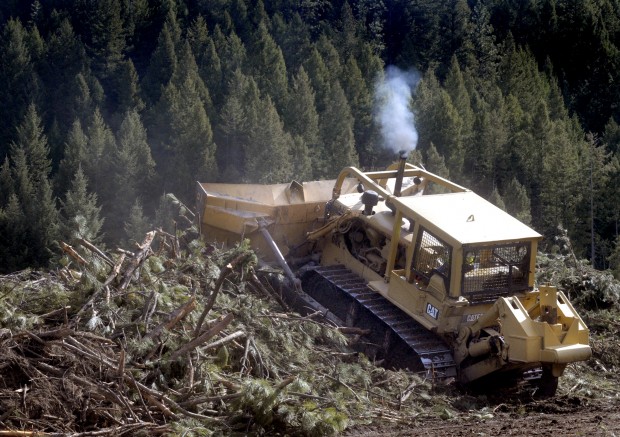
Wood waste from a thinning project is pushed into piles in the Bitterroot National Forest. The Northwest Advanced Renewables Alliance is looking to help the science and the infrastructure develop to produce jet fuel from such waste.

Related Links
Northwest Advanced Renewables Alliance website

The future of Pacific Northwest forests may lie in the stuff loggers now leave behind.

That’s the bet the Northwest Advanced Renewables Alliance has made in networking a roomful of professors, business leaders and government officials to turn wood waste into jet fuel. They’re working through a $40 million federal grant to envision all the mills, pipelines, refineries, outreach programs, permits and spinoffs the industry could create.

There’s just one hitch: Nobody has yet figured out how to economically make isobutanol fuel out of tree tops.

“We know that figuring out how to break cellulose down into sugars is the big gridlock,” said Montana State University extension forester Peter Kolb. “But you can’t afford not to pursue wood. Producing bioenergy from forests is the only agricultural practice in the world that also provides clean water and recreation and doesn’t compete with food production.”

Last week, about 20 NARA members and an equal number of interested stakeholders met in Missoula to hear the effort’s progress. Washington State University engineering professor Michael Wolcott acknowledged the program was a little like planning a city on Mars before anyone has a rocket to get there. But he argued there were plenty of good reasons to prepare for the rocket’s arrival.

Alternative energy ideas come in dozens of flavors. With cars, designers have promoted plug-in electric motors, hydrogen fuel cells, modified diesel fuels and mass-transit alternatives. But the aviation world is different.

“We can’t fly planes on electricity,” Wolcott said. “They’re going to be depending on liquid fuels for quite a while. Nothing else can match the energy density.”

That’s the amount of work a given technology can wring from a given amount of fuel. Nuclear power can move an aircraft carrier, but its reactors are too heavy to put in an aircraft. And so far, no one’s come up with a better plane-pusher than the internal combustion engine.

So NARA’s organizers feel safe betting that some scientist will crack the secret of turning wood into jet fuel. And when that breakthrough arrives, a lot of other things need to be in place.

“We need to understand the whole ecology of this industry,” said University of Idaho education coordinator Steve Hollenhorst. “There are decisions to be made about business locations, supply chains, how to develop the work force. We need to get people more literate about the implications.”

The concept resembles the old description of a good butcher who makes use of every part of a pig except the squeal. Kolb said traditional logging and present-day hazardous fuels reduction both produce huge amounts of now-valueless branches, needles, bark and skinny trees that can’t pay their way out of the woods. A biofuel industry would turn that material into a valuable resource supporting forest conservation as well as community jobs, he said.

Scientists already know ways to turn wood into jet fuel. The current methods can’t compete with conventional petroleum-based fuels. But anyone shopping for a plane ticket knows how much the airline industry gets whipsawed by the volatile nature of fuel prices. Adding a new supply source of jet fuel, even if it only met a fraction of the demand, would stabilize those price swings, according to Paul Smith, a NARA member from Pennsylvania State University.

“Just that stability is worth a premium,” Smith said. And both the private aviation industry and the U.S. military have committed to biofuel blends as a way to control their fuel costs.

The industry would need infrastructure that doesn’t currently exist. It takes people and equipment to haul the slash out of the woods and prepare it for fermentation that would turn the wood fibers to sugars and then alcohols. Fuel refineries would need capacity to process the wood fuels into forms that don’t corrode pipelines or engine parts, the way ethanol from corn now does. Those plants and processes might differ greatly between the wet Douglas fir forests of western Washington and Oregon and the dry pine forests of Montana, Wyoming and Idaho.

Kolb added that a host of environmental concerns needed attention, too. While harvesting slash could reduce the amount of waste burning in the forest, collection could affect water quality, wildlife habitat and forest health. The still-unclear effects of climate change and beetle-kill must be considered.

“This doesn’t mean vacuuming up all the woody debris in the forest,” Kolb said. “But in Montana, we’re looking at piles of thinning debris we’re spending $2,000 to $3,000 an acre to clean up. In this dry climate, they will persist for 50 years, unless they burn, in which case they burn so hot we get soil sterilization issues. This is a gold pile nobody’s using.”

NARA formed two years before winning its U.S. Department of Agriculture funding. It now wants to have its roadmap for industrial development ready for review by September. Then it will spend the next four or five years researching the ways that roadmap can become reality.

“I don’t want to see another study sitting on a shelf that I can’t use,” warned Tracy McIntire, the current president of the Montana Cooperative Development Center. “Who’s going to find the business models to run with this?”

“There are six companies in the hunt for this right now,” Wolcott responded. “They don’t start lawsuits over technologies that aren’t worth fighting over. We know cracking softwood is the hardest one to do. But if we’re able to crack that nut, the larger potential infrastructure is already there. That’s our big challenge.”

Reporter Rob Chaney can be reached at 523-5382 or at rchaney@missoulian.com.

Jun 19, 2012

Hines Farm Coal Creek - 2008 Storm Damage Cleanup


Larger Image

Hines Farm Coal Creek - 2008 Storm Damage Cleanup reaching conclusion. Damaged tree debris and brush being burnt and turned into biochar... to be used with composting materials...With Heat Index today at 96 degrees, glad we finished up around 2:00 PM...

Marsh Marigold at Merwin Nature Preserve Illinois - YouTube


Published on Apr 4, 2012 by illinoisbay
March blooming Marsh Marigold in cold seep.

Marsh Marigold
Caltha palustris
Buttercup family (Ranunculaceae)

Description: This native perennial plant is about ½–2' tall; it branches regularly. The stems are hairless and hollow. Basal leaves are produced early in the year, while alternate leaves are produced along the stems. The blades of these leaves are up to 4" long and 4" across; they are orbicular-cordate, finely crenate along the margins, and glabrous. Their venation is palmate. The petioles of the basal leaves are up to 6" long, while the petioles of the alternate leaves are shorter than this. The upper stems produce small clusters of bright yellow flowers on short petioles. Each flower spans about ¾–1½" across; it consists of 5-9 petal-like sepals, a thick ring of abundant stamens, and a cluster of carpels in the center. There are no true petals. The sepals are bright yellow, well-rounded, and slightly overlapping. The blooming period occurs during mid-spring and lasts about a month. There is no noticeable floral scent. Each of the carpels matures into a seedpod that contains several seeds. This seedpod is flattened and recurved; it splits open along the upper side to release the seeds (technically, it is a follicle). The root system consists of a short crown with fibrous roots. This plant spreads by reseeding itself. It occasionally forms loose colonies at favorable sites.


Cultivation: The preference is full or partial sun, wet conditions, and mucky soil. Shallow standing water is tolerated. Growth and development begin early in the year.

Range & Habitat: Marsh Marigold occurs primarily in central and northern Illinois, where it is occasional. In southern Illinois, it is uncommon or absent (see Distribution Map). This circumpolar species also occurs in Eurasia, where it is native as well. Habitats include various wetlands, including vernal pools in low woodlands, swamps, soggy meadows in river floodplains, marshes, fens, seeps and springs, and ditches. Marsh Marigold prefers sunny areas where the soil is consistently wet from underground seepage of water, although it occurs in other wetlands as well.

Faunal Associations: The nectar and pollen of the flowers attract flies and bees primarily. This includes Bombylius major (Giant Bee Fly), Syrphid flies, Halictid bees, honey bees, and others. Two leaf beetles are occasionally found on the foliage of Marsh Marigold: Plateumaris nitida and Hydrothassa vittata. It is possible that they eat the foliage. For other herbivores, specific information for Marsh Marigold is lacking. Because the acrid foliage contains toxic alkaloids and glycosides, it is usually avoided by mammalian herbivores. The seeds of plants in the closely related Ranunculus genus are eaten by the Wood Duck, Sora Rail, and some upland gamebirds. The seeds of such plants are also eaten by the Meadow Vole, Eastern Chipmunk, and other small rodents.


Photographic Location: Near the Collinson Marsh in Vermillion County. Several colonies of Marsh Marigold were growing in a ditch along a field where there was underground seepage of water from a neighboring bluff.

Comments: In sunny wetlands, Marsh Marigold is one of the first wildflowers to bloom during the spring. The flowers are showy and conspicuous because of their bright color and relatively large size. The foliage is an attractive bright green. This species is not a true marigold of the Aster family, in spite of its common name. Instead, it is closely related to the many Ranunculus spp.(Buttercups) that occur within the state. The various species of Buttercups have smaller flowers (less than ¾" across) and they usually bloom later in the year.

PERENNIAL MAXIMILIAN Sunflower - Seeds Forever


Uploaded by cookingupastory on Aug 17, 2007
A field of shimmering sunflowers; a flock of hungry birds feeding , and a farmer who shares some of his stories about his sunflower fields.

Maximilian's Sunflower
Helianthus maximilianii
Aster family (Asteraceae)
Description: This adventive perennial plant is 3-8' tall and largely unbranched, except where the flowers occur. The central stem is stout, round, light green to light red, and densely covered with short white hairs. The leaves occur alternately along the central stem, except for some of the lower leaves, which may occur oppositely from each other. These leaves are up to 12" long and 2" across. They are sessile against the stem, and narrowly lanceolate. Their upper and lower surfaces are light green and covered with fine white hairs. The margins of the leaves are smooth, or they may have widely spaced small teeth. Furthermore, the typical leaf folds upward from the central vein, and curls downward from the stem on account of its length. From the axils of the upper leaves, there are short flowering stalks. Each of these stalks is more or less erect, bearing a single composite flower and possibly 1 or 2 leaves. Each composite flower is about 2–3½" across. There are 20-40 yellow ray florets, which surround numerous disk florets. Behind each composite flower, there are green bracts that are lanceolate or narrowly lanceolate; they are covered with fine white hairs as well. The blooming period is late summer to fall and lasts about 1 month. The achenes are linear-oblong with a pair of awns on top. They are blown about by the wind, or distributed by animals. The root system consists of fleshy, fibrous roots and rhizomes. Like other perennial sunflowers, this plant can form vegetative colonies.

Cultivation: The preference is full sun and mesic to dry conditions. The soil can contain clay-loam, rocky material, or loess. This plant appears to have few problems with pests or foliar disease. It can grow tall and spread aggressively, and may flop over while in bloom if it is grown in moist rich soil.

Range & Habitat: Maximilian's Sunflower is an uncommon plant that occurs in NE Illinois, west central Illinois, and SW Illinois (seeDistribution Map). It is adventive from the west in most, if not all, of these areas. It is possible, however, that Maximilian's Sunflower is native to a few of the western counties where it occurs in high quality natural habitats. Habitats include rocky upland prairies, loess hill prairies, ledges of rocky cliffs, areas along railroads and roadsides, and waste ground. This plant is more common in states that lie west of the Mississippi River.

Faunal Associations: The flowers of this species probably attract many of the same insects as other sunflowers, including long-tongued bees, short-tongued bees, butterflies and skippers, and beetles. These insects seek nectar or pollen. The seeds of sunflowers are an attractive food source to both birds and small mammals (see Wildlife Table). The caterpillars of the butterfly Chlosyne nycteis (Silvery Checkerspot) feed on the foliage, while the caterpillars of several Papaipema spp. (Borer Moths) bore through the stems (see the Insect Table for additional species that feed on sunflowers). The foliage of young plants may be eaten by rabbits and groundhogs, while large plants are eaten by livestock.

Photographic Location: A city park in Champaign, Illinois, where a colony of plants occurred along a small lake.

Comments: Maximilian's Sunflower is named after an early botantical explorer of North America. This plant has attractive foliage and flowers, and it is easy to identify because of the unusual leaves. These narrow leaves are longer (up to 12") than the leaves of other Helianthus spp. in Illinois, and they have a distinctive light green or greyish green appearance because of their fine white hairs. Two native species, Helianthus grosseserratus (Sawtooth Sunflower) and Helianthus giganteus (Giant Sunflower), also have narrow leaves, but they are not covered with dense white hairs. Another species resembling Maximilian's Sunflower is Helianthus salicifolius (Willow Sunflower), which occurs in the southern Great Plains. The Willow Sunflower has narrow leaves that are even longer than Maximilian's Sunflower, but they are only ½" across or less. The Willow sunflower is not known to occur in Illinois at the present time, although a colony of 500 plants once existed in Cook County before it was destroyed by commercial development. These plants were undoubtedly adventive from the west

Jun 18, 2012

Coal Creek "Arch" - Hines Farm


Larger Image
"Arch" - Looking North - 2008 Wind Blown - Downed Cottonwood Tree


Larger Image
"Arch" - Looking South - 2008 Wind Blown - Downed Cottonwood Tree

St. Louis, Mo. has "Gateway Arch" and we have "Coal Creek Arch"... (-:

Wild Wood Duck Hen and 8 Babies Hiding From Camera - Hines Farm Coal Creek


Published on Jun 18, 2012 by HRT87

After being surprised by Wild Wood Duck Hen and 8 Babies swimming in Coal Creek, we attempted to video. Eileen was able to film 8 cute baby ducklings being called away by Mother Wood Duck Hen...
Nature is amazing....
Best viewed HD Full Screen

Jun 17, 2012

Korean Ginseng, Learn all about it's health benefits


Published on Jun 17, 2012 by overlander

Interesting story about how this interview came about. On Wednesday last week I decided I would like to do a story on Korean Ginseng after reading about it's benefits on the internet. So I put out a message on South Korean Facebook and couch surfing groups. Within 10 minutes someone replied to me on Facebook with a contact from the USA, the son of Shi Keum, the chairman of the Korea Ginseng Association. Only problem was Mr Keum did not speak English, so I needed a translator. I put out a call for anyone wanting to help with translation on couch surfing and that day Minji took up my offer. This is the english version of the interview with Mr Keum, with Minji providing translation ( I will upload the Korean version also)
We discuss the health benefits of Ginseng, why Korean Ginseng is considered the best in the world, what varieties of Ginseng are available, such as Red and Mountain Ginseng, how Ginseng can be taking and who should take it. This coming Wednesday I will be visiting the Geumsan province, which is the main area where Ginseng is grown to film how Ginseng is farmed and manufactured.