

For those of you who want to better understand the economics behind
our current food system (which is part of a larger extraction
economy), listening to or reading John Ikerd will provide much
satisfying food for thought.
economy), listening to or reading John Ikerd will provide much
satisfying food for thought.
Download files to play or save on your computer or mp3 player...
Foreword and Introduction - A Revolution of the Middle
The Great Recession is not simply the consequence of a crisis of confidence; we are facing a crisis of sustainability. We simply can’t continue doing what we have been doing. We can’t sustain economic growth rates of the past 200-year. Those growth rates were only possible because of cheap fossil energy and the days of cheap oil, natural gas, and coal are over. In addition we haven’t made the investments in research and education necessary to sustain the productivity of our workforce. Our economy no longer functions for the good of the American people. It serves the interests of corporate managers and investors instead. We have the power restore sustainability to the U.S. economy, but we won’t do it until more people understand that we have lost control of their society. American economy is not suffering from a lack of confidence but instead a lack of sustainability.
Chapter 1. A Crisis of Confidence?
The current U.S. economy is not really capitalist. In many respects, it’s a betrayal of capitalism. The so called competitive free markets of today are not the capitalist markets envisioned by classical economists Adam Smith and David Ricardo. The current U.S. government is not democratic, as least not democratic in the sense envisioned in our founding documents. It does not ensure equal access to those things to which we all have equal rights. It is preoccupied with the pursuit wealth for the few rather than the pursuit of happiness for the many. To regain and sustain our economy and our society, we must return to the classical roots of capitalism and democracy. A capitalist economy must function within physical limits of nature and the social bounds of equity and justice, if it is to function sustainably.
Chapter 2. A Society Held Hostage
As the founding documents of the United States clearly state the purpose of government is to ensure the unalienable rights of all, including life, liberty, and the pursuit of happiness. Capitalism is about the pursuit of wealth. Democracy is about the pursuit of happiness. Nothing is more fundamental to democracy than equity and justice for all, and a capitalist economy will ensure neither. Economic incentives are inadequate to ensure the long run investments in nature and society necessary for sustainability. Government is the only means of restraining economic extraction and exploitation of nature and society. However, the only just power of the government to ensure sustainability must be derived from a consensus of the governed.
Chapter 3. Keeping the American Promise
As the founding documents of the United States clearly state the purpose of government is to ensure the unalienable rights of all, including life, liberty, and the pursuit of happiness. Capitalism is about the pursuit of wealth. Democracy is about the pursuit of happiness. Nothing is more fundamental to democracy than equity and justice for all, and a capitalist economy will ensure neither. Economic incentives are inadequate to ensure the long run investments in nature and society necessary for sustainability. Government is the only means of restraining economic extraction and exploitation of nature and society. However, the only just power of the government to ensure sustainability must be derived from a consensus of the governed.
Chapter 4. A New Way of Thinking
Sustainability is the defining question of the 21st century. How can we meet the needs of the present without compromising the future? To answer this question we must see the world differently; we must develop a new worldview. We must see the world as a dynamic, self-renewing, regenerative living system, of which we humans are but a part. Once we change our understanding of how the world works and our place within it, it will change virtually every aspect of our lives. Our personal relationships within families and communities and our impersonal relationships within nations and global society will all be different. The trends of the past will be reversed. Both our society and economy will become more diverse, dispersed, and decentralized. A sustainable economy must function in harmony with nature and society.
Chapter 5. A New Way of Life
The change we need will not come easy. The status quo will be defended by powerful economic and political interests. First, we must find the courage to change our way of life. We must abandon the relentless quest for economic growth and return to the pursuit of happiness. Beyond some modest level of income or wealth, happiness is determined much more by the quality of our relationships and our sense of purpose and meaning in life than by any amount of additional income or wealth. We must reclaim the American Dream. The American Dream was never meant to be about the pursuit of wealth, but instead the pursuit of happiness. We must be willing to challenge the conventional wisdom of today’s scientific thinking that denies the existence of purpose in life. When we live out our unique purpose in life, we make the greatest contribution we possibly can make and receive the greatest possible rewards; we will find happiness.
Chapter 6. Returning to Truth
There are no formulas or recipes for sustainability. The living world doesn’t function by precise laws. However, living things do function by basic principles that are just as true as any law of physics or chemistry. The principles of natural ecosystems include holism, diversity, and interdependence. A healthy natural ecosystem is something more than the sum of its diverse parts. The principles of human relationship are just as valid as any other law of nature. Healthy relationships must be built upon a foundation of trust and kindness. To sustain positive relationships in families, communities, and societies we must find the courage to be trusting and kind. The principles of economic are the basic principles of individual behavior. We matter as individuals as well as members of society. We must respect the economic principles of scarcity, efficiency, and sovereignty if we are to meet our individual needs.
Chapter 7. Reestablishing Integrity
A sustainable economy and society must be built on a foundation of ecological, social, and economic integrity. Integrity is a matter of wholeness, completeness, and internal consistency. To ensure sustainability, the ecological principles of holism, diversity, and interdependence must also permeate our society and economy. The social principles of trust, kindness, and courage must be reflected in our economic relationships and our relationships with nature. We must respect the economic principles of scarcity, efficiency, and sovereignty in formulating and implementing social and ecological policies. Finally, sustainability ultimately is a matter of ethics and morality. What are our responsibilities for the well-being of other people or for the future of humanity? The answers to these questions can be found only in the most basic of all principles – in faith, hope, and love.
Chapter 8. Reclaiming Democracy
It will take a revolution for the American people to reclaim their society and our economy. Like the American Revolution of 1776, this revolution will be won only people who willing to commit their lives, their fortunes, and their sacred honor to the cause. The political process must move beyond the art of compromise to reestablish a consensus among the governed. Government must return to its most basic function of ensuring equal access to those things to which we all have equal rights. This will result in government that is much smaller than today but a government with very different priorities than today’s government. It will require a new consensus regarding what we should expect from our government and what we should do for ourselves. The new revolution will not come from the political Left or Right. It must be a Revolution of the Middle.
Chapter 9. Restoring Consent
Restoring the new consensus among Americans will not be easy, but it certainly doable. The U.S. Constitution was written with the expectation that it would periodically be changed or amended. Our failure to amend the Constitution to address emerging issues has led to many questionable interpretations of the Constitution by the Supreme Court. None of these is more threatening to the sustainability of our society and economy than the Court rulings granting of personhood to corporations. To find the consensus necessary to respond to concerns from both the political Left and Right, we will need to break free of previous Court rulings and return to our founding documents. Among the rights necessary to ensure sustainability are the right to economic sovereignty, the right to a healthy environment, and the rights of future generations equal the rights of those today.
Chapter 10. Renewing Prosperity
The economic growth rates of industrial era are not sustainable. However, we can have continuing prosperity without unsustainable economic growth. The earth provides more than enough renewable solar energy to meet the basic needs of global society both today and in the future. Once the basic causes of overpopulation are addressed, global population can be stabilized as sustainable levels. There will be enough for all to be prosperous in terms of overall quality of life, just not enough for everyone to have everything they might want. There will be no limit to human progress if we can find the wisdom to abandon our unsustainable pursuit of ever greater wealth and return to the pursuit of happiness. And best of all, we don’t have to wait for the rest of the world to change to find contentment and happiness in our own lives. When we live with purpose, we are doing our part, which is all we can do and need to do, to help make the world a better place. Having done all we can do, we can just let go, and be happy.
Postscript - Rethinking Reality
This book reflects my truth. I call it my truth because I believe what I have written in this book in internally consistent. We can never be certain that we have found the truth, but we know truth can never be in conflict with truth. What I have written also reflects a concept of reality that is consistent with what we see in the world around us. I believe reality exists as potentials. The same reality has the potential to be seen quite differently by different people. Our individual experiences of reality are unique, but the different experiences of reality among individuals are always consistent with same set of potentials – the same reality. By sharing our various perspectives, we gain greater insights into true nature of reality. That is what I have attempted to do in this book by sharing my truth.


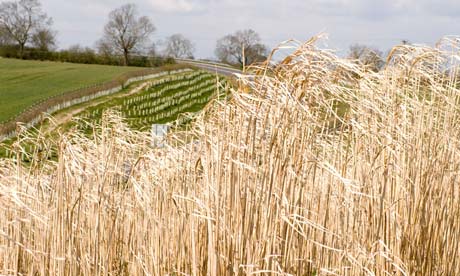 Miscanthus giganteus is a tall grass grown on European farms as a biofuel, such as this crop in rural Northamptonshire. Photograph: Alamy


 Reported by ; Emily Spain Posted by ; Christi Warren
 One of tomorrow's solutions
By Kathy Coatney
Eric Twombly, president of Biochar Products based in Halfway, Ore., is excited about the future. His company is in the early stages of developing a biochar plant that produces two products -- biochar, used as a soil amendment, and bio-oil to be used in place of fuel oil.
Most people are familiar with bio-oil, but biochar is formed when agricultural waste or biomass is converted into a fine-grained, highly porous charcoal.
It's basically the type of charcoal that has been used for centuries, according to Twombly. "It is the same darn thing as charcoal that you get in your briquette, except that it doesn't have a bunch of glue in it to hold it together."
Twombly spent 36 years as a range conservationist and a forester for the U.S. Forest Service and became interested in biochar. He and two associates created Biochar Products to take biochar research to the next stage.
Portable Machines
Currently, Twombly is testing a one-ton prototype fast pyrolysis (or gasification) biochar machine that produces both biochar and bio-oil. The biochar machine was built by Advanced Bio Refinery Incorporated (ABRI), a Canadian company.
The pyrolysis of biomass can be done slowly or fast. Done slowly, the process only makes charcoal, while the fast method makes both bio-oil and charcoal.
"Fast pyrolysis charcoal is more recalcitrant, which means it stays in the soil longer than slow pyrolysis charcoal, because the volatiles are removed better by the fast pyrolysis process," Twombly explains, adding he sees the real profits coming from producing both charcoal and bio-oil. And Biochar Products is currently working with ABRI to develop production 20-ton and 50-ton production machines.
A 20-ton machine would sit on two 40-foot trailers with articulate rear wheels. "You could steer the rear wheels. You could turn them around on a landing. You'd sit them side-by-side," Twombly said, adding it would be easily portable.
A 50-ton unit would sit on six trailers. "It probably would take two weeks to move," Twombly says, adding it would most likely be moved only a few times a year.
The company anticipates the 50-ton plant would be situated in an area that has a large supply of material. "They'll move them around wherever there's a good supply, and I would say you're not going to move them from one landing to the next. Most likely, what you'll do is, you'll park one at a good centralized location, then you'll haul the biomass in short distances," Twombly said.
The machines will be composed of three units -- the control unit, the reactor, and the dryer.
The control unit will control the entire system and be equipped with a computer screen that displays all the temperatures in the various units.
Each unit has pumps. "There's a pump that pumps the bio-oil through the system for cooling. There's a pump that the reactor biomass is moved through the system with hydraulic motors," Twombly says. There is also a pump that runs antifreeze through a radiator and through various units to cool down the char.
Another unique feature is the built-in dryer. "Most biochar production systems have to depend on some usually fairly expensive external system to get the biomass dried down enough to run through it," Twombly says. "This biochar machine from ABRI can handle wet and dry material and get good results. Everybody else has a heck of a time getting their biomass in the proper form to run through the reactor, and this does it all by itself beautifully."
The ABRI biochar machine also produces syngas. "If we can get our generator run by bio-oil, then we're 100 percent energy self-sufficient," Twombly says, except for the electric motors.
Down the road, the company envisions the machines going out in the woods with loggers or near mills. The products could be used on site or sold.
Twombly adds, "We expect that when these machines are in production, they'll run five days a week, 24 hours a day."
Profitability
Making biomass profitable is difficult. One of the key issues is hauling costs. "It's a very low value product," Twombly says.
He estimates that while charcoal energy is only worth about $100 a ton, the charcoal in biochar form (when used as a soil amendment) will sell for around $300 a ton. And every ton of waste that runs through the biochar machine can produce 100 gallons of bio-oil -- worth about $1.25 a gallon.
Biochar Products believes they may have the solution. Transporting the bio-oil is much simpler than transporting conventional oil. The bio-oil can be easily loaded onto any tank on a goose-neck trailer, and a crew in the woods could haul the bio-oil out every night.
"There would be no haul costs except for just getting your crew in and out of the woods," Twombly says.
The Future
Twombly is hoping to have a machine fully operational within two years, and he initially sees the forest industry as one of the first to use them because of the volume of biomass they have.
"I think it's probably going to be kind of a 50/50 thing. I think the farm waste community is going to be right on top of it," Twombly says, especially feedlots that need to remove manure waste. Brush removal from orchards would be another source.
The future could very well be processing forest slash seven to eight months of the year and farm waste the rest of the year, Twombly says, adding the alternative would be to stockpile slash and run it in the winter. "In fact, it will only be profitable if you can run pretty much most of the year."
Currently, Twombly is in negotiations with ABRI. "We've sent a whole series of engineering needs back to them… They're working on what it's going to take to put together the next generation. So by next spring, we might have the next generation machine that has a lot of the problems that we've got (now) resolved."
One of tomorrow's solutions
By Kathy Coatney
Eric Twombly, president of Biochar Products based in Halfway, Ore., is excited about the future. His company is in the early stages of developing a biochar plant that produces two products -- biochar, used as a soil amendment, and bio-oil to be used in place of fuel oil.
Most people are familiar with bio-oil, but biochar is formed when agricultural waste or biomass is converted into a fine-grained, highly porous charcoal.
It's basically the type of charcoal that has been used for centuries, according to Twombly. "It is the same darn thing as charcoal that you get in your briquette, except that it doesn't have a bunch of glue in it to hold it together."
Twombly spent 36 years as a range conservationist and a forester for the U.S. Forest Service and became interested in biochar. He and two associates created Biochar Products to take biochar research to the next stage.
Portable Machines
Currently, Twombly is testing a one-ton prototype fast pyrolysis (or gasification) biochar machine that produces both biochar and bio-oil. The biochar machine was built by Advanced Bio Refinery Incorporated (ABRI), a Canadian company.
The pyrolysis of biomass can be done slowly or fast. Done slowly, the process only makes charcoal, while the fast method makes both bio-oil and charcoal.
"Fast pyrolysis charcoal is more recalcitrant, which means it stays in the soil longer than slow pyrolysis charcoal, because the volatiles are removed better by the fast pyrolysis process," Twombly explains, adding he sees the real profits coming from producing both charcoal and bio-oil. And Biochar Products is currently working with ABRI to develop production 20-ton and 50-ton production machines.
A 20-ton machine would sit on two 40-foot trailers with articulate rear wheels. "You could steer the rear wheels. You could turn them around on a landing. You'd sit them side-by-side," Twombly said, adding it would be easily portable.
A 50-ton unit would sit on six trailers. "It probably would take two weeks to move," Twombly says, adding it would most likely be moved only a few times a year.
The company anticipates the 50-ton plant would be situated in an area that has a large supply of material. "They'll move them around wherever there's a good supply, and I would say you're not going to move them from one landing to the next. Most likely, what you'll do is, you'll park one at a good centralized location, then you'll haul the biomass in short distances," Twombly said.
The machines will be composed of three units -- the control unit, the reactor, and the dryer.
The control unit will control the entire system and be equipped with a computer screen that displays all the temperatures in the various units.
Each unit has pumps. "There's a pump that pumps the bio-oil through the system for cooling. There's a pump that the reactor biomass is moved through the system with hydraulic motors," Twombly says. There is also a pump that runs antifreeze through a radiator and through various units to cool down the char.
Another unique feature is the built-in dryer. "Most biochar production systems have to depend on some usually fairly expensive external system to get the biomass dried down enough to run through it," Twombly says. "This biochar machine from ABRI can handle wet and dry material and get good results. Everybody else has a heck of a time getting their biomass in the proper form to run through the reactor, and this does it all by itself beautifully."
The ABRI biochar machine also produces syngas. "If we can get our generator run by bio-oil, then we're 100 percent energy self-sufficient," Twombly says, except for the electric motors.
Down the road, the company envisions the machines going out in the woods with loggers or near mills. The products could be used on site or sold.
Twombly adds, "We expect that when these machines are in production, they'll run five days a week, 24 hours a day."
Profitability
Making biomass profitable is difficult. One of the key issues is hauling costs. "It's a very low value product," Twombly says.
He estimates that while charcoal energy is only worth about $100 a ton, the charcoal in biochar form (when used as a soil amendment) will sell for around $300 a ton. And every ton of waste that runs through the biochar machine can produce 100 gallons of bio-oil -- worth about $1.25 a gallon.
Biochar Products believes they may have the solution. Transporting the bio-oil is much simpler than transporting conventional oil. The bio-oil can be easily loaded onto any tank on a goose-neck trailer, and a crew in the woods could haul the bio-oil out every night.
"There would be no haul costs except for just getting your crew in and out of the woods," Twombly says.
The Future
Twombly is hoping to have a machine fully operational within two years, and he initially sees the forest industry as one of the first to use them because of the volume of biomass they have.
"I think it's probably going to be kind of a 50/50 thing. I think the farm waste community is going to be right on top of it," Twombly says, especially feedlots that need to remove manure waste. Brush removal from orchards would be another source.
The future could very well be processing forest slash seven to eight months of the year and farm waste the rest of the year, Twombly says, adding the alternative would be to stockpile slash and run it in the winter. "In fact, it will only be profitable if you can run pretty much most of the year."
Currently, Twombly is in negotiations with ABRI. "We've sent a whole series of engineering needs back to them… They're working on what it's going to take to put together the next generation. So by next spring, we might have the next generation machine that has a lot of the problems that we've got (now) resolved."


 A massive injection of spectrum might be about to revolutionize the digital infrastructure of rural America.
By Scott Woolley
For a glimpse of the wireless future, take a look at the Yurok Indian reservation, an out-of-the-way spot just south of the California-Oregon border at the mouth of the Klamath River. There, among the giant redwoods, stand three new towers built to create a new type of wireless network, known as "super Wi-Fi." If the U.S. Federal Communications Commission gets its way, super Wi-Fi will become a key part of rural America's digital infrastructure.
Most people living on the Yurok's 63,000-acre reservation lack phone service. Almost none have high-speed Internet. The new towers aim to fix both problems. Unlike regular Wi-Fi networks, which are generally limited to beaming high-speed Internet around a house, super Wi-Fi promises to blanket entire neighborhoods with high-speed access.
A Yurok tribal spokesman says the new signals will reach even into the steep-walled valleys that play havoc with most wireless signals. The tribe plans to start testing the system this week.
The FCC is so enthused with the idea of super Wi-Fi that it took the idea nationwide last month, issuing final rules that will free any town or county to do what the Yurok have done. On Monday, FCC chairman Julius Genachowski proposed a way to pay for much of that infrastructure that would be needed to support municipal Super Wi-Fi. He wants to convert the current system of rural phone subsidies, which now total $8 billion a year, into a more modern system that can pay for things like super Wi-Fi.
Unlike most wireless advances, super Wi-Fi's much-improved range has little to do with better technology. Instead, the dramatic jump comes from the FCC's decision to free up airwaves that have long been reserved exclusively for local TV broadcasts. Those TV airwaves are lower in frequency than standard cellular and Wi-Fi airwaves and thus better able to penetrate buildings and other objects.
Concerns about interference with remaining TV signals have led some analysts to question whether super Wi-Fi is feasible in urban areas. Super Wi-Fi devices need to determine their location, then consult a central database showing the available white spaces in that area in order to avoid causing interference.
Since rural America has fewer local TV stations, it will have far more of these empty "white spaces" to fill with new wireless signals, points out Alex Besen, who runs an industry consultancy, the Besen Group. In many rural areas, super Wi-Fi will have access to well over 200 megahertz of spectrum, he estimates—more capacity than Verizon and AT&T combined. That huge injection of spectrum could revolutionize the digital infrastructure of rural America, Besen says.
Many urban Americans, by contrast, will have to make do with far less spectrum, as cities' surviving TV channels limit the number of available white spaces. In addition, capacity in densely populated cities must be divided among more people.
The main point of deploying super Wi-Fi is its increased range—up to 50 miles or perhaps even more. Whatever the ultimate limitations of the "white spaces" prove to be, access to the new airwaves will dramatically improve America's wireless infrastructure, says Besen. "It's great spectrum," he says. "We are very lucky compared to other countries to have this unlicensed spectrum available today."
A massive injection of spectrum might be about to revolutionize the digital infrastructure of rural America.
By Scott Woolley
For a glimpse of the wireless future, take a look at the Yurok Indian reservation, an out-of-the-way spot just south of the California-Oregon border at the mouth of the Klamath River. There, among the giant redwoods, stand three new towers built to create a new type of wireless network, known as "super Wi-Fi." If the U.S. Federal Communications Commission gets its way, super Wi-Fi will become a key part of rural America's digital infrastructure.
Most people living on the Yurok's 63,000-acre reservation lack phone service. Almost none have high-speed Internet. The new towers aim to fix both problems. Unlike regular Wi-Fi networks, which are generally limited to beaming high-speed Internet around a house, super Wi-Fi promises to blanket entire neighborhoods with high-speed access.
A Yurok tribal spokesman says the new signals will reach even into the steep-walled valleys that play havoc with most wireless signals. The tribe plans to start testing the system this week.
The FCC is so enthused with the idea of super Wi-Fi that it took the idea nationwide last month, issuing final rules that will free any town or county to do what the Yurok have done. On Monday, FCC chairman Julius Genachowski proposed a way to pay for much of that infrastructure that would be needed to support municipal Super Wi-Fi. He wants to convert the current system of rural phone subsidies, which now total $8 billion a year, into a more modern system that can pay for things like super Wi-Fi.
Unlike most wireless advances, super Wi-Fi's much-improved range has little to do with better technology. Instead, the dramatic jump comes from the FCC's decision to free up airwaves that have long been reserved exclusively for local TV broadcasts. Those TV airwaves are lower in frequency than standard cellular and Wi-Fi airwaves and thus better able to penetrate buildings and other objects.
Concerns about interference with remaining TV signals have led some analysts to question whether super Wi-Fi is feasible in urban areas. Super Wi-Fi devices need to determine their location, then consult a central database showing the available white spaces in that area in order to avoid causing interference.
Since rural America has fewer local TV stations, it will have far more of these empty "white spaces" to fill with new wireless signals, points out Alex Besen, who runs an industry consultancy, the Besen Group. In many rural areas, super Wi-Fi will have access to well over 200 megahertz of spectrum, he estimates—more capacity than Verizon and AT&T combined. That huge injection of spectrum could revolutionize the digital infrastructure of rural America, Besen says.
Many urban Americans, by contrast, will have to make do with far less spectrum, as cities' surviving TV channels limit the number of available white spaces. In addition, capacity in densely populated cities must be divided among more people.
The main point of deploying super Wi-Fi is its increased range—up to 50 miles or perhaps even more. Whatever the ultimate limitations of the "white spaces" prove to be, access to the new airwaves will dramatically improve America's wireless infrastructure, says Besen. "It's great spectrum," he says. "We are very lucky compared to other countries to have this unlicensed spectrum available today."


 Posts
Posts


