
Mar 13, 2014
How to transfer an inkjet photo to wood - YouTube
Published on Mar 12, 2014
Inkjet to wood photo transfer technique. There is not a lot to the process, but this should help. Here's a recent project of demonstrated use: http://youtu.be/bdo64-wo63Q
Website: http://www.WoodworkingForMereMortals....
Support free woodworking videos:https://subbable.com/woodworking
Other ways you can support the show:http://www.woodworkingformeremortals....
Woodworking For Mere Mortals. Easy woodworking projects every Friday.
----------------
Subscribe to WWMM and never miss a video!
http://www.youtube.com/subscription_c...
Mere Minutes. My second channel:http://www.youtube.com/user/steveinmarin
Facebook: https://www.facebook.com/WoodworkingF...
Twitter: https://twitter.com/MereMortalsWW
Woodworking t-shirts! http://woodworkingformeremortals.spre...
Instagram: http://instagram.com/steveinmarin
Pinterest: http://pinterest.com/steveinmarin/
----------------
Music from Jason Shaw at http://audionautix.com/
How to transfer an inkjet photo to wood - YouTube
Additional Links:
https://www.youtube.com/watch?v=qSfj6eiNzew
https://www.youtube.com/watch?v=QoTcjXAgATs


TOLIET PAPER - Simple Garden Tip: Best Seed Tape Ever: Organic Gardening
Best Seed Tape Ever
Planting tiny seeds is easy with this simple gardening trick.

Planting tiny seeds is easy with this simple gardening trick.
It’s difficult to space tiny seeds, such as carrots, in the garden. The best way to solve this problem is to make homemade seed tape. Here’s how to do it:
1. Unroll a strip of toilet paper on a table (double ply works best), mist it with a sprayer, and place the seeds along the center of the strip. Be sure to space the seeds based on the seed packet’s recommendation. Tip: Alternate carrot seeds with radish seeds because when the radishes sprout, they help to mark the row and break the ground.
2. Starting along the strip’s long edge, fold a third of the paper over the seeds, then fold the other third over to cover the seeds completely. Lightly tamp the paper, misting it again to secure the seeds. Make as many of these strips as you need. Then carefully carry them to the garden.
3. Make shallow furrows in the prepared soil, lay the strips down, and cover them. In a jiffy, your small seeds will be planted and perfectly spaced.
Simple Garden Tip: Best Seed Tape Ever: Organic Gardening
1. Unroll a strip of toilet paper on a table (double ply works best), mist it with a sprayer, and place the seeds along the center of the strip. Be sure to space the seeds based on the seed packet’s recommendation. Tip: Alternate carrot seeds with radish seeds because when the radishes sprout, they help to mark the row and break the ground.
2. Starting along the strip’s long edge, fold a third of the paper over the seeds, then fold the other third over to cover the seeds completely. Lightly tamp the paper, misting it again to secure the seeds. Make as many of these strips as you need. Then carefully carry them to the garden.
3. Make shallow furrows in the prepared soil, lay the strips down, and cover them. In a jiffy, your small seeds will be planted and perfectly spaced.
Simple Garden Tip: Best Seed Tape Ever: Organic Gardening
Mar 11, 2014
A Primal Diet for Modern Times, part 1 - YouTube
https://www.youtube.com/watch?v=0-eaPlmzz94
Published on Mar 10, 2014
Nora Gedgaudas used to believe a plant-based diet was the healthiest. That belief got turned upside down when she spent a summer studying wolves near the North pole. "We are fundamentally ice-age hunter-gatherers," states the nutritionist and author of Primal Body, Primal Mind. She points out that our genes are 99.9% the same as our ancestors - they haven't yet adapted to the relatively recent agriculturally-based lifestyle based on grains. As a result, our bodies have no need for dietary carbohydrates. By contrast, "Fat, to us means survival.... Dietary fat is the most nutrient-dense thing we can consume, rich in fat-soluble nutrients, and essential for the functioning of our brain and nervous systems." Episode 260. [primalbody-primalmind.com]
Visit Peak Moment on:
Facebook: http://www.facebook.com/pages/Peak-Mo...
GooglePlus: https://plus.google.com/+peakmoment/p...
Janaia on Facebook: http://www.facebook.com/janaia.donaldson
Twitter: https://twitter.com/PeakMomentTV (handle: @peakmomenttv)
iTunes: http://itunes.apple.com/us/podcast/pe...
Visit Peak Moment on:
Facebook: http://www.facebook.com/pages/Peak-Mo...
GooglePlus: https://plus.google.com/+peakmoment/p...
Janaia on Facebook: http://www.facebook.com/janaia.donaldson
Twitter: https://twitter.com/PeakMomentTV (handle: @peakmomenttv)
iTunes: http://itunes.apple.com/us/podcast/pe...

A Primal Diet for Modern Times, part 1 - YouTube
UltraBattery a Boon to Renewable Energy, Grid Storage, and EVs > ENGINEERING.com
Tom Lombardo March 09, 2014

UltraBattery® with its Inventor, Dr. Lan Lam (Image courtesy of CSIRO)
Batteries pack a lot of energy into a small space, but they’re slow to charge, they lose their capacity after several charge-discharge cycles, and many are not environmentally friendly. Supercapacitors (also known as ultracapacitors) can be charged very quickly, can survive a near limitless number of charge-discharge cycles, and are made from relatively benign materials.
Electric and hybrid vehicles (EVs and HEVs) need the benefits of both technologies, and often employ a blend of batteries and supercaps, with the former providing a long driving range and the latter storing energy from regenerative braking and giving quick bursts of energy for rapid acceleration.
Grid-level storage combined with renewable energy has the potential to replace gas fired “peaker plants,” but like the EV, it requires the high energy density of batteries and the quick response time and long life of supercaps.
Using batteries and supercaps together requires control circuitry to move electricity to and from the different storage elements. But what happens if you combine the battery and the supercap in one package? You get the best of both worlds: the UltraBattery®, developed by a team from Australia’s Commonwealth Scientific and Industrial Research Organisation (CSIRO) and now produced by CSIRO spinoff company Ecoult. The UltraBattery is a lead-acid battery with a built in supercapacitor, as shown here:

Image courtesy of Ecoult
Conventional lead-acid batteries suffer from sulfation, lead sulfate crystals growing on the battery’s plates, causing a decrease in capacity and an increase in internal resistance. Sulfation occurs naturally with age, but it’s made worse by operating the battery at intermediate states of charge (somewhere between full and empty). Since that’s the normal condition for EV batteries and grid-level storage systems, you can see why many of those applications employ more costly NiMH or Li-ion batteries instead of inexpensive lead-acid batteries. According to CSIRO and Ecoult engineers, using a carbon-based supercap in parallel with the battery reduces negative plate sulfation. They don’t explain the chemistry behind that and I’m not a chemist, but independent testing by Sandia National Labs confirmed that the UltraBattery showed very little sulfation compared to standard deep-cycle lead-acid batteries under the same conditions.
Additional tests by Sandia National Labs showed that when subjected to cycles that are typical of grid-level storage applications, the UltraBattery lasted ten times longer than a conventional lead-acid battery. When tested under hybrid EV conditions, the UltraBattery once again outperformed its lead-acid counterpart by a factor of ten, performing at least as well as NiMH batteries but at a significantly lower cost.
UltraBatteries achieved a round-trip efficiency of around 90%, compared to 70% for conventional lead-acid batteries. This occurred under both low-current and high-current charge-discharge cycles. (For more details on the exact testing procedures and results, click the “Read More…” link at the end of this article and download the white paper.)
In addition to its superior electrical characteristics, the UltraBattery is non-flammable and made from materials that are abundant, non-hazardous, and fully recyclable. The UltraBattery is safe, clean, efficient, reliable, and inexpensive. What more can you ask for?
Renewable energy sources like solar and wind are intermittent, sometimes providing more energy than needed while other times not generating enough. Cost effective, efficient grid-level storage is the key to a renewable energy future. Electric vehicles and hybrids demand high capacity, inexpensive, and lightweight batteries. Likewise, storage is the main obstacle standing in the way of universal adoption of EVs. While research into alternative battery chemistry continues, it could be that the good old lead-acid battery, enhanced by a built-in supercapacitor, will satisfy both needs.
[Read More...]
UltraBattery a Boon to Renewable Energy, Grid Storage, and EVs > ENGINEERING.com
UltraBattery® with its Inventor, Dr. Lan Lam (Image courtesy of CSIRO)
Batteries pack a lot of energy into a small space, but they’re slow to charge, they lose their capacity after several charge-discharge cycles, and many are not environmentally friendly. Supercapacitors (also known as ultracapacitors) can be charged very quickly, can survive a near limitless number of charge-discharge cycles, and are made from relatively benign materials.
Electric and hybrid vehicles (EVs and HEVs) need the benefits of both technologies, and often employ a blend of batteries and supercaps, with the former providing a long driving range and the latter storing energy from regenerative braking and giving quick bursts of energy for rapid acceleration.
Grid-level storage combined with renewable energy has the potential to replace gas fired “peaker plants,” but like the EV, it requires the high energy density of batteries and the quick response time and long life of supercaps.
Using batteries and supercaps together requires control circuitry to move electricity to and from the different storage elements. But what happens if you combine the battery and the supercap in one package? You get the best of both worlds: the UltraBattery®, developed by a team from Australia’s Commonwealth Scientific and Industrial Research Organisation (CSIRO) and now produced by CSIRO spinoff company Ecoult. The UltraBattery is a lead-acid battery with a built in supercapacitor, as shown here:
Image courtesy of Ecoult
Conventional lead-acid batteries suffer from sulfation, lead sulfate crystals growing on the battery’s plates, causing a decrease in capacity and an increase in internal resistance. Sulfation occurs naturally with age, but it’s made worse by operating the battery at intermediate states of charge (somewhere between full and empty). Since that’s the normal condition for EV batteries and grid-level storage systems, you can see why many of those applications employ more costly NiMH or Li-ion batteries instead of inexpensive lead-acid batteries. According to CSIRO and Ecoult engineers, using a carbon-based supercap in parallel with the battery reduces negative plate sulfation. They don’t explain the chemistry behind that and I’m not a chemist, but independent testing by Sandia National Labs confirmed that the UltraBattery showed very little sulfation compared to standard deep-cycle lead-acid batteries under the same conditions.
Additional tests by Sandia National Labs showed that when subjected to cycles that are typical of grid-level storage applications, the UltraBattery lasted ten times longer than a conventional lead-acid battery. When tested under hybrid EV conditions, the UltraBattery once again outperformed its lead-acid counterpart by a factor of ten, performing at least as well as NiMH batteries but at a significantly lower cost.
UltraBatteries achieved a round-trip efficiency of around 90%, compared to 70% for conventional lead-acid batteries. This occurred under both low-current and high-current charge-discharge cycles. (For more details on the exact testing procedures and results, click the “Read More…” link at the end of this article and download the white paper.)
In addition to its superior electrical characteristics, the UltraBattery is non-flammable and made from materials that are abundant, non-hazardous, and fully recyclable. The UltraBattery is safe, clean, efficient, reliable, and inexpensive. What more can you ask for?
Renewable energy sources like solar and wind are intermittent, sometimes providing more energy than needed while other times not generating enough. Cost effective, efficient grid-level storage is the key to a renewable energy future. Electric vehicles and hybrids demand high capacity, inexpensive, and lightweight batteries. Likewise, storage is the main obstacle standing in the way of universal adoption of EVs. While research into alternative battery chemistry continues, it could be that the good old lead-acid battery, enhanced by a built-in supercapacitor, will satisfy both needs.
[Read More...]
UltraBattery a Boon to Renewable Energy, Grid Storage, and EVs > ENGINEERING.com
Enhancing the Mississippi Watershed with Perennial Bioenergy Crops on Vimeo
Today, non-point source pollution is the greatest threat to the nation’s water and the main reason why our waters remain polluted.
The vast majority of these nutrients come from corn and soybeans production in the upper Midwest. These nutrients not only contaminate drinking water wells and local surface waters, but are chiefly responsible for the Gulf’s hypoxic zone, the largest hypoxic region in the U.S. and the second largest in the world.
This CenUSA video, Enhancing The Mississippi River Watershed with Perennial Bioenergy Crops, focuses on the role perennial grass energy crops can play in improving water qualtiy. Compared to row crops, perennial grasses have been shown to reduce runoff, erosion and nutrients by as much as 90%. The video discusses the role perennial grasses can plan in improving the Mississippi River Watershed and the Gulf of Mexico.
It features interviews with and Gulf Hypoxia co-chairs Nancy Stoner (Acting Assistant Administrator for the Office of Water at EPA) and Bill Northey (Iowa Secretary of Agriculture) and CenUSA project director Ken Moore. It discusses land use modeling research being conducted by CenUSA co-project directors Cathy Kling (Iowa State University) and Jason Hill (University of Minnesota).
The video also features farmer and bioenergy pioneer Jamie Derr and University of Minnesota scientist Bonnie Keeler.
Enhancing the Mississippi Watershed with Perennial Bioenergy Crops from CenUSA Bioenergy on Vimeo.
Enhancing the Mississippi Watershed with Perennial Bioenergy Crops from CenUSA Bioenergy on Vimeo.
Mar 8, 2014
Mar 7, 2014
A Discussion on Ecology Ethics with Joel Salatin -- MOTHER EARTH NEWS FAIR - YouTube
Bryan Welch, Publisher of Mother Earth News, sat down with Farmer/Philosopher Joel Salatin at the MOTHER EARTH NEWS Fair in Seven Springs, PA. Joel has written multiple books including Fields of Farmers, The Sheer Ecstasy of Being a Lunatic Farmer and Everything I Want to do is Illegal. He lives and works on his multi-generational farm, Polyface Farms, in Virginia's Shenandoah Valley, where he and his family raise pastured meats and organic crops.
In this conversation we learn why at the end of the day it's much more satisfying to do physical labor rather than to "blink your existence into cyberspace" and the many ways we can be good stewards of the land.
More on Self-Sufficiency and Sustainable Living from MOTHER EARTH NEWS: Providing high-quality food for your family year-round takes foresight and planning, plus healthy doses of commitment and follow-through. Whether you grow as much of your food as you can or you source it from local producers, the guidelines here will help you decide how much to produce or purchase. The charts linked to in "Plan How Much to Grow" later in this article will also help you estimate how much space you'll need — both in your garden to grow the crops, and in your home and pantry or root cellar to store preserved foods.
The MOTHER EARTH NEWS YouTube channel is your go-to source for videos about sustainable living. Find tutorials on everything from indoor seed starting and knot tying to chicken processing and butter churning. Virtually attend presentations from our popular MOTHER EARTH NEWS FAIRs. Get to know our sharp (and fun-loving!) staff. We're proud to be the most popular and longest running magazine on sustainable living in the world, and we hope you enjoy getting to know us. Subscribe to our channel today! (http://www.youtube.com/user/MotherEar...)
Find us on these other social networks:
Facebook (http://www.facebook.com/motherearthne...)
Twitter (https://twitter.com/MotherEarthNews)
Google+ (https://plus.google.com/1178571591809...)
Pinterest (http://pinterest.com/motherearthnews/)
LinkedIn (http://www.linkedin.com/company/mothe...)
A Discussion on Ecology Ethics with Joel Salatin -- MOTHER EARTH NEWS FAIR - YouTube
Mar 6, 2014
Planer knife honing jig


Reference Link: http://www.woodworkingtalk.com/f27/my-planer-knife-honing-jig-14481/
Also:
http://lumberjocks.com/projects/70287
http://lumberjocks.com/projects/70562
Jig for honing planer / jointer knives. Featured in British Woodworking Magazine #14. Presented by Steve Maskery of http://www.WorkshopEssentials.com
Planer knife honing jig - YouTube
Mar 3, 2014
Weather --- 'Know you Risk'

As we move into National Severe Weather Preparedness week, today is 'Know you Risk'. This map shows active watches and warnings for the entire U.S. over land and coastal waters: http://www.nws.noaa.gov/largemap.php
It updates every five minutes. Thanks National Oceanic and Atmospheric Administration!
http://www.nws.noaa.gov/largemap.php
Feb 10, 2014
Iowa is getting sucked into scary, vanishing gullies | Grist
By Tom Philpot

See that gash in the land? Until heavy rains hit in May 2013, it was filled with topsoil. It’s an “ephemeral gully,” and Iowa is full of them after hard rains.
Last year, after a record drought in 2012, Iowa experienced the wettest spring in its recorded history. The rains triggered massive runoff from the state’s farms into its creeks, streams, and rivers, tainting water with toxic nitrate from fertilizer. Nitrate levels in the state’s waterways reached record levels — so high that they emerged as “a real issue for human health,” Bob Hirsch, a hydrologist for the U.S. Geological Survey, told the Associated Press.
The event illustrated two problems facing Iowa and the rest of the nation’s topsoil-rich grain belt. The first is the challenge of climate change: How to manage farmland in an era when weather lurches from brutal drought to flooding, as it likely will with increasing frequency. The second, related one is the largely invisible crisis of Iowa’s topsoil, which appears to be eroding at a much higher rate than U.S. Department of Agriculture numbers account for — and, more importantly, at 16 times the natural replacement rate.
I got that disturbing assessment from Richard Cruse, an agronomist and the director of Iowa State University’s Iowa Water Center. Cruse’s on-the-ground research documents a particular kind of soil erosion highly relevant to last year’s heavy rains. Cruse told me that with current methods, the USDA measures a kind of soil loss called sheet and rill erosion, wherein water washes soil away in small channels that farm at the soil surface during rains. Under that measure, Iowa farmland loses on average 5.1 tons of topsoil per acre every year, according to the USDA’s latest numbers, which are from 2007.
The USDA sees five tons per acre as a “magic number,” Cruse said, because it’s generally accepted to be the rate at which soil renews itself. So the prevailing view has been that “if we can limit erosion to five tons per acre, we can do this forever,” Cruse said. But he added that the “best science” (explained here) indicates that the real sustainable erosion rate is closer a half ton per acre — meaning that even by the USDA’s own limited measure, Iowa’s soils are eroding much faster than they can be replaced naturally.
But here’s where we get to the scary part. Using stereo-photographic techniques, Cruse and his team have been measuring a different from of erosion through what are known as “ephemeral gullies” — that is, large gashes in farm fields formed by water during heavy rains, bearing soil rapidly away and dispersing it into streams and rivers. This kind of erosion is not included in conventional soil-loss measures, and as a result, the USDA is “way underestimating” erosion in Iowa, he said.
Cruse’s team has have not collected data long enough, nor analyzed it thoroughly enough, to say exactly how much soil is being surrendered in this way. But he added that he “could say with a lot of confidence” that ephemeral gullies are claiming on average an additional 2.5 to three tons per acre — bringing the grand total as high as eight tons per acre, 60 percent higher than the USDA’s sustainable threshold of five tons and 16 times higher than the 0.5-ton limit that Cruse says is more scientifically valid.
Ephemeral gullies represent not only an alarming disappearance of productive soil; they also mean a concentrated transfer of farm chemicals into waterways, where they feed algae blooms and get into municipal drinking water. That’s because when an ephemeral gully appears one growing season, farmers use a plow implement called a disk to push fresh topsoil into the gullies. That topsoil, heavily treated with fertilizer and herbicides, is just the kind that causes the most water-quality damage when the next ephemeral gully forms, Cruse said. It’s a startling image: The gullies are essentially pipelines, periodically filled by farmers, that move prime soil from fields into streams.
And there’s a feedback loop operating here, Cruse said — as Iowa’s farmland loses soil, it also loses the ability to trap water, because soil acts as a sponge. That makes it more prone to flooding, and more likely to sprout ephemeral gullies.
Last year, after a record drought in 2012, Iowa experienced the wettest spring in its recorded history. The rains triggered massive runoff from the state’s farms into its creeks, streams, and rivers, tainting water with toxic nitrate from fertilizer. Nitrate levels in the state’s waterways reached record levels — so high that they emerged as “a real issue for human health,” Bob Hirsch, a hydrologist for the U.S. Geological Survey, told the Associated Press.
The event illustrated two problems facing Iowa and the rest of the nation’s topsoil-rich grain belt. The first is the challenge of climate change: How to manage farmland in an era when weather lurches from brutal drought to flooding, as it likely will with increasing frequency. The second, related one is the largely invisible crisis of Iowa’s topsoil, which appears to be eroding at a much higher rate than U.S. Department of Agriculture numbers account for — and, more importantly, at 16 times the natural replacement rate.
I got that disturbing assessment from Richard Cruse, an agronomist and the director of Iowa State University’s Iowa Water Center. Cruse’s on-the-ground research documents a particular kind of soil erosion highly relevant to last year’s heavy rains. Cruse told me that with current methods, the USDA measures a kind of soil loss called sheet and rill erosion, wherein water washes soil away in small channels that farm at the soil surface during rains. Under that measure, Iowa farmland loses on average 5.1 tons of topsoil per acre every year, according to the USDA’s latest numbers, which are from 2007.
The USDA sees five tons per acre as a “magic number,” Cruse said, because it’s generally accepted to be the rate at which soil renews itself. So the prevailing view has been that “if we can limit erosion to five tons per acre, we can do this forever,” Cruse said. But he added that the “best science” (explained here) indicates that the real sustainable erosion rate is closer a half ton per acre — meaning that even by the USDA’s own limited measure, Iowa’s soils are eroding much faster than they can be replaced naturally.
But here’s where we get to the scary part. Using stereo-photographic techniques, Cruse and his team have been measuring a different from of erosion through what are known as “ephemeral gullies” — that is, large gashes in farm fields formed by water during heavy rains, bearing soil rapidly away and dispersing it into streams and rivers. This kind of erosion is not included in conventional soil-loss measures, and as a result, the USDA is “way underestimating” erosion in Iowa, he said.
Cruse’s team has have not collected data long enough, nor analyzed it thoroughly enough, to say exactly how much soil is being surrendered in this way. But he added that he “could say with a lot of confidence” that ephemeral gullies are claiming on average an additional 2.5 to three tons per acre — bringing the grand total as high as eight tons per acre, 60 percent higher than the USDA’s sustainable threshold of five tons and 16 times higher than the 0.5-ton limit that Cruse says is more scientifically valid.
Ephemeral gullies represent not only an alarming disappearance of productive soil; they also mean a concentrated transfer of farm chemicals into waterways, where they feed algae blooms and get into municipal drinking water. That’s because when an ephemeral gully appears one growing season, farmers use a plow implement called a disk to push fresh topsoil into the gullies. That topsoil, heavily treated with fertilizer and herbicides, is just the kind that causes the most water-quality damage when the next ephemeral gully forms, Cruse said. It’s a startling image: The gullies are essentially pipelines, periodically filled by farmers, that move prime soil from fields into streams.
And there’s a feedback loop operating here, Cruse said — as Iowa’s farmland loses soil, it also loses the ability to trap water, because soil acts as a sponge. That makes it more prone to flooding, and more likely to sprout ephemeral gullies.
A tale of two fields: On one side of the road, a gully cuts through an unprotected field (bottom photo). On the other side (top) a grass waterway stops the gully, but is filled with rocks and mud from the other side.
In the wake of last year’s heavy rains, Environmental Working Group filed a great report called “Washout” on the damage done to Iowa’s soils, building on its landmark 2011 study on Iowa’s erosion problem, “Losing Ground.” EWG looked at data from ISU’s Iowa Daily Erosion Project, and found that that in less than a week, farmland in 50 townships covering 1.2 million acres suffered average erosion of more than five tons per acre — and that in 15 of those townships fields suffered average erosion of 7.5 to 13 tons per acre. (The recognized, and probably overstated, “sustainable” rate of erosion, recall, is five tons per year.)
And here’s the catch: The Iowa Daily Erosion Project doesn’t have the technology to account for ephemeral gullies. In the wake of the May storms, the EWG researchers “drove a random loop” through seven counties around EWG’s Midwest office in Ames. They found “gullies scarring field after field,” as well as roadside ditches “full of mud and polluted runoff — a very bad sign for Iowa’s already polluted streams.” (If you don’t believe that “field after field” had formed gullies, check out the EWG researchers’ slideshow from their trip, which I’ve plunked down below.) So, erosion from last year’s rains was “actually worse — likely far worse — than even the IDEP estimates,” EWG concludes.
I asked Cruse, whose team is creating tools that can help document gully erosion, what farming practices could stem the hemorrhaging of Iowa’s soils. He pointed to winter season cover crops, which have the twin virtues of (a) building organic matter in soil, giving it more capacity to sponge up water; and (b) providing a cover, a mat of plant matter that shields soil from being disturbed and dislodged by heavy rains. Both help keep soil in place and prevent gullies. (For a deep dive into cover crops, see my 2013 piece on the innovative Ohio farmer David Brandt.)
Cruse also mentioned reintegrating grazing animals into Iowa’s fields. Maintaining pastures for livestock means an abundance of perennial grasses, which act like cover crops and keep soil in place — granted, of course, that the animals are properly rotated and not allowed to overgraze, which also degrades soil.
I also asked him how long Iowa’s farmers could go on pushing their soils for maximum corn and soy production without integrating cover crops and livestock on a much larger scale than is happening now. He said that Iowa’s status as an agriculture powerhouse relative to other farming regions worldwide will likely continue for a while, because most of the globe’s farmland is experiencing equal or even greater soil degradation. Not the most comforting answer!
He added he he can’t pinpoint the year “when we cross a ‘game over’ condition.” But he could say with certainty that the “impact of soil erosion is a gradual decline in production potential and, probably even more important, soil resilience—the capacity of soil to supply needed water and nutrients under weather- or climate-stressful conditions.”
After talking to Cruse and reading the EWG report, I reread the first chapter of University of Washington ecologist David Montgomery’s terrific 2007 book Dirt: The Erosion of Civilizations. ”With just a couple feet of soil standing between prosperity and desolation, civilizations that plow through their soil vanish,” Montgomery wrote.
This story was produced by Mother Jones as part of the Climate Desk collaboration.
Tom Philpott was previously Grist's food writer. He now writes for Mother Jones.
Iowa is getting sucked into scary, vanishing gullies | Grist
In the wake of last year’s heavy rains, Environmental Working Group filed a great report called “Washout” on the damage done to Iowa’s soils, building on its landmark 2011 study on Iowa’s erosion problem, “Losing Ground.” EWG looked at data from ISU’s Iowa Daily Erosion Project, and found that that in less than a week, farmland in 50 townships covering 1.2 million acres suffered average erosion of more than five tons per acre — and that in 15 of those townships fields suffered average erosion of 7.5 to 13 tons per acre. (The recognized, and probably overstated, “sustainable” rate of erosion, recall, is five tons per year.)
And here’s the catch: The Iowa Daily Erosion Project doesn’t have the technology to account for ephemeral gullies. In the wake of the May storms, the EWG researchers “drove a random loop” through seven counties around EWG’s Midwest office in Ames. They found “gullies scarring field after field,” as well as roadside ditches “full of mud and polluted runoff — a very bad sign for Iowa’s already polluted streams.” (If you don’t believe that “field after field” had formed gullies, check out the EWG researchers’ slideshow from their trip, which I’ve plunked down below.) So, erosion from last year’s rains was “actually worse — likely far worse — than even the IDEP estimates,” EWG concludes.
I asked Cruse, whose team is creating tools that can help document gully erosion, what farming practices could stem the hemorrhaging of Iowa’s soils. He pointed to winter season cover crops, which have the twin virtues of (a) building organic matter in soil, giving it more capacity to sponge up water; and (b) providing a cover, a mat of plant matter that shields soil from being disturbed and dislodged by heavy rains. Both help keep soil in place and prevent gullies. (For a deep dive into cover crops, see my 2013 piece on the innovative Ohio farmer David Brandt.)
Cruse also mentioned reintegrating grazing animals into Iowa’s fields. Maintaining pastures for livestock means an abundance of perennial grasses, which act like cover crops and keep soil in place — granted, of course, that the animals are properly rotated and not allowed to overgraze, which also degrades soil.
I also asked him how long Iowa’s farmers could go on pushing their soils for maximum corn and soy production without integrating cover crops and livestock on a much larger scale than is happening now. He said that Iowa’s status as an agriculture powerhouse relative to other farming regions worldwide will likely continue for a while, because most of the globe’s farmland is experiencing equal or even greater soil degradation. Not the most comforting answer!
He added he he can’t pinpoint the year “when we cross a ‘game over’ condition.” But he could say with certainty that the “impact of soil erosion is a gradual decline in production potential and, probably even more important, soil resilience—the capacity of soil to supply needed water and nutrients under weather- or climate-stressful conditions.”
After talking to Cruse and reading the EWG report, I reread the first chapter of University of Washington ecologist David Montgomery’s terrific 2007 book Dirt: The Erosion of Civilizations. ”With just a couple feet of soil standing between prosperity and desolation, civilizations that plow through their soil vanish,” Montgomery wrote.
This story was produced by Mother Jones as part of the Climate Desk collaboration.
Tom Philpott was previously Grist's food writer. He now writes for Mother Jones.
Iowa is getting sucked into scary, vanishing gullies | Grist
Feb 5, 2014
The 101 Hottest Biofuels Feedstocks : The Digest’s 5-Minute Guide : Biofuels Digest
Jim Lane | January 28, 2014

Here’s what’s up with each of them, and all of them.
In Florida, Biofuels Digest released its annual Guide to biofuels feedstocks, tracking 10,658 items published in the Digest in the past 48 months on 101 feedstocks for biofuels, biopower, renewable chemicals and biobased materials.
The top 10 feedstocks, in Digest coverage
Corn — 1796 items
Microalgae — 1614 items
Sugarcane — 687 items
Carbon dioxide — 584 items
Soybeans — 442 items
Jatropha — 419 items
Oil palm — 365 items
Wheat — 295 items
Switchgrass — 248 items
Bagasse — 234 items
The top 5 feedstocks in each category
Established Grains & Grasses
Corn — 1796 items
Sugarcane — 687 items
Wheat — 295 items
Rice — 224 items
Cassava — 105 items
Established oilseeds
Soybeans — 442 items
Oil palm — 365 items
Rapeseed — 115 items
Coconut — 50 items
Castor — 49 items
Woods
Poplar — 64 items
Eucalyptus — 41 items
Willow — 24 items
White pine — 15 items
Yellow pine — 12 items
Novel feedstocks
Jatropha — 419 items
Switchgrass — 248 items
Sweet sorghum — 154 items
Camelina — 153 items
Miscanthus — 121 items
Aquatic species
Microalgae — 1614 items
Cyanobacteria — 119 items
Macroalgae — 48 items
Lemna — 30 items
Salicornia — 12 items
Residues
Carbon dioxide — 584 items
Bagasse — 234 items
Stover — 227 items
Cobs — 207 items
Straw — 190 items
In total, there were 3345 items on established grains & grasses, 1204 items on established oilseeds, 194 items on woods, 1399 items on novel feedstocks, 1824 items on aquatic species, and 2688 items on residues.
In all, the Digest is tracking 6 aquatic species, 8 established grains & grasses, 14 established oilseeds, 15 types of wood, 23 novel feedstocks, and 35 types of residues.
“Articles about a feedstock don’t always translate into acres and tonnes,” noted Digest editor Jim Lane. “A number of feedstocks are important, especially the woods, even if they receive less attention in the form of news. Plus, it’s important to keep in mind that almost every feedstock defined as “novel” has generally been around for some time; what is novel is generally that they are being investigated for use at industrial scale.”
Takeaways
Residues are king — even though popular feedstocks like corn, cane and soy attract the most attention as individual feedstocks. The very diversity of residues — agricultural, animal, forest, industrial, and municipal – tends to disperse interest against a wide backdrop of materials. At the same time, groupings like “algae” put hundreds of strains into one category. Accordingly, popularity sometimes is driven by the way the category os drawn.
Woods? An under-considered source for biofuels — primarily because fermentation systems struggle with woods, which generally (though not exclusively) lend themselves to thermocatalytic systems, which have generally received less attention over the years.
The complete list – and guide to The Digest’s coverage of all 101 feedstocks
Grains
Barley
Cassava
Corn
Rice
sorghum
Sugarbeet
Sugarcane
Wheat
Oils
Aloe
Castor
Coconut
Cotton
Flax
palm
Rapeseed
Mustard
Peanut
Poppy
Pongamia
Safflower
Soybeans
Sunflower
Tobacco
Woods
Alder
Bamboo
Beech
Birch
Blackwood
Brazilwood
Cottonwood
Eucalyptus
Juiper
Laurel
Mesquite
Poplar
Yellow pine
Willow
White pine
Grasses
Arundo
Beauty Tree
Big bluestem grass
Camelina
Carinata
Crambe
Fungi
Giant King Grass
Guayule
Hemp
Indian grass
Jatropha
Jojoba
Mallee
Millenium
Miscanthus
Napiergrass
Panicum
Pennycress
Sweet_sorghum
Switchgrass
Aquatic species
Cyanobacteria
Lemna
Macroalgae
Microalgae
Salicornia
Wolffia
Residues
Alligator Fat
Bagasse
Black liquor
Brewery
Brown_Grease
Coffee waste
Corn cobs
Cotton
Empty_fruit_bunch
Fish oil
Forest slash/thinnings
Fruit waste
Industrial CO off-gas
Industrial CO2 off-gas
Kudzu
Lard
Manure
Methane
MSW
Oil palm fronds
Oil palm shells
Rice hulls
Sawdust
Shrimp oil
Sludge
Soybean husk, hull
Stover
Straw
Tallow
Vinasse
White grease
Woodchips
Yard waste
Yellow grease
Waste vegetable oil
Whey
The 101 Hottest Biofuels Feedstocks : The Digest’s 5-Minute Guide : Biofuels Digest
Tired of corn, corn, corn or cane, cane, cane? There are 101 feedstocks in the biofuels canon.
Here’s what’s up with each of them, and all of them.
In Florida, Biofuels Digest released its annual Guide to biofuels feedstocks, tracking 10,658 items published in the Digest in the past 48 months on 101 feedstocks for biofuels, biopower, renewable chemicals and biobased materials.
The top 10 feedstocks, in Digest coverage
Corn — 1796 items
Microalgae — 1614 items
Sugarcane — 687 items
Carbon dioxide — 584 items
Soybeans — 442 items
Jatropha — 419 items
Oil palm — 365 items
Wheat — 295 items
Switchgrass — 248 items
Bagasse — 234 items
The top 5 feedstocks in each category
Established Grains & Grasses
Corn — 1796 items
Sugarcane — 687 items
Wheat — 295 items
Rice — 224 items
Cassava — 105 items
Established oilseeds
Soybeans — 442 items
Oil palm — 365 items
Rapeseed — 115 items
Coconut — 50 items
Castor — 49 items
Woods
Poplar — 64 items
Eucalyptus — 41 items
Willow — 24 items
White pine — 15 items
Yellow pine — 12 items
Novel feedstocks
Jatropha — 419 items
Switchgrass — 248 items
Sweet sorghum — 154 items
Camelina — 153 items
Miscanthus — 121 items
Aquatic species
Microalgae — 1614 items
Cyanobacteria — 119 items
Macroalgae — 48 items
Lemna — 30 items
Salicornia — 12 items
Residues
Carbon dioxide — 584 items
Bagasse — 234 items
Stover — 227 items
Cobs — 207 items
Straw — 190 items
In total, there were 3345 items on established grains & grasses, 1204 items on established oilseeds, 194 items on woods, 1399 items on novel feedstocks, 1824 items on aquatic species, and 2688 items on residues.
In all, the Digest is tracking 6 aquatic species, 8 established grains & grasses, 14 established oilseeds, 15 types of wood, 23 novel feedstocks, and 35 types of residues.
“Articles about a feedstock don’t always translate into acres and tonnes,” noted Digest editor Jim Lane. “A number of feedstocks are important, especially the woods, even if they receive less attention in the form of news. Plus, it’s important to keep in mind that almost every feedstock defined as “novel” has generally been around for some time; what is novel is generally that they are being investigated for use at industrial scale.”
Takeaways
Residues are king — even though popular feedstocks like corn, cane and soy attract the most attention as individual feedstocks. The very diversity of residues — agricultural, animal, forest, industrial, and municipal – tends to disperse interest against a wide backdrop of materials. At the same time, groupings like “algae” put hundreds of strains into one category. Accordingly, popularity sometimes is driven by the way the category os drawn.
Woods? An under-considered source for biofuels — primarily because fermentation systems struggle with woods, which generally (though not exclusively) lend themselves to thermocatalytic systems, which have generally received less attention over the years.
The complete list – and guide to The Digest’s coverage of all 101 feedstocks
Grains
Barley
Cassava
Corn
Rice
sorghum
Sugarbeet
Sugarcane
Wheat
Oils
Aloe
Castor
Coconut
Cotton
Flax
palm
Rapeseed
Mustard
Peanut
Poppy
Pongamia
Safflower
Soybeans
Sunflower
Tobacco
Woods
Alder
Bamboo
Beech
Birch
Blackwood
Brazilwood
Cottonwood
Eucalyptus
Juiper
Laurel
Mesquite
Poplar
Yellow pine
Willow
White pine
Grasses
Arundo
Beauty Tree
Big bluestem grass
Camelina
Carinata
Crambe
Fungi
Giant King Grass
Guayule
Hemp
Indian grass
Jatropha
Jojoba
Mallee
Millenium
Miscanthus
Napiergrass
Panicum
Pennycress
Sweet_sorghum
Switchgrass
Aquatic species
Cyanobacteria
Lemna
Macroalgae
Microalgae
Salicornia
Wolffia
Residues
Alligator Fat
Bagasse
Black liquor
Brewery
Brown_Grease
Coffee waste
Corn cobs
Cotton
Empty_fruit_bunch
Fish oil
Forest slash/thinnings
Fruit waste
Industrial CO off-gas
Industrial CO2 off-gas
Kudzu
Lard
Manure
Methane
MSW
Oil palm fronds
Oil palm shells
Rice hulls
Sawdust
Shrimp oil
Sludge
Soybean husk, hull
Stover
Straw
Tallow
Vinasse
White grease
Woodchips
Yard waste
Yellow grease
Waste vegetable oil
Whey
The 101 Hottest Biofuels Feedstocks : The Digest’s 5-Minute Guide : Biofuels Digest
Black locust showing promise for biomass potential | ACES News :: College of ACES, University of Illinois

URBANA – Researchers from the Energy Biosciences Institute at the University of Illinois, evaluating the biomass potential of woody crops, are taking a closer look at the black locust (Robinia pseudoacacia), which showed a higher yield and a faster harvest time than other woody plant species that they evaluated, said U of I associate professor of crop sciences Gary Kling.
“For now the only thing you can do with it is use it for direct combustion,” Kling said. “But if it becomes a major crop other researchers could start working on the process of how to break it down,” he said. “The EBI is working on how to get the sugars out of plants and how to turn those to alcohols. It is a very tough thing to do. It’s typically been tough to break down the biomass in woody plants to make it useful for alcohol production. Our plan is to be able to take anything we grow and convert it into a drop-in fuel.”
Kling said he and his team’s role in the EBI’s feedstock production/agronomy program, is to improve the production aspects of bioenergy crops. While other researchers in the program have evaluated miscanthus, switchgrass, and prairie cord grass, Kling is examining which short-rotation woody crops grow best in the Midwest.
“Robinia pseudoacacia is showing great potential as a biomass crop for Midwestern energy production, out-yielding the next closest species by nearly three-fold,” Kling said. “We picked the best crops and moved those forward. Other crops may catch up, but black locust was the fastest out of the gate. We will pursue other crops as well for a number of years, but we want to move to the next step which is on to improved selections.”
As part of the initial study, two-year old seedlings were planted in the spring of 2010, grown over the summers of 2010 and 2011, and were then coppiced in the winter of 2011-2012. By coppicing the plants after a period of growth, or cutting the plants back from a single stem just a few inches from the ground, Kling explained that this process allows the plant to grow back with multiple stems coming from the base and shoots coming up from underground root systems.
“Black locust is effective at colonizing an area, because it freely branches like that,” Kling said. “It’s a good candidate for this kind of treatment, but not all plants will tolerate this process. It forces the plants to essentially grow up as shrubs, with more frequent harvests. By planting much closer together and causing them to branch like that, you are able to fill up available space, intercept light more quickly, and use the field resources more efficiently.”
Researchers assumed they would harvest 3 to 5 years after coppicing, which is comparable to woody crops such as the willow. “After that first coppicing in February 2012, and then after last year’s very early spring, the black locust was growing quite rapidly. It was already a foot tall when we had that freeze in the middle of April, which froze them back to the ground. They began to regrow and put out new shoots in May. By the end of last season, the plants were nearly equivalent to the first two years’ growth,” he said.
This spring, a preliminary check on the black locust crops, which included harvesting 3 plants from the edge of the field, produced a yield of 12 to 13 mega grams per hectare (Mg ha-1), which exceeded what was produced over the first two years’ growth, Kling said.
This rapid growth is what distinguished the black locust from other woody plants in the study.
“We are now looking at harvesting every 2 years rather than every 3 to 5 years as we first assumed,” Kling explained. “This would allow producers to get some payback a lot quicker from their investment.”
Based on these encouraging findings, Kling said two new experiments were started this spring, through the EBI, both looking at different germplasm for black locust crops. In the first, Kling said seedlings were ordered from 10 different commercial sources across 8 states.
“We wanted to sample as much commercial germplasm as we could to see if some are faster growing,” he said. “For example, in Hungary, with appropriate selection, researchers were able to improve yield by approximately 25 percent compared to unimproved black locust. We’re certainly in our infancy yet in terms of trying to improve and select for improved yield, but you’ve got to start somewhere and looking at different germplasm sources is one way to do that.”
The second experiment involved obtaining seed sources internationally through the USDA, including seeds from Afghanistan, Uzbekistan, and Iran. Seeds were also taken from the site of a remediated quarry area in Vermillion County where they found native black locust growing.
The seeds and seedlings for the two new evaluations were treated in greenhouses over the winter, and then planted in EBI fields this spring. Kling said he and the other researchers will evaluate whether to coppice the plants at the end of 1 or 2 years.
“Illinois has a lot of land that is subpar for corn and soybeans, such as the southern part of state and northern parts of the state along rivers. Black locust could be cultivated along some of that area in large acreage. This would be well-suited to smaller producers who want to generate some of their own fuel,” he said. “We do have some producers out there who are looking at alternatives, and there are a lot of farmers who have riparian areas that could potentially grow black locust as a minor crop, in central Illinois we’re not going to see 100-acre lots of black locust growing, though.”
Kling and his team will present the findings from their evaluations at the EBI Feedstock Symposium program in August.
The Energy Biosciences Institute is a public-private collaboration in which bioscience and biological techniques are being applied to help solve the global energy challenge. The partnership, funded with $500 million for 10 years from the energy company BP, includes researchers from the University of California, Berkeley; the University of Illinois at Urbana-Champaign; and the Lawrence Berkeley National Laboratory. Details about the EBI can be found on the website: www.energybiosciencesinstitute.org.
News Source: Gary Kling, 217-333-3363
News Writer: Stephanie Henry, 217-244-1183
Black locust showing promise for biomass potential | ACES News :: College of ACES, University of Illinois
Feb 3, 2014
Rocket stove heater wood pellet mod!!! - YouTube
Published on Feb 2, 2014
This drop in mod is a must see for anyone with a rocket mass heater. No changes needed to the stove at all. Switch back to regular wood at any time.
Great innovation by ZeroFossilFuel!
Rocket stove heater wood pellet mod!!! - YouTube - ZeroFossilFuel
Rocket stove heater wood pellet mod!!! - YouTube - ZeroFossilFuel
Jan 29, 2014
Router Templates for Easy Curves - YouTube
Published on Jan 29, 2014
Chris Marshall demonstrates a reader's suggestion for routing curves using templates.
Router Templates for Easy Curves - YouTube
“The best gene in the world doesn’t fix dogshit germplasm” - Is Monsanto Giving Up On GMOs? | Mother Jones
By Tom Philpott

Photoillustration. Aleksey Oleynikov and koya979/Shutterstock
Is genetically modified seed giant Monsanto doing the unthinkable and moving away from genetically modified seeds?
It sounds crazy, but hear me out. Let’s start with Monsanto's vegetable division, Seminis, which boasts it is the "largest developer and grower of vegetable seeds in the world." Monsanto acknowledges Seminis has no new GM vegetables in development. According to a recent Wired piece, Seminis has has reverted instead to "good old-fashioned crossbreeding, the same technology that farmers have been using to optimize crops for millennia."
Why? The article points to people's growing avoidance of genetically modified foods. So far, consumers have shown no appetite to gobble up GM vegetables. (But that doesn't mean people aren't eating GMOs: Nearly all GMOs currently on the market are big commodity crops like corn and soy, which, besides being used as livestock feed, are regularly used as ingredients in processed food—think high-fructose corn syrup and soy oil.)
But the Wired piece also suggests a factor that doesn't get nearly enough attention: GM technology doesn't seem to be very good at generating complex traits like better flavor or more nutrients, the very attributes Monsanto was hoping to engineer into veggies. Here'sWired:
Furthermore, genetically modifying consumer crops proved to be inefficient and expensive. [Monsanto exec David] Stark estimates that adding a new gene takes roughly 10 years and $100 million to go from a product concept to regulatory approval.And inserting genes one at a time doesn’t necessarily produce the kinds of traits that rely on the interactions of several genes. Well before their veggie business went kaput, Monsanto knew it couldn’t just genetically modify its way to better produce; it had to breed great vegetables to begin with. As Stark phrases a company mantra: “The best gene in the world doesn’t fix dogshit germplasm.” [Emphasis added.]
Okay, that's vegetables. What about Monsanto's core business, selling seeds for big industrial commodity crops like corn, soybeans, cotton, and alfalfa? Monsanto has come to dominate these markets with its Roundup Ready products, which are designed to withstand Monsanto's flagship herbicide, and, for corn and cotton, its "Bt" products, which are engineered to produce a toxin found in bacillus thuringiensis, an insect-killing bacteria. Does the company have lots of novel GM products in mind for this vast, lucrative sector?
Monsanto's latest Annual R&D Pipeline Review, a document released earlier this month that showcases the company's research into new product lines, foretells all kinds of impressive-sounding stuff. But a surprising amount of the company's new research, even for its most lucrative crops like corn and soy, promise either new iterations of herbicide tolerance and Bt, or rely on classical breeding—not biotechnology.
The one major exception is a corn seed relying on a new kind of GMO: RNA interference (RNAi) technology, a recently discovered way to turn off certain genes, which Monsanto plans to engineer into crops to kill certain insects. According to Monsanto's pipeline review, RNAi corn remains in the early "proof of concept" phase. In a recent piece, the New York Times's Andrew Pollack reports that the technology is showing promise—Monsanto hopes to have it on the market "late this decade." But it's also generating controversy even in normally Monsanto-friendly regulatory circles because researchers have suggested it may kill beneficial insects like ladybugs along with targeted pests. Pollack points to this 2013 paper by Environmental Protection Agency scientists, which warned that the unfamiliar technology presented "unique challenges for ecological risk assessment that have not yet been encountered in assessments for traditional chemical pesticides."
So RNAi corn may be coming—and could bring public relations and regulatory complications for Monsanto, not to mention unpredictable ecological consequences for the rest of us. But how much other GMO-based stuff does Monsanto have up its sleeve? According to the US Department of Agriculture's Animal and Plant Health Inspection Service, the agency that oversees the rollout of new GM crops, not much. Of the 13 new GMOs APHIS is tracking, only two are from Monsanto: an alfalfa engineered to be more easily digestible as animal feed, and a soybean designed to withstand a harsh old herbicide called dicamba (a variation on the familiar Roundup Ready herbicide-tolerance theme).
Just two crops in the final stages of USDA deregulation, from the ballyhooed GMO seed giant? That makes me think of Monsanto's recent $1 billion purchase of Climate Corp., a company that proposes to use GPS-backed data analysis tools to help farmers make planting decisions, for a fee. The move reminds me of IBM's mid-2000s decision to transition out of the business that made it famous by ditching the personal computer and focusing on IT products and consulting.
I've called Monsanto's press office to ask about their plans, and I'll return to this topic if they get back to me. And in the meanwhile, to be sure, Monsanto still makes loads of money selling GMO seeds—along with their matching proprietary herbicide, and likely will for a long time. But the facts have me wondering if the company's quiet exit from genetically engineered vegetables and placement of a billion-dollar wager on data services signal that the GMO giant just might be hedging its bets on GM technology.
Is Monsanto Giving Up On GMOs? | Mother Jones
Is genetically modified seed giant Monsanto doing the unthinkable and moving away from genetically modified seeds?
It sounds crazy, but hear me out. Let’s start with Monsanto's vegetable division, Seminis, which boasts it is the "largest developer and grower of vegetable seeds in the world." Monsanto acknowledges Seminis has no new GM vegetables in development. According to a recent Wired piece, Seminis has has reverted instead to "good old-fashioned crossbreeding, the same technology that farmers have been using to optimize crops for millennia."
Why? The article points to people's growing avoidance of genetically modified foods. So far, consumers have shown no appetite to gobble up GM vegetables. (But that doesn't mean people aren't eating GMOs: Nearly all GMOs currently on the market are big commodity crops like corn and soy, which, besides being used as livestock feed, are regularly used as ingredients in processed food—think high-fructose corn syrup and soy oil.)
But the Wired piece also suggests a factor that doesn't get nearly enough attention: GM technology doesn't seem to be very good at generating complex traits like better flavor or more nutrients, the very attributes Monsanto was hoping to engineer into veggies. Here'sWired:
Furthermore, genetically modifying consumer crops proved to be inefficient and expensive. [Monsanto exec David] Stark estimates that adding a new gene takes roughly 10 years and $100 million to go from a product concept to regulatory approval.And inserting genes one at a time doesn’t necessarily produce the kinds of traits that rely on the interactions of several genes. Well before their veggie business went kaput, Monsanto knew it couldn’t just genetically modify its way to better produce; it had to breed great vegetables to begin with. As Stark phrases a company mantra: “The best gene in the world doesn’t fix dogshit germplasm.” [Emphasis added.]
Okay, that's vegetables. What about Monsanto's core business, selling seeds for big industrial commodity crops like corn, soybeans, cotton, and alfalfa? Monsanto has come to dominate these markets with its Roundup Ready products, which are designed to withstand Monsanto's flagship herbicide, and, for corn and cotton, its "Bt" products, which are engineered to produce a toxin found in bacillus thuringiensis, an insect-killing bacteria. Does the company have lots of novel GM products in mind for this vast, lucrative sector?
Monsanto's latest Annual R&D Pipeline Review, a document released earlier this month that showcases the company's research into new product lines, foretells all kinds of impressive-sounding stuff. But a surprising amount of the company's new research, even for its most lucrative crops like corn and soy, promise either new iterations of herbicide tolerance and Bt, or rely on classical breeding—not biotechnology.
The one major exception is a corn seed relying on a new kind of GMO: RNA interference (RNAi) technology, a recently discovered way to turn off certain genes, which Monsanto plans to engineer into crops to kill certain insects. According to Monsanto's pipeline review, RNAi corn remains in the early "proof of concept" phase. In a recent piece, the New York Times's Andrew Pollack reports that the technology is showing promise—Monsanto hopes to have it on the market "late this decade." But it's also generating controversy even in normally Monsanto-friendly regulatory circles because researchers have suggested it may kill beneficial insects like ladybugs along with targeted pests. Pollack points to this 2013 paper by Environmental Protection Agency scientists, which warned that the unfamiliar technology presented "unique challenges for ecological risk assessment that have not yet been encountered in assessments for traditional chemical pesticides."
So RNAi corn may be coming—and could bring public relations and regulatory complications for Monsanto, not to mention unpredictable ecological consequences for the rest of us. But how much other GMO-based stuff does Monsanto have up its sleeve? According to the US Department of Agriculture's Animal and Plant Health Inspection Service, the agency that oversees the rollout of new GM crops, not much. Of the 13 new GMOs APHIS is tracking, only two are from Monsanto: an alfalfa engineered to be more easily digestible as animal feed, and a soybean designed to withstand a harsh old herbicide called dicamba (a variation on the familiar Roundup Ready herbicide-tolerance theme).
Just two crops in the final stages of USDA deregulation, from the ballyhooed GMO seed giant? That makes me think of Monsanto's recent $1 billion purchase of Climate Corp., a company that proposes to use GPS-backed data analysis tools to help farmers make planting decisions, for a fee. The move reminds me of IBM's mid-2000s decision to transition out of the business that made it famous by ditching the personal computer and focusing on IT products and consulting.
I've called Monsanto's press office to ask about their plans, and I'll return to this topic if they get back to me. And in the meanwhile, to be sure, Monsanto still makes loads of money selling GMO seeds—along with their matching proprietary herbicide, and likely will for a long time. But the facts have me wondering if the company's quiet exit from genetically engineered vegetables and placement of a billion-dollar wager on data services signal that the GMO giant just might be hedging its bets on GM technology.
Is Monsanto Giving Up On GMOs? | Mother Jones
Jan 26, 2014
CoolTerra Biochar 28 Day Time Lapse - YouTube
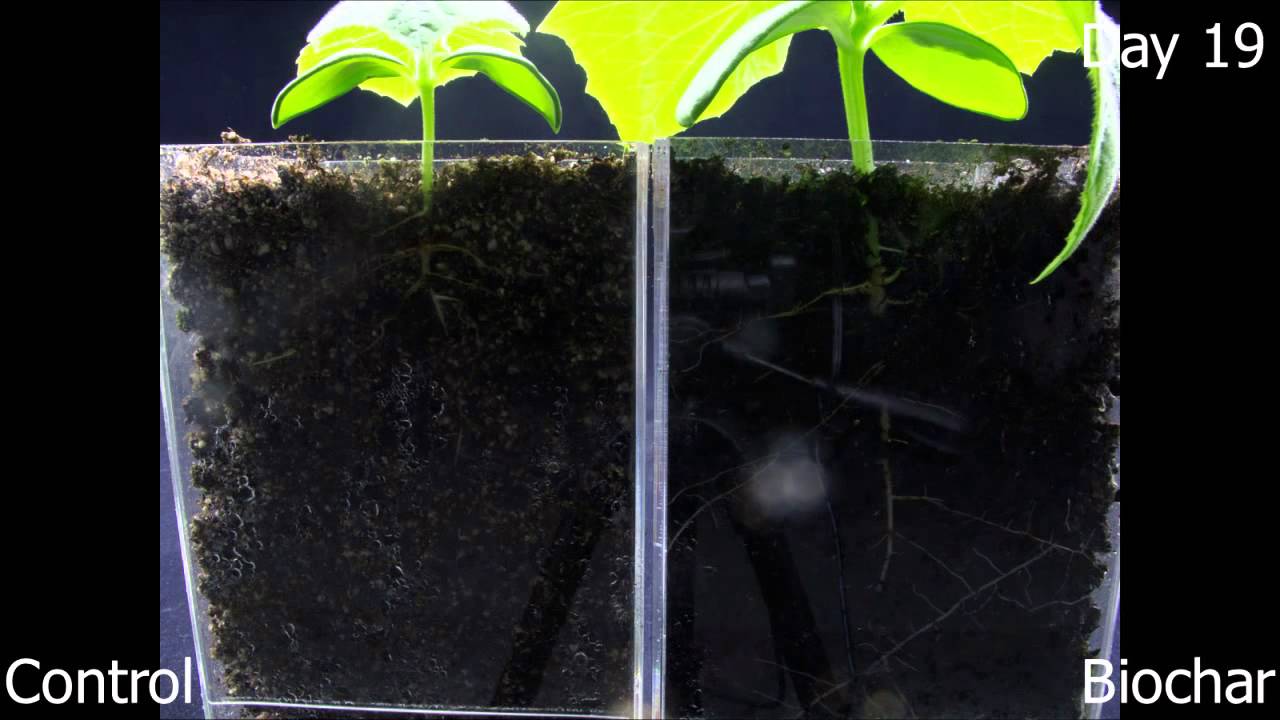
Larger Image
Published on Jan 23, 2014
Amazing 28 day time lapse video in 1 minute, comparing plants that do not have biochar and plants that are using Cool Planet's new soil amendment product called CoolTerra. CoolTerra boosts plant growth, retain soil moisture, locks-in soil nutrients, increases microbial life and builds lasting fertility. To learn more visit: www.coolplanet.com/biochar
CoolTerra Biochar 28 Day Time Lapse - YouTube
Jan 23, 2014
Crop flops: GMOs lead ag down the wrong path | Grist
By Tom Philpott
Martchan / Shutterstock
Editor’s note: After we ran What I learned from six months of GMO research: None of it matters, Nathanael Johnson’s essay concluding his “Panic-Free GMOs” series, we heard from a lot of people who think that GMOs really do matter. We’re publishing three responses: one from Denise Caruso, author of Intervention: Confronting the Real Risks of Genetic Engineering and Life on a Biotech Planet; one from Ramez Naam, author of The Infinite Resource: The Power of Ideas on a Finite Planet; and — to kick things off today — one from Tom Philpott, whose work long graced these pages and who is now at Mother Jones.
Before I respond to Nathanael Johnson’s assertion that the “stakes are so low” in the debate over GMOs, I want to address a smaller point. “The debate isn’t about actual genetically modified organisms — if it was we’d be debating the individual plants, not GMOs as a whole,” Johnson writes.
That’s a good place to start: actually existing GMOs. What traits are on the market today, in use by farmers? First, I’ll note that there’s no shortage of land devoted to GMOs. Since the novel seeds hit the market in 1996, global GM crop acreage has expanded dramatically, reaching 420 million acres by 2012, reports the International Service for the Acquisition of Agri-biotech Applications. That’s a combined landmass more than four times larger than California. The pro-GMO ISAAA hails this expansion as “fastest adopted crop technology in the history of modern agriculture.”
Yet, for all of that land devoted to GMOs, there are just two traits in wide use: herbicide resistance and pest resistance (Bt). Note, in the below ISAAA chart, the “<1″ at the bottom. That represents the percentage of all global GMO acres planted in crops that aren’t either herbicide- or pesticide-tolerant: that is to say, less than 1 percent.

Now, one might ask: But isn’t the industry on the brink of rolling out wonder crops — new varieties that are more nutritious, or use water more efficiently, or need less fertilizer? One way to tell is to peek into the U.S. Department of Agriculture pipeline of new GMO products being considered for deregulation. Here we can expect to find the stuff the industry has tested and found rugged and ready for field conditions. What’s in there? Thirteen products — nine of which involve herbicide tolerance or insect resistance. Of those nine, five are engineered to resist two herbicides — a dispiriting trend I’ll explore more below. The others are an apple variety engineered not to brown, a eucalyptus designed to resist freezing, a potato charged with bruising less easily, and an alfalfa type meant to contain less lignin.
Something tells me that none of these novelty items are destined to crack ISAAA’s <1 percent box.
It’s true that rice engineered to deliver beta-carotene is due out in 2016 in the Philippines, and that citrus trees engineered to resist a ruinous pathogen have shown promise. Then there are those virus-resistant GM papayas in Hawaii — though it should be noted that the state’s entire papaya production covers about 2,000 acres, the size of a moderately sized corn farm in Iowa. But until the “golden rice” and the novel oranges prove effective, durable, and acceptable to a large swath of growers, we live in a world in which upwards of 99 percent of GMOs are engineered for the two traits mentioned above.
And that means that actually-existing GMOs remain essentially an appendage of the pesticide industry, which has dominated the technology from the start. But a fixation on pesticides doesn’t fully answer the question of why the industry’s vaunted innovation has stagnated into variations on two themes, with a few promising products at the margin. Monsanto, for one, has signaled its intention to diversify away from pesticides by entering what might be called theclimate-change-services business; and back in 2008, the companypledged to create seeds that would “reduce by one-third the amount of key resources required to grow crops by the year 2030,” while also doubling yields.
More than five years later, where’s the progress? For that, I think, we have to look to the fact that genes and traits (the cool things we want plants to do in the field) don’t always track on a one-to-one basis. There are single genes that confer resistance to particular herbicides or express the toxic-to-insects trait of Bacillus thuringiensis, the basis of Bt corn and cotton. But there’s no one gene that regulates the way a plant uses water — which probably explains why Monsanto’s “drought-tolerant” corn, deregulated by the USDA in 2012, has fallen with such a thud. In its Final Environmental Assessment of the crop, the USDA delivered quite a caveat. “It is prudent to acknowledge,” the agency declared, that the Monsanto product’s ability to fend off drought “does not exceed the natural variation observed in regionally-adapted varieties of conventional corn (representing different genetic backgrounds).” Translation: In areas of the U.S. corn belt where drought is typically a factor, conventional breeders had already developed varieties that do just as well under drought conditions as Monsanto’s genetically altered product.
Churning out crops designed to require less nitrogen — which involves another complex process beyond the scope of a single gene — has so far proven to be an equally vexed project.
So what we have here, in essence, is a bit of a carnival-game scheme: an industry that lives by trumpeting elusive promises while quietly profiting from old tricks. In that sense, I agree with Johnson: stakes are low in the GMO debate, in that it’s an industry that’s wildly overhyped — by champions and foes alike.
But there’s another sense in which stakes are high indeed. The industry’s core traits, herbicide and pesticide resistance, have proven vulnerable. Nearly half — and growing — of all U.S. farms are plagued by weeds resistant to Monsanto’s herbicide Roundup, and farmers have responded by jacking up their Roundup doses and adding to them older, more toxic herbicides. Meanwhile, a pest called the western corn rootworm has evolved resistance to Bt corn. Here’s NPR’s Dan Charles, writing last summer:
It appears that farmers have gotten part of the message: Biotechnology alone will not solve their rootworm problems. But instead of shifting away from those corn hybrids, or from corn altogether, many are doubling down on insect-fighting technology, deploying more chemical pesticides than before. Companies like Syngenta or AMVAC Chemical that sell soil insecticides for use in corn fields are reporting huge increases in sales: 50 or even 100 percent over the past two years.
The failure of these products — a profitable failure, if you make both GMOs and pesticides — has brought industrial-scale agriculture to a crossroads. Farmers could respond by making tweaks that have been proven to maintain productivity while slashing herbicide, insecticide, and fertilizer use — simple changes like adding another crop to the rotation and planting fall cover crops, as demonstrated by a landmark 2012 study by Iowa State University researchers.
Such a relatively minor change in farming practices would bring enormous benefits to society — to name a few, more carbon stored in soil, less fouling of drinking water with agrichemical runoff, and greater resilience to drought in the heart of the U.S. grain belt. U.S. farm policy could and should underwrite a shift to a more diversified and low-input agriculture — an unlikely prospect, given that the industry deftly invests a chunk of its profits in lobbying Congress, and that its “feed the world” rhetoric has won over a broad swath of progressive thought leaders.
Or farmers could head down the path paved for them by Monsanto and its very few peers in the agrichemical/GMO game, including Dow and DuPont. This way involves responding to the plague of resistant weeds by adding yet another herbicide to the mix, through those double-herbicide-resistant products now marching through the USDA’s deregulation process.
In a 2012 paper, Penn State researchers pondered what would likely happen if those products make their way onto farm fields. Chances are “actually quite high” that they will give rise to a new generation of superweeds that resist both Roundup and the older, more toxic herbicides that will come into use. And farmers will likely respond just as they responded to the advent of Roundup resistance — by applying ever higher doses. Here’s what the Penn State team envisions:
Editor’s note: After we ran What I learned from six months of GMO research: None of it matters, Nathanael Johnson’s essay concluding his “Panic-Free GMOs” series, we heard from a lot of people who think that GMOs really do matter. We’re publishing three responses: one from Denise Caruso, author of Intervention: Confronting the Real Risks of Genetic Engineering and Life on a Biotech Planet; one from Ramez Naam, author of The Infinite Resource: The Power of Ideas on a Finite Planet; and — to kick things off today — one from Tom Philpott, whose work long graced these pages and who is now at Mother Jones.
Before I respond to Nathanael Johnson’s assertion that the “stakes are so low” in the debate over GMOs, I want to address a smaller point. “The debate isn’t about actual genetically modified organisms — if it was we’d be debating the individual plants, not GMOs as a whole,” Johnson writes.
That’s a good place to start: actually existing GMOs. What traits are on the market today, in use by farmers? First, I’ll note that there’s no shortage of land devoted to GMOs. Since the novel seeds hit the market in 1996, global GM crop acreage has expanded dramatically, reaching 420 million acres by 2012, reports the International Service for the Acquisition of Agri-biotech Applications. That’s a combined landmass more than four times larger than California. The pro-GMO ISAAA hails this expansion as “fastest adopted crop technology in the history of modern agriculture.”
Yet, for all of that land devoted to GMOs, there are just two traits in wide use: herbicide resistance and pest resistance (Bt). Note, in the below ISAAA chart, the “<1″ at the bottom. That represents the percentage of all global GMO acres planted in crops that aren’t either herbicide- or pesticide-tolerant: that is to say, less than 1 percent.
Now, one might ask: But isn’t the industry on the brink of rolling out wonder crops — new varieties that are more nutritious, or use water more efficiently, or need less fertilizer? One way to tell is to peek into the U.S. Department of Agriculture pipeline of new GMO products being considered for deregulation. Here we can expect to find the stuff the industry has tested and found rugged and ready for field conditions. What’s in there? Thirteen products — nine of which involve herbicide tolerance or insect resistance. Of those nine, five are engineered to resist two herbicides — a dispiriting trend I’ll explore more below. The others are an apple variety engineered not to brown, a eucalyptus designed to resist freezing, a potato charged with bruising less easily, and an alfalfa type meant to contain less lignin.
Something tells me that none of these novelty items are destined to crack ISAAA’s <1 percent box.
It’s true that rice engineered to deliver beta-carotene is due out in 2016 in the Philippines, and that citrus trees engineered to resist a ruinous pathogen have shown promise. Then there are those virus-resistant GM papayas in Hawaii — though it should be noted that the state’s entire papaya production covers about 2,000 acres, the size of a moderately sized corn farm in Iowa. But until the “golden rice” and the novel oranges prove effective, durable, and acceptable to a large swath of growers, we live in a world in which upwards of 99 percent of GMOs are engineered for the two traits mentioned above.
And that means that actually-existing GMOs remain essentially an appendage of the pesticide industry, which has dominated the technology from the start. But a fixation on pesticides doesn’t fully answer the question of why the industry’s vaunted innovation has stagnated into variations on two themes, with a few promising products at the margin. Monsanto, for one, has signaled its intention to diversify away from pesticides by entering what might be called theclimate-change-services business; and back in 2008, the companypledged to create seeds that would “reduce by one-third the amount of key resources required to grow crops by the year 2030,” while also doubling yields.
More than five years later, where’s the progress? For that, I think, we have to look to the fact that genes and traits (the cool things we want plants to do in the field) don’t always track on a one-to-one basis. There are single genes that confer resistance to particular herbicides or express the toxic-to-insects trait of Bacillus thuringiensis, the basis of Bt corn and cotton. But there’s no one gene that regulates the way a plant uses water — which probably explains why Monsanto’s “drought-tolerant” corn, deregulated by the USDA in 2012, has fallen with such a thud. In its Final Environmental Assessment of the crop, the USDA delivered quite a caveat. “It is prudent to acknowledge,” the agency declared, that the Monsanto product’s ability to fend off drought “does not exceed the natural variation observed in regionally-adapted varieties of conventional corn (representing different genetic backgrounds).” Translation: In areas of the U.S. corn belt where drought is typically a factor, conventional breeders had already developed varieties that do just as well under drought conditions as Monsanto’s genetically altered product.
Churning out crops designed to require less nitrogen — which involves another complex process beyond the scope of a single gene — has so far proven to be an equally vexed project.
So what we have here, in essence, is a bit of a carnival-game scheme: an industry that lives by trumpeting elusive promises while quietly profiting from old tricks. In that sense, I agree with Johnson: stakes are low in the GMO debate, in that it’s an industry that’s wildly overhyped — by champions and foes alike.
But there’s another sense in which stakes are high indeed. The industry’s core traits, herbicide and pesticide resistance, have proven vulnerable. Nearly half — and growing — of all U.S. farms are plagued by weeds resistant to Monsanto’s herbicide Roundup, and farmers have responded by jacking up their Roundup doses and adding to them older, more toxic herbicides. Meanwhile, a pest called the western corn rootworm has evolved resistance to Bt corn. Here’s NPR’s Dan Charles, writing last summer:
It appears that farmers have gotten part of the message: Biotechnology alone will not solve their rootworm problems. But instead of shifting away from those corn hybrids, or from corn altogether, many are doubling down on insect-fighting technology, deploying more chemical pesticides than before. Companies like Syngenta or AMVAC Chemical that sell soil insecticides for use in corn fields are reporting huge increases in sales: 50 or even 100 percent over the past two years.
The failure of these products — a profitable failure, if you make both GMOs and pesticides — has brought industrial-scale agriculture to a crossroads. Farmers could respond by making tweaks that have been proven to maintain productivity while slashing herbicide, insecticide, and fertilizer use — simple changes like adding another crop to the rotation and planting fall cover crops, as demonstrated by a landmark 2012 study by Iowa State University researchers.
Such a relatively minor change in farming practices would bring enormous benefits to society — to name a few, more carbon stored in soil, less fouling of drinking water with agrichemical runoff, and greater resilience to drought in the heart of the U.S. grain belt. U.S. farm policy could and should underwrite a shift to a more diversified and low-input agriculture — an unlikely prospect, given that the industry deftly invests a chunk of its profits in lobbying Congress, and that its “feed the world” rhetoric has won over a broad swath of progressive thought leaders.
Or farmers could head down the path paved for them by Monsanto and its very few peers in the agrichemical/GMO game, including Dow and DuPont. This way involves responding to the plague of resistant weeds by adding yet another herbicide to the mix, through those double-herbicide-resistant products now marching through the USDA’s deregulation process.
In a 2012 paper, Penn State researchers pondered what would likely happen if those products make their way onto farm fields. Chances are “actually quite high” that they will give rise to a new generation of superweeds that resist both Roundup and the older, more toxic herbicides that will come into use. And farmers will likely respond just as they responded to the advent of Roundup resistance — by applying ever higher doses. Here’s what the Penn State team envisions:
From Mortensen, at al, “Navigating a Critical Juncture for Sustainable Weed Management,” BioScience, Jan. 2012The authors predict that glyphosate (Roundup) use will hold steady at high levels — and use of other herbicides, like 2,4-D, will soar.
So it seems to me that the stakes in this fight are indeed quite high. Yet, given what’s going on within the halls of the USDA and on our farm fields — corn and soy covers more than half of U.S. cropland, and nearly 90 percent of it is GMO — I wonder if the agrichmemical industry hasn’t already won.
Crop flops: GMOs lead ag down the wrong path | Grist
So it seems to me that the stakes in this fight are indeed quite high. Yet, given what’s going on within the halls of the USDA and on our farm fields — corn and soy covers more than half of U.S. cropland, and nearly 90 percent of it is GMO — I wonder if the agrichmemical industry hasn’t already won.
Crop flops: GMOs lead ag down the wrong path | Grist
Jan 22, 2014
Are Agriculture Exports Killing Us? | Mother Jones
By Tom Philpott
Wed Jan. 22, 2014

Agricultural exports cause $36 billion in annual healthcare costs, along with about 5,100 premature deaths.
That kind of thinking has driven agriculture policy at least since the days when Richard Nixon's ag secretary Earl Butz exhorted farmers to scale up operations and plant "fencerow to fencerow" in order to supply foreign markets.
But a new paper (PDF) from Harvard suggests massive ag exports might not be the economic boon imagined by USDA secretaries. The researchers looked at a single farm pollutant, ammonia (NH3), which makes its way into the air from fertilizer applied to farm fields and from the manure that accumulates on livestock farms. Once it enters the atmosphere, as Erik Stokstad explained in an excellent (pay-walled) news item in Science, it "reacts with other air pollutants to create tiny particles that can lodge deep in the lungs, causing asthma attacks, bronchitis, and heart attacks."
The Harvard team found data on the ammonia emissions associated with various major crops and meat products between 2000 and 2009, calculated what percentage of each commodity goes to exports, and figured out what share of total ag-based ammonia emissions come from growing food for export.

Having calculated the total, they set about figuring out the public-health costs associated with all of that export-driven ammonia billowing about in the air we breathe. The results, as our friends at UpWorthy might say, will astonish you—but not in a warm and fuzzy way. They calculated that our agricultural exports cause $36 billion in annual ammonia-realted healthcare costs, along with about 5,100 premature deaths.
Now, $36 billion might seem somewhat modest compared to the total value of US ag exports, which as Vilsack recently announced, have surged to a record. But the headline export numbers are raw—they don't account for how much farmers spent to produce their export-bound bounty. When the researchers looked at the 2000-2009 period and averaged total exports minus production costs, they found that the net value of US ag exports came in at about $23.5 billion annually (see chart above).
Thousands of deaths aside, simple math—$23 billion in gains vs. $36 billion in costs—suggests that the US policy of pushing ag exports is a net economic loser. And as the authors make clear, ammonia emissions are only one of the hidden costs associated with large-scale agriculture. Others include eutrophication (fertilizer-fed dead zones in lakes and deltas), loss of biodiversity, and greenhouse-gas emissions, including another by-product of excess fertilizer and manure, nitrous oxide.
Of course, the $36 billion in costs associated with ammonia emissions don't affect the bottom lines of the gigantic meat and grain-trading firms that move all that meat and grain from here to foreign markets. Nor does it affect the input suppliers that sell farmers the fertilizers and pesticides to grow the grain that's exported, both directly and in the form of grain-fed beef, pork, and chicken. Such costs are what economists call "externalities"—burdens that fall not on the corporations that profit from making a problematic good, but rather on society as a whole.
And that's a pretty good deal, if you're in the business of, say, producing pork in the US for the booming Chinese market. No wonder a Chinese company bought US pork giant Smithfield last year.
Are Agriculture Exports Killing Us? | Mother Jones
Wed Jan. 22, 2014
A large hog farm and its ammonia–spewing "manure lagoon." USDA/NRCS
Late last year, US Department of Agriculture chief Tom Vilsack boasted that US agriculture exports had hit an all-time high in fiscal 2013, and hailed "historic work by the Obama Administration to break down barriers to US products and achieve new agreements to expand exports." Underlying Vilsack's glee is the idea that growing huge amounts of food here and selling a big chunk of it overseas bolsters the US economy and stabilizes rural America.
Late last year, US Department of Agriculture chief Tom Vilsack boasted that US agriculture exports had hit an all-time high in fiscal 2013, and hailed "historic work by the Obama Administration to break down barriers to US products and achieve new agreements to expand exports." Underlying Vilsack's glee is the idea that growing huge amounts of food here and selling a big chunk of it overseas bolsters the US economy and stabilizes rural America.
Agricultural exports cause $36 billion in annual healthcare costs, along with about 5,100 premature deaths.
That kind of thinking has driven agriculture policy at least since the days when Richard Nixon's ag secretary Earl Butz exhorted farmers to scale up operations and plant "fencerow to fencerow" in order to supply foreign markets.
But a new paper (PDF) from Harvard suggests massive ag exports might not be the economic boon imagined by USDA secretaries. The researchers looked at a single farm pollutant, ammonia (NH3), which makes its way into the air from fertilizer applied to farm fields and from the manure that accumulates on livestock farms. Once it enters the atmosphere, as Erik Stokstad explained in an excellent (pay-walled) news item in Science, it "reacts with other air pollutants to create tiny particles that can lodge deep in the lungs, causing asthma attacks, bronchitis, and heart attacks."
The Harvard team found data on the ammonia emissions associated with various major crops and meat products between 2000 and 2009, calculated what percentage of each commodity goes to exports, and figured out what share of total ag-based ammonia emissions come from growing food for export.
Having calculated the total, they set about figuring out the public-health costs associated with all of that export-driven ammonia billowing about in the air we breathe. The results, as our friends at UpWorthy might say, will astonish you—but not in a warm and fuzzy way. They calculated that our agricultural exports cause $36 billion in annual ammonia-realted healthcare costs, along with about 5,100 premature deaths.
Now, $36 billion might seem somewhat modest compared to the total value of US ag exports, which as Vilsack recently announced, have surged to a record. But the headline export numbers are raw—they don't account for how much farmers spent to produce their export-bound bounty. When the researchers looked at the 2000-2009 period and averaged total exports minus production costs, they found that the net value of US ag exports came in at about $23.5 billion annually (see chart above).
Thousands of deaths aside, simple math—$23 billion in gains vs. $36 billion in costs—suggests that the US policy of pushing ag exports is a net economic loser. And as the authors make clear, ammonia emissions are only one of the hidden costs associated with large-scale agriculture. Others include eutrophication (fertilizer-fed dead zones in lakes and deltas), loss of biodiversity, and greenhouse-gas emissions, including another by-product of excess fertilizer and manure, nitrous oxide.
Of course, the $36 billion in costs associated with ammonia emissions don't affect the bottom lines of the gigantic meat and grain-trading firms that move all that meat and grain from here to foreign markets. Nor does it affect the input suppliers that sell farmers the fertilizers and pesticides to grow the grain that's exported, both directly and in the form of grain-fed beef, pork, and chicken. Such costs are what economists call "externalities"—burdens that fall not on the corporations that profit from making a problematic good, but rather on society as a whole.
And that's a pretty good deal, if you're in the business of, say, producing pork in the US for the booming Chinese market. No wonder a Chinese company bought US pork giant Smithfield last year.
Are Agriculture Exports Killing Us? | Mother Jones
Jan 21, 2014
Resin 'n Wood Episode 1 The Basics

Published on Jan 21, 2014
A new series that look at using epoxy resin with woodturning. This episode looks at the basics of what type of resin to use, how to mix it and prevent the bubbles.
The resin used in this video is available from
http://store.brendanstemp.com.au
Resin 'n Wood Episode 1 The Basics
Jan 20, 2014
Homemade - DIY - Scroll Saw! Drill Powered! - YouTube

Published on Jan 10, 2014
Homemade Scroll Saw Powered by a Drill. Use A drill as a motor for this shop made scroll saw.
Foot Powered Scroll Saw- http://youtu.be/sGyJYMHP_Ww
Facebook - https://www.facebook.com/izzyswanswoo...
Homemade - DIY - Scroll Saw! Drill Powered!
Subscribe to:
Posts (Atom)

 Posts
Posts


