Dec 16, 2013

Tackling the Epidemic of Herbicide-Resistant Weeds with Sustainable Solutions - The Equation


Doug Gurian-Sherman, senior scientist, Food and Environment

Weeds that have developed resistance to glyphosate herbicide used with Monsanto’s engineered herbicide resistance trait have reached epidemic proportions. A recent survey puts the area infested by these weeds at 61 million acres, and increasing rapidly.
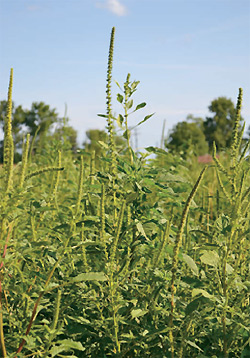

Palmer amaranth, also known as pigweed, infests a soybean field. Photo: United Soybean Board/Flickr.

Glyphosate resistant weeds have resulted in greatly increased levels of herbicide use, and an estimated 404 million pounds more pesticide (when insecticide savings from Bt GMO crops are counted) than may have been the case without these crops. They make it harder to grow crops, adding substantial expense and reducing yields, and are leading to increased tillage, which reduces soil fertility and leads to soil loss from erosion.

A new briefing paper by UCS, “The Rise of Superweeds — and What to do About It” concisely lays out how these crops are causing big environmental problems, how the seed and pesticide industry’s proposed solution will only make things worse, and how we can resolve this problem sustainably while achieving multiple benefits.

The paper shows that resistant weeds are mainly a symptom of a broken industrial agriculture system, which needs fundamental reform to address not only resistant pests, but also a host of other problems. Proposed solutions that do not recognize these underlying issues will only make matters worse.

In fact, the seed and pesticide industry is set to exacerbate the problem, because waiting in the wings are a new generation of engineered crops resistant to old herbicides like 2,4-D, developed in the 1940s. 2,4-D is a possible carcinogen, and threat to natural vegetation and fruit and vegetable crops due to its high toxicity to those plants and its propensity to drift beyond the soybeans, corn, and cotton it is intended for.
Not Just Your Parent’s Resistance Problem

The science community recognizes that glyphosate resistant weeds are not just another pest resistance problem (which are bad enough), as a few uncritically pro-GMO scientists have suggested. The National Academy of Sciences charged the Weeds Science Society of America with the task of holding a “weed summit,” convened in the spring of 2012, to address the problem, recognizing its severity. Another summit is being planned.

Almost two years later, though, nothing has changed to reduce the epidemic. In a recent meeting hosted by the USDA Economic Research Service on November 8, long-time leading USDA weed scientist Harold Coble said that we are heading for a train wreck, and that technological solutions will result in the same problems as in the past. Other weed scientists concur with this assessment.

Most importantly, it does not have to be this way, because, as the briefing paper shows, cost effective, highly productive alternatives are available. And these alternatives—such as cover crops and crop rotations—combined with minimal tillage and, in non-organic systems, minimal herbicide use, also provide big environmental payoffs.

Cover crops, besides suppressing weeds, can provide nutrients to crops, greatly reduce soil erosion, and increase soil fertility. Crop rotations reduce pest damage and improve yields. So moving to these systems is a win-win solution.
Different from Other Weed Resistance

Some commentators, including some scientists, have tried to downplay the crisis facing farmers. They have noted, correctly, that resistance has been a problem for many years for all chemicals, and even for genetic traits.

But despite the similarities to previous weed resistance, glyphosate resistant crops have exacerbated the problem substantially. And for the same reasons, the new generation of these crops in the pipeline, resistant to other herbicides, will only throw fuel on the fire.

Crops designed to allow an herbicide to be applied without harming the crop initially made weed control easier and more convenient for farmers, giving them more flexibility for when they could spray their crops.

But this advantage led to overuse of glyphosate, greatly increasing the selection of rare resistant plants, and giving them a huge competitive advantage over their susceptible siblings. It’s a case of Darwinian selection on steroids. Without regulations, or other means, to make sure this technology was used wisely, it has instead has become a liability. Without herbicide resistant GMOs, this perfect storm of selection for resistance would not have happened.

It is not a coincidence that this has come about. The industry has lobbied hard against better regulation. USDA has not developed better regulations under the 2000 Plant Protection Act, and has instead been greasing the skids to allow more “deregulated” engineered herbicide resistant crops under older, inadequate, rules. And industry has prioritized research development of these crops because, through patents and contracts and high cost, they have allowed increased control over the seed supply, increased seed costs, and increased herbicide sales. As noted in the new briefing paper, 13 of 20 GMOs in the regulatory pipeline at the time of writing were for new herbicide resistant GMOs.

It is also unlikely that glyphosate-resistant crops would have been made without genetic engineering. Some crops resistant to other herbicides have been developed without engineering, but they have not been nearly as successful as glyphosate resistant crops. And for various reasons, alternatives to engineering, such as mutagenesis, did not work for developing glyphosate resistant crops.

Therefore, in several ways, GMO technology has contributed greatly to the resistant weed problem.

As also analyzed in the briefing paper, the next generation of resistant crops will inevitably lead to weeds with resistance to multiple herbicides. Some weeds resistant to glyphosate already are resistant to other herbicides, and some populations of these weeds are already resistant to 2,4-D or dicamba.

It is only a matter of time before several serious weeds become resistant to all or most of the herbicides available, leaving no good herbicide choices. And, as several weed scientists have noted, there are no new herbicides in the development pipeline. This is the coming train wreck that Coble was referring to.
When in a Hole, First Stop Digging

Meanwhile much of the mainstream weed science community seems unable or unwilling to take effective action, perhaps because of the heavy involvement of the pesticide industry. For example, at the weed summit in 2012, there was essentially no mention of the herbicide resistant crops, poised to be approved, and little evidence since that they will tackle this 800 pound gorilla. If these crops are approved without big restrictions on their use—and given USDA’s record, that seems probable—history is likely to repeat itself with a vengeance.

The resistant weed problem should be a good teachable moment. Much better solutions are available, but also could be improved and made more farmer friendly with the right research agenda at USDA, and the right policies. There is also a need to adapt these practices to local conditions in various regions. This agenda has long been neglected, and this needs to change.

But as long as we are led by the nose by those with a vested interest in the current failing status quo, we will only see things get worse for everyone but the companies that stand to sell more of their products.

About the author: Doug Gurian-Sherman is a widely-cited expert on biotechnology and sustainable agriculture. He holds a Ph.D. in plant pathology. See Doug's full bio.
Tackling the Epidemic of Herbicide-Resistant Weeds with Sustainable Solutions - The Equation

Now This Is Natural Food - NYTimes.com

Future of Farming: Mark Bittman speaks to Wes Jackson from The Land Institute, who predicted that a prairie-like system capable of providing food for humans would be viable within 100 years.
By MARK BITTMAN

Published: October 22, 2013

A few weeks ago at the annual Prairie Festival in Salina, Kan. — a celebration, essentially, of true sustainability — I sat down with Wes Jackson to drink rich beer and eat delicious, chewy bread made from the perennial grain Kernza. The Kernza we ate was cultivated at the Land Institute, the festival’s sponsor and the organization Jackson founded here 37 years ago.

For Op-Ed, follow@nytopinion and to hear from the editorial page editor, Andrew Rosenthal, follow@andyrNYT.


Fred R. Conrad/The New York Times

Video Link: http://nyti.ms/18J0L5w

At 77, Jackson is a big man with big ideas. Clearly he was back then as well, when he became determined to change the face of agriculture from being dependent upon annual monoculture (that is, planting a new crop of a single plant each year) to one that includes perennial polyculture, with fields containing varieties of mutually complementary species, planted once, harvested seasonally but remaining in place for years.

Jackson has a biblical way of speaking: “The plow has destroyed more options for future generations than the sword,” he says. “But soil is more important than oil, and just as nonrenewable.” Soil loss is one of the biggest hidden costs of industrial agriculture — and it’s created at literally a glacial pace, maybe a quarter-inch per century. The increasingly popular no-till style of agriculture reduces soil loss but increases the need for herbicides. It’s a short-term solution, requiring that we poison the soil to save it.

Annual monoculture like that practiced in the Midwestern Corn Belt is one culprit. It produces the vast majority of our food, and much of that food — perhaps 70 percent of our calories — is from grasses, which produce edible seeds, or cereals. For 10,000 years we’ve plowed the soil, planted in spring and harvested in fall, one crop at a time.

In an essay he published 26 years ago, called “The Worst Mistake in the History of the Human Race,” Jared Diamond theorized that this was essentially our downfall: by losing our hunter-gatherer roots and becoming dependent on agriculture, we made it possible for the human population to expand but paid the price in the often malnourishing, environmentally damaging system we have today.

That’s fascinating, and irreversible; barring a catastrophe that drastically reduces the human population, we’ll rely on agriculture for the foreseeable future. But if we look to the kind of systems Jackson talks about, we can markedly reduce the damage. “We don’t have to slay Goliath with a pebble,” he says of industrial agriculture. “We just have to quit using so much fertilizer and so many pesticides to shrink him to manageable proportions.”

Perennial polysystems are one way forward, because they allow us to produce grains, legumes, oils and other foods with a host of benefits. Gesturing across the road from where we sat, Jackson said to me: “That prairie — a prime example of a self-sustaining system — doesn’t have soil erosion, it’s not fossil-fuel dependent, you have species and chemical diversity. If you look around you’ll see that essentially all of nature’s ecosystems are perennial polycultures; that’s nature’s instruction book.” In perennial polycultures, the plants may fertilize one another, physically support one another, ward off pests and diseases together, resist drought and flood, and survive even when one member suffers.

When Jackson founded the Land Institute, he predicted that a prairie-like system capable of providing food for humans would be viable in 50 to 100 years. About 15 years short of the near end of that spectrum, there is definite progress, most notably in the form of Kernza, which is not yet sold commercially but has been domesticated in Salina and elsewhere.

Kernza is just the beginning. In addition to domesticating wild food-producing species, the Land Institute staff has taken on a far more challenging task: converting annuals into perennials. Perenniality is a complex trait, controlled by multiple genes. Perennials put more energy into their roots and less into flowers and seeds and greens, they send reserve energy into storage to wake up in the spring and they seldom die.

The work might go faster if Jackson had adequate funding, which isn’t much; he’d consider himself fully funded for the next 30 years with about one-third of the 2011 Federal subsidy for producing ethanol.

If Jackson’s followers are successful, we could see prairies producing different kinds of foods in commercial quantities with little or no chemical applications, irrigation, annual reseeding, tillage or tending; the work would be maintenance and harvesting. Creating the right plants for these habitats will take time, so much that we may not see the benefits in our lifetimes but, as Jackson says, “If you think you’re going to complete your life’s vision in your lifetime, you’re not thinking big enough.”

This article has been revised to reflect the following correction:

Correction: October 29, 2013

Mark Bittman’s column on Wednesday did not specify the year for which one-third of the federal subsidy for producing ethanol would have been enough to finance a program to perennialize an annual for 30 years. It was 2011, not “one year.”
Now This Is Natural Food - NYTimes.com

Sea Kale: Moving Away From Varieties That Need to be Replanted Every Year | TakePart

October 23, 2013 By Willy Blackmore

Willy Blackmore is TakePart’s Food editor. He has written for The Awl, The New Inquiry, and elsewhere.
full bio

A packet of seeds arrived in the mail yesterday, a kind kale. I’m slowly switching my gardenover from summer’s tomatoes and chiles to fall and winter crops: Another round of radishes, turnips, carrots, and greens. Except rather than buying Russian Red or Lacinato or another kind of kale you stumble across just about everywhere these days, the seeds I bought are for sea kale.

Belonging to a different genus but the same family as more familiar kale varieties, sea kale or Brassicaceae, was a favorite of Thomas Jefferson and has one significant difference from its leafy cousins: It’s a perennial. A single plant will persist year after year, yielding tender asparagus-like shoots in the spring, then greens and peppery flowers throughout the summer and fall, before it goes dormant in the winter. Other annual kales have to be planted, well, annually.

Beyond being a sucker for weird vegetable seeds, my reasoning for planting sea kale is that a few plants will provide many, many more salads than an equivalent quantity of annual kale plants. Additionally, planting perennial food crops—which are few and far between outside of fruits and nuts and berries—helps to reduce topsoil erosion, can reduce the need for weed controls, and, in aggregate, can build a rich polyculture that, according to Wes Jackson of the Land Institute, could offer an alternative model for agriculture in the coming decades.


Kale Bites Back: Turns Out the Popular Green Has a Potent Self-Defense System

My sea kale experiment is by no means so utopian in scope, but a new column and video about Jackson’s efforts to breed perennial cereal grains done by Mark Bittman for the New York Times makes a compelling case for making a broader shift to perennials in agriculture. Jackson’s inspiration? The prairie ecosystem that, over the course of thousands of years, built up the deep, rich topsoil that made states like Kansas, where the Land Institute is located, into such prime farmland—topsoil that’s been slowly depleted thanks to the erosion caused by farming annual crops.

Video ---> http://nyti.ms/18J0L5w
Jackson tells Bittman, “That prairie—a prime example of a self-sustaining system—doesn’t have soil erosion, it’s not fossil-fuel dependent, you have species and chemical diversity. If you look around you’ll see that essentially all of nature’s ecosystems are perennial polycultures; that’s nature’s instruction book.”

The breeding program at the Land Institute is working to domesticate a perennial variety of wheat grass into a grain-producing crop. The project is still in the experimental phase, but it could become commercially available in the next decade or so.

Named Kernza, flour produced from the grain is mixed with traditional wheat to bake what Bittman calls “delicious, chewy” bread at the Institute.

Sounds like it would go well with a sea kale salad.

Sea Kale: Moving Away From Varieties That Need to be Replanted Every Year | TakePart

15 Surprising Uses For Eggshells


Jill  jill@byjillee.com
A couple of weeks ago I bought a composter for my garden. It’s a pretty fancy contraption. It’s actually TWO composters in one. The idea being that you can have one batch “brewing” while another batch is being utilized. They even SPIN…which is apparently important because compost needs to be “stirred” as its’ “cooking”.

As you can probably tell, I don’t know a whole lot about composting….YET. But I am learning…things like what you can and can’t put into your composter. One thing I have learned CAN go in, and is a rich source of calcium and other essential nutrients that plants need, is egg shells! So recently I started my egg shell collection in a container under the kitchen sink which has grown quite rapidly because we eat a lot of eggs around here. (Naturally gluten-free!)


Ironically, since I’ve started saving my eggshells for the composter, I’ve also been learning about many OTHER uses of eggshells. Now I’m torn between throwing them in the composter and using them for some of the MANY other ideas listed below. I guess we’ll just have to start eating MORE eggs so I can do them BOTH.


A FEW FUN FACTS ABOUT EGG SHELLS:
An egg shell is made of calcium carbonate, which is also the main ingredient in some antacids. Each medium sized egg shell has about 750-800 mgs of calcium.
The shell makes up 9-12 percent of an egg’s total weight, and contains pores that allow oxygen in and carbon dioxide and moisture out.
The shell color of an egg is representative of the breed of hen that produces the egg. White hens produce white eggs and brown hens produce brown eggs.


A FEW SURPRISING USES OF EGG SHELLS:

Nourishing Face Mask
Pulverize dried egg shells with a mortar and pestle, then whisk the powder in with an egg white and use for a healthful, skin-tightening facial. Allow the face mask to dry before rinsing it off.


Treat Skin Irritations
Drop an eggshell into a small container of apple cider vinegar and let it soak for a couple of days. Dab the mixture on minor skin irritations or on itchy skin.


Powerful Cleaner
Ground eggshells make a wonderful (and nontoxic!) abrasive for those tough-to-clean pots and pans. Mix them with a little soapy water for a powerful clean.

Hummingbird feeders tend to grow all sorts of nasty stuff. Clean it by first by rinsing with hot water. Then add some crushed egg shells, fill 1/2 way with water, and shake. The shells act as an abrasive, removing mold or other built-up gunk. Rinse well before re-filling with hummingbird food.

It’s almost impossible to get a scrub brush down the narrow neck of a thermos. Clean your thermos using the instructions above for hummingbird feeders.


Garden Fertilizer
Eggshells are rich in calcium and other minerals that help your garden thrive. Crush eggshells into tiny pieces and sprinkle into each hole before planting. Then, sprinkle additional shells around the base of your plants every two weeks.


Start Some Seedlings
Fill an egg carton with empty, rinsed eggshell halves and poke a hole in each one for drainage. Then add potting soil and one or two seeds to each shell. When the seedlings are big enough for transplanting outside, just crack the shell at the bottom and plant them, shell and all.

Pest Control
Crush eggshells and scatter them around your vegetables and flowers to fend off slugs, snails, and cutworms. These soft-bodied critters don’t like crawling over sharp pieces of shell. The smell of eggs will also deter deer.

House Plant Booster
Keep a mason jar of eggshells covered with water for watering indoor plants.

Cat Deterrent
Have a problem with cats using your garden as a litter box? Crushed up egg shells will keep them away, too. Just scatter shells in the areas that they frequent, and after stepping on those shells a few times, they’ll move on.


Better Tasting Coffee
Add some crushed eggshells to ground coffee before brewing it to make it taste less bitter. When you’re done, toss the grounds and shells on your compost heap!


Make Your Own Powdered Calcium Supplement
Skip the pills and simply bake your shells at 350 degrees for 8 minutes. Let them cool and grind them to a fine powder. Add your supplement (a teaspoon or less) to your favorite smoothie or juice once a day.


Make Your Own Sidewalk Chalk

What you need:
Approximately five empty egg shells
1 teaspoon flour
1 teaspoon very hot water
food coloring (for colored chalk)

Wash and dry the egg shells.
Crush the egg shell into a bowl and grind it until it is a powder. Make sure all the pieces are ground. Take out any big pieces before going on to the next step.
Mix the flour and hot water in another bowl. Then add 1 tablespoon egg shell powder and mix into a thick paste. Add your favorite color food coloring. Just add a drop or two for colored chalk. If you want white chalk do not add anything. Shape the paste into chalk sticks or press into soap molds for fun shapes. If making chalk sticks roll the sticks up tightly in a paper towel.
Let your chalk dry for 3 days.


Laundry Whitener
Some say that if you toss some shells in a mesh bag in your laundry, the gray tint to your whites will disappear.


Eggshell Candles
The next time you have eggs for breakfast, carefully crack the shells in half and save them as a base to fill with beeswax for candles. Just insert a wick, let the wax set and remove the peel.


For most eggshell uses, it is better to make sure they are clean and free from bacteria. If you don’t wash the eggs thoroughly before using, bake the shells at 150 degrees Fahrenheit on a cookie sheet for about 10 minutes.

15 Surprising Uses For Eggshells | One Good Thing by Jillee

Scientists Say Microbes Create Hardier, Bigger Crops—Without Chemicals | TakePart


Wheat fields outside Pullman, Wash. (Photo: Vetta/Getty Images)

December 12, 2013 By Clare Leschin-Hoar

Clare Leschin-Hoar's stories on seafood and food politics have appeared in Scientific American, Eating Well and elsewhere.
full bio

Ever since Michael Pollan shared the nitty-gritty details of his gut bacteria, a lot of us have been not-so-secretly obsessed with microbes. Supermarket shelves are jammed with products boasting good-for-you probiotics.

What if microbes can give plants the same benefits?

Considered through the lens of a warming planet with a burgeoning population, that question has scientists buzzing with the possibility.

In the early 2000s, plant biologist Rusty Rodriquez studied plants that survived near Yellowstone National Park’s geothermal vents. How could plants withstand the kind of heat that would cause other species to wither? It turns out, they weren’t facing the intense heat alone—they carried a symbiotic fungus. Together, the fungus and the plant could survive Yellowstone’s hot soil.

That discovery prompted Rodriquez and his colleagues to look at other habitats and plants; what they found were other similar symbiotic relationships, which may make it easier for the crops we humans rely on to weather a future in which temperatures are on the rise and droughts are more common.

How? Certain fungi can help a plant survive fluctuations in heat, survive drought, or flourish in salty soil, and the fungi can successfully be transferred to other plants. If you stop to take that in for a minute, the possibility is thrilling.

Dr. James White, who studies the microbial endophytes of plants at Rutgers University, says we’re still in the early stages of this type of technology but that it holds great promise.

“We’re finding microbial endophytes in plant after plant after plant. They’re bacterial and fungal. There’s a whole community there that contributes to how a plant performs. And understanding that might enable us to grow crops without so many agrichemicals on them,” says White.

Field trials have been promising. Corn, rice, wheat, sugarcane, barley, and other seeds treated with a fungus identified by Rodriguez’s company, Adaptive Symbiotic Technologies, showed increased yields during drought and required less water. Other trials showed seeds could do well in salt-affected soils, a problem faced by California farmers.

“We are not modifying the plant genome. The fungal genome itself is not being modified. When you put a plant out in a field, it will get colonized with fungus. We’re just bringing in a fungus we know will be a mutualist inside the plant. They’re nontoxic, pose no threat to animals or invertebrates, and do not end up in the plant products themselves,” says Rodriguez.

“It’s nowhere near genetic modification,” says White. “It’s very comparable to the gut microbes that enhance the stress tolerance of a host and provide nutrients to a host.”

Rodriguez says the ability to commercialize the process isn’t far away.

“We’re pursuing organic certification for our products,” he says. If all goes well, a commercially available product could be launched by the first quarter of 2014.

How will it work? Farmers will buy seeds treated with the fungus.

“The farmer just sticks it in the ground. When the plant germinates, the fungus germinates, and they form a symbiosis within a few hours,” says Rodriguez.

Scientists Say Microbes Create Hardier, Bigger Crops—Without Chemicals | TakePart

Dec 13, 2013

Burning To Produce Biochar - Biochar burn school results


Biochar burn school results from kelpiew

November 20, 2013
Kelpie Wilson
Biochar Burn School was fantastically successful! Many thanks to all the participants. I was especially pleased at the diversity of people who attended - young folks and elders, permaculturists and scientists, land owners, nomads and Forest Service professionals. Thanks to everyone who came back for an extra day, just to see what else we could learn about this process.

Special thanks to Peter Hirst of New England Biochar for showing up with tools, educational materials and expertise.

I will be writing up a report with more details, but for now, the best way to understand what we did is to take a look at these pictures

Links:
http://www.greenyourhead.com/2013/11/biochar-burn-school-results.html
Biochar burn school results

Polyfaces Farm Movie - Trailer


Polyfaces Trailer from Regrarians Ltd. on Vimeo.

'Polyfaces' is a biopic that charts the involvement of the Polyface Farm community of farmers, employees, interns, customers, animals & landscapes in the iconic Shenandoah Valley in Virginia, USA. This short trailer provides the viewer with a sense of the extremely high quality cinematography captured by European filmakers Alex Amengual & Hans Hansen along with up & coming Australian filmakers Isaebella Doherty & Lisa Heenan.

Shot exclusively with Canon 5D DSLR cameras this film captures the emotion, beauty & reality of a whole 'foodshed' determined to change the current food system for the better.

Credits:
Producer, Director & Writer: Lisa Heenan
Editor/Post Production: Bergen O'Brien
Sound & Cinematography: Alex Amengual, Isaebella Doherty, Hans Hansen & Lisa Heenan
Narrator: Darren J. Doherty
Title: Pearl Doherty
Copyright 2013 Regrarians Ltd. (Australia)


Larger Image


Larger Image

Polyfaces Trailer

Dec 12, 2013

Preparing Large Logs for the Sawmill - YouTube


Larger Image


Published on Nov 27, 2013

Many people miss out on the opportunity to mill really good lumber when the logs are too large for the sawmill. With a little bit of planning and some effort your can get logs you would otherwise pass on to the mill and in the drying shed...


The Courthouse Elm

Preparing Large Logs for the Sawmill - YouTube

Cool Planet: A Company That Makes Biochar And Gasoline - Forbes

Peter Kelly-Detwiler, Contributor
I cover the forces and innovations that shape our energy future.
12/11/2013 

Every so often, one hears about a technology or start-up company that appears too good to be true. Most of the time they are just that, and you never hear about them again. The case of Cool Planet, however, may prove to be one of those memorable exceptions.
Image: Cool Planet

First, let’s start with the investors. Heavy hitters GE, Exelon, NRG, ConocoPhillips, BP, and Google are just some of the companies who have put money behind the venture. Then there’s the management team. These are serious players from the communications, finance, and fuels industries. The chief technology officer – Mike Cheiky – who came up with the company’s technology has over 50 patents, two World Economic Forum Energy awards, and has founded six start-ups.

So much for the bona fides, what does Cool Planet do? Well, they make gasoline from organic materials such as trees, grass, or corn cobs. The company can manufacture gasoline in modular plants, and their long-term goal is to produce it at $1.50 a gallon. Their first $50+million, 10 million gallon-per-year manufacturing facility is now being built in Louisiana.

But what may be even more important is the residual ‘waste’ that results from the creation of gasoline. That waste is essentially the carbonized remainder of the biomass they heat up, from which the vapors were extracted and liquefied into gasoline. This co-product is called biochar, and if you haven’t heard of it yet, you may well soon. Biochar is defined by the International Biochar Initiative (yes, there is such a thing; the IBI has 400 paying members from 34 countries) as “a solid material obtained from the carbonization of biomass.”

Biochar – when blended with soil – has the unique ability to vastly improve plant harvests while reducing the amount of water and fertilizer needed. According to the IBI, biochar also has appreciable carbon sequestration that is measurable and verifiable. Cool Planet’s biochar is the first product to be certified by the IBI.

I spoke to two executives from Cool Planet to find out more about the whole business, and what the company was up to. Mike Rocke, vice president for business development explained that because of the properties outlined above “We aren’t carbon neutral, we can be carbon negative.”

Here’s how the process works, according to Rocke:

We take any non-food biomass, we grind it up and then we use pressure and heat like mother nature does, and we do it in minutes versus years, to drive all the reactive gases out of the biomass. Then we take it through a catalytic column, and then out of that we get fuel – floating on water – and biochar.

Unlike ethanol – which is mainly produced from corn in this country – CoolPlanet doesn’t have to use food to make fuel. Rocke comments, “We could use all of the dead trees in Colorado with the beetle-killed wood, to avoid forest fires, and we could make fuel and biochar to help recover the land.”

In fact, U.S. Secretary of Agriculture Tom Vilsack announced in November a grant of $9.8 million to the Colorado State University to work with Cool Planet in helping to convert some of the 42 million acres of diseased wood in western forests into fuel and biochar.

The process is flexible. It’s not just wood that can be used as a source of fuel “We can use any cellulose – switchgrass, for example or woody products like ligno-cellulose.” And the manufacturing plants are relatively flexible as well, since they can be built in a modular fashion, much smaller than the typical investments in the gasoline industry.

The plants are low capex – these are low cost units. They are eventually planned to go in cargo containers and you can ship them anywhere. Our Louisiana facility, which will be Cool Planet’s 1st commercial site, will cost $56 million and yield 10 million gallons a year in capacity. It will be ready by Q3 of 2014

The long-term goal is to scale manufacturing to get the plants into the $20 million range, and Rocke notes, “We should be able to put out gasoline at cost of $1.50 when we get to scale. We’ve already presold our fuel to the big majors to blend with existing fossil in order to lower their carbon footprint.”

In creating this mix of products, Cool Planet has faced more than one arched eyebrow. Rocke noted that one of the major oil companies initially looked at the fuel, which has been verified by independent research labs to be 99.98% the same as gasoline, and thought it was a traditional ancient hydrocarbon product.

They thought it was fossil because of the gas-chromatograph test and said ‘we’ll come back in two weeks and tell you where it was from’ (oil companies can test random samples and tell you what part of the world they originate from and their age). They came back and apologized because they had done a carbon 14 dating test and said ‘this is new.’ We said, ‘yes, we told you that.’ Then they responded – we can now tell you the fuel came from corn cobs.’

Rocke commented that the ability to create valuable biochar as an additional product was somewhat accidental. “Originally we were going to put this stuff back in the ground as coal. We didn’t know what we had with biochar.”

In the early stages of development, the biochar they created was actually killing the plants they tested it on. Then Cool Planet realized the trick was to actually apply less energy to the production process (called fast pyrolysis).

We use a minimal amount of energy – everybody else (other competitors) heats it up real hot and creates gases and reclaims the gas, but they tend to over-heat it. We use a minimum of energy and out comes this biochar at the end.

A number of approaches were necessary to get to the right outcome, with the input of agronomists, botanists, and microbiologists to optimize the impact on plants.

Rocke noted that there was a good deal of initial trial and error.

There has been a lot of work. The first time we created biochar three years ago we created a herbicide. We are now the first company certified the by Int’l BioChar Initiative. With this whole rhyzosphere, you need a symbiotic relationship between microbes and bacteria to fix nitrogen. You create cable-ready condos for microbes at the root level of plants. Not only do we have condo-ready move in, it comes with running water.

Rick Wilson, the executive responsible for the Cool Planet biochar operations, observed that the entire biochar industry is relatively new.

There have been a lot of false starts in marketing biochar. The product has to work every time, and that was not the state of the technology. We generally saw that people cooked biochar too high and it didn’t work very well.

Wilson noted that Mother Nature’s biochar is a forest fire.

A dead tree turns into a dead zone for a while, and then just takes off and the forest flourishes. All our IP came from looking at interaction with soil. If you overcook, you remove organic compounds that the microbes need. The function of biochar is to nurture symbiotic microbial populations. We discovered we need to not only do cooking right, but fix the chemistry before we put it in the soil. That’s the one-two punch that allows us to get pretty profound results 100% of time, not only in yields but faster growth rates. We tell farmers to reduce fertilizer use and water use by half.

Cool Planet is focusing on higher value crops like strawberries – which are worth 40 times as much per acre as corn. The company is currently engaged in field trials in row and orchard crops in both California and Florida, and they are testing in dairy as well, where European experiments show that small amounts of biochar can improve the health of animals while increasing milk output.

The company put me in touch with David Holden, an expert in agricultural field development research with a very long, 40- year resume, to discuss the results of the field trials to date. Holden is your quintessential cautious and understated researcher. He has to be, since he runs 120-140 agricultural trials every year on different products and applications, and people rely on him for accuracy and reliability.

Holden indicated that he first started trials of biochar in California in late May, on tomatoes and peppers, with strawberries and celery to come next. Applying a rigorous process “to avoid the possibility of cherry-picking the data,” he’s looked at biochar applications with normal fertilizer levels, as well as levels reduced by 20% and 40%. Likewise, he has tested with traditional applications of water, as well as applications reduced by 20% and 40%. He observed plant growth, nutrient uptake, soil depletion, and general levels of plant response. And so far, Holden has been impressed. He noted that with the biochar, a number of trials demonstrated higher than standard yields even with reduced fertilizer and water use. He also spoke like a true scientist. “With this early data, I would say that it was ‘significantly beneficial’ when we used the biochar.” Holden also commented “I would just say from a general perspective that I am impressed with the due diligence they (Cool Planet) are applying in developing the data for their product.”

So, while it’s still relatively early days for Cool Planet, things look pretty good to date. They are building their first modular gasoline plant in Louisiana, and they are still undertaking their field trials in California, and so far the results appear promising. The economic value associated with fuel production may be quite significant. And the value of the biochar could have profound implications as well. Holden insinuated that if the data continue to be positive, the economic opportunity could be immense just in this country alone. “In the US, we are the best in the world at producing food. Farmers don’t waste money, and they know what they are doing. If they see benefit in this, they will spend the money.”


Cool Planet: A Company That Makes Biochar And Gasoline - Forbes

Dec 11, 2013

How to Make an End Grain Cutting Board


Larger Image


One of my favorite woodworking projects is a butcher block end-grain cutting board. In Part 1 of this two part series, we cover the preparation and construction of the board itself.


In Part 2, I show you two of the most popular ways to finish cutting boards, or any wooden kitchen item for that matter. I go over a few finishes to avoid. And I review the care and maintenance required for an end-grain cutting board.

Dec 9, 2013

Joel Salatin responds to New York Times’ ‘Myth of Sustainable Meat’ | Grist

By Joel Salatin

The following post originally appeared on the Polyface Farms Facebook page.
Cows at Polyface Farm. Photo by Amber Karnes.

The recent editorial by James McWilliams, titled “The Myth of Sustainable Meat,” contains enough factual errors and skewed assumptions to fill a book, and normally I would dismiss this out of hand as too much nonsense to merit a response. But since it specifically mentionedPolyface, a rebuttal is appropriate. For a more comprehensive rebuttal, read the book Folks, This Ain’t Normal.

Let’s go point by point. First, that grass-grazing cows emit more methane than grain-fed ones. This is factually false. Actually, the amount of methane emitted by fermentation is the same whether it occurs in the cow or outside. Whether the feed is eaten by an herbivore or left to rot on its own, the methane generated is identical. Wetlands emit some 95 percent of all methane in the world; herbivores are insignificant enough to not even merit consideration. Anyone who really wants to stop methane needs to start draining wetlands. Quick, or we’ll all perish. I assume he’s figuring that since it takes longer to grow a beef on grass than on grain, the difference in time adds days to the emissions. But grain production carries a host of maladies far worse than methane. This is simply cherry-picking one negative out of many positives to smear the foundation of how soil builds: herbivore pruning, perennial disturbance-rest cycles, solar-grown biomass, and decomposition. This is like demonizing marriage because a good one will include some arguments.

As for his notion that it takes too much land to grass-finish, his figures of 10 acres per animal are assuming the current normal mismanagement of pastures. At Polyface, we call it neanderthal management, because most livestock farmers have not yet joined the 20th century with electric fencing, ponds, piped water, and modern scientific aerobic composting (only as old as chemical fertilization). Hence, while his figures comparing the relative production of grain to grass may sound compelling, they are like comparing the learning opportunities under a terrible teacher versus a magnificent teacher. Many farmers, in many different climates, are now using space-age technology, biomimicry, and close management to get exponential increases in forage production. The rainforest, by the way, is not being cut to graze cattle. It’s being cut to grow transgenic corn and soybeans. North America had twice as many herbivores 500 years ago than it does today due to the pulsing of the predator-prey-pruning cycle on perennial prairie polycultures. And that was without any corn or soybeans at all.

Apparently if you lie often and big enough, some people will believe it: Pastured chicken has a 20 percent greater impact on global warming? Says who? The truth is that those industrial chicken houses are not stand-alone structures. They require square miles of grain to be carted into them, and square miles of land to handle the manure. Of course, many times that land is not enough. To industrial farmers’ relief, more often than not a hurricane comes along just in time to flush the toilet, kill the fish, and send pathogens into the ocean. That’s a nice way to reduce the alleged footprint, but it’s devilish sleight of hand with the data to assume that ecological toxicity compensates for the true land base needed to sustain a factory farm.

While it’s true that at Polyface our omnivores (poultry and pigs) do eat local GMO (genetically modified organism)-free grain in addition to the forage, the land base required to feed and metabolize the manure is no different than that needed to sustain the same animals in a confinement setting. Even if they ate zero pasturage, the land is the same. The only difference is our animals get sunshine, exercise, fresh pasture salad bars, fresh air, and a respectful life. Chickens walking on pasture certainly do not have any more leg sprains than those walking in a confinement facility. To suggest otherwise, as McWilliams does, is sheer nonsense. Walking is walking — and it’s generally considered to be a healthy practice, unless you’re a tyrant.

Interestingly, in a lone concession to compassion, McWilliams decries ranging hogs with rings in their noses to keep them from rooting, lamenting that this is “one of their most basic instincts.” Notice that he does not reconcile this moral imperative with his love affair with confinement hog factories. Nothing much to use their noses for in there. For the record, Polyface never rings hog noses, and in the few cases where we’ve purchased hogs with rings, we take them out. We want them to fully express their pigness. By moving them frequently using modern electric fencing, polyethylene water piping, high-tech float valves, and scientifically designed feed dispensers, we do not create nor suffer the problems encountered by earlier large-scale outdoor hog operations 100 years ago. McWilliams has apparently never had the privilege of visiting a first-rate, modern, highly managed, pastured hog operation. He thinks we’re all stuck in the early 1900s, and that’s a shame because he’d discover the answers to his concerns are already here. I wonder where his paycheck comes from?

Then McWilliams moves on to the argument that economic realities would kick in if pastured livestock became normal, driving farmers to scale up and end up right where we are today. What a clever ploy: justify the horrible by eliminating the alternatives. At Polyface, we certainly do not discourage scaling up — we actually encourage it. We think more pasture-based farms should scale up. Between the current abysmal state of mismanagement, however, and efficient operations, is an astronomical opportunity to enjoy economic and ecological advantages. McWilliams is basing his data and assumptions on the poorest, the average or below. If you want to demonize something, always pick the lowest performers. But if you compare the best the industry has to offer with the best the pasture-based systems have to offer, the factory farms don’t have a prayer. Using portable infrastructure, tight management, and techno-glitzy tools, farmers running pastured hog operations practically eliminate capitalization costs and vet bills.

Finally, McWilliams moves to the knock-out punch in his discussion of nutrient cycling, charging specifically that Polyface is a charade because it depends on grain from industrial farms to maintain soil fertility. First of all, at Polyface we do not assume that all nutrient movement is anti-environmental. In fact, one of the biggest reasons for animals in nature is to move nutrients uphill, against the natural gravitational flow from high ground to low ground. This is why low lands and valleys are fertile and the uplands are less so. Animals are the only mechanism nature has to defy this natural downward flow. Fortunately, predators make the prey animals want to lounge on high ground (where they can see their enemies), which insures that manure will concentrate on high lookout spots rather than in the valleys. Perhaps this is why no ecosystem exists that is devoid of animals. The fact is that nutrient movement is inherently nature-healing.

But, it doesn’t move very far. And herein lies the difference between grain used at Polyface and that used by the industry: We care where ours comes from. It’s not just a commodity. It has an origin and an ending, start to finish, farmer to eater. The closer we can connect the carbon cycles, the more environmentally normal we will become.

Second, herbivores are the exception to the entire negative nutrient flow argument because by pruning back the forage to restart the rapid biomass accumulation photosynthetic engine, the net carbon flow compensates for anything lost through harvest. Herbivores do not require tillage or annuals, and that is why all historically deep soils have been created by them, not by omnivores. It’s fascinating that McWilliams wants to demonize pasture-based livestock for not closing all the nutrient loops, but has no problem, apparently, with the horrendous nutrient toxicity like dead zones in the Gulf of Mexico the size of New Jersey created by chemical fertilizer runoff to grow grain so that the life of a beef could be shortened. Unbelievable. In addition, this is one reason Polyface continues to fight for relaxing food safety regulations to allow on-farm slaughtering, precisely so we can indeed keep all these nutrients on the farm and not send them the rendering plants. If the greenies who don’t want historically normal farm activities like slaughter to occur on rural acreage could understand how devastating these government regulations actually are to the environmental economy, perhaps McWilliams wouldn’t have this bullet in his arsenal. And yes, human waste should be put back on the land as well, to help close the loop.

Third, at Polyface, we struggle upstream. Historically, omnivores were salvage operations. Hogs ate spoiled milk, whey, acorns, chestnuts, spoiled fruit, and a host of other farmstead products. Ditto for chickens, who dined on kitchen scraps and garden refuse. That today 50 percent of all the human edible food produced in the world goes into landfills or greenie-endorsed composting operations rather than through omnivores is both ecologically and morally reprehensible. At Polyface, we’ve tried for many, many years to get kitchen scraps back from restaurants to feed our poultry, but the logistics are a nightmare. The fact is that in America we have created a segregated food and farming system. In the perfect world, Polyface would not sell eggs. Instead, every kitchen, both domestic and commercial, would have enough chickens proximate to handle all the scraps. This would eliminate the entire egg industry and current heavy grain feeding paradigm. At Polyface, we only purport to be doing the best we can do as we struggle through a deviant, historically abnormal food and farming system. We didn’t create what is and we may not solve it perfectly. But we’re sure a lot farther toward real solutions than McWilliams can imagine. And if society would move where we want to go, and the government regulators would let us move where we need to go, and the industry would not try to criminalize us as we try to go there, we’ll all be a whole lot better off and the earthworms will dance.

Joel Salatin is the owner of Polyface Farm -- which was featured in Michael Pollan's book The Omnivore's Dilemma and the documentary film Food, Inc. He is a third generation family farmer working his land in Virginia's Shenandoah Valley with his wife, Teresa, son Daniel, daughter Rachel, and their families. Polyface Farm, an organic grass-fed farm, services more than 3,000 families, 10 retail outlets and 50 restaurants through on-farm sales and metropolitan buying clubs. Salatin writes extensively in magazines such as Stockman Grass Farmer, Acres USA, and American Agriculture.
Joel Salatin responds to New York Times’ ‘Myth of Sustainable Meat’ | Grist

Healing Quest: Grass Fed Movement - YouTube


A revolution is quietly rolling across pastures and kitchens all over the U.S. Its aim is to foster a new attitude about healthy fats in our diet and the value of grass fed, pasture raised livestock.
Healing Quest: Grass Fed Movement - YouTube

Dec 8, 2013

'Dressing' Animals For The Table and Don't Eat Anything With A Face ???


Don't Eat Anything With A Face from Intelligence Squared U.S. Debates on FORA.tv


Gene Baur, president and co-founder of Farm Sanctuary and farmer and author Joel Salatin, discuss the assumption that because one dresses an animal, they can not love the animal.

BIO

Neal Barnard
Neal Barnard, M.D., is Adjunct Associate Professor of Medicine at the George Washington University School of Medicine in Washington, D.C., who guides numerous clinical trials investigating the effects of diet on body weight, chronic pain, and diabetes. Barnard’s most recent study of dietary interventions in type 2 diabetes was funded by the National Institutes of Health. He has authored dozens of scientific publications, 15 books for lay readers, and has hosted three PBS television programs on nutrition and health, ranging from weight loss to Alzheimer’s prevention. As President and Founder of the nonprofit Physicians Committee for Responsible Medicine, Barnard has been instrumental in efforts to reform federal dietary guidelines. He also leads programs advocating for preventive medicine, good nutrition, and higher ethical standards in research.

Gene Baur
Gene Baur, President and Co-founder of Farm Sanctuary, has been hailed as “the conscience of the food movement” by Time magazine. Since the mid-1980s, Gene has traveled extensively, campaigning to raise awareness about the abuses of industrialized factory farming and our system of cheap food production. His book, Farm Sanctuary: Changing Hearts and Minds About Animals and Food (2008), a national bestseller, is a thought-provoking investigation of the ethical questions surrounding beef, poultry, pork, milk, and egg production. It describes what each of us can do to promote compassion and help stop the systematic mistreatment of the billions of farm animals who are exploited for food in the United States every year.

John DonvanJohn
Donvan is a correspondent for ABC News Nightline. He has served as ABC White House Correspondent, along with postings in Moscow, London, Jerusalem and Amman.

Chris Masterjohn
Chris Masterjohn pursued a career in health and nutrition after recovering from health problems he developed as a vegan by including high-quality, nutrient-dense animal foods in his diet. He earned a PhD in Nutritional Sciences from the University of Connecticut in 2012 and currently researches the physiological interactions between fat-soluble vitamins A, D, and K at the University of Illinois, Urbana-Champaign. He has published six peer-reviewed publications and has submitted one manuscript for review. He also writes two blogs. The first, The Daily Lipid, is hosted on his web site, Cholesterol-And-Health.Com. The second, Mother Nature Obeyed, is hosted by the Weston A. Price Foundation at westonaprice.org. The opinions expressed in this debate are his own and do not necessarily represent the positions of the University of Illinois.

Joel Salatin
Joel Salatin has been featured in Michael Pollan's book, The Omnivore's Dilemma, and in the films Fresh and Food Inc. He is also the author of six books including Family Friendly Farming, Salad Bar Beef, and his latest, Everything I Want To Do is Illegal: War Stories from the Local Food Front. He is a full-time farmer of the highly successful Polyface Farms, and winner of the Heinz International Award for Environmental Leadership.
According to a 2009 poll, around 1% of American adults reported being vegan. In 2011 that number rose to 2.5%--more than double, but still dwarfed by the 48% who reported eating meat, fish or poultry at all of their meals. In this country, most of us are blessed with an abundance of food and food choices. So taking into account our health, the environment and ethical concerns, which diet is best? Do vegans have the right idea, or are we meant to be carnivores?

Link to Full Video:
http://fora.tv/2013/12/04/Dont_Eat_Anything_With_A_Face

Dec 6, 2013

How to Grow Chickens Without Buying them Grain By Only Feeding them Compost - YouTube


Karl Hammer and his amazing system of feeding compost to his flock of 100-plus chickens, and without feeding them any grain. Chickens live off the compost eating worms and biota and help in the composting process. Nobody thought it was possible, until now. An amazing story.

How to Grow Chickens Without Buying them Grain By Only Feeding them Compost - YouTube
http://www.ecofilms.com.au/how-to-grow-chickens-without-buying-them-grain/

Dec 5, 2013

Outfeed Table Ideas


Sawhorse and rollers with frame!

John Pesek on Soil: Ubiquitous, underappreciated but indispensable | Leopold Center for Sustainable Agriculture

By JOHN PESEK, Guest columnist

Underfoot and out of mind seems to be the general attitude many have concerning soil, if they even give it a thought.

Soil naturally develops, over time, on terrestrial areas of the earth when the land surface is exposed to conditions that favor biological activity. In many cases, soils were formed thousands of years ago and then destroyed or covered by subsequent geological events.

The windblown loess-covered areas of western and southern Iowa are underlain by ancient soils once found at the surface. The latest glaciation in central and north central Iowa covered extensive forests, while the present soils in near northeastern Iowa were developed on geological material after ancient soils were stripped away by erosion. Evidence of such events is appears worldwide in the wake of every flood, landslide, earthquake or volcanic eruption.

Soils, wherever they occur, have been the ultimate source of plant products for food, clothing and shelter because they form the basis for green plant growth. Surface- and groundwaters are generated, for the most part, from precipitation falling on soil and bear the influence of the soil over which or through which they pass. Not only does soil influence quality of local water supplies, but its effect can be observed a thousand miles away, as in the hypoxic zone at the mouth of the Mississippi River. The air in soil pores is continually exchanged with the atmosphere, allowing soils to remove or add compounds in the air.

Humans have deliberately employed soil to meet their basic needs since agriculture and civilization emerged about 12,000 years ago. We have observed the demise of civilizations as a result of soil deterioration caused by human ignorance or neglect; they were not sustainable. Irrigated Mesopotamian fields declined in productivity due to salt accumulation for several centuries before they were abandoned to the desert from which they were acquired. Soil erosion was prominent in the decline of the Greek and Roman empires, and the denuding of the hills in Asia Minor led to erosion and the siltation of the harbor at Ephesus until it now lies several miles inland from the modern harbor.

There are some exceptions to this general rule. A prominent one is the Nile Valley where cultivation has continued for thousands of years with annually freshly renewed water and plant nutrients, however, some evidence indicates that massive human intrusion now may be having an undesirable effect. Some cultivated parts of China also have endured for thousands of years and apparently many of the rice paddies have been cultivated and remained productive through the millennia. One might argue that the nomadic peoples of central Asia, who once threatened Europe, have reached equilibrium with their environment as they follow a primitive form of agriculture.

Soil in Iowa, a history
We have used soils in Iowa for less than two centuries, and soil scientists have observed profound changes over that time period. Most of these changes are directly attributable to human activities, mostly to cultivation for food, feed and fiber production. In tandem with cultivation, our soils have been drained and streams straightened, both leading to loss of wetlands.

Some Iowa soils have eroded to the point where we now grow crops in what were formerly “subsoils.” In parts of western Iowa, almost all of the original organic matter has been lost from cultivated fields, along with much of the topsoil. Even in the relatively level landscape of north central and northwestern Iowa, we have lost more than half of the organic matter that had accumulated under prairie and wetland vegetation since the glaciers receded about 12,000 years ago. This loss is the result of cultivation that regularly stirs the soil and causes organic matter to oxidize at an accelerated rate.

I learned about the fragility of the soil when I was not even nine years old. A violent rain and hail storm devastated our crops, with major gullies forming on a sandy loam rise and much of the sediment deposited on a lower-lying field. We had put the land under cultivation only six years earlier, from its virgin state of short-grass prairie and brush. At the same time, our county had its first agricultural agent who helped my father establish lines for terraces. We built terraces with mule-power and brawn, and I spent much time on a scraper filling in those gullies.

Our family did not put any more land in cultivation until after it had been terraced to protect it from erosion and to conserve water. My affinity for soil was firmly entrenched from that time forward. I planned and built terraces in high school and college, and considered a career in soil conservation until military service altered my opportunities and plans.

The nature of agriculture in Iowa for the first century of statehood was one of numerous farms, almost all devoted to the production of both crops and animals. This kept some of the land under a dense plant cover of small grain and meadow grasses or legumes so it was not exposed to severe erosion for more than a year at a time. Thus, farming practices did not have a profound effect on water supplies, except that straightened streams encouraged streambed erosion and accelerated the accumulation of rain water causing flash floods.

The hay and grain produced was largely consumed by the animal enterprises on the farm, leaving the manure near at hand for distribution on crop land from which the feed had been taken. This system slowed the depletion of mineral plant nutrients, and replenished the organic nitrogen lost from soils by oxidization of organic matter.

Early impacts of conservation programs
Even this relatively mild system of farming did not prevent the depletion of some soils in the United States and Iowa. Steeper fields with more erodible soils were washed away, which encouraged serious flooding east of the Mississippi. This prompted Congress to appropriate funds to battle soil erosion in 1928. The Soil Erosion Service in the U.S. Department of the Interior was created in 1933. Later in the 1930s, the Soil Conservation Service (now the Soil and Water Conservation Service) was established, better to focus on the general objective of protecting the nation's soils.

One of the early experimental stations for study of soil conservation practices was along Iowa Highway 2 between Clarinda and Shenandoah. Pioneering work on soil and meteorological factors affecting the erosion of soils was conducted at this site from the mid-1930s.

Two world wars during the first century of Iowa statehood brought a heavy demand to increase food and fiber production to support the war effort of the United States and its allies, so more land was cultivated and exposed to erosion and depletion. Farmers also began to grow a new crop, soybean, for feed and oil. Like corn, it was cleanly cultivated with intense land preparation prior to its planting. To make matters worse, soybean plants left soils more susceptible to both wind and water erosion than did corn plants. Farmers began to grow more corn and soybean grain for use off their farms, accelerating nutrient depletion as well as increasing soil losses.

We have compensated for losses of nitrogen in soil organic matter and the more stable plant nutrients in soils by replacing them, in the absence of livestock manures, with synthetic nitrogen fertilizers, and by mining and processing phosphorus and potassium ores for use as fertilizers. This has led us to the point where the petroleum supplies for production of nitrogen fertilizer and for the mining of the ores is ever less available and more expensive, and its coal substitute is not looked upon favorably. The ore supplies are increasingly more difficult to locate, mine and transport, thus making fertilizer increasingly more expensive. The frightening aspect is that we're using these geologic resources to rectify our casual use of soil, all of which has occurred during the past 200 of the 12,000 years that agriculture has been practiced.

Our newest challenge
The most recent challenge imposed upon our soil is its cultivation for delivering vastly more fuel for mechanical power than ever was utilized in the animal-powered agriculture of only a century ago. Currently, plant materials for fuel are predominately from annual and formerly inter-tilled crops such as corn and soybeans. Part of the additional production may need to come from putting highly erosive soils into some type of permanent vegetation.

Experience has taught us that soil losses and accompanying losses of plant nutrients are severe on many soils without major efforts to retard water runoff and soil erosion on all but the least undulating topography. How best to produce more fuel without compromising our sustained ability to produce crops in the future will require ingenuity and a willingness to adopt new practices and different crops for fuel purposes than in the past.

Are we up to this challenge? Can we rebuild the integrity of our soils and adopt the practices needed to enter the age of renewable fuel production from agriculture? Can we develop a system that is sustainable? We will have to search for the answers; no less than civilization depends upon it.
John Pesek on Soil: Ubiquitous, underappreciated but indispensable | Leopold Center for Sustainable Agriculture

Air-drying Hardwood Lumber | University of Missouri Extension

H.E. "Hank" Stelzer
Forestry State Specialist
School of Natural Resources

Hardwood lumber may be dried for many reasons. First, drying increases dimensional stability. Wood shrinks considerably more across the grain than along the grain when it dries. Because wood shrinks during drying, if it is cut to size before properly dried, it will be undersized in its final form. Second, drying can reduce, or even eliminate, decay or stain. Wood dried below 20 percent moisture content is not susceptible to decay or sap staining. Third, drying reduces weight. Removal of most of the water in the wood reduces lumber weight by 35 percent or more. Finally, drying increases the stiffness, hardness and strength of wood. Most species of wood increase their strength characteristics by at least 50 percent during the process of drying to 15 percent moisture content.

Air-drying and solar kiln drying are the most economical ways to remove much of the water from green lumber. Correct exposure of lumber to the outside air can reduce moisture content to 14–19 percent; lumber at this moisture content is suitable for many construction uses and exterior applications. Solar kiln drying can reduce the moisture content of lumber to 7–8 percent so it can be used in furniture and other applications within a heated building. Further drying beyond air and solar drying is usually accomplished in a dry kiln where temperature, humidity and air circulation can be carefully controlled.
Proper stacking of lumber

Lumber is stacked in a special way to maximize the surface of each piece of lumber exposed to the air and to support each piece so it will dry straight and without unnecessary warping. Proper stacking of lumber for air-drying involves building a strong foundation, careful placing and spacing of the boards in the stack, and providing roof protection (Figure 1).

Locate the lumber stack on a level site with good drainage and exposure to prevailing winds. Orient the stack so that the prevailing winds blow across the boards. Covering the ground beneath and around the stack with black polyethylene can help prevent moisture from moving from the soil to the wood, and weeds and grass from growing and restricting air movement.


Figure 1. Side view of stack highlighting essential features of good lumber stacking for proper air-drying.
Foundation

Start with a good foundation. Various materials such as railroad crossties, treated wood beams or concrete blocks can be used to build the foundation and support the stack. The supports should be tall enough so the first layer of boards to be dried is at least 12 inches above the ground. They should be spaced no more than 24 inches apart to provide adequate support for the lumber stack. The cross-supports should be aligned because any low or high spot or twist from opposite corners of the stack will result in lumber with the same amount of warp.
Stack

Ideally, the lumber should be sorted by length and thickness. Lumber of the same length should be put in one stack. If this is not possible, you can “box pile” the lumber (Figure 2): For each layer, place the long boards on the edges of the stack. These outside boards help tie the stack together, making it less subject to tilting or falling over. Place shorter boards on the inside, flush with alternating ends of the stack. Do not let loose ends overhang without support.

Do not mix lumber of varying thickness within the same layer. Put thicker lumber on the bottom of the stack. This positioning prevents some handling of the heavier stock, and the weight from the top of the stack will restrain the thicker material as it dries, preventing excessive warping. Furthermore, the thick stock will take longer to dry. If you plan to use certain boards first, place them near the top of the stack for easier access.

Stack the lumber in neat layers as soon after sawing as possible. Leave a 1- or 2-inch space between boards within a layer. Wood strips, called “stickers,” provide the space between layers to allow air movement. Place stickers perpendicular to the length of the lumber and directly over the foundation crossbeams to space each layer. Stickers should be straight, uniformly thick, free of bark decay and stain, and thoroughly dry. Stickers are commonly 1 inch thick by 11/2 inches wide. The length of the stickers should be the width of the lumber stack. Building lathe doubled in thickness can be used if nothing else is available.

The stack should be only as high as you can comfortably and safely stack the boards; usually no more than head-high. If properly stacked, the weight of the lumber helps prevent excessive warping in all but the top layers. Therefore, low-grade boards should be placed on the top of the stack. Weights such as concrete blocks can be used to restrain the top layers.


Figure 2. Top view of a layer of boards, illustrating the system of alternating short lengths for box piling. Unsupported ends of boards placed on the inside of the pile will dry with less defect than if allowed to extend over the end of the pile.
Roof

The lumber stack should be covered. Practically any device that sheds water can be used as a roof. The roof should extend 24 inches beyond the front, back and each side of the stack. Leave an air space of 6 inches between the top of the stack and the roof.
Minimizing degrade during drying

Stresses develop in lumber as moisture is lost during drying. Shrinkage in width and thickness will occur; warp, checks or other defects may develop. The potential for drying defects such as checking and warping also increases with greater lumber thickness.

Warping can be minimized through proper stacking technique and adding weight to the top of the stack (about 40 pounds per square foot).

Lumber dries several times faster from the ends of a board than from the surface or edges. As a result, wide boards often crack severely. This defect is called “checking.” Checking can be reduced by coating the ends of the boards with a commercial wax emulsion sealer, such as Anchorseal, or aluminum paint in a spar varnish base. However, end-coating the lumber will slow drying rates and is only appropriate for higher-quality lumber.
Drying time

The rate at which properly stacked green lumber dries depends on the wood characteristics, the lumber thickness and the climatic conditions.

Heavier hardwoods require longer drying times than lighter woods. Some species of wood have higher green moisture content than others; sapwood and heartwood may have quite different drying characteristics.

Drying time required increases rapidly with increase in lumber thickness. For example, 2-inch thick lumber may take from two to four times longer than 1-inch lumber. Do not saw lumber any thicker than is necessary for the intended use (after allowing for shrinkage and surfacing) if drying speed is important.

The climate and the season in which green lumber is exposed have a major influence on the time required to air-dry lumber. Temperature perhaps is the most influential factor, but rainfall and humidity are also important. Green lumber stacked during the warm months will typically dry much faster than lumber exposed during the late fall and winter.

The USDA Forest Products Laboratory has estimated the air-drying times for several hardwood species at selected locations across the United States (http://www.fpl.fs.fed.us/documnts/fplgtr/fplgtr121.pdf); the graphs in Figure 3 are for 4/4 (1-inch thick) and 8/4 (2-inch thick) boards of northern red oak drying in Columbia, Mo.

Figure 3 clearly shows the effect on drying times of time of year when the lumber is stacked and board thickness.

Lumber at 15–20 percent moisture content is adequate for building unheated structures such as garages or barns. If the wood is to be used inside a heated structure, further drying in a commercial kiln to reduce moisture content to 6–8 percent is required.


Problem
If 4/4 northern red oak is stacked on Aug. 1, how many days are required for the moisture content to reach 20 percent?

Solution
Locate Aug. 1 on the horizontal axis of the 4/4 graph and go up to the 20 percent moisture content (MC) curve. Notice that the 20 percent MC curve intersects the Aug. 1 vertical grid line at 60 days. Thus, the air-drying time to 20 percent MC for 4/4 northern red oak stacked on Aug. 1 is estimated to be 60 days. Note that 8/4 lumber stacked on Aug. 1 will require almost 320 days to reduce MC to 20 percent.

Figure 3. Example wood drying-time graphs. (Source: Simpson, W.T., and C.A. Hart. 2000. Estimates of air drying times for several hardwoods and softwoods. Gen. Tech. Rep. FPL–GTR–121. Madison, WI: U.S. Department of Agriculture, Forest Service, Forest Products Laboratory.)
Original author
James Pastoret, School of Forestry, Fisheries and Wildlife

G5550, revised November 2011

Air-drying Hardwood Lumber | University of Missouri Extension

How to Stick Lumber For Drying, Oak Milled on Wood-Mizer Sawmill - YouTube


Published on Nov 13, 2013

Drying lumber starts with kiln dried stickers (spacers) of uniform thickness. The stickers should be evenly spaced 12 inches apart, with each successive row of stickers directly above the previous rows. The finished bundle of lumber should be placed on level ground, on skids of uniform height, that are directly under every second vertical row of stickers.
How to Stick Lumber For Drying, Oak Milled on Wood-Mizer Sawmill - YouTube

Dec 4, 2013

Quartersawing a large red oak


A simple method of quartersawing that minimizes the handling of heavy cants while producing excellent quality quartersawn lumber

Quartersawing a large red oak

Discovery Channel Documentary - Moringa Oleifera "Miracle Tree" - YouTube


Published on Aug 10, 2013

http://www.zijamoringaforlife.com - Moringa oleifera is nature's "miracle tree". It's packed with 90+ verifiable, cell-ready vitamins, minerals, vital proteins, antioxidants, omega oils, and other benefits. The story begins with one man viewing a Discovery Channel documentary on a plant grown in far away lands. As he watched, his interest piqued when he observed people literally being sustained by consuming small amounts of this miracle plant.
Discovery Channel Documentary - Moringa Oleifera "Miracle Tree" - YouTube

Dec 1, 2013

Newly Constructed - Outdoor - 8 Foot Long - Log Bench


Green Ash Salvaged Log - Linseed Oil Finish
Larger Photo


Routed Letters


Watch Peter Buffett: Big Philanthropy and Philanthro-Feudalism |


Peter Buffett: Big Philanthropy and Philanthro-Feudalism

Laura Flanders' interviews stream at GRITtv.org. This week, Peter Buffett, son of billionaire investor Warren on the conflict between capitalism and humanism. Says Buffett:"You can't have both"

Peter Buffett argues that philanthropy needs to do a better job of listening. He says that the structure of philanthropy is such that nothing seems to get better, but rather locks existing problems into place.

"Poverty, hunger, the environment, education, health - all those things are symptoms of a larger problem of nobody really wanting to get in there and blow some things up," Buffett says.

Link:
Watch Peter Buffett: Big Philanthropy and Philanthro-Feudalism | GRITtv with Laura Flanders Episodes | News & Politics Videos | Blip

Mary Berry is Fomenting an Agrarian Revolution

October 3, 2013
by John Collins

This post first appeared in In These Times.

Image courtesy of the Berry Center.

Everything we eat has a story behind it. The bread aisle (at the store with the massive parking lot) is a thrill ride. That story starts on stretches of land in places you’ve never been. Its main characters are gene-splicing scientists, patented life forms and huge industrial robots. Fleets of 18-wheelers make epic road trips before the narrative climaxes in the cash register of one mega-corporation or another. By comparison, the story of sustainably raised, locally marketed food is a bucolic tale: a hop from farm to table.

In 1975, Wendell Berry — the poet, novelist, farmer, activist and philosopher — released The Unsettling of America. That collection of essays focused on the cultural and environmental implications of modern agriculture and the need to put intelligence before profit when it comes to the business of farming. On October 4 on PBS, Moyers & Company will present Wendell Berry: Poet and Prophet, a documentary produced by the Schumann Media Center that features a conversation between veteran journalist Bill Moyers and rural America’s man of letters.

Thirty-eight years after the publication of The Unsettling of America, we remain disconnected from the production of the food that keeps us alive. What we put in our mouths we trust to the hands of an industry so massive it’s difficult to comprehend. Transforming the current system into one that values healthy land, production on a sensible scale and a reliable marketplace for small farmers requires a David-at-the-heels-of-Goliath kind of mindset.

Small farmers must select which stones to throw at Big Ag. And Mary Berry, Wendell’s daughter, is helping them take aim as executive director of the Berry Center in New Castle, Ky.

John Collins: Why did you and your father create the Berry Center?

Mary Berry: The Berry Center’s goal is to institutionalize agrarian thought and make a movement towards cultural change. We’ve been developing a four-year farm degree at St. Catherine College in Washington County, Kentucky. We’re also working on a farm school, in Henry County, to help new or existing farmers learn what they need to know to get out of the commodity economy and into a local food economy. We’re talking about everything farmers and landowners can produce on their land — from timber to tomatoes — and how to keep them secure, and out of a boom and bust economy.

We need to look at the economic system first. Farmers aren’t moving toward local food, but they will if they think there’s a reliable market. Right now, they’re in corn and soybeans because that’s where the money is. And in Kentucky there are a lot of beef cattle, and beef cattle, if they’re well raised, and are dependent on perennial grasses, that’s good. If they’re raised on CAFOs [concentrated animal feeding operations] — on feedlots — that’s not good.

The excitement for local food in Louisville, the closest big city, is not matched in the countryside where I live. It’s an uncertain market. Farmers are scared of it, and rightly so. Even farmers who are doing well at farmers markets are uncertain because they are unable to plan ahead. We need a food system that allows farmers to plan their economic year. That would mean farmers signing contracts. A good example: The largest school system in Kentucky is now contracting with some local farmers for produce and meat. The interest in the entrepreneurial aspect of small farms is wonderful and needs to continue, but we’re trying to take it a step further.

Collins: What would be a good food system?

This is not just for rural people. …If you’re far away from a mountaintop that’s been removed, but are still using electricity that’s cheap because of it, you still have responsibility.Berry: There’s not one answer. They’ll be many and we’re still trying to figure it out. I listen to people working on agricultural ideas talk about “food systems,” but I don’t know what they’re referring to. We don’t have one. There is a system that’s highly dependent on poisons and petroleum. And maybe some places have the beginnings of a small food system. But we’re not there yet. For example, I’ve heard people refer to the “Louisville Foodshed.” What does that mean? How far out does that go? Louisville is surrounded by small farms. And I know it’s possible that Louisville can be fed by the landscape around it. We just need to figure out a way to make that work for the farmers.

Collins: Is there a cultural shift in agricultural awareness taking place?

Berry: Urban people’s interest in where their food comes from, and the quality of it — their worry about poisoned food, soil loss, toxicity, etc. — is a good thing. Community Supported Agriculture (CSAs), farmers markets, urban gardens, community gardens and school gardens are also all good. The worry, to me, is that all of this is entrepreneurial. Too many CSAs in any given area can make it hard for a farmer to sell enough CSA shares to get by. Our work is to try to get farmers out of a faddish economy.

The other day, I was talking to a friend of mine who had the first CSA in Kentucky. He was saying that the CSA is a great model for a young farmer. He paid off his farm with a CSA. (He had borrowed the money in the 1980s, at 13 percent interest.) But he said, “You know what? It’s a young person’s game.” And that’s true, simply because it’s really hard work. He’s 55 now, sustainably logging on his own land and doing fine, but do we want farmers to quit at 55? No. We need a place for farmers, an economy for them to function in. This is critical and crucial. If we stick only with the “local food” part of the movement, it’s not going to amount to much. We’ve got to simultaneously talk about cultural change and land use more generally. No matter how different things seem to be, we are still a land-based economy. People seem to not know that, but we are.

Collins: Are young people latching onto this cultural change?

Berry: Very rightly, a lot of young people see agriculture as the place to work in. If we can turn around agriculture, we can deal with a lot of our other problems. Young people interested in agriculture these days might finally be what Wallace Stegner called “stickers.” They appear to be in it for the long haul.

Collins: Why do you think that’s the case?

Berry: Part of it is because our economy just isn’t what it was before 2008. Many of the back-to-the-landers who were around Henry County in the 1970s had college degrees from good universities. When the going got rough on farms, they had a lot to fall back on. I don’t think that’s the case anymore. Young people understand that they’re not going to graduate from college and make whatever they thought — $100,000 a year, $50,000 — right off the bat. It’s just not out there. So they are looking for a different way. Maybe agriculture will be where more young people will end up.

Collins: Does this land-based education you advocate have a place in urban communities and universities?

Berry: Absolutely. This is not just for rural people. And thank God, because there are only 15 percent of us left in rural America. This is about all of us. We all need to understand what’s going on. If you’re far away from a mountaintop that’s been removed, but are still using electricity that’s cheap because of it, you still have responsibility. We have to be good citizens. And a way to be a good urban citizen is to be an informed shopper and eater. In this economy it’s almost impossible. We are all complicit in what’s wrong here. But if you, or if I, think about the place where we’re from — its health and its welfare — then that makes it easier to imagine having some effect on it.

Collins: Do you and your father ever disagree?

Berry: My father and I have never had a serious disagreement about anything, at least not since I was a teenager and wanted to stay out all night. I have always thought that farms and farm people, and the health of the place where we were living were important. But I’m trying to work on policy in a way that Daddy hasn’t. I needed to take a public role in this struggle. And that really didn’t happen until five years ago when I was appointed — by Obama actually, although I don’t think he knows it — to the Kentucky state board of the Farm Service Agency. It allowed me to see the two sides of agriculture at the same time: the grassroots, small farm world (which I was obviously much more familiar with) and the Farm Service Agency side, which is a massive USDA program. That’s when I realized the two sides were absolutely polarized.

Neither side understood what was going on. The grassroots people didn’t understand much about the history of agriculture and were very small in their interests. They were talking about farms much smaller than I considered a traditional Kentucky farm. On the USDA side, I thought I’d find people who understood the problems with Big Ag that my father and his friends had been talking about for a long time. It turned out they hadn’t even heard of them.

I get asked if I ever feel bad about preaching to the choir, and I say, “You know what? The choir doesn’t understand rural places very well or the lives of farmers very well.” Very often people in urban places think, “If we just got rid of subsidies then a whole lot of farmers would start raising organic cucumbers and broccoli.” Well, it’s not going to happen that way.

Collins: How does this movement press forward?

Berry: It’s incredible to me how threatened Big Ag feels. What’s the local food market — like one percent? But we have to be ready for how threatened they’re going to be. And we have to be very careful. One of the weaknesses of our movement is bastardized language. If you listen to ads from Wal-Mart and big chain grocery stores, they’ve got our language. They’re talking “local, local, local” and “sustainably raised,” and that’s just bulls–t. If the big grocery store claims they’re selling local produce, find out what they’re talking about. And if you can’t, that means they’re lying. You have to educate yourself. You have to be vigilant. It really makes the world more interesting. It’s called living an informed, awake life, and it’s way more interesting than sleepwalking through it.

John Collins is a writer and carpenter in Northern Wisconsin.

YOU MAY ALSO LIKE...
Pushing Back Against Poverty Wages on Black Friday
“Dance of the Honey Bee”
Wendell Berry on His Hopes for Humanity

Full Article:
http://billmoyers.com/2013/10/03/mary-berry-is-fomenting-an-agrarian-revolution/