Nov 9, 2012

Climate science is Nate Silver and U.S. politics is Karl Rove | Grist


Throughout this long, crazy campaign, there’s been a tension simmering between empiricists like Nate Silver andSam Wang, who cited poll data showing Obama with a small but durable lead, and pundits who trusted their “guts” and the “narrative,” both of which indicated that Romney had all the momentum after the first debate.

In the face of model projections like Silver’s, Jonah Goldberg said that “the soul … is not so easily number-crunched.” David Brooks warnedthat “experts with fancy computer models are terrible at predicting human behavior.” Joe Scarborough said “anybody that thinks that this race is anything but a tossup right now is such an ideologue.” Peggy Noonan said that “the vibrations are right” for a Romney win. All sorts of conservative pundits were convinced the Romney campaign just feltlike a winner.

You know how that turned out. Jon Stewart put it way better than I could:

Empiricism won. It didn’t win because it’s a truer faith or a superior ideology. It won because it works. It is the best way humans have figured out to set aside their prejudices, their perceptual limitations, their cognitive shortcomings, and get a clear view of what’s to come.

As it happens, there’s another issue in American politics where empiricists are forecasting the future and being ignored. Here’s what the Nate Silvers of climate science are up to:


Looking back at 10 years of atmospheric humidity data from NASA satellites, [John Fasullo and Kevin Trenberth of the National Center for Atmospheric Research] examined two dozen of the world’s most sophisticated climate simulations. They found the simulations that most closely matched actual humidity measurements were also the ones that predicted the most extreme global warming.

In other words, by using real data, the scientists picked simulation winners and losers.

“The models at the higher end of temperature predictions uniformly did a better job,” Fasullo said. The simulations that fared worse — the ones predicting smaller temperature rises — “should be outright discounted,” he added.

The Washington Post spells out what that means:


That means the world could be in for a devastating increase of about eight degrees Fahrenheit by 2100, resulting in drastically higher seas, disappearing coastlines and more severe droughts, floods and other destructive weather.

Such an increase would substantially overshoot what the world’s leaders have identified as the threshold for triggering catastrophic consequences. In 2009, heads of state agreed to try to limit warming to 3.6 degrees, and many countries want a tighter limit.

This is in keeping with a recent report from PricewaterhouseCoopers [PDF], which showed that, to hold warming to that 3.6 degree target (2 degree Celsius), global average carbon intensity would have to decline by 5.1 percent a year, on average, between now and 2050. That rate of decarbonization has never been achieved, ever, for as long as we have records. It is, the report notes dryly, “highly unrealistic.” Even to limit warming to 7.2 degrees (4 degrees Celsius) would require nearly quadrupling the current rate of decarbonization. And at our current rate rate of decarbonization (1.6 percent) we are on track for a temperature rise of 10.8 degrees (6 degrees Celsius) by 2100.

Let’s be clear about this. Scientists consider 3.6 degrees catastrophic. There are serious scientists who doubt that human civilization can endure at all in the face of 7.2 degrees. And we are headed for 10.8.

In short, the Nate Silvers of climate science are forecasting a landslide — that is, humanity under a landslide of drought, floods, disease, and dislocation. They’re telling us that unless we change our campaign strategy, i.e., undertake rapid, large-scale efforts to mitigate and adapt to climate change, our chances of surviving and prospering are dim and getting dimmer.

We simply haven’t come to terms with what empirical science is telling us. The mainstream media hasn’t come to terms with it. Most public intellectuals have not come to terms with it. And almost no politicians have come to terms with it. (Republicans deny it, most centrists ignore it, and Dems mouth platitudes about it.)

We all sound like pundits, going with our “guts.” The science feels too scary, too abrasive, too implausible. The hippies out there protesting over climate change feel “unserious.” The notion that energy prices might have to rise or lifestyles change feels “alarmist.” We talk about climate, if we talk about it at all, in terms of these time-worn prejudices and outdated folk theories. We all sound like Peggy Noonan with her vibrations.

It’s our own version of “math you do as a Republican to make yourself feel better.” Call it math you do as an American to make yourself feel better.

This election is being hailed in many quarters as a triumph for Nate Silver and forces of empiricism. But on the biggest, most pressing risk facing the country, those involved in U.S. politics might as well be witch doctors. Or worse, Karl Rove.

It’s not a wise approach, because in the climate race, losses are permanent and irreversible. There will be no recount.

Hugelkultur - The ultimate garden bed


Published on Nov 7, 2012 by paulwheaton12
http://richsoil.com/hugelkultur/
http://permies.com

Oct 26, 2012

Bob Dylan - With God On Our Side (1964)


Poignant and ironic still today... Several new verses could be written...

"With God On Our Side"

Oh my name it is nothin'
My age it means less
The country I come from
Is called the Midwest
I's taught and brought up there
The laws to abide
And the land that I live in
Has God on its side.

Oh the history books tell it
They tell it so well
The cavalries charged
The Indians fell
The cavalries charged
The Indians died
Oh the country was young
With God on its side.

The Spanish-American
War had its day
And the Civil War too
Was soon laid away
And the names of the heroes
I's made to memorize
With guns on their hands
And God on their side.

The First World War, boys
It came and it went
The reason for fighting
I never did get
But I learned to accept it
Accept it with pride
For you don't count the dead
When God's on your side.

When the Second World War
Came to an end
We forgave the Germans
And then we were friends
Though they murdered six million
In the ovens they fried
The Germans now too
Have God on their side.

I've learned to hate Russians
All through my whole life
If another war comes
It's them we must fight
To hate them and fear them
To run and to hide
And accept it all bravely
With God on my side.

But now we got weapons
Of the chemical dust
If fire them we're forced to
Then fire them we must
One push of the button
And a shot the world wide
And you never ask questions
When God's on your side.

In a many dark hour
I've been thinkin' about this
That Jesus Christ
Was betrayed by a kiss
But I can't think for you
You'll have to decide
Whether Judas Iscariot
Had God on his side.

So now as I'm leavin'
I'm weary as Hell
The confusion I'm feelin'
Ain't no tongue can tell
The words fill my head
And fall to the floor
If God's on our side
He'll stop the next war.

Another version by Neville Brothers:

Oct 23, 2012

Climate of Doubt | FRONTLINE | PBS


Watch Climate of Doubt on PBS. See more from FRONTLINE.
Man-made climate change deniers --> You can't fix stupid... Monte and Eileen

Oct 19, 2012

Stan Musial, The Greatest Living St. Louis Cardinal


The former Cards' great took in Game 4 of the NLCS between the Cards and Giants at Busch Stadium on Thursday, 10-19-2012. Musial also rode around the ballpark, receiving a huge applause from the fans -- because, well, he's the man.


Cardinals legend Stan Musial makes a surprise appearance before Game 4 of the National League Championship Series between the St. Louis Cardinals and the San Francisco Giants on Thursday, Oct. 18, 2012, at Busch Stadium. Photo by J. B. Forbes, jforbes@post-dispatch.com
BY DAN O'NEILL 

Five things worth mentioning about Game 4 of the National League Championship Series on Thursday at Busch Stadium:

NO. 1: A PERFECT KNIGHT

The Cardinals made it a memorable night, Stan Musial made it a Perfect Knight. Approaching his 92nd birthday, the living legend was introduced before the game as goose bumps ran wild.

Musial was chauffeured around the stands wearing a Cardinals jacket and waving to fans. Classy Giants skipper Bruce Bochy shook hands with No. 6 and players from both dugouts applauded as Musial handed a game ball to manager Mike Matheny.

It was William Shakespeare who wrote, "Be not afraid of greatness; some are born great, some achieve greatness, and some have greatness thrust upon them."

And some are just The Man.

Related links:
http://www.stltoday.com/sports/baseball/professional/stan-the-man-makes-it-a-perfect-knight/article_0afdaf6e-5234-5312-8e16-e61764c3cd21.html

Oct 9, 2012

Ozzie Zehner - Green Illusions


Published on Oct 8, 2012 by AtGoogleTalks

"Ten years from now, will we think of renewable energy as clean and green? Emerging research on the side effects and limitations of solar cells, wind turbines, biofuels, electric cars and other alternative energy strategies will likely transform conventional wisdom about what's green, and what's not. Which players will be left in the dust? Who will innovate the next green revolution? And how?

The Sunday Times describes Ozzie Zehner an "an academic who is causing shockwaves." He is the author of Green Illusions and a visiting scholar at the University of California, Berkeley. He lectures at universities and public policy organizations."

Thought provoking... Monte

Muskrat for Supper: Exploring the Natural World with Kenny Salwey


Published on Aug 15, 2012 by argusfest

Kenny Salwey is the last of a breed of men whose lifestyle has all but disappeared in this fast-paced, high-tech digital world. For 30 years, this weathered woodsman eked out a living on the Mississippi River running a trapline, hiring out as a river guide, digging and selling roots and herbs, and eating the food he hunted and fished. Today, Salwey is A master storyteller, environmental educator, keynote speaker, nature writer, and advocate for the Upper Mississippi River. Kenny Salwey spoke at the Tattered Cover Bookstore in Denver, Colorado on July 21, 2012

Wonderful man, great story teller, talkin' about nature, life, and the great Mississippi River, ...  Monte and Eileen

Sep 27, 2012

Monsanto’s Tricky Plan to Defeat GMO Labeling?

Created 2012-09-24 16:04


Okay—let’s not miss the point about the Stanford “study” on organic food, the one released in early September that concludes that the scientific literature “lacks strong evidence that organic foods are significantly more nutritious than conventional foods.”

Every reaction I’ve seen in the press grants that maybe organic food isn’t more nutritious, but it’s healthier in many other ways, like much lower amounts of toxic agricultural chemicals, and so on. But there are many studies that show that organic food is indeed more nutritious. To really understand those studies, you have to know who paid for them. If Monsanto or Cargill is paying a researcher at a land-grant university to look into the nutritional value of foods, there’s a temptation there to work the data in favor of the company paying the bills, especially if they like your work and order more studies.

So who’s paying for the Stanford study? The Stanford doctor who was the principal author, Crystal Smith-Spangler, M.D., writes that there was no funding for the study, which appeared in the Annals of Internal Medicine (vol. 157, no. 5 [4 September 2012]: 348–366)—this despite the listing of 11 coauthors including physicians and health specialists along with Dr. Smith-Spangler. Since no funding is listed, we can’t know whether Dr. Smith-Spangler and cohorts did the rather exhaustive study out of the goodness of their hearts or if someone took them to lunch, so to speak. But even that isn’t the point.

The real question is, why do you think this Stanford study came out now? The title of the study raises a red flag as it asks, “Are Organic Foods Safer or Healthier than Conventional Alternatives?” Its conclusion states, “The published literature lacks strong evidence that organic foods are significantly more nutritious than conventional foods. Consumption of organic foods may reduce exposure to pesticide residues and antibiotic-resistant bacteria.” So it casts doubt on the value of organic food, even as it admits organic food has fewer toxic residues and pathogenic microbes. Yet I’m aware of several strong studies supporting the nutritional superiority of organic food,* and I looked through all 298 studies cited in the Stanford overview of the scientific literature, but they were nowhere to be found. But even that’s not the point.

Remember: This November, Californians will be asked to vote on Proposition 37, which will require foods containing genetically modified ingredients to be so labeled. Remember too that organic food is not allowed by law to contain any genetically modified ingredients.

Now think about Monsanto, Dow, DuPont, Syngenta, and other corporations turning out genetically modified farm seed. Why do you think they’re doing that? They say it’s to improve agriculture, to feed the world, to solve farming’s problems—but there’s another reason they seldom mention. When they make a genetically modified (GMO) seed, they patent it. And those who hold the patents reap the financial rewards.


Farmers, who used to be able to save seed from year to year, now must buy GMO seed from Monsanto and their pals each year to get the “advances” in agricultural technology that the corporations say their seed will deliver. Conventional farmers buy the genetically altered corn, for instance, because it’s Roundup Ready, meaning that glyphosate herbicide won’t damage the corn. And patented corn seed has been genetically altered to manufacture its own pesticide within its cells—a function borrowed from Bacillus thuringiensisand inserted into the corn’s genes, meaning farmers don’t have to spray for corn earworm or corn rootworm; this is killer corn, ready for any caterpillar that comes along. Once patented, the seeds of the world’s major crops like corn, soybeans, and alfalfa represent a cornered market. You think that’s hyperbole? Worldwide, 395 million acres of farmland were planted in GMO crops, according to figures in the 2011 International Service for the Acquisition of Agri-biotech Applications. The United States leads the world in GMO plantings with 170 million acres in 2012—that’s 95 percent of this nation’s sugar beets, 94 percent of its soybeans, 90 percent of the cotton and 88 percent of our feed corn.

And woe betide any farmer who saves those seeds, or whose seeds have cross-pollinated with the GMO crops, because they will be—and have been—sued.

But there are always those pesky organic farmers and consumers. So here comes Prop 37, and Monsanto and its pals realize that if it passes in California, other states may start passing similar laws. As Norman Braksick, president of Asgrow Seed Company, a Monsanto subsidiary, was quoted in the Kansas City Star, “If you put a label on genetically engineered food you might as well put a skull and crossbones on it.” So Monsanto and pals know that labeling means sharp cuts in the market for those foods—and more importantly for them, in the profit from seeds farmers plant to grow those foods. To stop Prop 37, they have put together a coalition that has already started a disinformation campaign and amassed a $32 million war chest. The coalition is called No on 37, and includes a long list of biotech, big ag, and drug and chemical manufacturers, including front groups like the American Council on Science and Health (ACSH), whose president, Elizabeth Whelan, describes herself as a lifelong conservative “more libertarian than Republican.” ACSH supporters include Dow, DuPont, Exxon, General Mills, David H. Koch Charitable Foundation, and of course Monsanto. And Coke and Pepsi if you need an artificially sweetened beverage.

The first volley of propaganda has been fired in California. A mailing has been sent out by a group called No on 37: Coalition Against the Deceptive Food Labeling Scheme, whose major funding comes from Monsanto, Dow, DuPont, and Syngenta, among others on the Council on Biotechnology Information, and from the Grocery Manufacturers Association. The mailing is a flier that proclaims, in all-caps, 60-point type: “DEMOCRATS OPPOSE PROP 37.”

The three Democrats cited include two Central Valley members of the California Assembly, Henry Perea and Manuel Perez, and the vice chairperson of the California Democratic Party, Alexandra Rooker. I sent emails to all three, asking them to explain their opposition to Prop 37 and, additionally, whether they had received any campaign contributions from the Council on Biotechnology Information, the Grocery Manufacturers Association, or from BASF, Bayer, Dow, DuPont, Monsanto, or Syngenta. Perea’s office said he was away on family business and that was all I heard from him. Rooker never responded. Perez’s office passed my request for elaboration to Kathy Fairbanks of Bicker, Castillo, and Fairbanks, a Sacramento lobbying firm hired by the anti-Prop 37 forces. Here’s what Perez said in the flier:

“This initiative was rushed to the ballot and contains flaws that will lead to unintended consequences. Prop 37 is an unfunded mandate filled with confusing loopholes, contradictory exemptions, and extreme restrictions that will cost the state millions of dollars to administer.” Some of his wording is identical to wording in an accompanying “fact sheet.”

And Fairbanks responded to all his complaints, but summed up the thrust of the opposition at the end of her email by saying that Prop 37 will have a “detrimental impact on California’s economy. It will increase state costs at a time when the state has a severe budget deficit. It will raise grocery bills when families are still struggling.”

Higher food prices! Whoa! That’ll get the public’s attention. But, people may say, it could be worth paying more if the food is organic. After all, a 4-year British study showed that organic fruits and vegetables contained up to 40 percent more antioxidants and on average 12 percent higher levels of nutrients than conventional varieties, according to Professor Carlo Leifert at Newcastle University, which did the EU-funded study that appeared in Critical Reviews in Plant Sciences (vol. 30, no. 1: 177–197). Even larger differences were found in milk, with organic varieties containing more than 60 percent more antioxidants and healthy fatty acids, Leifert reported.

So here comes Stanford University’s impeccable reputation and a group of its doctors and health personnel to go over 298 studies from the 1970s to the 2000s, looking to see how organic and conventional foods stack up nutritionally. But where is the Newcastle study? Not there. I’ve selected just a few of the studies that show organic foods’ nutritional superiority and listed them as footnotes at the end of this article. Not one appears among the 298 studies perused by the Stanford team. Are they ignoring these studies and others that show a nutritional benefit of organic food on purpose? Looks that way. And they conclude there really is no difference in nutrition between organic and conventional. In reaction, Frances Moore Lappé, writing an opinion piece in Reader Supported News, called the Stanford study “reprehensible.”

So Monsanto and its pals can now say that science (pointing at the Stanford study) shows that if Proposition 37 passes, not only will you pay much more for your food, but it will be for no good reason.
This Stanford study, no matter how or why it came about, certainly drops an armload of ammunition in Monsanto and pals’ laps. How fortunate for the Council on Biotechnology Information and the Grocery Manufacturers Association that this study comes along just in time for the big campaign against Proposition 37! What luck.

Wake up, people. Of course organic food can be and often is more nutritious. And it has fewer toxic chemicals, antibiotics, and pathogenic microbes. And it keeps farm workers and farm families safe from toxic chemicals. And it protects the environment and the ecosystems around the farms. And, as a 30-year study conducted at the Rodale Institute’s Maxatawny, Pennsylvania, farm has shown, organic farms can out-yield their conventional counterparts in terms of bushels of corn produced per acre.

It’s a shame that Stanford, a respected university, finds itself in a position to be used for a blatant disinformation campaign mounted by Monsanto and its pals. Isn’t anyone awake there in Palo Alto? Well, neither Dr. Smith-Spangler nor Dan Stober of Stanford’s Office of Public Affairs responded to my queries about the university’s one-sided study.

*Just some of the well-known studies citing the nutritional superiority of organic over conventional food that were not listed in the Stanford group’s article:
American Chemical Society. 2002. Research shows more vitamin C in organic oranges than conventional oranges. ScienceDaily, June 3, 2002. http://www.sciencedaily.com/releases/2002/06/020603071017.htm
Benbrook, Charles. 2005. Elevating antioxidant levels in food through organic farming and food processing. The Organic Center State of Science Review, January 2005.
Benbrook, Charles, Xin Zhao, Jaime Yanez, Neal Davies, and Preston Andrews. 2008. New evidence supports the nutritional superiority of organic plant-based foods. The Organic Center State of Science Review, March 2008.
Brandt, K., and J. P. Melgaard. 2001. Organic agriculture: does it enhance or reduce the nutritional value of plant foods? Journal of the Science of Food and Agriculture 81, no. 9:924–931.
Paddock, C. 2007. Organic food is more nutritious say EU researchers. Medical News Today, 29 Oct 2007. http://www.medicalnewstoday.com/articles/86972.php.
Reganold, J. P., P. K. Andrews, J. R. Reeve, L. Carpenter-Boggs, C. W. Schadt, et al. 2010. Fruit and soil quality of organic and conventional strawberry agroecosystems.PLOS One 5(9): e12346. doi:10.1371/journal.pone.0012346.
Rist L., et al. 2007. Influence of organic diet on the amount of conjugated linoleic acids in breast milk of lactating women in the Netherlands. British Journal of Nutrition 97, no. 4 (April 2007), 735–743.


Jeff Cox started his career at Rodale in 1963, was Organic Gardening's managing editor in the 1970s, and the company's Director of Electronic Publishing in the early 80s. He's the author of the James Beard-nominated The Organic Cook's Bible, and currently writes a regular science column for Horticulture magazine. His newest book, The Essential Book of Fermentation will be published in early 2013 by Avery.

It's Over: The NFL's Union Referees Return to Work in Style | The Nation


Dave Zirin on September 27, 2012

The NFL referee lockout is over and we now have an answer to the question, "What does it take to pierce the shame-free cocoon of unreality where NFL owners reside?" All you need, it seems, is condemnation across the political spectrum ranging from the President of the United States to small-town mayors, to even anti-union corporate lickspittles like Wisconsin Governor Scott Walker. All you need is one of your flagship teams, the Green Bay Packers, publicly threatening to strike or "take a knee on every play." All you need are your star quarterbacks Aaron Rodgers and Drew Brees blasting your product. All you need are online petitions with miles of signatures and 70,000 fans calling the league offices in the 24 hours following the debacle of a Monday night game between the Seattle Seahawks and the Green Bay Packers. All of this collective scorn finally punctured the owners' magical mental space, bringing them to the negotiating table to settle.

The deal is damn near a slam dunk for the NFL referees. Remember the root of this lockout was two-fold: the league wanted to end the pension system and ban refs from holding jobs outside of the sport. Now the league will continue—and even increase—the pension payouts for the next five years before a negotiated transfer to a 401K. Refs will also be given a 25% hike in pay starting next year, with more salary increases until the end of the seven-year agreement. The NFL owners wanted to hire 21 more officials to phase in as full-time employees. The refs agreed to seven new full-time hires, and no restrictions on their own abilities to take outside work. In other words, Roger Goodell and the owners were shellacked by the same people they locked out, dismissed, and disrespected. The now infamous words of NFL VP Ray Anderson, “You’ve never paid for an NFL ticket to watch someone officiate a game", is now the league’s version of “You’re doing a heckuva job Brownie.”

But there is a bigger story here as well: the entire country received a High Def, prime time lesson in the difference between skilled, union labor and a ramshackle operation of unskilled scabs. When Scott Walker is sticking up for the union, you know we've arrived at a teachable moment worth shouting from the hills. People who care about stable jobs with benefits and reversing the tide of inequality in the United States should seize this moment. We should ask not only the Scott Walkers of the world but politicians of both parties drinking from the same neoliberal fever-swamp: why do you think we need skilled union labor on the football field but not in our firehouses, our classrooms, or even our uranium facilities? Similarly players need to be asking questions to the owners: how can you actually posture like you care about our health and safety ever again after subjecting us to this hazardous environment the first three weeks of the season, or as Drew Brees tweeted, "Ironic that our league punishes those based on conduct detrimental. Whose CONDUCT is DETRIMENTAL now?"

Lastly, it's another embarrassment after a year of embarrassments, for NFL Commissioner Roger Goodell. He has through his arrogance placed an asterisk on this season, left an indelible mark on his legacy as commissioner, and created a crisis of confidence in his ability to do his job. He learned that people may not pay to watch referees but they do pay to watch a competently officiated contest. He also hopefully learned that if there's one thing people don't pay to watch, it's him: sweating before the cameras and doing his damnedest to make the NFL a reflection of the worst corporate arrogance. Hear the message Roger. This nine billion dollar league? This unprecedented popularity? This immense national audience? You didn't build that. Your owners didn't build that. Your sponsors didn't build that. It was built by the blood, sweat, and tears of those on the field of play including the referees. It was built by fans who invest their passion and the tax payers who have underwritten your archipelago of mega-domes in cities across the country. I can't wait for the union refs to be cheered when they take the field this weekend. We may go back to booing them after the first play, but it will be with respect: respect earned because they stood as one and beat the NFL bosses.

For more on the referee lockout, watch Dave Zirin talk about how the dispute highlighted the problem of class in the US on Democracy Now!

Sep 26, 2012

The Highland Woodworker!


EPISODE 3, SEPTEMBER 2012

Former President Jimmy Carter takes you on a tour of the Maloof furniture and Moulthrop bowls in his office and tells about his friendships with these icons in our Feature segment.

As the first family of artistic woodturning, Philip and Matt Moulthrop show us how they turn their beautiful bowls and carry on Ed’s legacy in our Moment with a Master.

Bert the Wood Expert gives a colorful lesson on white oak!

An inexpensive and instant upgrade to your bandsaw! We’re profiling the Wood Slicer!

A Quick Tip with Matthew Teague teaches how to make quick and useful bridle joints.

Putting the finishing touches on your project is as easy 1-2-3. We demonstrate the new Masterpiece Wood Finish.

All of these stories and more on this episode of “The Highland Woodworker.”

Sep 25, 2012

Signs of the U.S. Drought Are Underground


http://earthobservatory.nasa.gov/IOTD/view.php?id=79228 --> full story

acquired September 17, 2012


acquired August 5, 2002 - August 20, 2012download web resolution animation (9 MB, QuickTime)

acquired September 17, 2012download high definition animation (38 MB, QuickTime)

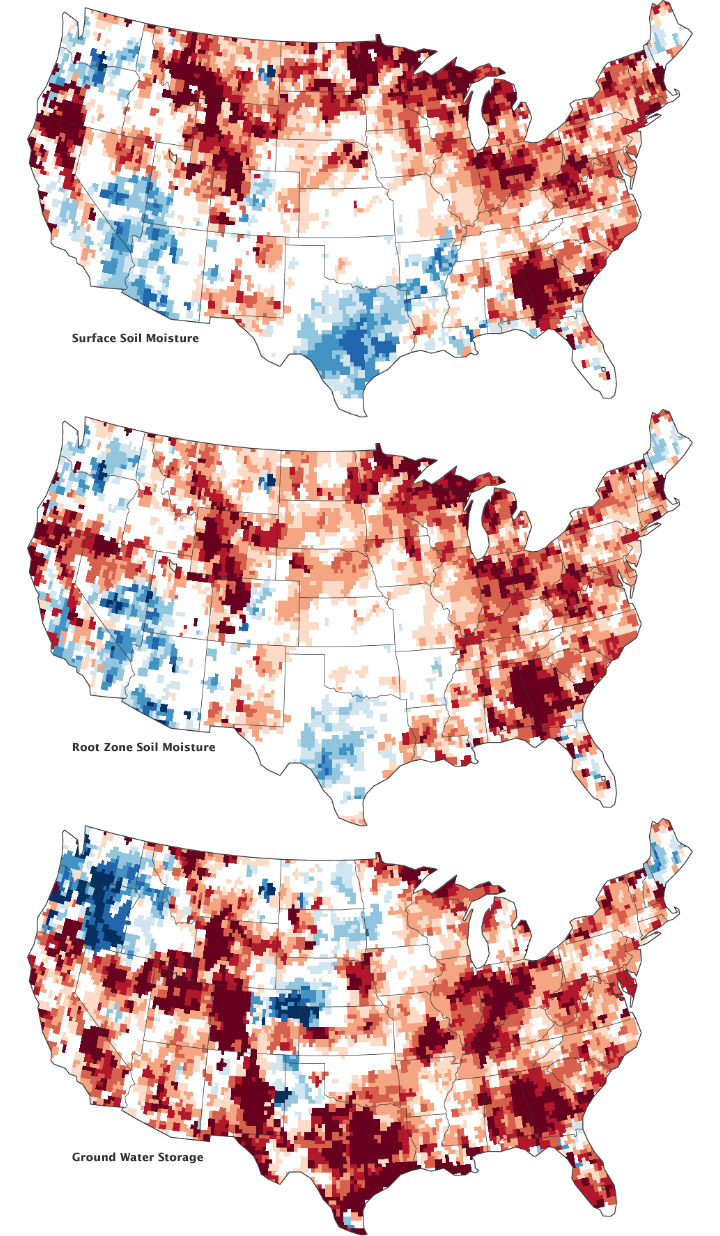
A deep and persistent drought struck vast portions of the continental United States in 2012. Though there has been some relief in the late summer, a pair of satellites operated by NASA shows that the drought lingers in theunderground water supplies that are often tapped for drinking water and farming.

The maps above combine data from the twin satellites of the Gravity Recovery and Climate Experiment (GRACE) with other satellite and ground-based measurements to model the relative amount of water stored near the surface and underground as of September 17, 2012. The top map shows moisture content in the top 2 centimeters (0.8 inches) of surface soil; the middle map depicts moisture in the “root zone,” or the top meter (39 inches) of soil; and the third map shows groundwater in aquifers.

The wetness, or water content, of each layer is compared to the average for mid-September between 1948 and 2009. The darkest red regions represent dry conditions that should occur only 2 percent of the time (about once every 50 years). For a long-term view, download the animation below the third image, which shows the storage of groundwater from August 2002 through August 2012. (The animation is also available on YouTube.)

In all of the maps above, September 2012 conditions remain significantly drier than the norm, particularly in the eastern third of the United States, the Midwest, the High Plains and Rockies, and along the California–Oregon border. Surface and root moisture recently rebounded in the south central and southwestern states, largely due to Hurricane Isaac and other rainfall in 2012. But even there, the severe droughts of 2011 and 2012 persist below ground in aquifers. Groundwater supplies in the Southeast, the Rockies, the Midwest, New Mexico, and Texas are still far below the norm, according to GRACE.

All of the maps are experimental products funded by NASA’s Applied Sciences Program and developed by scientists at NASA’s Goddard Space Flight Center and the National Drought Mitigation Center. The maps do not attempt to represent human consumption of water; but rather, they show changes in water storage related to weather, climate, and seasonal patterns.

“GRACE gives you variations in the total water stored on and in the land,” says NASA scientist Matt Rodell in arecent feature story on the Earth Observatory. GRACE does not measure the water directly, but instead detects changes in Earth’s gravity. When the satellites encounter a change in the distribution of Earth’s mass—such as a blanket of fresh snow on California’s Sierra Nevada—they are pulled toward the mountains a tiny bit more than normal. By tracking trends in how the satellite orbits change, researchers can calculate how gravity is changing on Earth. So when groundwater supplies dwindled in the United States in 2011 and 2012, that region of the planet had a little less mass and gravitational pull. The satellite orbits moved a bit in response, allowing GRACE to reveal the change in groundwater storage.

“To figure out whether those [gravity and mass] changes are happening in the ground water, soil moisture, snow, or surface water, we need auxiliary information,” Rodell adds. “We use physics equations and computer models to figure out what happens to the water after it hits the land as rain or snow.”

Read more about GRACE and studies of groundwater in the new Earth Observatory feature: The Gravity of Water.

References

National Drought Mitigation Center. (n.d.) Groundwater and soil moisture conditions from GRACE data assimilation.Accessed September 19, 2012.

Maps by Chris Poulsen, National Drought Mitigation Center at the University of Nebraska-Lincoln, based on data from Matt Rodell, NASA Goddard Space Flight Center, and the GRACE science team. Caption by Mike Carlowicz, including reporting from Holli Riebeek.

Instrument: GRACE

The Day Carl Sandburg Died | Watch American Masters Online | PBS Video


Watch Film: The Day Carl Sandburg Died on PBS.

Carl Sandburg Playlist: Carl Sandburg Sings America! “Folk lore tells of giants and long-lived men. On far travels they saw and heard much… Also hoary legends have dealt with the Champion Liar… We have in this instance a vest pocket encyclopedia, an outline of history with numerous references to picturesque peronages… It packs a wicked lot of biography.” — Carl Sandburg, from The American Songbag
BY TOM McNAMARA You could call Carl Sandburg a polymath, the American sort: poet, historian, musician, ethnomusicologist, folklorist. Really, an American in the tradition of Benjamin Franklin and Thomas Jefferson. He did it all (at least more than most). And in all of his undertakings, Sandburg was moved by his love of country. From America the beautiful–of amber waves of grain, purple mountain majesties, and fruited plains–to America the underbelly–of slaughterhouses, workdays that just didn’t quit, and smoke and dust. So, in 1927, when Sandburg published

The American Songbag, it was a collection of American traditionals from the America he saw: for better and for worse. Sandburg said: “The American Songbag comes from the hearts and voices of thousands of men and women. They made new songs, they changed old songs, they carried songs from place to place, they resurrected and kept alive dying and forgotten songs.”

 These were songs Sandburg collected traveling a country that was as pretty as it was hard.

Related Links: