Sep 27, 2012

Monsanto’s Tricky Plan to Defeat GMO Labeling?

Created 2012-09-24 16:04


Okay—let’s not miss the point about the Stanford “study” on organic food, the one released in early September that concludes that the scientific literature “lacks strong evidence that organic foods are significantly more nutritious than conventional foods.”

Every reaction I’ve seen in the press grants that maybe organic food isn’t more nutritious, but it’s healthier in many other ways, like much lower amounts of toxic agricultural chemicals, and so on. But there are many studies that show that organic food is indeed more nutritious. To really understand those studies, you have to know who paid for them. If Monsanto or Cargill is paying a researcher at a land-grant university to look into the nutritional value of foods, there’s a temptation there to work the data in favor of the company paying the bills, especially if they like your work and order more studies.

So who’s paying for the Stanford study? The Stanford doctor who was the principal author, Crystal Smith-Spangler, M.D., writes that there was no funding for the study, which appeared in the Annals of Internal Medicine (vol. 157, no. 5 [4 September 2012]: 348–366)—this despite the listing of 11 coauthors including physicians and health specialists along with Dr. Smith-Spangler. Since no funding is listed, we can’t know whether Dr. Smith-Spangler and cohorts did the rather exhaustive study out of the goodness of their hearts or if someone took them to lunch, so to speak. But even that isn’t the point.

The real question is, why do you think this Stanford study came out now? The title of the study raises a red flag as it asks, “Are Organic Foods Safer or Healthier than Conventional Alternatives?” Its conclusion states, “The published literature lacks strong evidence that organic foods are significantly more nutritious than conventional foods. Consumption of organic foods may reduce exposure to pesticide residues and antibiotic-resistant bacteria.” So it casts doubt on the value of organic food, even as it admits organic food has fewer toxic residues and pathogenic microbes. Yet I’m aware of several strong studies supporting the nutritional superiority of organic food,* and I looked through all 298 studies cited in the Stanford overview of the scientific literature, but they were nowhere to be found. But even that’s not the point.

Remember: This November, Californians will be asked to vote on Proposition 37, which will require foods containing genetically modified ingredients to be so labeled. Remember too that organic food is not allowed by law to contain any genetically modified ingredients.

Now think about Monsanto, Dow, DuPont, Syngenta, and other corporations turning out genetically modified farm seed. Why do you think they’re doing that? They say it’s to improve agriculture, to feed the world, to solve farming’s problems—but there’s another reason they seldom mention. When they make a genetically modified (GMO) seed, they patent it. And those who hold the patents reap the financial rewards.


Farmers, who used to be able to save seed from year to year, now must buy GMO seed from Monsanto and their pals each year to get the “advances” in agricultural technology that the corporations say their seed will deliver. Conventional farmers buy the genetically altered corn, for instance, because it’s Roundup Ready, meaning that glyphosate herbicide won’t damage the corn. And patented corn seed has been genetically altered to manufacture its own pesticide within its cells—a function borrowed from Bacillus thuringiensisand inserted into the corn’s genes, meaning farmers don’t have to spray for corn earworm or corn rootworm; this is killer corn, ready for any caterpillar that comes along. Once patented, the seeds of the world’s major crops like corn, soybeans, and alfalfa represent a cornered market. You think that’s hyperbole? Worldwide, 395 million acres of farmland were planted in GMO crops, according to figures in the 2011 International Service for the Acquisition of Agri-biotech Applications. The United States leads the world in GMO plantings with 170 million acres in 2012—that’s 95 percent of this nation’s sugar beets, 94 percent of its soybeans, 90 percent of the cotton and 88 percent of our feed corn.

And woe betide any farmer who saves those seeds, or whose seeds have cross-pollinated with the GMO crops, because they will be—and have been—sued.

But there are always those pesky organic farmers and consumers. So here comes Prop 37, and Monsanto and its pals realize that if it passes in California, other states may start passing similar laws. As Norman Braksick, president of Asgrow Seed Company, a Monsanto subsidiary, was quoted in the Kansas City Star, “If you put a label on genetically engineered food you might as well put a skull and crossbones on it.” So Monsanto and pals know that labeling means sharp cuts in the market for those foods—and more importantly for them, in the profit from seeds farmers plant to grow those foods. To stop Prop 37, they have put together a coalition that has already started a disinformation campaign and amassed a $32 million war chest. The coalition is called No on 37, and includes a long list of biotech, big ag, and drug and chemical manufacturers, including front groups like the American Council on Science and Health (ACSH), whose president, Elizabeth Whelan, describes herself as a lifelong conservative “more libertarian than Republican.” ACSH supporters include Dow, DuPont, Exxon, General Mills, David H. Koch Charitable Foundation, and of course Monsanto. And Coke and Pepsi if you need an artificially sweetened beverage.

The first volley of propaganda has been fired in California. A mailing has been sent out by a group called No on 37: Coalition Against the Deceptive Food Labeling Scheme, whose major funding comes from Monsanto, Dow, DuPont, and Syngenta, among others on the Council on Biotechnology Information, and from the Grocery Manufacturers Association. The mailing is a flier that proclaims, in all-caps, 60-point type: “DEMOCRATS OPPOSE PROP 37.”

The three Democrats cited include two Central Valley members of the California Assembly, Henry Perea and Manuel Perez, and the vice chairperson of the California Democratic Party, Alexandra Rooker. I sent emails to all three, asking them to explain their opposition to Prop 37 and, additionally, whether they had received any campaign contributions from the Council on Biotechnology Information, the Grocery Manufacturers Association, or from BASF, Bayer, Dow, DuPont, Monsanto, or Syngenta. Perea’s office said he was away on family business and that was all I heard from him. Rooker never responded. Perez’s office passed my request for elaboration to Kathy Fairbanks of Bicker, Castillo, and Fairbanks, a Sacramento lobbying firm hired by the anti-Prop 37 forces. Here’s what Perez said in the flier:

“This initiative was rushed to the ballot and contains flaws that will lead to unintended consequences. Prop 37 is an unfunded mandate filled with confusing loopholes, contradictory exemptions, and extreme restrictions that will cost the state millions of dollars to administer.” Some of his wording is identical to wording in an accompanying “fact sheet.”

And Fairbanks responded to all his complaints, but summed up the thrust of the opposition at the end of her email by saying that Prop 37 will have a “detrimental impact on California’s economy. It will increase state costs at a time when the state has a severe budget deficit. It will raise grocery bills when families are still struggling.”

Higher food prices! Whoa! That’ll get the public’s attention. But, people may say, it could be worth paying more if the food is organic. After all, a 4-year British study showed that organic fruits and vegetables contained up to 40 percent more antioxidants and on average 12 percent higher levels of nutrients than conventional varieties, according to Professor Carlo Leifert at Newcastle University, which did the EU-funded study that appeared in Critical Reviews in Plant Sciences (vol. 30, no. 1: 177–197). Even larger differences were found in milk, with organic varieties containing more than 60 percent more antioxidants and healthy fatty acids, Leifert reported.

So here comes Stanford University’s impeccable reputation and a group of its doctors and health personnel to go over 298 studies from the 1970s to the 2000s, looking to see how organic and conventional foods stack up nutritionally. But where is the Newcastle study? Not there. I’ve selected just a few of the studies that show organic foods’ nutritional superiority and listed them as footnotes at the end of this article. Not one appears among the 298 studies perused by the Stanford team. Are they ignoring these studies and others that show a nutritional benefit of organic food on purpose? Looks that way. And they conclude there really is no difference in nutrition between organic and conventional. In reaction, Frances Moore LappĂ©, writing an opinion piece in Reader Supported News, called the Stanford study “reprehensible.”

So Monsanto and its pals can now say that science (pointing at the Stanford study) shows that if Proposition 37 passes, not only will you pay much more for your food, but it will be for no good reason.
This Stanford study, no matter how or why it came about, certainly drops an armload of ammunition in Monsanto and pals’ laps. How fortunate for the Council on Biotechnology Information and the Grocery Manufacturers Association that this study comes along just in time for the big campaign against Proposition 37! What luck.

Wake up, people. Of course organic food can be and often is more nutritious. And it has fewer toxic chemicals, antibiotics, and pathogenic microbes. And it keeps farm workers and farm families safe from toxic chemicals. And it protects the environment and the ecosystems around the farms. And, as a 30-year study conducted at the Rodale Institute’s Maxatawny, Pennsylvania, farm has shown, organic farms can out-yield their conventional counterparts in terms of bushels of corn produced per acre.

It’s a shame that Stanford, a respected university, finds itself in a position to be used for a blatant disinformation campaign mounted by Monsanto and its pals. Isn’t anyone awake there in Palo Alto? Well, neither Dr. Smith-Spangler nor Dan Stober of Stanford’s Office of Public Affairs responded to my queries about the university’s one-sided study.

*Just some of the well-known studies citing the nutritional superiority of organic over conventional food that were not listed in the Stanford group’s article:
American Chemical Society. 2002. Research shows more vitamin C in organic oranges than conventional oranges. ScienceDaily, June 3, 2002. http://www.sciencedaily.com/releases/2002/06/020603071017.htm
Benbrook, Charles. 2005. Elevating antioxidant levels in food through organic farming and food processing. The Organic Center State of Science Review, January 2005.
Benbrook, Charles, Xin Zhao, Jaime Yanez, Neal Davies, and Preston Andrews. 2008. New evidence supports the nutritional superiority of organic plant-based foods. The Organic Center State of Science Review, March 2008.
Brandt, K., and J. P. Melgaard. 2001. Organic agriculture: does it enhance or reduce the nutritional value of plant foods? Journal of the Science of Food and Agriculture 81, no. 9:924–931.
Paddock, C. 2007. Organic food is more nutritious say EU researchers. Medical News Today, 29 Oct 2007. http://www.medicalnewstoday.com/articles/86972.php.
Reganold, J. P., P. K. Andrews, J. R. Reeve, L. Carpenter-Boggs, C. W. Schadt, et al. 2010. Fruit and soil quality of organic and conventional strawberry agroecosystems.PLOS One 5(9): e12346. doi:10.1371/journal.pone.0012346.
Rist L., et al. 2007. Influence of organic diet on the amount of conjugated linoleic acids in breast milk of lactating women in the Netherlands. British Journal of Nutrition 97, no. 4 (April 2007), 735–743.


Jeff Cox started his career at Rodale in 1963, was Organic Gardening's managing editor in the 1970s, and the company's Director of Electronic Publishing in the early 80s. He's the author of the James Beard-nominated The Organic Cook's Bible, and currently writes a regular science column for Horticulture magazine. His newest book, The Essential Book of Fermentation will be published in early 2013 by Avery.

It's Over: The NFL's Union Referees Return to Work in Style | The Nation


Dave Zirin on September 27, 2012

The NFL referee lockout is over and we now have an answer to the question, "What does it take to pierce the shame-free cocoon of unreality where NFL owners reside?" All you need, it seems, is condemnation across the political spectrum ranging from the President of the United States to small-town mayors, to even anti-union corporate lickspittles like Wisconsin Governor Scott Walker. All you need is one of your flagship teams, the Green Bay Packers, publicly threatening to strike or "take a knee on every play." All you need are your star quarterbacks Aaron Rodgers and Drew Brees blasting your product. All you need are online petitions with miles of signatures and 70,000 fans calling the league offices in the 24 hours following the debacle of a Monday night game between the Seattle Seahawks and the Green Bay Packers. All of this collective scorn finally punctured the owners' magical mental space, bringing them to the negotiating table to settle.

The deal is damn near a slam dunk for the NFL referees. Remember the root of this lockout was two-fold: the league wanted to end the pension system and ban refs from holding jobs outside of the sport. Now the league will continue—and even increase—the pension payouts for the next five years before a negotiated transfer to a 401K. Refs will also be given a 25% hike in pay starting next year, with more salary increases until the end of the seven-year agreement. The NFL owners wanted to hire 21 more officials to phase in as full-time employees. The refs agreed to seven new full-time hires, and no restrictions on their own abilities to take outside work. In other words, Roger Goodell and the owners were shellacked by the same people they locked out, dismissed, and disrespected. The now infamous words of NFL VP Ray Anderson, “You’ve never paid for an NFL ticket to watch someone officiate a game", is now the league’s version of “You’re doing a heckuva job Brownie.”

But there is a bigger story here as well: the entire country received a High Def, prime time lesson in the difference between skilled, union labor and a ramshackle operation of unskilled scabs. When Scott Walker is sticking up for the union, you know we've arrived at a teachable moment worth shouting from the hills. People who care about stable jobs with benefits and reversing the tide of inequality in the United States should seize this moment. We should ask not only the Scott Walkers of the world but politicians of both parties drinking from the same neoliberal fever-swamp: why do you think we need skilled union labor on the football field but not in our firehouses, our classrooms, or even our uranium facilities? Similarly players need to be asking questions to the owners: how can you actually posture like you care about our health and safety ever again after subjecting us to this hazardous environment the first three weeks of the season, or as Drew Brees tweeted, "Ironic that our league punishes those based on conduct detrimental. Whose CONDUCT is DETRIMENTAL now?"

Lastly, it's another embarrassment after a year of embarrassments, for NFL Commissioner Roger Goodell. He has through his arrogance placed an asterisk on this season, left an indelible mark on his legacy as commissioner, and created a crisis of confidence in his ability to do his job. He learned that people may not pay to watch referees but they do pay to watch a competently officiated contest. He also hopefully learned that if there's one thing people don't pay to watch, it's him: sweating before the cameras and doing his damnedest to make the NFL a reflection of the worst corporate arrogance. Hear the message Roger. This nine billion dollar league? This unprecedented popularity? This immense national audience? You didn't build that. Your owners didn't build that. Your sponsors didn't build that. It was built by the blood, sweat, and tears of those on the field of play including the referees. It was built by fans who invest their passion and the tax payers who have underwritten your archipelago of mega-domes in cities across the country. I can't wait for the union refs to be cheered when they take the field this weekend. We may go back to booing them after the first play, but it will be with respect: respect earned because they stood as one and beat the NFL bosses.

For more on the referee lockout, watch Dave Zirin talk about how the dispute highlighted the problem of class in the US on Democracy Now!

Sep 26, 2012

The Highland Woodworker!


EPISODE 3, SEPTEMBER 2012

Former President Jimmy Carter takes you on a tour of the Maloof furniture and Moulthrop bowls in his office and tells about his friendships with these icons in our Feature segment.

As the first family of artistic woodturning, Philip and Matt Moulthrop show us how they turn their beautiful bowls and carry on Ed’s legacy in our Moment with a Master.

Bert the Wood Expert gives a colorful lesson on white oak!

An inexpensive and instant upgrade to your bandsaw! We’re profiling the Wood Slicer!

A Quick Tip with Matthew Teague teaches how to make quick and useful bridle joints.

Putting the finishing touches on your project is as easy 1-2-3. We demonstrate the new Masterpiece Wood Finish.

All of these stories and more on this episode of “The Highland Woodworker.”

Sep 25, 2012

Signs of the U.S. Drought Are Underground


http://earthobservatory.nasa.gov/IOTD/view.php?id=79228 --> full story

acquired September 17, 2012


acquired August 5, 2002 - August 20, 2012download web resolution animation (9 MB, QuickTime)

acquired September 17, 2012download high definition animation (38 MB, QuickTime)

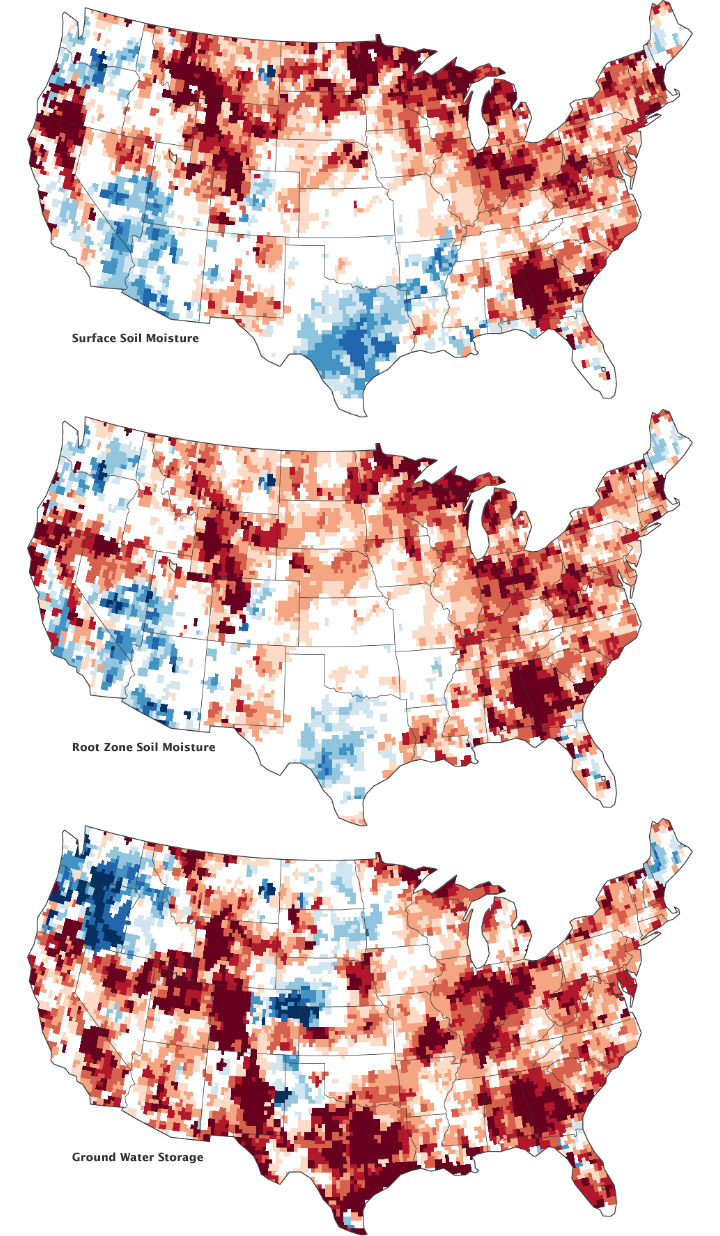
A deep and persistent drought struck vast portions of the continental United States in 2012. Though there has been some relief in the late summer, a pair of satellites operated by NASA shows that the drought lingers in theunderground water supplies that are often tapped for drinking water and farming.

The maps above combine data from the twin satellites of the Gravity Recovery and Climate Experiment (GRACE) with other satellite and ground-based measurements to model the relative amount of water stored near the surface and underground as of September 17, 2012. The top map shows moisture content in the top 2 centimeters (0.8 inches) of surface soil; the middle map depicts moisture in the “root zone,” or the top meter (39 inches) of soil; and the third map shows groundwater in aquifers.

The wetness, or water content, of each layer is compared to the average for mid-September between 1948 and 2009. The darkest red regions represent dry conditions that should occur only 2 percent of the time (about once every 50 years). For a long-term view, download the animation below the third image, which shows the storage of groundwater from August 2002 through August 2012. (The animation is also available on YouTube.)

In all of the maps above, September 2012 conditions remain significantly drier than the norm, particularly in the eastern third of the United States, the Midwest, the High Plains and Rockies, and along the California–Oregon border. Surface and root moisture recently rebounded in the south central and southwestern states, largely due to Hurricane Isaac and other rainfall in 2012. But even there, the severe droughts of 2011 and 2012 persist below ground in aquifers. Groundwater supplies in the Southeast, the Rockies, the Midwest, New Mexico, and Texas are still far below the norm, according to GRACE.

All of the maps are experimental products funded by NASA’s Applied Sciences Program and developed by scientists at NASA’s Goddard Space Flight Center and the National Drought Mitigation Center. The maps do not attempt to represent human consumption of water; but rather, they show changes in water storage related to weather, climate, and seasonal patterns.

“GRACE gives you variations in the total water stored on and in the land,” says NASA scientist Matt Rodell in arecent feature story on the Earth Observatory. GRACE does not measure the water directly, but instead detects changes in Earth’s gravity. When the satellites encounter a change in the distribution of Earth’s mass—such as a blanket of fresh snow on California’s Sierra Nevada—they are pulled toward the mountains a tiny bit more than normal. By tracking trends in how the satellite orbits change, researchers can calculate how gravity is changing on Earth. So when groundwater supplies dwindled in the United States in 2011 and 2012, that region of the planet had a little less mass and gravitational pull. The satellite orbits moved a bit in response, allowing GRACE to reveal the change in groundwater storage.

“To figure out whether those [gravity and mass] changes are happening in the ground water, soil moisture, snow, or surface water, we need auxiliary information,” Rodell adds. “We use physics equations and computer models to figure out what happens to the water after it hits the land as rain or snow.”

Read more about GRACE and studies of groundwater in the new Earth Observatory feature: The Gravity of Water.

References

National Drought Mitigation Center. (n.d.) Groundwater and soil moisture conditions from GRACE data assimilation.Accessed September 19, 2012.

Maps by Chris Poulsen, National Drought Mitigation Center at the University of Nebraska-Lincoln, based on data from Matt Rodell, NASA Goddard Space Flight Center, and the GRACE science team. Caption by Mike Carlowicz, including reporting from Holli Riebeek.

Instrument: GRACE

The Day Carl Sandburg Died | Watch American Masters Online | PBS Video


Watch Film: The Day Carl Sandburg Died on PBS.

Carl Sandburg Playlist: Carl Sandburg Sings America! “Folk lore tells of giants and long-lived men. On far travels they saw and heard much… Also hoary legends have dealt with the Champion Liar… We have in this instance a vest pocket encyclopedia, an outline of history with numerous references to picturesque peronages… It packs a wicked lot of biography.” — Carl Sandburg, from The American Songbag
BY TOM McNAMARA You could call Carl Sandburg a polymath, the American sort: poet, historian, musician, ethnomusicologist, folklorist. Really, an American in the tradition of Benjamin Franklin and Thomas Jefferson. He did it all (at least more than most). And in all of his undertakings, Sandburg was moved by his love of country. From America the beautiful–of amber waves of grain, purple mountain majesties, and fruited plains–to America the underbelly–of slaughterhouses, workdays that just didn’t quit, and smoke and dust. So, in 1927, when Sandburg published

The American Songbag, it was a collection of American traditionals from the America he saw: for better and for worse. Sandburg said: “The American Songbag comes from the hearts and voices of thousands of men and women. They made new songs, they changed old songs, they carried songs from place to place, they resurrected and kept alive dying and forgotten songs.”

 These were songs Sandburg collected traveling a country that was as pretty as it was hard.

Related Links:

Sep 24, 2012

Stay Healthy with 5 Essential Herbs

Ready for cold and flu season? The National Oceanic and Atmospheric Administration released its winter forecast, predicting a colder- and wetter-than-average winter for the Pacific Northwest and northern Plains, equal chances for warmer or colder weather in the northeastern and central U.S., and warmer-than-usual conditions for some southern and western states. Wherever you live or however warm, or cold, your winter winds up being, protect yourself against winter ailments by stocking up on herbal cold and flu remedies.

Scientific studies have found the following five to be particularly effective at fighting the diseases. They can be brewed as herbal teas or taken in supplement form.


Thyme
Keep a supply of thyme essential oil or dried thyme on hand in the event that you fall ill with either the flu or with a common cold. Thyme has long been known as an expectorant, which makes coughs more productive (that is, it helps clear out your lungs faster so you feel better sooner). You can brew a thyme herbal tea by steeping 2 teaspoons fresh thyme in a cup of boiling-hot water for 10 minutes. Or make a thyme steam bath: Toss either a handful of dried thyme or a few drops of thyme essential oil into a bowl of hot water and lean over the bowl, covering both your head and the bowl with a towel. Inhaling the steam will help loosen mucus in your chest.


Licorice Root
Licorice root contains a compound called glycyrrhizin that has been found to have pretty potent antiviral effects against serious diseases, such as HIV and SARS, and a number of studies have found that licorice-root extracts can fight off the flu, including strains of the avian flu virus. In Ayurvedic medicine, licorice root is also used as an expectorant. A number of companies make licorice-root supplements and teas, but if using those, be sure they contain actual licorice—many products (licorice candy, for instance) don't contain any of the herb but instead contain anise seed, which tastes like licorice. Also talk to a doctor or pharmacist if you’re taking any prescriptions, as licorice has been found to interfere with some medications.


Garlic
Garlic boosts the health of your immune system, and a number of studies have found that animals given regular doses of garlic supplements are better able to ward off viruses like the flu and various strains of rhinovirus, the kind responsible for the common cold. In one study from 2001, volunteers who took a daily garlic supplement were less likely to get colds than volunteers taking a placebo, and even when the garlic takers did get sick, they recovered more quickly. For the sake of people who have to talk to you, garlic supplements are probably the kindest way to go. But you can also get the same benefits by chewing on a clove of garlic once a day for prevention or twice a day to get over a cold or flu. Mince a clove of garlic into some honey if the flavor is too overpowering. It’s not clear whether adding more garlic to your cooking affords the same protection, but if you love the flavor, you can add more to your recipes while possibly getting an immune boost.


Echinacea
There isn’t much evidence that echinacea will do anything for you once you get a cold, other than possibly shorten the duration of your symptoms. But there is some evidence that it could prevent colds and flus if taken in conjunction with garlic supplements, according to an article in the Journal of the National Medical Association. The problem with most echinacea products on the market is that they don’t tell you how much of the herb is in the product. Forgo teas and instead take a supplement containing 1000 milligrams three times a day. One note: People who are allergic to ragweed or to pollen may be allergic to echinacea, as well.


Elderberry Extract
Another botanical that helps you cope with cold and flu symptoms is elder, also known as black elder. The extract of elderberries has been tested repeatedly and found to shorten the duration of symptoms by as much as 4 days, and the extract has been found effective at fighting up to 10 strains of flu virus. Nearly all of the scientific studies conducted on elderberry have used a commercial product called Sambucol, which is available as a liquid supplement from a number of different companies.

Dig Deeper: What are the best foods to boost your immune system?
Source URL: http://www.organicgardening.com/living/stay-healthy-5-essential-herbs

Sep 21, 2012

How to Harvest & Store Seeds by Texas Ready Seed Bank - YouTube


Published on Sep 21, 2012 by LDSPrepper

Today Lucinda teaches us how to harvest and store seeds. She discusses:
1. Which fruit from your plants produces the best harvestable seeds.
2. Why seed are like batteries
3. Where the term "heirloom" seed originated and what it means.
4. The wrong and right way to save Tomato seeds.
5. What does it mean if seeds are floating when you go to store them.
6. The best way to harvest different varieties of seeds
7. The best source to learn how to save 100 different types of seeds.
8. If you should you vacuum pack your seeds.
9. Which plants in your garden only produce seeds every two years.
10. If you should store your seeds in a freezer.

RESOURCES:
- Seed Banks & Books: http://bit.ly/RX4Hao

- Seed to Seed: Seed Saving and Growing Techniques for Vegetable Gardeners:
http://www.amazon.com/gp/product/1882424581/ref=as_li_ss_tl?ie=UTF8&camp=...

Sep 20, 2012

University of Illinois' Ag/Bio Engineering Department Ranked Number One - Farm Progress

Published on: Sep 20, 2012

The undergraduate program in the Department of Agricultural and Biological Engineering at the University of Illinois Urbana-Champaign has been ranked number one in the nation by U.S. News and World Report. "Best Colleges 2013" placed Illinois in a tie with Purdue University for the top spot, followed by Iowa State University.

U.S. News ranks undergraduate programs accredited by the Accreditation Board for Engineering and Technology based solely on the judgments of deans and senior faculty from participating colleges. U.S. News also asks for nominations of the best programs in specialty areas, such as agricultural engineering; those receiving the most mentions are ranked in the publication.
University of Illinois' Ag/Bio Engineering Department Ranked Number One

K.C. Ting has been department head of ABE since 2004. "We are in very good company," Ting says. "We are among the best departments in the nation in our discipline, so being recognized as number one by U.S. News is an honor."

ABE at Illinois has been ranked in one of the top two spots for the last seven years, including a four-year stint as number one, and Ting acknowledges that "says something" about the department.

"We try to give our students the best education and the most diverse opportunities we're able to offer. We are very comprehensive," he adds. "Our teaching is student-centered, and many of our engineering courses are project-based. There are excellent opportunities for international study abroad, and we bring exchange students into our student body to provide those kinds of interactions. We do all we can to give our students a complete educational package, not just courses you take to get credit hours and graduate."

The department is part of two colleges on the Urbana-Champaign campus, the College of Agricultural, Consumer and Environmental Sciences and the College of Engineering.

"The strength of ACES and CoE is a tremendous asset to our department," Ting notes. "It helps significantly to be a part of two top colleges on our campus."

"We have a clear vision of what we want to do, and we follow through with that," he concluded. "We deliver. If the ranking follows, we're very happy, but our real goal is simply to be a great department."

Sep 19, 2012

Top 10 Tips for Storing Seeds

Created 2011-05-16

1. Think dry and cool no matter where you store seed. Humidity and warmth shorten a seed’s shelf life.
2. Keep seed packets in plastic food storage bags, plastic film canisters, Mason jars with tight-fitting lids, or glass canisters with gasketed lids.
3. The refrigerator is generally the best place to store seeds.
4. Keep your seed-storage containers well away from the freezer section of your refrigerator.
5. To keep seeds dry, wrap 2 heaping tablespoons of powdered milk in 4 layers of facial tissue, then put the milk packet inside the storage container with the seed packets. Or add a packet of silica gel. Replace every 6 months.
6. Store each year’s seeds together and date them. Because most seeds last about 3 years, you’ll know at a glance which container of seeds might be past its prime when planting season comes.
7. When you’re ready to plant, remove seed containers from the refrigerator and keep them closed until the seeds warm to room temperature. Otherwise, moisture in the air will condense on the seeds, causing them to clump together.
8. If you’re gathering and saving seeds from your own plants, spread the seeds on newspaper and let them air dry for about a week. Write seed names on the newspaper so there’s no mix-up. Pack the air-dried seeds in small paper packets or envelopes, and label with plant name, date, and other pertinent information. Remember, if you want to save your own seeds, you’ll need to plant open-pollinated varieties. They’ll come back true; hybrids won’t.
9. Or dry saved seeds on paper towels. They’ll stick to the towels when dry, so roll them up right in the towel to store them. When you’re ready to plant, just tear off bits of the towel, one seed at a time, and plant seed and towel right in the soil.
10. Even if you’re organized, methodical, and careful about storing seeds, accept the fact that some seeds just won’t germinate the following year. Home gardeners will find that stored sweet corn and parsnip seeds, in particular, have low germination rates, and other seeds will only remain viable for a year or two.
Source URL: http://www.organicgardening.com/learn-and-grow/top-10-tips-storing-seeds

Results of first animal feeding trial on GM maize & Roundup

By Anne Sewell
Sep 19, 2012

This is the first study of its kind, it is peer-reviewed, and will be published in the American journal, Food and Chemical Toxicology. The results are not reassuring.

The first animal feeding trial, set up to study the lifetime effects of exposure to NK603 Roundup tolerant GM maize, and also to Roundup, the world's best-selling herbicide and weedkiller, has been completed.
The research was lead by Professor Gilles-Eric Séralini, Molecular Biologist at Caen University and first author of the research being discussed.

Professor SĂ©ralini was in charge of risk assessment for two government commissions and has advised the European Commission on the use of GMO’s commercially. He is the President of the Scientific Board at Committee of Independent Research and Information on Genetic Engineering (CRII-GEN).


CRIIGEN

Additional contributors at a telepress conference held on Wednesday, include Dr. Michael Antoniou – Professor in Molecular Genetics, Kings College, London School of Medicine. Dr. Antoniou has over 40 peer-reviewed publications of original work.
Dr. Antoniou was also involved in the GMO Myths & Truths Report, as reported on Digital Journal.
Patrick Holden, Founder and Director for the Sustainable Food Trust. SFT has an interest in comparing different systems of agriculture and their impact on human and environmental health.
An audio file of the telepress conference will be added later today.
According to the study, levels currently considered "safe", can cause mammary tumors and multiple organ damage (kidney and liver), and can also lead to premature death in laboratory animals.


CRIIGEN

Trial Methodology:

The trial studied the long-term effects of exposure to NK603 GM corn and Roundup, individually and combined, on the health of rats over two years, their entire lifetime.
The study was carried out using two hundred rats fed a standard balanced diet. They were divided into ten groups each containing ten males and ten females.
žThree groups tested the effect of NK603 alone. Each group had a different proportion of NK603 in their feed starting at 11%, then 22% and finally 33% of their total diet.
žThree groups tested the effect of NK603, which had been sprayed with Roundup in the field at the same proportions of 11%, 22 % and 33% of their total diet.
Three groups tested the effect of Roundup alone, administered via their drinking water at three different concentrations with one control group.
žThe lowest level corresponded to contamination found in some tap water.
žThe intermediate level corresponded to the maximum level permitted in the US in GM feed
žThe highest level was half the strength of Roundup when diluted for use in agriculture.
žThe control group was fed a diet containing 33% of non-GM corn and plain drinking water.
The researchers took blood and urine samples for analysis monthly for the first three months and then every three months and at the end of the trial studied the rats’ principal organs.
Findings:


CRIIGEN

Researchers found that even consuming low levels of NK603 and Roundup, separately or combined, can cause serious health problems in rats, that only became apparent when they were older than 90 days. The first tumor was observed after 120 days, but the majority were only detected after 18 months.
The outcome of this research immediately calls into question the current regulatory process, used to license all new industrial chemicals, pesticides and other "novel crops" since the Second World War. Currently all tests on GM food crops have been approved as "safe" on the basis of a 90-day feeding study in mammals.
In this study, the first large tumor was only observed four months into the trial, and most tumors were not even detected until after 18 months.


CRIIGEN
This research highlights the need for more research and long-term studies to evaluate the safety of all GM food crops, which are currently grown on almost 10% of the world's arable land.

Copies of the research can be obtained on request from CRIIGEN and from Food and Chemical Toxicology.

The full report, as published in Food and Chemical Toxicology, can be read here.

Read more: http://www.digitaljournal.com/article/333136#ixzz26wNOgVFE

Biochar is an investment in soil - Iowa State Daily: News


Biochar Fuels Soil
Full Article: http://www.iowastatedaily.com/news/article_1e80d8e8-01a1-11e2-8ada-001a4bcf887a.html
Eric Debner, eric.debner@iowastatedaily.com | Posted: Wednesday, September 19, 2012

While no meteorologist or agronomist can accurately predict which years will be "dry years," scientists and farmers can now take steps to protect themselves against plant dehydration during a drought. Biochar, a substance known for its ability to retain water and enrich soil fertility, is on the mind of researchers at Iowa State.

Created from a process called pyrolysis, biochar exhibits many unique properties that could provide aid to combat future dry spells, the most noteworthy being water retention. In a lab study conducted at Iowa State, researchers discovered biochar increased the soil’s water retention by 15 percent.

“This year, [water retention is] huge because of the drought,” said David Laird, professor of agronomy. “If you can improve the soil quality and make it so the soil holds water better, then it will be more robust in a dry year.”

This revolutionary remedy is biochar, named for its similarity to charcoal.

“The word 'charcoal' is generally used when talking about a fuel, something you can burn,” Laird said. “'Biochar' is a name we give it when we put it into the soil.”

Laird explained that a feedstock or raw material, such as corn stover, is heated to extreme temperatures where it breaks down into bio-oil and noncondensable gases with biochar as a byproduct.

Bernardo del Campo, graduate research assistant in mechanical engineering who is studying biochar, said specific types of biochar fit well with specific soils. The type of feedstock, process conditions and peak temperatures the material is exposed to during pyrolysis influences the biochar’s properties and qualities.

Corn stover produces a very fine, almost dust-like biochar, while red oak produces a biochar that is bulkier, jagged and takes up more surface area. Biochar is also similar to fertilizer — too much or the wrong type of char for the wrong soil will kill the plants.

“It’s going to be more like a soil amendment,” del Campo said. “That amendment should balance or complement some properties of the soil. The best biochar will match with your soil.”

In agricultural plots where the soil is less than optimal, biochar can also help restore fertility and crop yields.

“We do see a benefit from biochar on poor quality soils, degraded soils and sandy soils that have low water holding capacities,” Laird said. “It’s not so much that it can raise the yields on the best soils, so much as it can increase the yields on the worst soils.”

Biochar makes the soil better which improves agricultural productivity. Laird said it helps the soil retain nutrients otherwise lost through leaching because the char acts as a filtering material.

“It retains the nutrients in the soil where they can be used by the next crop instead of leaching down into the river,” Laird said. “It’s not new; what is new is the realization that biochar could be used as a co-product of bioenergy production so that we could simultaneously be producing renewable energy and a char that could be returned to the soil that could build soil quality.”

Sep 14, 2012

RSA Animate: The Truth About Dishonesty - YouTube


Published on Sep 14, 2012 by theRSAorg

Are you more honest than a banker? Under what circumstances would you lie, or cheat, and what effect does your deception have on society at large? Dan Ariely, one of the world's leading voices on human motivation and behaviour is the latest big thinker to get the RSA Animate treatment.

Taken from a lecture given at the RSA in July 2012 . Watch the longer talk here http://www.youtube.com/watch?v=ZGGxguJsirI

The RSA is a 258 year-old charity devoted to driving social progress and spreading world-changing ideas. For more information about the RSA, visithttp://www.thersa.org

Michael Lewis on his exclusive with President Barack Obama


Published on Sep 13, 2012 by ReutersTV

Michael Lewis on his exclusive with President Barack Obama in Vanity Fair. Lewis tells Impact Players host Robert Wolf what makes Obama tick and how Goldman Sachs played a role in Europe's financial crisis. The author of "Moneyball" and "Boomerang" also says the thought of a CEO being president would be disastrous. (September 14, 2012)

Charlie Rose - Michael Lewis Interview
http://www.charlierose.com/view/interview/12549 - Video link
Best-selling author and journalist Michael Lewis on his article 'Obama's Way'

Both interviews - Very interesting!!!                 ... Monte Hines

Corporate Funded Science - The Connecting the Dots Video - YouTube


Published on Sep 14, 2012 by organicconsumer

The Goliaths of the biotech and processed-food industries have raised $27.2 million to defeat Prop 37, the California Right to Know Genetically Engineered Food Act, and keep you from knowing what's in your food. We can win with much less money. But we do need to raise another $1 million by Sept. 30th to educate voters, distribute leaflets, print signs, saturate the media with the truth about GMOs, and get out the vote. Join us in a fight for consumers right to know what is in the food they are buying and feeding their families http://organicconsumersfund.org/donate/david-goliath.cfm

Corporate Funded Science In Our Universities Sucks Big Time!!!  
.................. 
Monte Hines

60 years on the Upper Mississippi. My life and experiences : McMaster, S.W. b.1811 : Free Download & Streaming : Internet Archive


Source: http://archive.org/details/60yearsonuppermi00mcma

60 years on the Upper Mississippi. My life and experiences, by McMaster, S.W.

Published in 1895

Lots of great history and information on Mississippi River and Illinois River from 1835 through 1895.

Read Online
PDF
B/W PDF
EPUB
Kindle
Daisy
Full Text

We like using Kindle version for easy viewing and reading...

We downloaded free Kindle Software:
Free Kindle Apps - Read eBooks on your Phone, Tablet, or Computer
http://www.amazon.com/gp/feature.html?ie=UTF8&docId=1000493771
You don't need to own a Kindle to enjoy Kindle books. Just get a free Kindle app for Android, iPad, iPhone, PC, Mac, BlackBerry, or Windows Phone 7.

Monte and Eileen Hines

Internet Archive

The Internet Archive - http://archive.org/ - is wonderful resource for "universal access to all knowledge". We find it great resource, great for viewing and reading old books and movies on subjects we are interested in... "Mississippi River History", "Rock island County History", ...

We like using Kindle version for easy viewing and reading...

We downloaded free Kindle Software:
Free Kindle Apps - Read eBooks on your Phone, Tablet, or Computer
http://www.amazon.com/gp/feature.html?ie=UTF8&docId=1000493771

You don't need to own a Kindle to enjoy Kindle books. Just get a free Kindle app for Android, iPad, iPhone, PC, Mac, BlackBerry, or Windows Phone 7.

                                        Monte & Eileen Hines


From Wikipedia, the free encyclopedia

Type Digital library
Founded 1996
Key people Brewster Kahle (Chairman)
Website www.archive.org


Since 2009, the Internet Archive has been headquartered at 300 Funston in San Francisco, California, a former Christian Science Church

From 1996 to 2009, the Internet Archive headquarters were in the Presidio, a former U.S. military base in San Francisco.

Mirror of the Internet Archive in the Bibliotheca Alexandrina

Wayback Machine logo

The Internet Archive is a non-profit digital library with the stated mission of "universal access to all knowledge".[2][3] It offers permanent storage of and free public access to collections of digitized materials, including websites, music, moving images, and nearly three million public-domain books.

The Archive allows the public to upload and download digital material to its data cluster, and provides unrestricted online access to that material at no cost. Its largest collection is its web archive, "snapshots of the World Wide Web". The Archive also oversees one of the world's largest book digitization projects. In addition to its archiving function, the Archive is an activist organization, advocating for a free and open Internet.

Founded by Brewster Kahle in 1996, the Archive is a 501(c)(3) non-profit operating in the United States. It has an annual budget of $10 million, derived from a variety of sources: revenue from its Web crawling services, various partnerships, grants, donations, and the Kahle-Austin Foundation.[4] Its headquarters are in San Francisco, California, USA, where about 30 of its 200 employees work. Most of its staff work in its book scanning centers. The Archive has data centers in San Francisco, Redwood City, and Mountain View, California, USA. Its collection is mirrored for stability and endurance at the Bibliotheca Alexandrina in Egypt.[5]

The Archive is a member of the IIPC (International Internet Preservation Consortium).[6] and the American Library Association and is officially recognized by the State of California as a library.[7]

Sep 13, 2012

University of Illinois Rated # 1 Biological/Agricultural Engineering School in Nation | Rankings | US News


Larger Image
Having graduated from there, it is my great pleasure to report that our ABE undergraduate program has regained the number 1 ranking by the U.S. News and World Report (http://colleges.usnews.rankingsandreviews.com/best-colleges/rankings/engineering-doctorate-biological-agricultural) ... Monte Hines

Mississippi River Flood of 1927

Short silent film produced by the Signal Corps of the Mississippi flood of 1927.

View Film at http://archive.org/details/mississippi_flood_1927
Free Download & Streaming : Internet Archive

Reel 1, flood waters rage through Illinois, carrying houses and debris. Kleinwood, La., is under water. Marooned families, their salvaged possessions, and livestock cling to levees. Sec. of Commerce Hoover meets Red Cross heads. Army troops load equipment on freight cars. Levees are reinforced at Baton Rouge. Coast Guard cutters and miscellaneous craft evacuate people and animals in La. Reel 2, Hoover and Sec. of War Davis inspect flooded areas at Vicksburg and along the River to Natchez. Refugees are inoculated, fed, and given shelter at an Army camp in Louisiana.

The material comes from a 3/4" U-matic video viewing copy made available at the National Archives facility in College Park, MD. The condition of the source material is relatively good for its age. Unfortunately, the transfer to video was badly done with lots of flicker and crooked perspective. Additionally, there are many video artifacts as a result of the age and wear of the video tape. High quality preservation 35mm film exists.

Source Link:
Free Download & Streaming : Internet Archive

Sep 12, 2012

Buffalo Herd Near Joy, Illinois -- September 10, 2012 - YouTube


Larger Image

Bison truly are "iconic" native American animals!  
Monte & Eileen Hines

Related Links:
Aug 16, 2012
This election year, we have the perfect nominee for the coveted position of national mammal. The iconic bison is impeccably qualified to join the bald eagle as a symbol of the United States. Truely, US's most magnificent ...
Dec 11, 2011
WashingtonPost.com: Bring Back the Buffalo! A Sustainable Future for America's Great Plains By Ernest Callenbach Chapter One: The Bison Heartland For more than ten centuries the bison, elk, deer, and pronghorn played in ...

Sep 9, 2012

Prairie Fire - Revolutionize the Food System - YouTube


Published on Sep 9, 2012 by peakmoment

Prairie Fire - Revolutionize the Food System from Peak Moment TV. Like this? Watch the latest episode of Peak Moment TV on Blip! http://blip.tv/peak-moment-tv/watch

Peak Moment 219: Novelist Dan Armstrongapos;s "Prairie Fire" is a fast-paced thriller whose characters forge unlikely alliances to revolutionize the American food system. Itapos;s spearheaded by farmers squeezed by skyrocketing oil prices while marketeers get whopping price gains. This revolution is unlikely to succeed, yet? well, we wonapos;t spoil it! In Danapos;s "Taming the Dragon", climate change causes Chinese grain production to plummet, bringing the world to the brink. Dan illuminates the real-world backdrop behind both novels. His solution? Localize food production. Meet farmer Harry MacCormack with exciting results in central Oregon. [www.mudcitypress.com, sunbowfarm.org]