Jan 5, 2011

Free Online Tool for Farm Mapping - farm-file.com

Farm-File provides a simple way to accurately make a farm map. Via the website you can map your farm, mark out and measure areas and produce professional working farm maps.The basic plan is free to sign up for. Here’s a short video showing how it works: Great free tool... Monte

Jan 4, 2011

8 Shops to Buy Rustic Reclaimed Wood Furniture From | BarefootFloor.com

I’m sold on rustic decor and its use of sustainable reclaimed wood furniture. If you aren’t yet, take my word for it until you see the photos or get up to speed with my first post in the series. The short story is that adding country-inspired furniture and accents is a fun new trend, reclaimed wood is eco friendly, and it lets you keep family heirlooms without going for totally country decor. This post is dedicated to the best places to window-shop for rustic furniture, in no particular order since I like them all.
Hudson Furniture Reclaimed Wood Table and Chairs

Bees in freefall as study shows sharp US decline | Environment | The Guardian


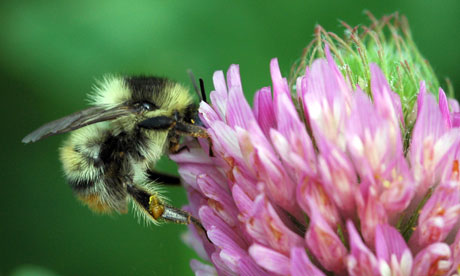
Rare bumblebees comebackBumblebees are important pollinators of wild plants and crops around the world. Photograph: RSPB/PA

The abundance of four common species of bumblebee in the US has dropped by 96% in just the past few decades, according to the most comprehensive national census of the insects. Scientists said the alarming decline, which could have devastating implications for the pollination of both wild and farmed plants, was likely to be a result of disease and low genetic diversity in bee populations.

Bumblebees are important pollinators of wild plants and agricultural crops around the world including tomatoes and berries thanks to their large body size, long tongues, and high-frequency buzzing, which helps release pollen from flowers.

Bees in general pollinate some 90% of the world's commercial plants, including most fruits, vegetables and nuts. Coffee, soya beans and cotton are all dependent on pollination by bees to increase yields. It is the start of a food chain that also sustains wild birds and animals.

But the insects, along with other crucial pollinators such as moths and hoverflies, have been in serious decline around the world since the last few decades of the 20th century. It is unclear why, but scientists think it is from a combination of new diseases, changing habitats around cities, and increasing use of pesticides.

Sydney Cameron, an entomologist at the University of Illinois, led a team on a three-year study of the changing distribution, genetic diversity and pathogens in eight species of bumblebees in the US.

By comparing her results with those in museum records of bee populations, she showed that the relative abundance of four of the sampled species (Bombus occidentalis, B. pensylvanicus, B. affinis andB. terricola) had declined by up to 96% and that their geographic ranges had contracted by 23% to 87%, some within just the past two decades.

Cameron's findings reflect similar studies across the world. According to the Centre for Ecology and Hydrology in the UK, three of the 25 British species of bumblebee are already extinct and half of the remainder have shown serious declines, often up to 70%, since around the 1970s. Last year, scientists inaugurated a £10m programme, called the Insect Pollinators Initiative, to look at the reasons behind the devastation in the insect population.

Cameron's team also showed that declining species of bee had higher infection levels of a pathogen called Nosema bombi and lower genetic diversity compared with the four species of bee that were not in decline –B. bifarius, B. vosnesenskii, B. impatiens and B. bimaculatus.

The N. bombi pathogen is commonly found in bumblebees throughout Europe but until now has been largely unstudied in North America. The infection reduces the lifespans of individual bees and also results in smaller colony sizes.

The reduction in genetic diversity seen in the declining bees means that they are less able to fight off any new pathogens or resist pollution or predators. "Higher pathogen prevalence and reduced genetic diversity are, thus, realistic predictors of these alarming patterns of decline in north America, although cause and effect remain uncertain," Cameron wrote today in Proceedings of the National Academy of Sciences.

Insects such as bees, moths and hoverflies pollinate around a third of the crops grown worldwide. If all of the UK's insect pollinators were wiped out, the drop in crop production would cost the UK economy up to £440m a year, equivalent to around 13% of the UK's income from farming.

The collapse in the global bee population is a major threat to crops. It is estimated that a third of everything we eat depends upon pollination by bees, which means they contribute some £26bn to the global economy.

Other identified causes of bee decline include parasites such as the bloodsucking varroa mite and viral and bacterial infections, pesticides and poor nutrition stemming from intensive farming methods.

"Pollinator decline has become a worldwide issue, raising increasing concerns over impacts on global food production, stability of pollination services, and disruption of plant-pollinator networks," wrote Cameron. "In accordance with the goals of the United Nations convention on biological diversity to reduce the rate of species loss by 2010, such efforts to elucidate the causes and ecological impacts of bumble bee decline, in co-ordination with informed conservation strategies, will go a long way to mitigating further losses."

A walk in the greenhouse « The Farming Engineers

One of our experiments this winter has been growing produce in the ground in our unheated greenhouse. We first learned about this idea from Eliot Coleman’s writings, and got many more specifics from several of John Bierbaum’s presentations at the MOSES conference last winter.
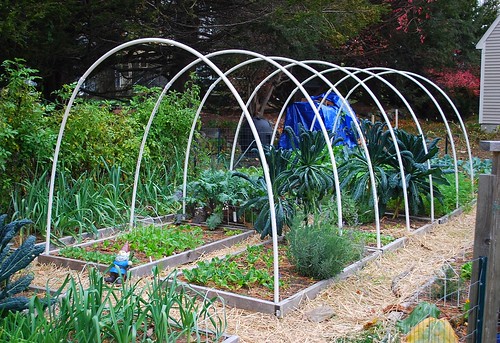
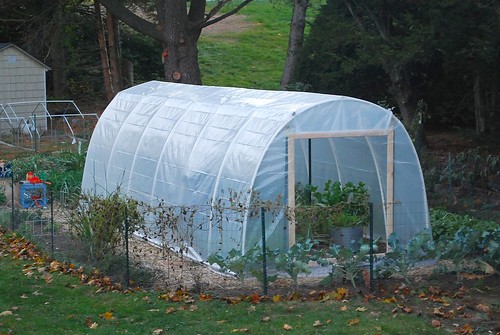
The whole idea of keeping vegetables of any kind alive all winter in central Indiana without supplemental heat when it’s below zero outside may seem a little crazy.. but what’s starting to seem crazy now is leaving the greenhouse empty in the winter! Take a look inside of our hoophouse, as of today.
Long view - greenhouse
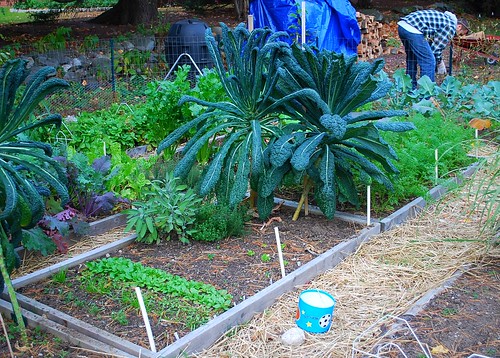
Spinach, kale, lettuces, arugula, chard, cilantro, and a few assorted mustard greens are growing right now. We’re standing in front of a hay bale wall. Later on in the spring, we’ll pull down the bales to build tables for our seed starting flats.
Weeding with a hoe
Between the rows, that white stuff is polyester row cover. We put two layers of it on the wire hoops over the rows. Sometimes we use old greenhouse plastic instead, which is stiffer. Greenhouse plastic handles better when frozen and/or wet, but we don’t have enough of it yet for all of the beds.
Watering is kind of a hassle, but we don’t have to water very often during the winter. We have an outdoor spigot about 100 feet away from the hoophouse. When there’s a sunny day above freezing, we haul a hose out to the spigot, hook it up, uncover the greens, and do the watering. Then we unhook the hose, haul all the hose back into the hoophouse, and let the leaves dry off before covering the plants back up. We try to water every 10 days or so. The plants stay pretty moist with the two layers of row cover on.
With this arrangement, the limiting factor in growing greens becomes day length. Right now, in early January, days are very short and everything is growing very slowly. Greens grown for cut & come again use just don’t grow back very fast. We’re planning to put up a second hoophouse during the 2011 growing season that is twice as long, so that we can have more greens and other items available throughout the fall & winter.
There are definite limits on what can be grown this way- notice that we are growing cold-tolerant leafy greens. We had radishes and salad turnips in the beds earlier, which also did well. Certainly nothing is in the beds that can’t handle a frost.
spinach bed
Spinach anyone? It gets sweeter after every cold spell. The sugars are a natural form of antifreeze.
Assorted kale
However, kale is what will really get you to live forever.

Quarter-Sawn Lumber - Woodworking Tips - What is Quarter-Sawn Lumber?

Quarter-sawing is a method of milling trees into lumber. Quarter-sawn lumber is highly sought after, particularly in certain species such as oak or maple, where look of the grain in the wood is accentuated by the method of cutting the tree. While rip-sawing is the most efficient (and common) method of milling, quarter-sawing is more difficult to cut but yields much more stable lumber. Because it is more difficult to cut and there is more waste, quarter-sawn lumber is considerably more expensive than rip-sawn material.

Why Quarter-Saw Lumber?:
Quarter-sawn lumber is more stable, because it is cut in a manner that attempts to get as much of the end grain of the wood perpendicular to the face of the board as possible. Without having grain running parallel to the face of the board, there is far less chance of the board twisting or cupping as it dries, or worse, when in use in a project. The more square the end grain is to the face of the board, the more stable that board will likely be over the course of its life in the project.

Additionally, quarter-sawn lumber of a variety of species has a look that is unmatched by a rip-sawn board. Oak is a prime example: the grain of oak is much more wavy and displays medullary ray flecks that are far more unlikely to be visible if the board is rip-sawn. Because of these qualities, quarter-sawn oak was the primary type of wood used to create authentic Arts and Crafts era pieces of furniture.

How is a Tree Quarter-Sawn?:
There are a few methods of quarter-sawing a tree, but the most common is for the mill to cut the round tree into four quarters along the long axis of the tree, much like four 90-degree wedges of pie. These wedges are then placed with the center point facing upwards, and boards are ripped off of the wedge. As you might expect, the widest board will be from the center of the wedge, with very narrow boards from the edges. By cutting the tree in this manner, the growth rings (which form the grain of the wood) are going to be closer to square to the face of the board than on most of the boards from a rip-sawn tree.

How Does Quarter-Sawn Lumber Move?:
Properly quarter-sawn lumber will certainly move, just like all other cuts, based on fluctuations in humidity in the environment that the board is used. However, by cutting with the grain square to the face of the board, a quarter-sawn board will swell primarily across the face (making the board wider), whereas a rip-sawn board may grow in width and height (and very likely will twist or cup as it swells). Knowing how the wood will adjust to moisture changes should be considered when laying out the boards for your project.

The Basics of Biochar : A Natural Soil Amendment

PDF file showing benefits of adding biochar to soil.  ... Monte

Dec 31, 2010

Energy Related Charts of The Year 2010


A picture says a thousand words. In this post you will find many charts and graphs conveying important points from the world of energy 2010. Click header and get a wealth of factual charts... Monte

Dec 28, 2010

Build an Easy Drill Press Guide

This is a short video about how to made a Drill Press guide for a work shop. It consists of a BASE PLATE, A FENCE that pivots on a quarter inch bolt, and a STOP BLOCK to make uniform holes. It is very easy to make.

Dec 21, 2010

Don't Miss The Boat On Biochar!

The EcoTechnologies Group, having become smitten with the powerful promise of biochar, the pyrolysis technologies that create it and its potentials for sustainable agriculture, traveled to Northern Brazil to see the original biochar, called Terra Preta, in action. The journey would become more than expected, and what I would see would convince me of those professed potentials.

A DV camera first hand experience.

We have all read and heard about Terra Preta; now we have a great video experience seeing it... Monte

Dec 16, 2010

Hines Farm - Moxon's Double-screw Vise

Inspired by Christopher Schwarz, Woodworking Magazine articles on building Moxon's Double-screw Vise (Joseph Moxon's Double-screw Vise May 25, 2010 and Declaring Victory with the Double-screw Vise), I just built my own from Oak on the Hines Farm. I utilized, a Beall threader to make 1-1/2" vise screws. This portable vise should come in handy for our woodworking projects. Vise is pictured holding a 3 inch diameter dowel in it's jaws.

Front View

Back View

Dec 15, 2010

Beautiful Quartersawn White and Red Oak Boards


Quartersawn white and red oak are my favorite woods. The vertical lines on the end grain in the photo above are the growth rings, and the thin, almost horizontal lines are the medullary rays that radiate from the center of the tree out to the edge. When a ray crosses the surface of a board, the flaked figure appears. Quartersawn logs are more stable and are less likely to shrink, expand, and warp.

Quarter-sawing maximizes the beauty of Medullary Rays and Growth Rings of White and Red Oak. Above is an animation of the quarter-sawing process and the beautiful wood grain characteristics of the quartered and rift boards that result.


Credits: http://blogs.popularwoodworking.com/editorsblog/Frank+Miller+Lumber+Road+Trip.aspx

Dec 14, 2010

Our Reliance on Plants is Increasing

Our Reliance on Plants is Increasing
Color bar for Our Reliance on Plants is Increasingdownload large image (3 MB, JPEG) acquired 2005
download GeoTIFF file (115 MB, TIFF)
Take a look around you: Chances are good that you’re touching at least one thing that came from a plant. We build our homes, furniture, and other structures from wood products; we use plants like cotton and flax (linen) to make cloth for clothing, towels, bedding, and more; we eat a variety of plants and cook with wood; some of our vehicles run on biofuels; and we rely on animals that eat plants for food, transportation (in some places), and other products like wool and leather. Much of what we use every day comes from plants, and new research led by Marc Imhoff at NASA Goddard Space Flight Center is showing that our reliance on plants is increasing.

Between 1995 and 2005, the global demand for plant matter went up about five percent. In 1995, we required 20.3 percent of the plant material Earth currently produces (the photosynthetic capacity of the land). By 2005, that number increased to 25.6 percent both because each person is using more plant products and because there are more of us. Imhoff and his team reached these conclusions by comparing the rate at which people require plant products, in terms of carbon, to the rate that the Earth can produce plant carbon.

This map shows the comparison for 2005. The colors represent the ratio between the amount of carbon people require and the amount of carbon Earth produced. At the top of the scale (dark red), the population needs at least ten times more plants than are grown locally. At the lower end of the scale (dark green), the land produces more vegetation that the local population needs. Gray areas are places where people in the area use less than 10 percent of the vegetation growing there. In the center of the scale (pale yellow) people use most of the vegetation.

In general, the greatest use of plant products occurs in highly populated regions, like Asia and large cities, and places that can not produce enough to support the population’s requirements for plants, such as the African Sahel. Because these places use everything they grow and still need vegetation from elsewhere, they are very vulnerable to changes in climate that would reduce production and disruption in transportation that would make it more difficult to bring food and other plant products from other places.

The map shows the pressure on local ecosystems, but not per capita use. For example, in the United States, each person uses 5.94 metric tons of carbon (vegetation) per year, while in South-central Asia, people use 1.23 metric tons per year. However, the United States produces more than it requires, so the ratio between usage and vegetation is low. South-central Asia, on the other hand, uses less per person, but it has a high population that collectively require more carbon than the land produces, and so must import products from other regions.

“What we’re realizing is the biosphere doesn’t care whether you have a lot of people consuming a little or a few people consuming a lot. It’s the total amount or rate relative to what can be produced that is important,” says Imhoff. “Right now, humans are increasing both population and per capita consumption.” For this reason, it is important to monitor vegetation and land use on a global scale.

The vegetation measurements used to produce the map (net primary productivity) are a measure of the amount of carbon plants convert into plant matter (biomass) as recorded by the Moderate Resolution Imaging Spectroradiometer (MODIS) on NASA’s Terra and Aqua satellites. (Earlier research from 1995 used measurements from another sensor, AVHRR.)

The researchers measured the requirement for plant products by using statistics from the United Nations Food and Agriculture Organization, which reports how much food, livestock, and wood products each country produces, imports, and exports. They calculated usage by first determining what each country produces and imports and then subtracting exports. They calculated the amount of plant material (carbon) required to support such usage by using models that translate between final products, like flour, beef, or paper, and the amount of plant material required to produce the products. Finally, they divided by the population of the country to figure out how many plant products each person in the country uses on average. In the map, the requirement for plant products is mapped by population distribution.

When comparing carbon requirements and production for 2005 to earlier figures from 1995, Imhoff found that people were using about five percent more of Earth’s vegetation in 2005. “People worry about that percentage. If, in future scenarios, it’s going to go up to something like 50 percent, we’re looking at a very high demand for land management at all levels on the landscape. We would be heading toward a place where the planet would be very carefully managed, from end to end.”

To see an interview with Dr. Imhoff and to read more about this work, see How hard are we pushing the land? on the NASA web site.

References
Imhoff, M., Bounoua, L., and Zhang, P. (2010, December 15). Satellite supported estimates of human rate of NPP carbon use on land: Challenges ahead (pdf). Presented at the Fall Meeting of the American Geophysical Union.
Lynch, P. (2010, December 14). How hard are we pushing the land? NASA. Accessed December 14, 2010.
NASA image provided courtesy of Trent Schindler, Scientific Visualization Studio, using data provided by Marc Imhoff (NASA Goddard Space Flight Center). Caption by Holli Riebeek.

Instrument:
Terra - MODIS

Woodworking for engineers

MeWoodgears.ca is a wonderful site for woodworkers. Lots of great ideas and ingenious plans for tools. Matthias Wandel is a 2nd generation woodworker who is also an engineer. He shares his plans and projects. I especially like his pages on his father's beginnings  and his ideas, equipment, ..., and works (My dad's sawmill & My dad's woodworking workshop). If you are interested in woodworking, get ready to spend some time on this great site! ... Monte

Dec 6, 2010

Slow Money: Reconnecting the Economy to Soil, Biodiversity and Food Quality - Nature and Community - MOTHER EARTH NEWS

Slow Money
Peak Soil
By Woody Tasch

The following is an excerpt from Inquiries into the Nature of Slow Money: Investing as if Food, Farms, and Fertility Mattered by Woody Tasch (Chelsea Green, 2008). Tasch presents an essential new strategy for investing in local food systems, and introduces a group of fiduciary activists who are exploring what should replace the outdated concepts of industrial finance and industrial agriculture. This excerpt is from the prologue.

Civilization is a big idea. So is the idea that as soil goes, so goes civilization. So is the idea that as money goes, so goes the soil. We don’t need any more big ideas.

We need small ideas. Beautiful ideas. Beautiful because they lead to a large number of beautiful, small actions — the kind alluded to by Wendell Berry: “Soil is not usually lost in slabs or heaps of magnificent tonnage. It is lost a little at a time over millions of acres by careless acts of millions of people. It cannot be solved by heroic feats of gigantic technology, but only by millions of small acts and restraints.”

There is another kind of erosion at work, just as surely, here: erosion of social capital, erosion of community, erosion of an understanding of our place in the scheme of things.

Peak Soil

It takes roughly a millennium to build an inch or two of soil. It takes less than 40 years, on average, to strip an inch of soil by farming in ways that are more focused on current yield than on sustaining fertility. A third of America’s topsoil has eroded since 1776. In the 1970s, the United States lost 4 billion tons of soil per year. Roughly a third of all farmland in the world has been degraded since World War II, with annual soil erosion worldwide equivalent to the loss of 12 million hectares of arable land, or 1 percent of total arable land. About a third of China’s 130 million hectares of farmland is seriously eroded, and Chinese crop yields fell by more than 10 percent from 1999 to 2003, despite increasing application of synthetic fertilizers.

Awareness of the centrality of soil health is nothing new. Aristotle laid the foundation for the humus theory of plant nutrition, and his student, Theophrastus, is often called “the father of botany.” The homo of Homo sapiens is derived from the Latin, humus, for living soil. Leonardo da Vinci observed, “We know more about the movement of the celestial bodies than about the soil underfoot.” Darwin spent the last years of his life studying the role of earthworms in soil fertility. After World War I, Sir Albert Howard, perhaps the father of 20th-century organic agriculture, heralded the problems that would follow the manufacture of synthetic fertilizers by munitions factories looking for new postwar markets for nitrates: Fertilizers offered farmers boosts in yield but had deleterious effects on the health of microorganisms and the processes of growth and decay that are vital to the preservation of humus. In the first decade of the 21st century, despite beyond-explosive growth in our knowledge of everything from atomic energy to galactic motion, our ignorance with respect to life teeming in the soil remains humbling: It is estimated that in a gram of soil, there are billions of single-celled organisms and millions more multicelled ones, as well as more than 4,000 species, most of them not yet named or studied by scientists.

Yet we have slipped during the past half century — as if pulled by the gravitational or centripetal forces of population growth, technological innovation, consumerism and free markets— into a food system that treats the soil as if it were nothing more than a medium for holding plant roots so that they can be force-fed a chemical diet.

We have become dependent on technology and synthetic inputs, subsidized by what was, until very recently, cheap oil, which facilitated not only the production of nitrogen fertilizer, but also the management of large-scale, mechanized farms and the energy-intensive system of processing and long-range transportation necessary to bring agricultural products to distant markets. Agriculture accounts for more than 20 percent of U.S. greenhouse gas emissions— all the more shocking when one realizes that recent science indicates that fertile soil is a potent carbon sink, holding the potential to play a significant role in remediating global warming.

The problems of our food and agricultural systems go beyond Peak Oil and Peak Soil, however. Aquifer depletion, biodiversity decline, widespread use of pesticides and other toxics, industrial feedlots that pose health and waste-management problems, nutrition and food safety challenges that attend centralized processing, the decline of rural economies, price volatility in global commodities markets: It is quite a litany, surprising in its breadth and even more surprising in the degree of its invisibility when seen through the lens of the modern economy.

A Flawed System

You wouldn’t use a 747 to go to the corner store for a quart of milk. You wouldn’t use a backhoe to plant a garlic bulb. You wouldn’t use a factory to raise a pig. You wouldn’t spray poison on your food. You wouldn’t trade fresh food from family farms down the road for irradiated or contaminated or chemical-laden or weeks-old food from industrial farms halfway around the world. You wouldn’t create financial incentives for farms to become so large that they need GPS technology to apply chemical inputs with quasi-military precision. You wouldn’t design a system that gets only 9 cents of every food dollar to the farmer. You wouldn’t allow topsoil to wash down the Mississippi River, replete with pesticides and fertilizer residues, creating a dead zone the size of Rhode Island in the Gulf of Mexico. You wouldn’t use 57 calories of petro-energy to produce one calorie of food energy.

No, no one ever sat down and designed such a system. Yet it is precisely such a technology-heavy, extractive, intermediation-laden food system that we now need to remediate and reform.

This is the system that has evolved in the wake of global capital markets and the investors who use them, much as industrial farmers use their land—as a medium into which to pour capital in order to harvest maximum yield.

Slow Money

In August 2007, at the 25th Anniversary Gala for the Rocky Mountain Institute, eminent panelists tried to answer questions posed by moderator Thomas Friedman: “If this is a win-win-win, if these new technologies and design solutions are so elegant and so profitable and so clean, what is holding them back? Where is the resistance to these innovations coming from?” Unexpectedly, because this was not a finance conference, the group discussion zeroed in on CEO compensation, short-term financial incentives, and the structure of capital markets.

Inventor Dean Kamen opined from the dais: “Venture capitalists have great enthusiasm but short attention spans. We are stuck in a 19th-century way of thinking that leads to large-scale, centralized production and power generation. We don’t have the mindset to really invest for the long-term in small-scale solutions that would improve life for billions of people.”

Such questions and observations lead to the premise for a new kind of financial intermediation, going by the improbable name of “slow money.”

That premise is this: The problems we face with respect to soil fertility, biodiversity, food quality and local economies are not primarily problems of technology. They are problems of finance. In a financial system organized to optimize the efficient use of capital, we should not be surprised to end up with cheapened food, millions of acres of GMO corn, billions of food miles, dying Main Streets, kids who think food comes from supermarkets, and obesity epidemics side by side with persistent hunger.

Speed is a big part of the problem. We are extracting generations’ worth of vitality from our land and our communities. We are acting as if the biological and the agrarian can be indefinitely subjugated to the technological and the industrial without significant consequence. We are, as the colloquial saying puts it, beginning to believe our own bullshit.

Which reminds me of a story.

About 15 years ago, I was turning a horse stall into my office. My first project was to shovel out the dried horse manure and shovel in sand, in advance of the construction of a wooden floor.

One day, reflecting on the transition from equine to intellectual, I realized, “How appropriate: from horseshit to bullshit.”

No discussion of the disconnect between capital markets and the land is complete without at least one reference to manure.

Let’s throw in a few bees and pigs, too:

“The story of colony collapse disorder and the story of drug-resistant staph are also the same story: Both are parables about the precariousness of monocultures. Whenever we try to rearrange natural systems along the lines of a machine or a factory, whether by raising too many pigs in one place or too many almond trees, whatever we may gain in industrial efficiency, we sacrifice in biological resilience. The question is not whether systems this brittle will break down, but when and how, and whether when they do, we’ll be prepared to treat the whole idea of sustainability as something more than a nice word.” — Michael Pollan

A Hot Potato

There is such a thing as money that is too fast.

Money that is too fast is money that has become so detached from people, place, and the activities that it is financing that not even the experts understand it fully. Money that is too fast makes it impossible to say whether the world economy is going through a correction in the credit markets, triggered by the subprime mortgage crisis, or whether we are teetering on the edge of something much deeper and more challenging, tied to petrodollars, derivatives, hedge funds, futures, arbitrage and a byzantine hyper-securitized system of intermediation that no quant, no program trader, no speculator, no investment bank CEO, can any longer fully understand or manage. Just as no one can say precisely where the meat in a hamburger comes from (it may contain meat from as many as hundreds of animals), no one can say where the money in this or that security has come from, where it is going, what is behind it, whether — if it were to be “stopped” and, like a hot potato, held by someone for more than a few instants — it represents any intrinsic or real value. Money that is too fast creates an environment in which, when questioned by the press about the outcome of the credit crisis, former treasury secretary Robert Rubin can only respond, “No one knows.”

This kind of befuddlement is what arises when the relationships among capital, community and bioregion are broken:

“There is an appropriate velocity for water set by geology, soils, vegetation and ecological relationships in a given landscape. There is an appropriate velocity for money that corresponds to long-term needs of communities rooted in particular places and to the necessity of preserving ecological capital. There is an appropriate velocity for information, set by the assimilative capacity of the mind and by the collective learning rate of communities and entire societies. Having exceeded the speed limits, we are vulnerable to ecological degradation, economic arrangements that are unjust and unsustainable, and, in the face of great and complex problems, to befuddlement that comes with information overload.” — David Orr

As long as money accelerates around the planet, divorced from where we live, our befuddlement will continue. As long as the way we invest is divorced from how we live and how we consume, our befuddlement will worsen. As long as the way we invest uproots companies, putting them in the hands of a broad, shallow pool of absentee shareholders whose primary goal is the endless growth of their financial capital, our befuddlement at the depletion of our social and natural capital will only deepen.


Read more: http://www.motherearthnews.com/print-article.aspx?id=2147492059#ixzz17OcfJEbL

Nov 26, 2010

Global Village Construction Set in 2 Minutes on Vimeo

Open Source Ecology (OSE) and the Global Village Construction Set (GVCS), also known as the Resilient Community Construction Set. We are also going on OSE Tour USA in 2011. ... Innovative bunch of guys ... keep up the great work! Monte

Nov 21, 2010

World Energy Outlook Homepage

The 2010 edition of the World Energy Outlook (WEO) was released on 9 November and it provides updated projections of energy demand, production, trade and investment, fuel by fuel and region by region to 2035. It includes, for the first time, a new scenario that anticipates future actions by governments to meet the commitments they have made to tackle climate change and growing energy insecurity. WEO-2010 also puts the spotlight on several topical issues, including what more must be done and spent post-Copenhagen to limit the global temperature increase to 2°C and how these actions would impact oil markets; how emerging economies – led by China and India – will increasingly shape the global energy landscape; the costs and benefits of increasing renewable energy, the outlook for Caspian energy markets and their implications for global energy supply, the future role for unconventional oil and the crucial importance of energy in achieving the UN Millennium Development Goals. Table of Contents
See related material:

International Energy Agency: Peak Oil Has Already Passed | Fast Company

BY ARIEL SCHWARTZMon Nov 15, 2010

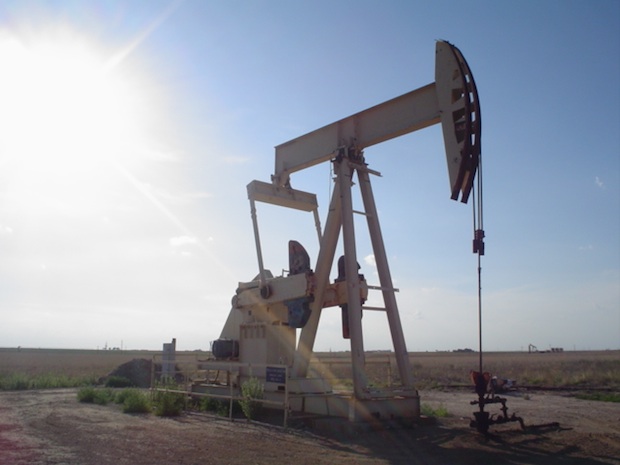
oil jackpump
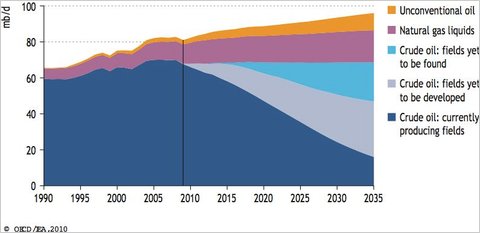
The imminent arrival of peak oil, or the point in time when the maximum rate of worldwide petroleum extraction has been reached and enters into a continuous decline, has long been regarded as a fringe theory. As oil prices have crept up in recent years, the concept has gradually entered the mainstream--and now the International Energy Agency, an intergovernmental organization that offers energy analysis to 28 countries, has announced that peak oil passed us by in 2006. There is nowhere for our oil supply to go but down. So what do we do?
The IEA, which has been accused in the past of downplaying the risks of peak oil, explained in the 2010 edition of the annual World Energy Outlook (WEO) that production of conventional crude oil peaked in 2006 with a production rate of 70 million barrels each day. That doesn't mean crude oil will disappear entirely. The IEA explains:
Globally, fossil fuels remain dominant over the Outlook period in the New Policies Scenario, though their share of the overall energy mix falls in favour of renewable energy sources and nuclear power. Oil nonetheless remains the leading fuel in the energy mix by 2035, followed by coal. Of the three fossil fuels, gas consumption grows most rapidly, its share of total energy use almost reaching that of coal.
Oil prices will, according to the IEA, creep up to $135 per barrel by 2035, but oil supply will remain steady for the next 25 years thanks to new oil field discoveries. The bad news is, of course, that CO2 emissions will continue to rise as long as long as oil and coal are readily available--a fact that the IEA readily acknowledges in its report.
If our economy is to survive, it will be thanks to a drastically increased use of renewables, a large infrastructure for alternative energy (and pedal-powered) vehicles--and the elimination of fossil fuel subsidies. Is there reason to be hopeful? We suggest taking a lookat how many hybrid and electric vehicles are featured at this week's L.A. Auto Show. It's a heartening display.

Nov 17, 2010

The Biochar Solution

The Biochar Solution by Albert Bates“Reads like a detective story but marked by impressive scholarship. New historical evidence that climate is remarkably responsive to human impacts had me gripping the edge of my seat.” —The Permaculture Activist
A Message from Author Albert Bates:

Our choice as a global civilization is to stay with the path we are on — one that turns forest and farm to salty deserts — or to try a different path — one that was widely practiced in nearly half the world, and then tragically lost. If our fates can realign, we might get back to where we once belonged.

From excavations on the banks of the Amazon river, clearings of the savanna/gallery forests in the Upper Xingu, and ethnographic studies of Mesoamerican milpas, science has now re-traced the path of the second great agriculture, and, to its astonishment, found it more sustainable and productive that what we are currently pursuing.

While conventional agriculture leads to deserts, blowing parched dirt across the globe and melting ice caps, this other, older style, brings fertile soils, plant and animal diversity, and birdsong. While the agriculture we use has been shifting Earth’s carbon balance from soil and living vegetation to atmosphere and ocean, the agriculture that was nearly lost moves carbon from sky to soil and crops.

The needed shift, once embarked upon, can be profound and immediate. We could once more become a garden planet, with deep black earths and forests of fruit and nuts where deserts now stand. We can heal our atmosphere and oceans.

Come along on this journey of rediscovery with The Biochar Solution: Carbon Farming and Climate Change.

What Is the Biochar Solution?

Civilization as we know it is at a crossroads. For the past 10,000 years, we have turned a growing understanding of physics, chemistry and biology to our advantage in producing more energy and more food and as a consequence have produced exponential population surges, resource depletion, ocean acidification, desertification and climate change.

The path we are following began with long-ago discoveries in agriculture, but it divided into two branches, about 8,000 years ago. The branch we have been following for the most part is conventional farming – irrigation, tilling the soil, and removing weeds and pests. That branch has degraded soil carbon levels by as much as 80 percent in most of the world’s breadbaskets, sending all that carbon skyward with each pass of the plow.

The other branch disappeared from our view some 500 years ago, although archaeologists are starting to pick up its trail now. At one time it achieved success as great as the agriculture that we know, producing exponential population surges and great cities, but all that was lost in a fluke historical event borne of a single genetic quirk.

It vanished when European and Asian diseases arrived in the Americas.

From excavations on the banks of the Amazon river, clearings of the savanna/gallery forests in the Upper Xingu, and ethnographic studies of Mesoamerican milpas, science has now re-traced the path of the second great agriculture, and, to its astonishment, found it more sustainable and productive that what we are currently pursuing.

While conventional agriculture leads to deserts, blowing parched dirt across the globe and melting ice caps, this other, older style, brings fertile soils, plant and animal diversity and birdsong. While the agriculture we use has been shifting Earth’s carbon balance from soil and living vegetation to atmosphere and ocean, the agriculture that was nearly lost moves carbon from sky to soil and crops. The needed shift, once embarked upon, can be profound and immediate. We could once more become a garden planet, with deep black earths and forests of fruit and nuts where deserts now stand. We can heal our atmosphere and oceans.

Come along on this journey of rediscovery with The Biochar Solution: Carbon Farming and Climate Change.

The Biochar Solution explores the dual function of biochar as a carbon-negative energy source and a potent soil-builder. Created by burning biomass in the absence of oxygen, this material has the unique ability to hold carbon back from the atmosphere while simultaneously enhancing soil fertility. Author Albert Bates traces the evolution of this extraordinary substance from the ancient black soils of the Amazon to its reappearance as a modern carbon sequestration strategy.

Combining practical techniques for the production and use of biochar with an overview of the development and future of carbon farming, The Biochar Solution describes how a new agricultural revolution can reduce net greenhouse gas emissions to below zero while increasing world food reserves and creating energy from biomass wastes.

Biochar and carbon farming can:

Reduce fossil fuels inputs into our food system
Bring new life to desert landscapes
Save cooking and heating fuel with super-efficient stoves
Help build carbon-negative homes, communities and nations.
Biochar is not without dangers if unregulated, and it is not a panacea, but if it fulfills its promise of taking us back from the brink of irreversible climate change, it may well be the most important discovery in human history. Buy The Biochar Solution.

Albert Bates was a civil sector representative at the Copenhagen climate conference, trying to point the world back towards a stable atmosphere using soils and trees. His books include Climate in Crisis and The Post-Petroleum Survival Guide and Cookbook. Working with the Global Ecovillage Network, he has taught appropriate technology, natural building, and permaculture to students from more than 60 nations.

A MUST READ FOR ME... I bought mine at Amazon.com - http://www.amazon.com/Biochar-Solution-Farming-Sustainable-Agriculture/dp/0865716773 Price: $12.21 & eligible for free shipping with Amazon Prime ... Monte

Nov 13, 2010

A Growing Tradition: Building a Hoop House for the Garden


Building hoop house 15
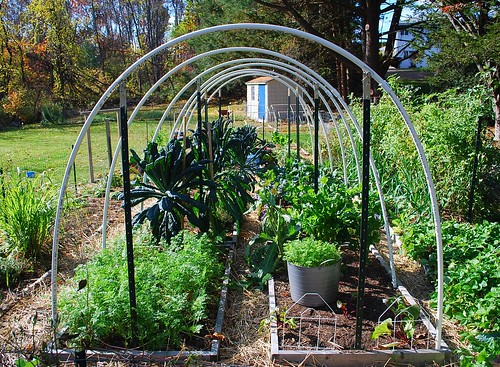
This weekend I finally got around to building my hoop house. I've wanted one for a long time now and had gone over the design in my head during the past three months. After many mental revisions and plenty of second guessing, I realized last week that time was running out and that I just had to wing it.

My goal was to erect a structure that would house six of my 3 x 6 ft raised beds. I wanted something that could be dismantled easily if needed and yet be sturdy enough to withstand our New England winters. Also I didn't want to spend an arm and a leg on the materials either.

Anyway, here is how it all came together:

Building hoop house 1
I started off by driving stakes made from 1/2 in PVC pipe into the ground spaced about 3 feet apart. (Marc is in the background loading firewood.)

Building hoop house 2
I installed the seven arches that will serve as the backbone of the hoop house by bending 15 ft lengths of 1 inch PVC piping and slipping the hollow ends onto the stakes. (PVC piping generally comes in 10 ft lengths but can be joined together easily using plastic couplings to create the desired length.)

Building hoop house 5
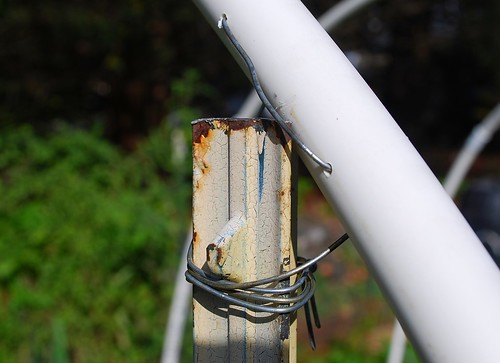
To help prevent the arches from buckling under the weight of snow, I drove 5 ft tall metal poles (8 total) into the ground and positioned each pair underneath every other arch.

Building hoop house 4
Metal wire was then used to attach the arches to the poles.

Building hoop house 6
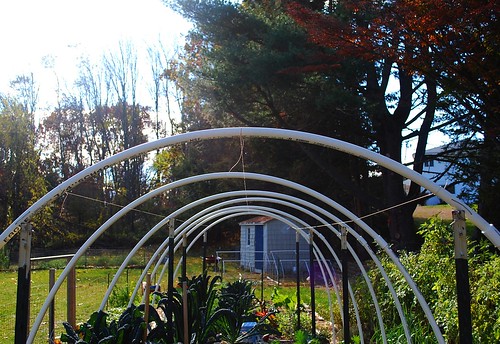
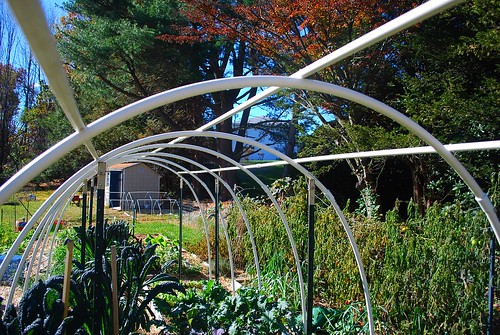
I then used string to mark the center-ridge line as well as two additional side lines that will provide additional stability to the structure.

Building hoop house 7
I attached the three lines (3/4 inch PVC pipe) to the arches using metal screws. The lines help to keep the arches perfectly straight under the weight of snow.

Building hoop house 8
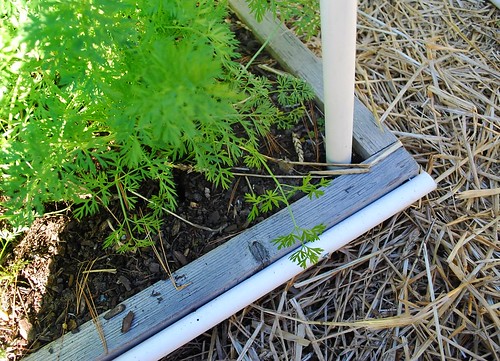
I also attached 3/4 in PVC piping to the base and down length of the structure.

Building hoop house 9
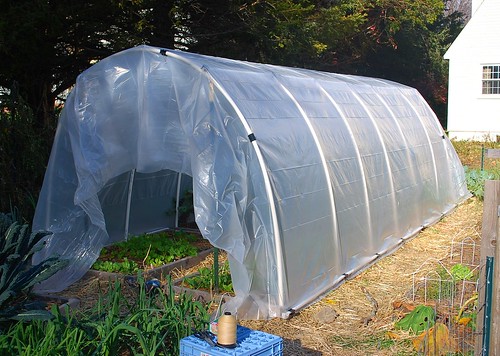
Once the hoop house frame was finished, the next order of business was to attach the plastic sheeting to it. I needed to cover an area that measured approximately 15 ft (the length of the arches) by 19 ft (the length of my beds). After deciding against purchasing professional greenhouse plastic, I went the practical route and bought two rolls of the 10 x 25 ft 3.5 mil polyethylene sheeting available at most hardware stores. (I opted for the 10 ft width because the difference in pricing between it and the 20 ft width was HUGE!)

Building hoop house 11
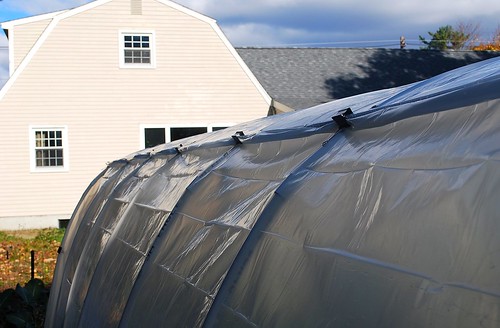
We attached the plastic sheeting to frame one roll at the time using heavy metal clips (the jumbo-sized ones found at most office supplies stores) and allowed for a 5 ft overlap at the top. The first roll went over the center-ridge line and was attached to the far side line. Then the second roll was draped over the first one at the top and attached to the side line on the opposite side.

Building hoop house 10
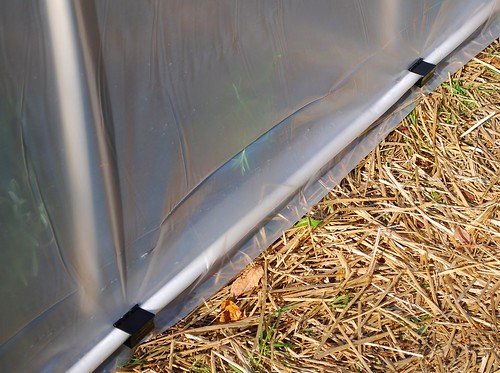
Metal clips were also used to attach the poly sheeting to the base of the hoop house.

Building hoop house 13
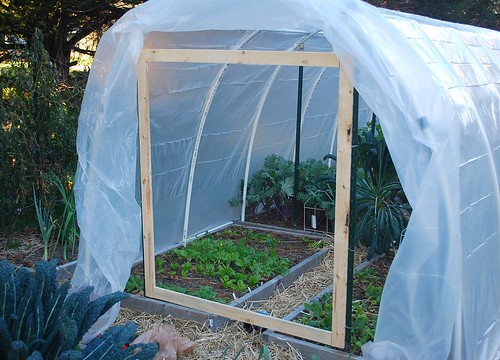
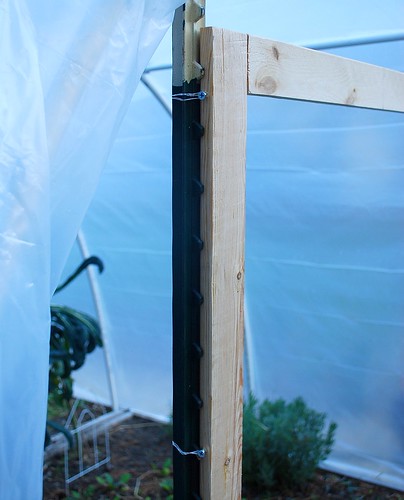
Next I focused on constructing the end-wells. The wooden frame pictured here was built using 1 x 3 inch lumber and is just wide enough to fit over the metal poles.

Building hoop house 12
The wooden frame was attached to the poles using screws and metal wire. (I was pleasantly surprised by how sturdy it felt.)

Building hoop house 14
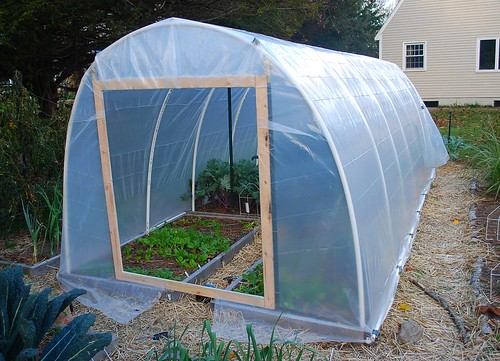
I then wrapped the poly sheeting over the frame, stapled it to the inside and trimmed the excess. The end result looked reasonably neat and clean.

Building hoop house 16
I have yet to construct the hoop house doors but they will fit over and be hinged to the wooden frames.

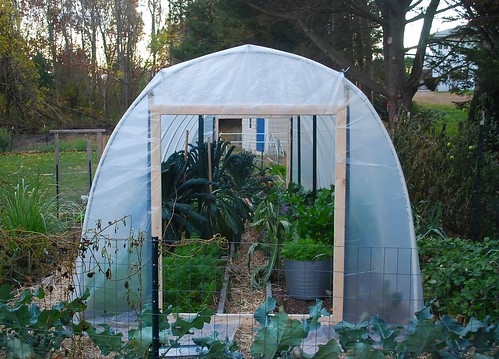
All in all, I was very pleased with my (almost) finished hoop house. It feels really sturdy and best of all, the materials (not including the metal poles, which I had lying around) cost me a modest 120 dollars. I am really excited to see how my winter veggies will fair this year and will consider growing heat-loving summer veggies inside of it as well.

Life on a Southern Farm: The Saw Mill and Video

One day about 15 years ago as I was doing some yard work I could hear a clank, bang, clunk coming down our long dirt driveway through the woods.
As I looked up I saw FarmMan in his truck come through the gate. In the back of the truck looked like a big pile of scrap metal. I didn't even blink an eye. I knew that pile of scrap metal would become something useful around the farm.

And it did.


It was a very old sawmill. A friend of FarmMan's was going to throw it away. It hadn't been used in years and years. So FarmMan brought it home and put it to use.

One of the first projects was lumber for the barn.


The trees for the lumber came from the back of our property.


Some of the oak lumber became flooring for the kitchen.


more lumber was put to use as side bodies for the pick up truck.


for a chicken house


Cut boards were stacked out in the sun to dry for later use.


and stacked later in the barn loft to finish drying


which became more flooring for inside the house.


No, I wasn't concerned the least little bit about that pile of scrap metal that came clunking down the driveway years and years ago.

When a relative from the big city came to visit years ago she saw a collection of FarmMan's finds scattered around the farm. She asked " What is all that stuff? It looks like it was left over from the Civil War!". I just laughed. I could see beyond the rusty looks of the relics.
What looked like junk to someone else really wasn't junk to a hardworking farm man with plans and dreams. It was our future.


FarmMan putting that pile of scrap metal to use.


I am sure there will more unrecognizable piles of metal come through the gate here on the farm.
But... I won't even blink an eye!

Have a great weekend!