Apr 19, 2013

Midwest Rainfall & Flooding 2013 - Assessing Nitrogen Losses after Heavy Rains - Topsoil Erosion - COPPER'S CREEK FLOODING 2013


Larger Image
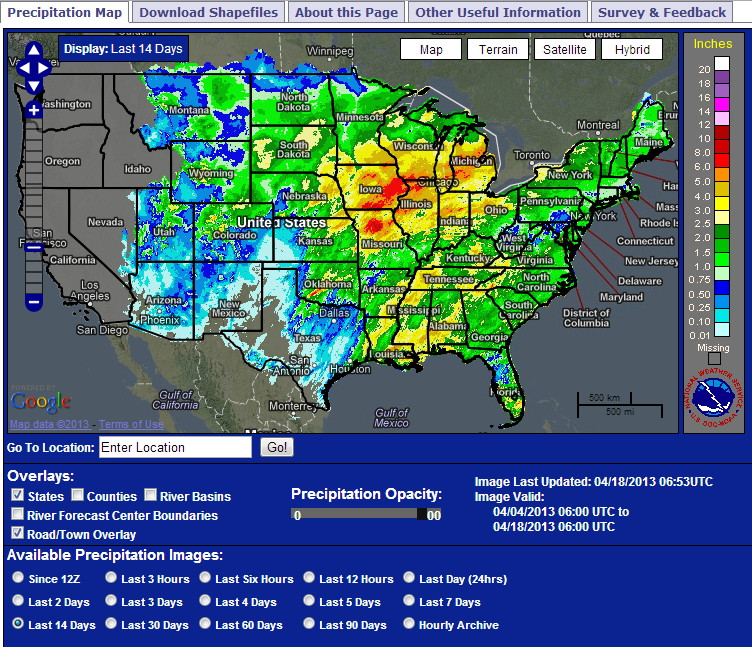
Midwest Rainfall - 4/5/2013-4/19/2013


Larger Image
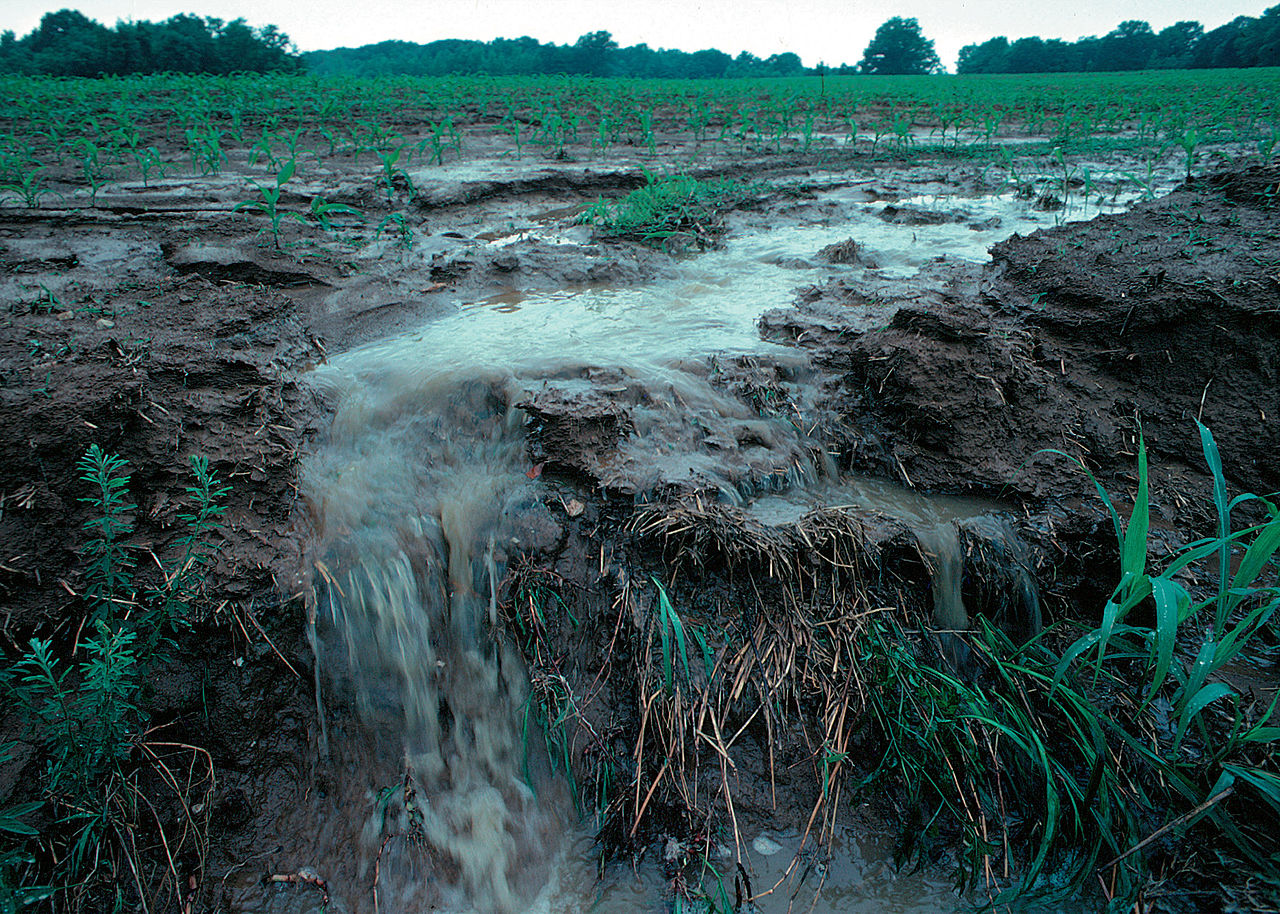
Topsoil and Erosion Due to Conventional Agricultural Practices

Assessing Nitrogen Losses after Heavy Rains
Mike Rankin
Crops and Soils Agent
University of Wisconsin - Extension


Anytime heavy rains occur early in the growing season, a legitimate concern arises regarding nitrogen (N) loss from fertilizers that were applied prior to the rain. The major N loss processes of concern are leaching of available N below the crop root zone and gaseous loss of available N through denitrification in saturated or flooded soils. The exact extent of N losses through leaching and/or denitrification following the heavy rains is unknown. Both of these loss processes occur through the nitrate form of N, so the potential for significant loss is determined by the amount of the crop N supply that was in the nitrate form when the excess rainfall occurred. Losses depend on many factors such as when the N was applied, the forms of N applied or expected to provide N for the crop, soil characteristics, and how wet the soil is/was. In general, leaching losses are more likely on sandy soils where water can move through the profile quickly. Denitrification is more likely on medium and fine textured soils that are not well drained. These soils tend to become saturated with water and/or retain flooded areas for several days following excess rain.

Where fertilizer N was applied before planting, the timing of the application and the form of N used are important in determining the risk of loss. Keeping in mind that losses occur through the nitrate form of N, the timing of nitrate formation is an important consideration in evaluating potential losses. For spring preplant applications, ammonium forms of N such as anhydrous ammonia or urea are converted to nitrate-N in about 4 to 6 weeks. Urea usually is converted to nitrate more rapidly than anhydrous ammonia. Nitrogen solutions (28% UAN) contain half of the N as urea and the remainder as ammonium nitrate. Essentially, this fertilizer contains 75% of the N as ammonium and 25% as nitrate when it is applied. Urea-containing fertilizers are converted to ammonium-N in 3 to 5 days after application, and this conversion occurs even in saturated or flooded soils.

Table 1. Estimated denitrification losses as influenced by soil temperature and days of saturation

Table 1.  Estimated denitrification losses as influenced by soil temperature and days of saturation
Soil temperature
Days saturated
N loss
(% of applied)
55-60
5
10

10
25
75-80
3
60

5
75

7
85

9
95

Denitrification losses can occur within a few days if the soil remains saturated or flooded and nitrate-N is present. Warm temperatures and extended periods of saturated conditions favor high losses. Work in Illinois suggests that 4 to 5% of the nitrate-N present can be lost each day the soil remains saturated. Table 1 from the University of Nebraska provides some estimates of denitrification losses at various temperatures and times of saturated soil conditions.

If part or all of the crop N requirement is expected to be provided from organic sources such as manure and/or previous legume crops, losses through leaching and denitrification are expected to be relatively small at this point in the growing season. This is because most of the N from organic sources has not yet been converted to nitrate. Rapid nitrate production from manures and previous legumes usually begins in mid-June and continues for several weeks during the growing season. The availability of N from organic sources can be checked using the preplant soil nitrate test (PSNT) described below.

Determining the need for additional N

A key decision for corn producers is whether additional N should be applied to compensate for N losses that may have occurred. The best method to assess N loss is to perform a presidedress nitrogen test (PSNT). The PSNT offers a diagnostic method for evaluating the N supply for the crop. The test is particularly useful for those cases where previous legumes or manure applications are providing part or all of the crop’s N need. It can also be used to confirm the extent of fertilizer N loss in the soil depth sampled. Since soil samples for the PSNT are taken to a 1-ft depth, nitrogen that has leached below this depth will not be reflected in the test. To use the PSNT, soil samples should be collected to a 1-ft depth when corn plants are between 6 and 12 inches tall. The details of performing the PSNT can be seen at the following web site. http://ipcm.wisc.edu/pubs/cards/a3630.htm

Other considerations

Options for applying supplemental N when it is needed include traditional sidedressing with anhydrous ammonia or N solutions. Where the entire crop N requirement has not yet been applied, sidedress or other postemergence applications should contain the balance of the crop N requirement plus 25-50% of the N that was already applied. Urea-ammonium nitrate solutions (28%) can also be applied as a surface band or as a broadcast spray over the growing crop. Dry N fertilizers such as urea can be broadcast. Leaf burning from solution or dry broadcast applications should be expected. Applying the dry materials when foliage is dry will help to minimize burning. Several precautions should be followed in making broadcast fertilizer applications over growing corn. Basically, broadcast N rates should be limited to 90 lb N/acre for corn with 4 to 5 leaves and to 60 lb N/ acre for corn at the 8-leaf stage. Under N deficient conditions, corn will respond to supplemental N applications through the tassel stage of development if the N can be applied.

-------------------------------

From Wikipedia, the free encyclopedia
Surface runoff, also called nonpoint source pollution, from a farm field in Iowa during a rain storm.
Topsoil as well as farm fertilizers and other potentialpollutants run off unprotected farm fields when heavy rains occur.
Topsoil is the upper, outermost layer of soil, usually the top 2 inches (5.1 cm) to 8 inches (20 cm). It has the highest concentration of organic matter and microorganisms and is where most of the Earth's biological soil activity occurs.

Contents

  [hide] 

[edit]Importance

Plants generally concentrate their roots in and obtain most of their nutrients from this layer. The actual depth of the topsoil layer can be measured as the depth from the surface to the first densely packed soil layer known as subsoil.

[edit]Classification

In soil classification systems, topsoil is known as the "A Horizon," therefore, it is the very top layer.[1]

[edit]Evaluation

The two common types of Topsoil are Bulk and Bagged Topsoil. The following table illustrates major differences between the two. [2]
Topsoil TypeHM%BS%pHP-IK-ICa%Mg%
Bulk0.3695.20090264510
Bagged0.7785.8166+1785612.3
When starting a gardening project, it is very crucial to check whether or not the Soil is satisfactory. Following are the desired levels of Topsoil nutrients. [3]
CategoryDesired Results
pH Level5.8 to 6.2
Phosphorus (P-I)Index of 50
Potassium (K-I)Index of 50
Calcium (Ca%)40-60% of Cation Exchange Capacity (CEC)
Magnesium (Mg%)8-10% of CEC
Base saturation (BS%)60-80% of CEC
Manganese (Mn-I)Index > 25
Zinc (Zn-I)Index > 25
Copper (Cu-I)Index > 25

[edit]Commercial application

A variety of soil mixtures are sold commercially as topsoil, usually for use in improving gardens and lawns, e.g. container gardens, potting soil and peat. Another important yet not commonly known use for topsoil is for proper surface grading near residential buildings such as homes. "The ground around the home should slope down six inches for the first ten feet away from the home. This can often be done by adding topsoil (not sand or gravel)."

[edit]Erosion

A major environmental concern known as topsoil erosion occurs when the topsoil layer is blown or washed away. Without topsoil, little plant life is possible. The estimated annual costs of public and environmental health losses related to soil erosion exceed $45 billion.[4] Conventional agriculture encourages the depletion of topsoil because the soil must be plowed and replanted each year. Sustainable techniques attempt to slow erosion through the use of cover crops in order to build organic matter in the soil. The United States alone loses almost 3 tons of topsoil per acre per year.[5] This is of great ecological concern as one inch of topsoil can take 500 years to form naturally.[6] On current trends, the world has about 60 years of topsoil left.[7] However, farmer and engineer P. A. Yeomans developed a technique known as Keyline design, which has been proven to convert subsoil into topsoil much faster; Yeomans published a book called Water For Every Farm, in 1954 about the technique[citation needed].

[edit]See also

[edit]References

  1. ^ U.S. Department of Agriculture (USDA), Soil Survey Division Staff (1993). "Soil Survey Manual."
     USDA Handbook 18. Chapter 3.
  2. ^ Topsoil . North Carolina Department of Agriculture(July, 1995).[1]
  3. ^ Topsoil . North Carolina Department of Agriculture(July, 1995).[2]
  4. ^ http://www.ce.cmu.edu/~gdrg/readings/2007/02/20/Pimental_EnvironmentalEnergeticAndEconomicComparisonsOfOrganicAndConventionalFarmingSystems.pdf
  5. ^ http://www.nrcs.usda.gov/technical/nri
    , "Summary Report, 2007 Natural Resources Inventory," Natural Resources Conservation Services, U. S. Department of Agriculture, December 2009, p. 97
  6. ^ http://discovermagazine.com/2001/may/feateatlocal
  7. ^ http://world.time.com/2012/12/14/what-if-the-worlds-soil-runs-out/

[edit]External links

--------------------------------


COPPER'S CREEK FLOODING -  April 18, 2013 - about 10 am. Out of bank flow... 

Eileen and Monte Hines took video.

Feb 09, 2013
If the Illinois team is correct, synthetic nitrogen's effect on carbon sequestration swings from being an important ecological advantage to perhaps its gravest liability. Not only would nitrogen fertilizer be contributing to climate ...

Feb 13, 2013
Dep. of Natural Resources and Environmental Sciences, Turner Hall, 1102 S. Goodwin Ave., Univ. of Illinois, Urbana, IL 61801. This study ... Hines Farm Blog: New research: synthetic nitrogen destroys soil ... Feb 09, 2013 ...

Mar 02, 2010
Overuse of Nitrogen is Depleting our Soils! TECHNICAL REPORTS ... Khan and T. R. Ellsworth Dep. of Natural Resources and Environmental Sciences, Turner Hall, 1102 S. Goodwin Ave., Univ. of Illinois, Urbana, IL 61801.

Apr 18, 2013

Advanced Hydrologic Prediction Service: Lincoln

'River Forecasts' = EXCELLENT SOURCE
LINK: Advanced Hydrologic Prediction Service: Lincoln

None of the world’s top industries would be profitable if they paid for the natural capital they use | Grist

By David Roberts

The notion of “externalities” has become familiar in environmental circles. It refers to costs imposed by businesses that are not paid for by those businesses. For instance, industrial processes can put pollutants in the air that increase public health costs, but the public, not the polluting businesses, picks up the tab. In this way, businesses privatize profits and publicize costs. Read rest of the story at: None of the world’s top industries would be profitable if they paid for the natural capital they use | Grist

GLAD TO SEE ARTICLE PUBLISHED RELATED TO MY BLOG POST "APR 16, 2013 HOLISTIC WAY OF MEASURING! - New Study Shows Multi-Trillion Dollar Natural Capital Risk Underlining Urgency of Green Economy Transition - UNEP"  ay Link: http://tinyurl.com/d3vba29

MIDWEST RAINS 4/18/2013 - SERIOUS RAINFALL! - WHICH WILL CAUSE SERIOUS FARM EROSION ON UNVEGETATED SLOPING FIELDS, RUNOFF OF CHEMICALS, AND FLOODING!!!


How long do you think we can afford?

$8 CORN
HIGH SOYBEAN PRICES, 
BIG AG - HIGH COST INPUTS 
FUEL, SEED, CHEMICALS, & FERTILIZER 
KILLING & LOSS OF OUR FERTILE SOILS
(FARMERS BEST CAPITAL ASSET)

Before we move to a "soil regenerative agriculture"?

Monte Hines

US Midwest

Apr 16, 2013

HOLISTIC WAY OF MEASURING! - New Study Shows Multi-Trillion Dollar Natural Capital Risk Underlining Urgency of Green Economy Transition - UNEP

Mon, Apr 15, 2013
The report shows that the scale and variation in impacts provide opportunities for companies and their investors to differentiate themselves by optimizing their supply chains and investment strategies.


Larger Image
London / New Delhi, 15 April 2013 - A new report by the TEEB for Business Coalition estimates the global top 100 environmental externalities are costing the economy world-wide around US$4.7 trillion a year in terms of the economic costs of greenhouse gas emissions, loss of natural resources, loss of nature-based services such as carbon storage by forests, climate change and air pollution-related health costs.

The report, "Natural Capital at Risk - The Top 100 Externalities of Business", was released today during the Business for the Environment summit in New Delhi.

FURTHER RESOURCES
Full report
TEEB for Business Coalition

Companies and their investors face both an opportunity and a significant problem. Consumer demand is set to grow significantly over the next few years with the increase in middle class consumers, especially in emerging markets. However, this is against a backdrop of increasing resource scarcity and the degradation of our natural ecosystems. One of the challenges will be to understand the value of the natural systems we rely on - commonly referred to as natural capital - and how these systems can be managed. The current business model creates significant environmental externalities. For example, water is not usually priced according to how scarce it is. The report, authored by Trucost, identifies financial risk from environmental externalities e.g. damages from climate change, pollution, land conversion and depletion of natural resources, across business sectors at a regional level. It demonstrates that high impact business sectors make an economic loss when the costs of environmental damage such as their natural resource use and pollution costs are accounted for. However, businesses and investors can take account of natural capital impacts in decision making to manage risk and gain competitive advantage.

Headline findings are: - The primary production (agriculture, forestry, fisheries, mining, oil and gas exploration, utilities) and primary processing (cement, steel, pulp and paper, petrochemicals) sectors analyzed are estimated to have externality costs totalling US$7.3 trillion, which equates to 13% of global economic output in 2009.

The value of the Top 100 externalities is estimated at US$4.7 trillion or 65% of the total primary sector impacts identified.

The majority of environmental externality costs are from greenhouse gas emissions (38%) followed by water use (25%); land use (24%); air pollution (7%), land and water pollution (5%) and waste (1%).

The highest impact sectors by region globally include:-Coal-fired power in Eastern Asia and in Northern America rank 1 and 3, respectively estimated at US$ 453 billion per annum in Eastern Asia and US$ 317 billion in North America. These consist of the damage impacts of GHG emissions, and the health costs and other damage due to air pollution. In both instances, these social costs exceeded the production value of the sector.

The other highest impact sectors are agriculture, in areas of water scarcity, and where the level of production and therefore land use is also high. Cattle ranching in South America, at an estimated US$ 354 billion ranks second. Wheat and rice production in Southern Asia rank fourth and fifth respectively.

Iron, steel and ferroalloy manufacturing ranks 6 at US$225 billion. Cement manufacturing globally accounts for 6% of CO2 emissions, and Eastern Asia produces an estimated 55% of the world's cement, so it is not surprising that it comes in at # 7.

During the past decade commodity prices erased a century-long decline in real terms, and risks are growing from over-exploitation of increasingly scarce, unpriced natural capital. Depletion of ecosystem goods and services, such as damages from climate change, pollution or land conversion, generate economic, social and environmental externalities. Growing business demand for natural capital, and falling supply due to environmental degradation and events such as drought, are contributing to natural resource constraints including water scarcity.

The report assessed more than 100 environmental impacts using the Trucost environmental model which condenses them into six eKPIs to cover the major categories of natural capital consumption: water use, greenhouse gas (GHG) emissions, waste, air pollution, water and land pollution, and land use. These eKPIs were then quantified by region across over 500 business sectors. The method used has limitations and is only designed to give a high-level indication of the priority sectors and regions where natural capital risk lies. Limitations in the method are outlined in the report to support ongoing development of this type of analysis.

The study ranks the top 100 impacts in each sector, broken down by region to provide a platform for companies and investors to assess exposure to unpriced natural capital, both directly and through supply chains and holdings. It also highlights sector-level variation in regional exposure to impacts to identify opportunities to enhance competitive advantage. Impacts across all six eKPIs were combined by region and sector to create a ranking of the top region-sectors globally.

Alastair MacGregor, Chief Operating Officer of Trucost, who conducted the study states, "Recent soft commodity price volatility due to drought, and its impacts on company profits, nation's trade balances and inflation has underscored the dependency of investment returns on natural capital. This trend will accelerate in the future on a number of fronts ."

Dr. Dorothy Maxwell, Director of the TEEB for Business Coalition states, "Understanding natural capital risk and opportunities is essential for businesses to position themselves in an increasingly resource constrained world."

The report shows that the scale and variation in impacts provide opportunities for companies and their investors to differentiate themselves by optimizing their supply chains and investment strategies. Some recommendations for companies include implementing processes to measure and manage natural capital used; strengthening business models to mitigate exposure to global risks such as water scarcity, volatile energy and agricultural prices, rising GHG emissions and climate change impacts.

Pavan Sukhdev, Chair of the Advisory Board of TEEB for Business Coalition states, "We need undoubtedly to change how we do business, but we cannot manage what we do not measure - and at present only a handful of businesses measure their externalities. Resolving this is at the heart of the green economy and sustainability itself."

Achim Steiner, UN Under-Secretary General and Executive Director, UN Environment Programme (UNEP) states, "Forward-looking companies are already recognizing that the key to competitiveness in an increasingly resource-constrained world will hinge in large part on escalating natural resource efficiencies and cutting pollution footprints-the numbers in this report underline the urgency but also the opportunities for of all economies in transitioning to a Green Economy in the context of sustainable development and poverty eradication."

Peter Bakker, President World Business Council for Sustainable Development comments, "Now that we have this high-level assessment of where the priority areas are, we need to encourage companies to increasingly consider the value of nature in decision-making, and ultimately accounting and reporting. The results of such company assessments should also be shared so we can fit the pieces of the puzzle together to develop a standardized approach to account for nature."

Commenting on the study Michael Izza, chief executive of ICAEW explains, "This study highlights that the disciplines of accountancy and economics need to evolve to recognise that the limiting factors to production and growth are no longer just labour, capital and technology. As our economies, populations and our consumption have grown exponentially relative to nature, which once seemed so abundant and limitless, we now have to face the fact that this is not so."

"Sound natural capital management goes hand in hand with benefits for companies, investors, communities, and the environment," said Usha Rao-Monari, Director, Sustainable Business Advisory, IFC, a member of the World Bank Group. "This study makes the business case for companies and investors to take natural capital into account if they wish to save on resource use, access markets and financing, and mitigate major environmental and social risks," she added.

"Incorporating the use of natural capital into a business' sustainability strategy is something that every company must do to understand their real sustainability issues in order to engrain them into day to day operations and overall planning. This is no longer an option and now more than ever it is critical for reporting requirements to include natural capital accounting and government legislation to address corporate transparency and accountability,"states Jochen Zeitz, Director of Kering and Chairman of the board's sustainable development committee and Co-Chair, The B Team.

Download the Natural Capital at Risk: the Top 100 Externalities for Business Report at http://www.teebforbusiness.org

Background

Planetary boundaries are being approached at a reckless pace, and some argue that global biodiversity, nitrogen and climate thresholds have already been breached. Global economic direction and resource use is the underlying cause of this.

Corporations today account for two-thirds of our economy and resource use, and most of the global stressors of planetary boundaries (emissions, freshwater use, land-use change, chemical pollutants, etc) are in reality the negative externalities of "business as usual".

These externalities have grown too large to ignore, and are estimated at close to US$2.1 trillion for the top-3,000 listed corporations (UN Principles for Responsible Investment, 2010).

To mainstream the measurement and management of externalities in business, the "TEEB for Business Coalition", a global coalition of pioneering organizations on natural capital, was formed in 2012. It aims to create awareness of this issue amongst decision makers in business and support scaling 'best-of-breed' solutions from leading corporations to value, manage and report their externalities.

About the TEEB for Business Coalition - www.teebforbusiness.org

Launched in November 2012, The TEEB for Business Coalition is a global, multi stakeholder platform formed to develop and support the uptake of natural capital accounting in business decision-making. The vision of the TEEB for Business Coalition is to support a transformative shift in corporate behaviour to preserve and enhance rather than deplete natural capital. The Coalition is the business application of G8 and United Nations Environment Programme supported TEEB (The Economics of Ecosystems and Biodiversity) programme. TEEB provides a compelling economic case for the conservation of natural capital and is the cornerstone of current Green Economy policy. The Coalition founding organisations and supporters include the World Business Council for Sustainable Development (WBCSD), The Institute of Chartered Accountants in England and Wales (ICAEW), H.R.H. The Prince of Wales's Accounting for Sustainability Project, Global Reporting Initiative, Corporate Eco Forum, Business for Social Responsibility, International Federation of Accountants, Conservation International, International Union for Conservation of Nature (IUCN), WWF and Global Initiatives. From international and government, supporters include the United Nations Environment Programme, the International Finance Corporation and the World Bank. From business supporters include Puma, Deutsche Bank, FMO Dutch Development Bank, Deloitte, Ernst & Young, International Federation of Accountants (IFAC) and Chartered Institute of Management Accountants (CIMA).

About Trucost - www.trucost.com

Trucost has been helping companies, investors, governments, academics and thought leaders to understand the economic consequences of natural capital dependency for over 12 years. Our world leading data and insight enables our clients to identify natural capital dependency across companies, products, supply chains and investments; manage risk from volatile commodity prices and increasing environmental costs; and ultimately build more sustainable business models and brands. Key to our approach is that we not only quantify natural capital dependency, we also put a price on it, helping our clients understand environmental risk in business terms. It isn't "all about carbon"; it's about water; land use; waste and pollutants. It's about which raw materials are used and where they are sourced, from energy and water to metals, minerals and agricultural products. And it's about how those materials are extracted, processed and distributed.

About the Business for the Environment summit - http://www.b4esummit.com/

The 8th annual B4E Global Summit in Delhi, 15-16 April is co-organised with the Confederation of Indian Industry and The Club of Rome in partnership with CNN, The Climate Group, Carbon Disclosure Project, World Agroforestry Centre, and other partners. The TEEB for Business Coalition is chairing a plenary session on 'Integrating Natural Capital Valuation into Business'. Amongst the panellists Richard Mattison, CEO Trucost will be disseminating the findings of Natural Capital at Risk. The event is being held back to back with the Clean Energy Ministerial (CEM), nearby at The Ashok Hotel. There will be 25 to 30 Ministers in Delhi for this together with a group of CEOs and international business leaders involved in CEM.

Media Contacts: 

Charlotte Masiello-Riome, Senior Communications Strategy Advisor
communications@teebforbusiness.org

Sarah Wainwright, Head of Marketing, Trucost
sarah.wainwright@trucost.com
Patrick Schulze, Director, Strategic Engagement, Global Initiatives B4E Summit
patrick.schulze@globalinitiatives.com

For more information see http://teebforbusiness.org/ .

Full Article: New Study Shows Multi-Trillion Dollar Natural Capital Risk Underlining Urgency of Green Economy Transition - UNEP

===========================

FRIENDS - THIS IS BIG!!!
STUDIES AND WAYS TO MEASURE TRUE COSTS! THIS CAN HELP US TO MOVE MORE QUICKLY TO A HUMAN EXISTENCE AND PLANET SAVING STRATEGY!!!


HOLISTIC WAY OF MEASURING!

Significant to making judgements on: Changes to Make Future Farming Better

See: http://tinyurl.com/cjqt25z
New Study Shows Multi-Trillion Dollar Natural Capital Risk Underlying Urgency of Green Economy Transition Mon, Apr 15, 2013

Full Report: http://tinyurl.com/blw52hn

TEEB for Business Coalition - http://www.teebforbusiness.org/

Trucost - http://www.trucost.com

Business for the Environment summit - http://www.b4esummit.com/

==========================

"Trucost has been helping companies, investors, governments, academics and thought leaders to understand the economic consequences of natural capital dependency for over 12 years."

See "Our clients": http://www.trucost.com/203-our-clients

Almost as significant are the companies who you don't see on list:
BIG AG, BIG OIL, BIG SEED, BIG MEAT, BIG COAL, ... etc.

Appears they have no interests in TRUE COSTS    WHY?    RATHER TELLING!     :-)

Exception to BIG OIL is Conoco Phelps / Venezuela Connection???

For those not on client list, it helps validate "my lack of trust" in their "business integrity".

For those on the list, it provides "me a higher level of trust and appreciation" of their "business integrity".

Monte Hines

========================

Join a discussion on Linked in: http://tinyurl.com/c57pcg2

Changes to Make Future Farming Better
present styles of Farming have their advantages and disadvantages, and with changing times and conditions, different ways of farming will evolve. What are the weaknesses of various Farming systems" at teh present, and hopw can they be improved upon?
* Low nutritional value of food?
* High farming energy requirements?
* excessive use of fertilizer and chemicals?
* Soil degradation?
* Excess water use?
* Poor soil management?
* Others?

What can be done so that the Individual Farmer becomes more prosperous in a sustainable manner?

What are present obstacles that should be removed to enable better Farming in the future?

Apr 12, 2013

A Frame 14x14 Cabin by Solarcabin - YouTube


Published on Apr 12, 2013

A Frame 14x14 Cabin design. Free sketchup files on my website:
http://www.simplesolarhomesteading.com

A Frame 14x14 Cabin by Solarcabin - YouTube:

Bosski ATV Wagon 1600 Aluminum ATV Trailer - YouTube


Published on Apr 12, 2013

ATV Television Product Review - Bosski ATV Wagon 1600 Aluminum ATV Trailer
SEE ALL OUR OVER 615 REVIEWS @ http://www.ATVTV.Com/
FOR more info on this product: http://www.ATVWagon.com

ATV Television Product Review - Bosski ATV Wagon 1600 Aluminum ATV Trailer - YouTube:

Look Out Monsanto: The Global Food Movement Is Rising

Harvesting Justice.
Look Out Monsanto: The Global Food Movement Is Rising

re:char Grow more Food and Fight Climate Change on Vimeo


re:char Grow more Food and Fight Climate Change from re:char on Vimeo.

"This video showcases re:char's work to help farmers around the world grow more food and fight climate change. We use biochar, a carbon-negative soil amendment, to help farmers grow up to 144% more food while offsetting the equivalent emissions of 2 US automobiles each year. Watch as we help farmers in Western Kenya to access some of the most advanced agricultural technology on Earth. We are very grateful to Raleigh Latham for directing and producing this film."

re:char - Helping change the world.......... Monte & Eileen Hines

http://www.re-char.com/

The Fossil Fuel Resistance | Politics News | Rolling Stone As the world burns, a new movement to reverse climate change is emerging - fiercely, loudly and right next door

The Fossil Fuel Resistance | Politics News | Rolling Stone
As the world burns, a new movement to reverse climate change is emerging - fiercely, loudly and right next door 

---> http://tinyurl.com/c6ofdw9
PLEASE! READ THIS IMPORTANT ARTICLE
AND SPREAD IT TO YOUR FRIENDS

"Here's the good news: 

We'll at least be able to say we fought" BILL MCKIBBEN

"What other choice do we have?" MONTE HINES

115 comments already on article! 

I LIKED THIS ONE ON BOTH A LIGHTER AND SERIOUS NOTE! by pmagn

I would like to see a campaign started to get Michelle Obama to withhold sex from the president until he starts to move climate action to a war footing. Do you think that this can fly?

===========================


Join Future Farming Discussion On Linked in
http://tinyurl.com/c423xag
101 comments • Jump to most recent comments


Apr 10, 2013

Do the Math - The Movie | Official Trailer - YouTube


Uploaded on Apr 10, 2013
Join in at http://www.350.org/math

The Do the Math Movie is being screened at house-parties and screenings across the country on April 21st. At 42 minutes, it tells the story of the rising movement to change the terrifying math of the climate crisis and fight the fossil fuel industry.

dandelions in permaculture - video

Facts and Information on Dandelions! Might surprise you... :-)
Monte Hines


Published on Apr 10, 2013

http://permies.com

Eden Gal from True Nature Farm in Boulder, Utah starts off by telling us about how dandelions will soften soil.

Alexia Allen pf Hawthorn Farm in Woodinville, Washington shows a polyculture with a lot of garlic and some huge dandelions. She finds a dandelion leaf that is more than half her height. And eat it. She talks about which leaves are less bitter and how her taste for bitter has developed as she has gotten older.

Toby Hemenway, the author of the popular permaculture book "Gaia's Garden" explains how the dislike of dandelion is due to the desire of an unnatural single species of grass for a lawn. He talks about how the dandelion will show up in compacted soil, and solve that compaction problem. And he covers how dandelions will share the nutrients they find down deep with their neighboring polyculture plants.

Jamie from Vashon Island, Washington shows how sometimes when you try to blow on a dandelion puff ball, the little parachutes (seeds) aren't ready to leave yet.

Matt, from Feral Farm, talks about the permaculture concept of being a dynamic accumulator because of it's tap root. He then talks about how grass is a big focus/battle for his techniques and the dandelion helps to displace the grass.

Kristi from Carnation, Washington eats a dandelion blossom. She expresses that it isn't just edible, but also quite palatible.

Gunella from Carnation, Washington is eating the blossoms and explains that she doesn't like the stems.

Michael "Skeeter" Pilarski, of Hot Springs, Montana, talks about how eating dandelion is good for your liver. Later in this video he explains how he sold a bunch of dandelions for $900!

Kyle Kolini from Duvall, Washington tells us that the scientific name for dandelion is "Taraxacum officinale" which means "the official remedy for disorders". Apparently dandelion was brought to north america as a medicine and as a food.

Samantha Lewis thinks that if we can get more dandelions in our lawns that would be awesome. She explains how the dandelion taproot will punch through hardpan soil and bring minerals up from the deep and then shares those minerals with neighboring plants. She advocates eating the leaves, the root and the blossom. She thinks putting the leaf, root and flower into a tea makes an excellent tea. She explains that the dandelion coffee is actually roasted dandelion root tea. Then she points out that it doesn't taste like coffee, "it tastes like kinda burnt roots."

Samantha says the name for the dandelion comes from the leaves being deeply notched like the teeth of the lion. One identifier for dandelion is that there is no stem.

Samantha pointed out that some gravel in the video is machine packed, but the dandelion was still able to get through.

Owen Hablutzel, director of PRI USA and a holistic management certified educator, asks why farmers and ranchers buy lime to put on the soil, when dandelions will bring calcium to the surface for free.

The mighty, the glorious, the amazing Sepp Holzer (author of "Rebel Farmer", "Sepp Holzer's Permaculture" and "Desert or Paradise", plus the star of several documentaries about permaculture) scatters some dandelion seeds for the sake of having more lettuce near the kitchen.

Jacqueline Freeman of Friendly Haven Rise Farm and spiritbee.com in Battleground, Washington, talks about how dandelions provide some of the earliest bee food.

Helen Atthowe of veganicpermaculture.com in Stevensville, Montana expresses how eating the first dandelions in the spring not only helps cleanse your system, but helps to fight a lot of human ailments including cancer. She mentions vitamin A, vitamin C, iron and other micro nutrients, B vitamins including B6.

Kelda Miller, a permaculture instructor in Tacoma, Washington, gives tips on how to reduce the bitter flavor. Both by removing the central leaf vein, and by chopping the leaf finely and adding olive oil.

Norris Thomlinson from Portland, Oregon talks about the flavor from the different parts of the dandelion. He says the stems can be used to make dandelion spaghetti. He finds that the roots taste really good when cooked.

Samantha comes back and shares that the seeds come off of the head at 70% humidity. This is so the seeds will come off just before the rain comes.

Relevant:
http://www.permies.com/t/712/plants/p...
http://www.permies.com/t/4188/medicin...
http://www.permies.com/t/4246/wild-ha...

The plants forum:
http://www.permies.com/forums/f-70/pl...

music by Jimmy Pardo http://permies.com/t/6301#62570
dandelions in permaculture - video

Monsanto Claims to Ditch Herbicide While Selling More of It | Mother Jones

—By Tom Philpott
| Wed Apr. 10, 2013

efwp/Flickr

Genetically modified seed giant Monsanto likes to trumpet its "commitment to sustainable agriculture." The story goes like this: by generating novel, high-tech crop varieties, Monsanto will wean farmers off of synthetic chemical poisons. The company even markets its flagship product, seeds genetically engineered to survive its own Roundup weed killer, as a tool they can use to to "decrease the overall use of herbicides."

But as I've shown before, herbicide use has actually dramatically ramped up as the Roundup Ready technology conquers vast swaths of US farmland. That's because weeds quickly developed resistance to it, forcing farmers to apply ever-larger doses and resort to older, more toxic herbicides to combat resistant weeds. And while the company has tried hard to leave behind its past as a purveyor of toxic chemicals and rebrand itself as a technology company, those toxic chemicals remain central to its growth and profitability, as its latest quarterly profit report shows. 

.....

Big Agriculture flexes its muscle - David Rogers - POLITICO.com


Lawmakers sent in a budget with orders on how Tom Vilsack should run the place. | AP PhotoClose
By DAVID ROGERS | 3/25/13 4:34 AM EDT

Congress holds the purse strings, but who holds Congress these days when it comes to farm policy: the meatpackers and Monsanto?

Give them enough rope and they will hang themselves.... !!!
:-)
Monte Hines

Apr 8, 2013

7 Chemical-Free Fixes for Common Lawn Problems

What you can do: Fix the underlying problem before you resort to unhealthy chemicals.

By some estimates, our chemically addicted lawns are as polluting to our health and to waterways as chemical agriculture. The U.S. Environmental Protection Agency says that Americans apply 90 million pounds of pesticides and herbicides every year in order to get lush green yards, and surveys have found that because their use is so heavy, those chemicals can drift into our homes—even if they started out on a neighbor’s lawn and not our own.

However, like many problems for which chemicals seem like a quick, easy fix, lawn problems can usually be corrected without nerve-damaging and ecohazardous chemicals like glyphosate (used in Roundup) and 2,4-D (used in products made by Scotts and Weed B Gone).

Here are some of the most common lawn and yard problems you’ll encounter, what they signify, and how to fix them:
1. Clover
Some weeds you can eat, some weeds are pretty, and other weeds are signs of a problem. If you want your lawn to be healthy, clover is a good weed to have in the landscape. It usually appears when your soil is low in nitrogen levels, but it helps fix the problem by bringing nitrogen to the soil. Solution: Leave it alone! When you mow, the clover clippings will add nitrogen to your lawn, helping to fix the problem without fertilizer.


2. Dandelions
Dandelions indicate that your grass isn’t developing healthy roots, or that there are nutrient problems in your soil. The turf may be either low in calcium, too high in potassium, or too acidic. Get a soil test to find out what’s out of whack, and use the results to strategize ways to balance out the nutrients. You can use a spray of undiluted white vinegar to kill the existing weeds (aim carefully so you don’t zap too much nearby grass), or dig out their deep root systems with a dandelion weeder.

Next spring, spread corn gluten on the lawn. Corn gluten prevents dandelions from germinating, and it also feeds the grass, making it stronger and more resistant to weeds. Use flowers as your guide; Paul Tukey, founder of SafeLawns.org, recommends applying corn gluten when forsythia blooms in the North and dogwoods bloom in the South.


3. Crabgrass
It only takes a little bit of sunlight breaking through your grass to allow crabgrass to grow, and usually it appears when you’ve mowed the lawn too short. Dig out the crabgrass, roots and all, and then set your mower’s blade higher. Corn gluten will help prevent crabgrass, too. But, again, it has to be applied in early spring, before the crabgrass has taken root.


4. Bare or ragged patches
Bare spots in your lawn may be a sign of nothing more than heavy traffic or too much dog stuff. If heavy traffic is the culprit, consider replacing grass with a gravel walkway, and make dog-poop cleanup part of your weekly lawn maintenance. However, bare spots may also be caused by armyworms, which you’ll probably be able to see crawling around in the soil. Rather than resort to fertilizers or additional grass seed, kill the armyworms off with beneficial nematodes, which you can buy from online retailers.


5. Brown grass
This is usually a sign of overmowing, which prevents the grass from getting enough water. Set your mower a little higher and mow less frequently. The higher you allow your grass to grow, the better it retains moisture, especially during hot, dry spells. Sometimes brown grass is a sign of nutrient depletion, in which case you may want to plant some clover to help affix nitrogen in the soil. A soil test will tell you if your soil needs added nutrients. Brown grass may also be caused by white grubs, a pest that can be eliminated with the same beneficial nematodes used to fix bare patches.


6. Mildew
An overly watered or overly fertilized lawn is prone to mildew, which can coat your grass with a white sheen. Lay off the fertilizers, and water in the morning rather than early evening. Leaving grass wet overnight makes it more prone to mildew and other fungal diseases. Also, water infrequently and deeply, which not only cuts down on mildew problems, but it also allows your grass to grow a deeper root system that makes it less prone to weeds. Grass that gets a lot of shade can be prone to mildew. If you see it in a shady area, consider replacing the grass that’s there with a more shade-tolerant variety.


7. Chemically addicted neighbors
Who wants their chemical-free lawn that’s safe for kids and grandkids contaminated by pesticide drift or fertilizer runoff from the yard down the street? Talk to your neighbors and ask them not to spray pesticides in areas that border your lawn. If you live in a rural area, talk to local authorities about not spraying along your property when they clear brush from roadways (offer to cut back the brush yourself, and post “no spray” signs, in case roadworkers forget).

If fertilizer runoff is a concern, Harriet Behar, organic specialist from the Midwest Organic and Sustainable Education Service, recommends digging a ditch between your yard and the offending neighbor’s. You just need a shallow ditch—about a foot wide and six inches deep—she says, lined with woven landscape cloth (black plastic garden tarps won’t work because water needs to be able to drain through) and filled with gravel. You can use decorative gravel if you’re worried the ditch may be unsightly.

This article originally appeared on Rodale.com.

Full Article: 7 Chemical-Free Fixes for Common Lawn Problems

Reviving the American Forest with the American Chestnut: William Powell at TEDxDeExtinction - YouTube


Published on Apr 7, 2013

Dr. William A. Powell received his BS in biology in 1982 at Salisbury State University, MD, and his PhD in 1986 at Utah State University studying the molecular mechanisms of hypovirulence in the chestnut blight fungus, Cryphonectria parasitica. He is currently the Director of the Council on Biotechnology in Forestry and SUNY-ESF and the Co-Director of the New York State American Chestnut Research and Restoration Program. One of his significant accomplishments is the enhancement of blight resistance in American chestnut by his research team and collaborators.
Reviving the American Forest with the American Chestnut: William Powell at TEDxDeExtinction

Breakthrough in hydrogen fuel production could revolutionize alternative energy market


April 3, 2013  - CreditVirginia Tech

A team of Virginia Tech researchers has discovered a way to extract large quantities of hydrogen from any plant, a breakthrough that has the potential to bring a low-cost, environmentally friendly fuel source to the world.

"Our new process could help end our dependence on fossil fuels," said Y.H. Percival Zhang, an associate professor of biological systems engineering in the College of Agriculture and Life Sciences and the College of Engineering. "Hydrogen is one of the most important biofuels of the future." Zhang and his team have succeeded in using xylose, the most abundant simple plant sugar, to produce a large quantity of hydrogen that previously was attainable only in theory. Zhang's method can be performed using any source of biomass. The discovery is a featured editor's choice in an online version of the chemistry journal Angewandte Chemie International Edition. This new environmentally friendly method of producing hydrogen utilizes renewable natural resources, releases almost no zero greenhouse gasses, and does not require costly or heavy metals. Previous methods to produce hydrogen are expensive and create greenhouse gases.

The U.S. Department of Energy says that hydrogen fuel has the potential to dramatically reduce reliance of fossil fuels and automobile manufacturers are aggressively trying to develop vehicles that run on hydrogen fuel cells. Unlike gas-powered engines that spew out pollutants, the only byproduct of hydrogen fuel is water. Zhang's discovery opens the door to an inexpensive, renewable source of hydrogen.

Jonathan R. Mielenz, group leader of the bioscience and technology biosciences division at the Oak Ridge National Laboratory, who is familiar with Zhang's work but not affiliated with this project, said this discovery has the potential to have a major impact on alternative energy production. "The key to this exciting development is that Zhang is using the second most prevalent sugar in plants to produce this hydrogen," he said. "This amounts to a significant additional benefit to hydrogen production and it reduces the overall cost of producing hydrogen from biomass." Mielenz said Zhang's process could find its way to the marketplace as quickly as three years if the technology is available. Zhang said when it does become commercially available, it has the possibility of making an enormous impact.

"The potential for profit and environmental benefits are why so many automobile, oil, and energy companies are working on hydrogen fuel cell vehicles as the transportation of the future," Zhang said. "Many people believe we will enter the hydrogen economy soon, with a market capacity of at least $1 trillion in the United States alone." Obstacles to commercial production of hydrogen gas from biomass previously included the high cost of the processes used and the relatively low quantity of the end product. But Zhang thinks he has found the answers to those problems.

For seven years, Zhang's team has been focused on finding non-traditional ways to produce high-yield hydrogen at low cost, specifically researching enzyme combinations, discovering novel enzymes, and engineering enzymes with desirable properties. The team liberates the high-purity hydrogen under mild reaction conditions at 122 degree Fahrenheit and normal atmospheric pressure. The biocatalysts used to release the hydrogen are a group of enzymes artificially isolated from different microorganisms that thrive at extreme temperatures, some of which could grow at around the boiling point of water.

The researchers chose to use xylose, which comprises as much as 30 percent of plant cell walls. Despite its abundance, the use of xylose for releasing hydrogen has been limited. The natural or engineered microorganisms that most scientists use in their experiments cannot produce hydrogen in high yield because these microorganisms grow and reproduce instead of splitting water molecules to yield pure hydrogen. To liberate the hydrogen, Virginia Tech scientists separated a number of enzymes from their native microorganisms to create a customized enzyme cocktail that does not occur in nature.

The enzymes, when combined with xylose and a polyphosphate, liberate the unprecedentedly high volume of hydrogen from xylose, resulting in the production of about three times as much hydrogen as other hydrogen-producing microorganisms. The energy stored in xylose splits water molecules, yielding high-purity hydrogen that can be directly utilized by proton-exchange membrane fuel cells.

Even more appealing, this reaction occurs at low temperatures, generating hydrogen energy that is greater than the chemical energy stored in xylose and the polyphosphate. This results in an energy efficiency of more than 100 percent—a net energy gain. That means that low-temperature waste heat can be used to produce high-quality chemical energy hydrogen for the first time. Other processes that convert sugar into biofuels such as ethanol and butanol always have energy efficiencies of less than 100 percent, resulting in an energy penalty. In his previous research, Zhang used enzymes to produce hydrogen from starch, but the reaction required a food source that made the process too costly for mass production.

The commercial market for hydrogen gas is now around $100 billion for hydrogen produced from natural gas, which is expensive to manufacture and generates a large amount of the greenhouse gas carbon dioxide. Industry most often uses hydrogen to manufacture ammonia for fertilizers and to refine petrochemicals, but an inexpensive, plentiful green hydrogen source can rapidly change that market. "It really doesn't make sense to use non-renewable natural resources to produce hydrogen," Zhang said. "We think this discovery is a game-changer in the world of alternative energy."

Read more at: http://phys.org/news/2013-04-breakthrough-hydrogen-fuel-production-revolutionize.html#jCp

Breakthrough in hydrogen fuel production could revolutionize alternative energy market

Apr 7, 2013

Lawrence Lessig: We the People, and the Republic we must reclaim | Video on TED.com

WOW!  - Straight up facts - Clear description of what has gone wrong...
Monte Hines


There is a corruption at the heart of American politics, caused by the dependence of Congressional candidates on funding from the tiniest percentage of citizens. That's the argument at the core of this blistering talk by legal scholar Lawrence Lessig. With rapid-fire visuals, he shows how the funding process weakens the Republic in the most fundamental way, and issues a rallying bipartisan cry that will resonate with many in the U.S. and beyond.

Lawrence Lessig has already transformed intellectual-property law with his Creative Commons innovation. Now he's focused on an even bigger problem: The US' broken political system.


Related Links:
http://www.rootstrikers.org/
Full bio »
Lawrence Lessig: We the People, and the Republic we must reclaim | Video on TED.com

Forest Farming vs. Forest Gardening: What’s the Difference? | Farming the Woods


Forest Farming vs. Forest Gardening: What’s the Difference?
April 4, 2013 · by michaelgburns

Steve Gabriel
In our pursuit of discovering forest farmers for the writing of our book, we’ve received a lot of responses from folks around developing forest gardens. This post describes the difference between the two practices. We are absolutely supportive and encouraging of forest gardens and see the two practices as companions. The topic of forest gardening has been well articulated in Dave Jacke and Eric Toensmeier’s 2005 book, Edible Forest Gardens Vol 1 & 2. (EFG)


Definitions

With many agricultural and horticultural practices out in the world, there are many lines that one can draw in the sand; some useful and some less so. When writing a book it is useful to contain your content a bit as you can quickly see the book getting bigger while watering down key concepts. So, for the sake of discussion and comprehension it is good to distinguish one thing from another. In practice, especially in permaculture design, the lines between forest gardening and forest farming blur together. 

Ken and I define the two practices as follows:

Forest Gardening: mimicking the structure and function of forests in the way we garden, or using the forest as a model for the way we garden.

Dave Jacke and others advocate that in Forest Gardening we want to mimic mid-succession forests and woodlands with a 40 – 50% canopy cover. It is here that many shrubs and herbaceous plants can thrive and many of our multi-functional species are adapted to this phase of growth.

As Dave Jacke says, this is

“…gardening LIKE the forest, but not necessarily IN the forest. One can obviously garden in the forest using the principles EFG talks about. I tend to focus people on converting lawn however, since there is so much of that to convert, and try to steer people away from messing with existing forests which we have done so much damage to already.”


Forest Farming: the intentional cultivation of non-timber forest crops underneath the established canopy of an existing forest.

This is gardening/farming IN the forest. Since we are working with later succession ecosystems, our palette of species is quite a bit more limited. Species need to be considerably more shade tolerant. We tend to focus more on things like mushrooms, and shade loving perennials that are already found in woodlands (ginseng, leeks, goldenseal, etc). And, in contrast to Dave’s strategy described above, Ken and I are actually advocating that forest landowners get into their woodlots and actively manage their forests for long-term health. We are convinced this activity is not only possible, but necessary, as so many forests have been degraded from poor and limited decision making in the past. Non-timber forest crops, like those covered in the practice of forest farming, are 
a potential incentive to support good forestry practices.

Further Distinctions

Based on the above definitions, one basic distinction between Forest Farming and Forest Gardening might be the type of ecosystem we are starting with. Are we going from open field or semi-brushy field and thinking about taking this “blank slate” toward a forested system, or are we working with expanding the diversity and functionality of an existing forest? Our context provides a direction to employ the tools. In Permaculture we want to work with the system, rather than against it’s natural succession. Therefore it’s inappropriate to think about cutting down a forest, with its accumulated ecosystem wealth, in order to plant a garden (or field crops). Yet this happens all the time. When a culture values it’s forests for timber and firewood only, it’s somehow easy to justify clearing woods for food production.

Another distinction between the two systems is scale. As Jacke notes,

” […with Forest Gardening] I am mostly talking about small-scale intensive systems of high diversity, primarily for home use.”

In Forest Farming systems we are often looking for farm scale, production systems. Forest Farming is very appropriate for hobby growers, but that our focus is often on systems that work in managed forests, with the implication that we are working in spaces larger than one’s own backyard.

We can use the Permaculture principle of Zone planning to further our thinking of these systems not as dichotomous, but as companions. In Zone Planning, we arrange invisible boundaries on a site to facilitate system design in relation to how intensive the managed system is – that is, how often we need to visit to harvest, maintain, and so forth. The classic zones model for a landbase would be:

Zone 0: Home or center of human activity (like a barn)
Zone 1: Intensively managed gardens
Zone 2: Small animals and broadacre crops (like corn, beans, etc)
Zone 3: Orchard and larger pasture systems
Zone 4: Forested systems managed for multiple yields
Zone 5: The “wild” zone, not managed or manipulated

This is a rough guideline, as the specific context of a site ultimately determines the actual layout of zones. The borders between on and the next are not ridged, either. Some grazing animals may move between multiple zones, for example.

Taking the zones principles in the context of our discussion, we might see that Forest Gardens, which tend to mix many different species in patches, might best be thought of as a Zone 1/Zone 2 tool. Zone 4, with it’s forest as the base ecosystem, implies the practice of Forest Farming. Zone 3, depending again on the context, is perhaps where the two practices meet. But then again, it can easily get a bit more complex.


Other Agroforestry Practices

The USDA Agroforestry Center says that the practice “intentionally combines agriculture and forestry to create integrated and sustainable land-use systems. Agroforestry takes advantage of the interactive benefits from combining trees and shrubs with crops and/or livestock.”

They further distinguish several types of agroforestry:

• Forest Farming (as discussed above)
• Silvopasture: grazing animals under a forest canopy of about 50% cover, so that grasses can persist)
• Riparian Buffers: tree crop systems in waterways like steams, rivers, wetlands, etc.
• Windbreaks: tree crop systems to buffer effects of wind
• Alley Cropping: rows of trees in between conventional crops, like Black Walnuts in-between rows of corn or soybeans

There are some excellent videos put out by the University of Missouri Agroforestry Center that detail these practices. We’ve embedded the Forest Farming edition:

Ken and I have added Forest Gardening (developing patches of multiple species and layers, mimicking forest structure and function) to this list, though some agroforestry “experts” are not prepared to accept forest gardening as one of the basic agroforestry practices. In our upcoming book, we plan to continue the discussion on this topic, as each practice mentioned above tends to act as complement to the others.

Does it really matter?

As mentioned in the beginning of this article, drawing distinctions between all these practices is tricky business. For example, when we regard silvopasture as “three-story agriculture”, as it is often called, we are limiting the potential to the management of trees, grasses, and grazing animals. Often, the forest needs to be thinned (or planted) at a wide spacing to allow adequate light to grow grasses. If this is the case, then were do foraging animals like ducks or goats fit in? If we are not growing grasses for foraging, are we still doing silvopasture?

As Ken notes, “by my general nature I tend to be a lumper, not a splitter.” I agree. We are interested in this dialogue, but not to contain a practice in any one category. In fact, we seek just the opposite. Like a carpenter needs more than a hammer… we see these different agroforestry practices (forest gardening included) to be analogous to a well stocked toolbox of saws, pliers, hammers, etc.


As I work on the farm design with my partner Liz, we have actually discovered that we will likely employ many of the above agroforestry practices, on just 7 acres of land:

We have one acre of existing Sugar Maple that we are managing for maple syrup, mushrooms, ginseng, and wild leek (hopefully) production.(Forest Farming) Our ridgetop site is very windy, and we have plans for a multi-functional windbreak of short-term trees (willow, red alder, locust), mid-term shrubs (seaberry, hazelnut) and long term conifers (Korean Nut Pine). Several patches next to hedgerows and in sheltered parts of the farm will be allocated to Forest Gardens, with more intensive management layering trees, shrubs, and herbaceous plants for our own enjoyment and consumption The lower portion of our land is wet and alongside a seasonal stream, already hosting a number of butternut trees. We plan to support a productive riparian buffer zone of walnuts, paw paw, berries, and pasture. Silvopasture will be accomplished throughout the farm, as we move our ducks and eventual sheep through ALL of the previously mentioned systems (except for sheep in the Maple woods.)

All these practices will combine to reforest our farm, while meeting our personal goals for hobby and commercial production. Whether managing existing forests, or building new ones, engaging the diverse array of agroforestry practices has helped our thinking and planning. Forest Farming, at least in the temperate climate, is perhaps the least articulated of all these practices, yet holds great potential. We see our book as a companion to Edible Forest Gardens, as well as publications like“Silvopasturing in the Northeast” by Brett Chedzoy and Peter Smallidge and others.

As for the case studies we are fundraising for, we ARE specifically looking for current farmers and hobby woodlot owners who are cultivating crops under the canopy of an existing woods while engaging in forest management. This doesn’t mean we won’t visit a few other agroforestry examples, such as the Alley Cropping/Silvopasture practices of Mark Shephard’s New Forest Farm. While Mark didn’t start with an existing woodlot, we have much to learn from his trials and tribulations with tree crops. Our main interest is to further the understanding of tree-based agriculture, by whatever name. If Farming the Woods can strengthen that conversation, we will have done our job.
FullArticle: Forest Farming vs. Forest Gardening: What’s the Difference? | Farming the Woods

Leopold & The Land Ethic and Levittown flashcards | Quizlet

Leopold & The Land Ethic and Levittown flashcards | Quizlet

--> http://tinyurl.com/cytjk6w

Leopold & The Land Ethic
Short Quiz With Answers That Teaches MUNCH!
:-)
With Respect and Regards To All
Monte and Eileen Hines