Sep 19, 2012

Results of first animal feeding trial on GM maize & Roundup

By Anne Sewell
Sep 19, 2012

This is the first study of its kind, it is peer-reviewed, and will be published in the American journal, Food and Chemical Toxicology. The results are not reassuring.

The first animal feeding trial, set up to study the lifetime effects of exposure to NK603 Roundup tolerant GM maize, and also to Roundup, the world's best-selling herbicide and weedkiller, has been completed.
The research was lead by Professor Gilles-Eric Séralini, Molecular Biologist at Caen University and first author of the research being discussed.

Professor Séralini was in charge of risk assessment for two government commissions and has advised the European Commission on the use of GMO’s commercially. He is the President of the Scientific Board at Committee of Independent Research and Information on Genetic Engineering (CRII-GEN).


CRIIGEN

Additional contributors at a telepress conference held on Wednesday, include Dr. Michael Antoniou – Professor in Molecular Genetics, Kings College, London School of Medicine. Dr. Antoniou has over 40 peer-reviewed publications of original work.
Dr. Antoniou was also involved in the GMO Myths & Truths Report, as reported on Digital Journal.
Patrick Holden, Founder and Director for the Sustainable Food Trust. SFT has an interest in comparing different systems of agriculture and their impact on human and environmental health.
An audio file of the telepress conference will be added later today.
According to the study, levels currently considered "safe", can cause mammary tumors and multiple organ damage (kidney and liver), and can also lead to premature death in laboratory animals.


CRIIGEN

Trial Methodology:

The trial studied the long-term effects of exposure to NK603 GM corn and Roundup, individually and combined, on the health of rats over two years, their entire lifetime.
The study was carried out using two hundred rats fed a standard balanced diet. They were divided into ten groups each containing ten males and ten females.
žThree groups tested the effect of NK603 alone. Each group had a different proportion of NK603 in their feed starting at 11%, then 22% and finally 33% of their total diet.
žThree groups tested the effect of NK603, which had been sprayed with Roundup in the field at the same proportions of 11%, 22 % and 33% of their total diet.
Three groups tested the effect of Roundup alone, administered via their drinking water at three different concentrations with one control group.
žThe lowest level corresponded to contamination found in some tap water.
žThe intermediate level corresponded to the maximum level permitted in the US in GM feed
žThe highest level was half the strength of Roundup when diluted for use in agriculture.
žThe control group was fed a diet containing 33% of non-GM corn and plain drinking water.
The researchers took blood and urine samples for analysis monthly for the first three months and then every three months and at the end of the trial studied the rats’ principal organs.
Findings:


CRIIGEN

Researchers found that even consuming low levels of NK603 and Roundup, separately or combined, can cause serious health problems in rats, that only became apparent when they were older than 90 days. The first tumor was observed after 120 days, but the majority were only detected after 18 months.
The outcome of this research immediately calls into question the current regulatory process, used to license all new industrial chemicals, pesticides and other "novel crops" since the Second World War. Currently all tests on GM food crops have been approved as "safe" on the basis of a 90-day feeding study in mammals.
In this study, the first large tumor was only observed four months into the trial, and most tumors were not even detected until after 18 months.


CRIIGEN
This research highlights the need for more research and long-term studies to evaluate the safety of all GM food crops, which are currently grown on almost 10% of the world's arable land.

Copies of the research can be obtained on request from CRIIGEN and from Food and Chemical Toxicology.

The full report, as published in Food and Chemical Toxicology, can be read here.

Read more: http://www.digitaljournal.com/article/333136#ixzz26wNOgVFE

Biochar is an investment in soil - Iowa State Daily: News


Biochar Fuels Soil
Full Article: http://www.iowastatedaily.com/news/article_1e80d8e8-01a1-11e2-8ada-001a4bcf887a.html
Eric Debner, eric.debner@iowastatedaily.com | Posted: Wednesday, September 19, 2012

While no meteorologist or agronomist can accurately predict which years will be "dry years," scientists and farmers can now take steps to protect themselves against plant dehydration during a drought. Biochar, a substance known for its ability to retain water and enrich soil fertility, is on the mind of researchers at Iowa State.

Created from a process called pyrolysis, biochar exhibits many unique properties that could provide aid to combat future dry spells, the most noteworthy being water retention. In a lab study conducted at Iowa State, researchers discovered biochar increased the soil’s water retention by 15 percent.

“This year, [water retention is] huge because of the drought,” said David Laird, professor of agronomy. “If you can improve the soil quality and make it so the soil holds water better, then it will be more robust in a dry year.”

This revolutionary remedy is biochar, named for its similarity to charcoal.

“The word 'charcoal' is generally used when talking about a fuel, something you can burn,” Laird said. “'Biochar' is a name we give it when we put it into the soil.”

Laird explained that a feedstock or raw material, such as corn stover, is heated to extreme temperatures where it breaks down into bio-oil and noncondensable gases with biochar as a byproduct.

Bernardo del Campo, graduate research assistant in mechanical engineering who is studying biochar, said specific types of biochar fit well with specific soils. The type of feedstock, process conditions and peak temperatures the material is exposed to during pyrolysis influences the biochar’s properties and qualities.

Corn stover produces a very fine, almost dust-like biochar, while red oak produces a biochar that is bulkier, jagged and takes up more surface area. Biochar is also similar to fertilizer — too much or the wrong type of char for the wrong soil will kill the plants.

“It’s going to be more like a soil amendment,” del Campo said. “That amendment should balance or complement some properties of the soil. The best biochar will match with your soil.”

In agricultural plots where the soil is less than optimal, biochar can also help restore fertility and crop yields.

“We do see a benefit from biochar on poor quality soils, degraded soils and sandy soils that have low water holding capacities,” Laird said. “It’s not so much that it can raise the yields on the best soils, so much as it can increase the yields on the worst soils.”

Biochar makes the soil better which improves agricultural productivity. Laird said it helps the soil retain nutrients otherwise lost through leaching because the char acts as a filtering material.

“It retains the nutrients in the soil where they can be used by the next crop instead of leaching down into the river,” Laird said. “It’s not new; what is new is the realization that biochar could be used as a co-product of bioenergy production so that we could simultaneously be producing renewable energy and a char that could be returned to the soil that could build soil quality.”

Sep 14, 2012

RSA Animate: The Truth About Dishonesty - YouTube


Published on Sep 14, 2012 by theRSAorg

Are you more honest than a banker? Under what circumstances would you lie, or cheat, and what effect does your deception have on society at large? Dan Ariely, one of the world's leading voices on human motivation and behaviour is the latest big thinker to get the RSA Animate treatment.

Taken from a lecture given at the RSA in July 2012 . Watch the longer talk here http://www.youtube.com/watch?v=ZGGxguJsirI

The RSA is a 258 year-old charity devoted to driving social progress and spreading world-changing ideas. For more information about the RSA, visithttp://www.thersa.org

Michael Lewis on his exclusive with President Barack Obama


Published on Sep 13, 2012 by ReutersTV

Michael Lewis on his exclusive with President Barack Obama in Vanity Fair. Lewis tells Impact Players host Robert Wolf what makes Obama tick and how Goldman Sachs played a role in Europe's financial crisis. The author of "Moneyball" and "Boomerang" also says the thought of a CEO being president would be disastrous. (September 14, 2012)

Charlie Rose - Michael Lewis Interview
http://www.charlierose.com/view/interview/12549 - Video link
Best-selling author and journalist Michael Lewis on his article 'Obama's Way'

Both interviews - Very interesting!!!                 ... Monte Hines

Corporate Funded Science - The Connecting the Dots Video - YouTube


Published on Sep 14, 2012 by organicconsumer

The Goliaths of the biotech and processed-food industries have raised $27.2 million to defeat Prop 37, the California Right to Know Genetically Engineered Food Act, and keep you from knowing what's in your food. We can win with much less money. But we do need to raise another $1 million by Sept. 30th to educate voters, distribute leaflets, print signs, saturate the media with the truth about GMOs, and get out the vote. Join us in a fight for consumers right to know what is in the food they are buying and feeding their families http://organicconsumersfund.org/donate/david-goliath.cfm

Corporate Funded Science In Our Universities Sucks Big Time!!!  
.................. 
Monte Hines

60 years on the Upper Mississippi. My life and experiences : McMaster, S.W. b.1811 : Free Download & Streaming : Internet Archive


Source: http://archive.org/details/60yearsonuppermi00mcma

60 years on the Upper Mississippi. My life and experiences, by McMaster, S.W.

Published in 1895

Lots of great history and information on Mississippi River and Illinois River from 1835 through 1895.

Read Online
PDF
B/W PDF
EPUB
Kindle
Daisy
Full Text

We like using Kindle version for easy viewing and reading...

We downloaded free Kindle Software:
Free Kindle Apps - Read eBooks on your Phone, Tablet, or Computer
http://www.amazon.com/gp/feature.html?ie=UTF8&docId=1000493771
You don't need to own a Kindle to enjoy Kindle books. Just get a free Kindle app for Android, iPad, iPhone, PC, Mac, BlackBerry, or Windows Phone 7.

Monte and Eileen Hines

Internet Archive

The Internet Archive - http://archive.org/ - is wonderful resource for "universal access to all knowledge". We find it great resource, great for viewing and reading old books and movies on subjects we are interested in... "Mississippi River History", "Rock island County History", ...

We like using Kindle version for easy viewing and reading...

We downloaded free Kindle Software:
Free Kindle Apps - Read eBooks on your Phone, Tablet, or Computer
http://www.amazon.com/gp/feature.html?ie=UTF8&docId=1000493771

You don't need to own a Kindle to enjoy Kindle books. Just get a free Kindle app for Android, iPad, iPhone, PC, Mac, BlackBerry, or Windows Phone 7.

                                        Monte & Eileen Hines


From Wikipedia, the free encyclopedia

Type Digital library
Founded 1996
Key people Brewster Kahle (Chairman)
Website www.archive.org


Since 2009, the Internet Archive has been headquartered at 300 Funston in San Francisco, California, a former Christian Science Church

From 1996 to 2009, the Internet Archive headquarters were in the Presidio, a former U.S. military base in San Francisco.

Mirror of the Internet Archive in the Bibliotheca Alexandrina

Wayback Machine logo

The Internet Archive is a non-profit digital library with the stated mission of "universal access to all knowledge".[2][3] It offers permanent storage of and free public access to collections of digitized materials, including websites, music, moving images, and nearly three million public-domain books.

The Archive allows the public to upload and download digital material to its data cluster, and provides unrestricted online access to that material at no cost. Its largest collection is its web archive, "snapshots of the World Wide Web". The Archive also oversees one of the world's largest book digitization projects. In addition to its archiving function, the Archive is an activist organization, advocating for a free and open Internet.

Founded by Brewster Kahle in 1996, the Archive is a 501(c)(3) non-profit operating in the United States. It has an annual budget of $10 million, derived from a variety of sources: revenue from its Web crawling services, various partnerships, grants, donations, and the Kahle-Austin Foundation.[4] Its headquarters are in San Francisco, California, USA, where about 30 of its 200 employees work. Most of its staff work in its book scanning centers. The Archive has data centers in San Francisco, Redwood City, and Mountain View, California, USA. Its collection is mirrored for stability and endurance at the Bibliotheca Alexandrina in Egypt.[5]

The Archive is a member of the IIPC (International Internet Preservation Consortium).[6] and the American Library Association and is officially recognized by the State of California as a library.[7]

Sep 13, 2012

University of Illinois Rated # 1 Biological/Agricultural Engineering School in Nation | Rankings | US News


Larger Image
Having graduated from there, it is my great pleasure to report that our ABE undergraduate program has regained the number 1 ranking by the U.S. News and World Report (http://colleges.usnews.rankingsandreviews.com/best-colleges/rankings/engineering-doctorate-biological-agricultural) ... Monte Hines

Mississippi River Flood of 1927

Short silent film produced by the Signal Corps of the Mississippi flood of 1927.

View Film at http://archive.org/details/mississippi_flood_1927
Free Download & Streaming : Internet Archive

Reel 1, flood waters rage through Illinois, carrying houses and debris. Kleinwood, La., is under water. Marooned families, their salvaged possessions, and livestock cling to levees. Sec. of Commerce Hoover meets Red Cross heads. Army troops load equipment on freight cars. Levees are reinforced at Baton Rouge. Coast Guard cutters and miscellaneous craft evacuate people and animals in La. Reel 2, Hoover and Sec. of War Davis inspect flooded areas at Vicksburg and along the River to Natchez. Refugees are inoculated, fed, and given shelter at an Army camp in Louisiana.

The material comes from a 3/4" U-matic video viewing copy made available at the National Archives facility in College Park, MD. The condition of the source material is relatively good for its age. Unfortunately, the transfer to video was badly done with lots of flicker and crooked perspective. Additionally, there are many video artifacts as a result of the age and wear of the video tape. High quality preservation 35mm film exists.

Source Link:
Free Download & Streaming : Internet Archive

Sep 12, 2012

Buffalo Herd Near Joy, Illinois -- September 10, 2012 - YouTube


Larger Image

Bison truly are "iconic" native American animals!  
Monte & Eileen Hines

Related Links:
Aug 16, 2012
This election year, we have the perfect nominee for the coveted position of national mammal. The iconic bison is impeccably qualified to join the bald eagle as a symbol of the United States. Truely, US's most magnificent ...
Dec 11, 2011
WashingtonPost.com: Bring Back the Buffalo! A Sustainable Future for America's Great Plains By Ernest Callenbach Chapter One: The Bison Heartland For more than ten centuries the bison, elk, deer, and pronghorn played in ...

Sep 9, 2012

Prairie Fire - Revolutionize the Food System - YouTube


Published on Sep 9, 2012 by peakmoment

Prairie Fire - Revolutionize the Food System from Peak Moment TV. Like this? Watch the latest episode of Peak Moment TV on Blip! http://blip.tv/peak-moment-tv/watch

Peak Moment 219: Novelist Dan Armstrongapos;s "Prairie Fire" is a fast-paced thriller whose characters forge unlikely alliances to revolutionize the American food system. Itapos;s spearheaded by farmers squeezed by skyrocketing oil prices while marketeers get whopping price gains. This revolution is unlikely to succeed, yet? well, we wonapos;t spoil it! In Danapos;s "Taming the Dragon", climate change causes Chinese grain production to plummet, bringing the world to the brink. Dan illuminates the real-world backdrop behind both novels. His solution? Localize food production. Meet farmer Harry MacCormack with exciting results in central Oregon. [www.mudcitypress.com, sunbowfarm.org]

Visionary Scholar Charles Eisenstein: Authors at Google - YouTube


One smart dude!  Worth viewing... Monte Hines

Published on Sep 8, 2012 by AtGoogleTalks

"Charles Eisenstein is a visionary scholar who maps economics, science, philosophy, psychology, and the history of civilization onto our daily activities, with inquiries like, 'How should we live?' 'What's really important?' 'How can our relationship to money be transformed?' He is the author of ""The Yoga of Eating"", ""Ascent of Humanity"", and ""Sacred Economics"".

Sacred Economics is Eisenstein's exploration of the history of money from ancient gift economies to modern capitalism, where he reveals how the money system has contributed to alienation, competition, and scarcity, destroyed community, and necessitated endless growth. Sacred Economics explores avant-garde concepts of the New Economics, including negative-interest currencies, local currencies, resource-based economics, gift economies, and the restoration of the commons. Author Charles Eisenstein also considers the personal dimensions of this transition, speaking to those concerned with "right livelihood" and how to live according to their ideals in a world seemingly ruled by money. Tapping into a rich lineage of conventional and unconventional economic thought, Sacred Economics presents a vision that is original yet commonsense, radical yet gentle, and increasingly relevant as the crises of our civilization deepen and we move into a new age, a new way of being with each other and our planet.

Eisenstein graduated from Yale University in 1989 with a degree in Mathematics and Philosophy, and spent the next ten years as a Chinese-English translator. He currently lives in Harrisburg, Pennsylvania and serves on the faculty of Goddard College. His writings on the web magazine ""Reality Sandwich"" have generated a vast online following.

True to his word, he lives in a gift economy and has made available both ""Ascent of Humanity"" and ""Sacred Economics"" to read online for free!"

Sep 7, 2012

Under Cover Farmers - YouTube


Published on Sep 6, 2012 by Buzatesri

Changing the paradigm! Seeing, doing, and believing ... Monte Hines

Sep 4, 2012

THE MAGNIFICENT MISSISSIPPI, by Jim Arpy - Great History Stories of The Mississippi River


Larger Image

I just read  THE MAGNIFICENT MISSISSIPPI, by Jim Arpy.

It was great! Lots of stuff about this area of river. Blackhawk stories were great, Lincoln being sworn in Army at now the intersection of Andalusia & Ridgewood Road. Clark starting first ferry across Mississippi River between Buffalo, Ia. and Andalusia, IL. Asenal and Cloctower stories included...55 stories in all...   Monte Hines


ABOUT THE MAGNIFICENT MISSISSIPPI

The farmer who shocked his Illinois neighbors when he sawed the horns off his cattle; the bugging of an Iowa mayor's office; the "man from the moon," who was aboard the first steamboat to voyage all the way up the Mississippi River to Minneapolis.

These are just a few of the more than SS true and wonderful tales of the past recounted in Jim Arpy's newest book, "The Magnificent Mississippi," just released by Iowa Heritage Gallery Publications and Sutherland Printing Co., of Grinnell and Montezuma, Iowa.

Arpy's stories of early life in the Upper Mississippi Valley are not told in the dry manner of the historian. Rather, researched and collected by the longtime newspaper feature writer over more than 30 years, they are vibrant and lively accounts of colorful. often off-beat events that helped shape the future.

He portrays the raw, lanky Abe Lincoln being sworn in as a captain in the Black Hawk War, and catches the frustration and pathos of the Indian war leader for whom that unequal struggle was named.

Through the pages of "The Magnificent Mississippi" march heroes and scoundrels, fur trappers and Indian warriors and orators, future presidents and rugged pioneers, stage coach drivers, burlesque dancers, railroad men and horse thieves. Each in his own way became part of the pattern of a colorful history.

"No portion of the United States is richer in history than the Mississippi Valley. The events that occurred in and around that vast portion of the great river were exciting, and often improbable. The purpose of 'The Magnificent Mississippi' is to make Americans aware of its contributions to our shared heritage," Arpy says.

John M. Zielinski, photographer, and author of five books on Midwest history, has illustrated the new book with more than 108 old, and often quite rare, drawings and photographs, many being published for the first time.

Arpy's tales cover a broad range, from the story of the wily horse thief who wouldn't stay hanged, to the wacky saga of the "kissing bug," whose attack, it was said, could leave a victim with a four-pound lip.

He makes the brawling days of the log raftsmen live again, introducing such unlikely characters as "Two-Headed Bob" and "Whisky Jack."

Readers will meet the ambitious young artist who completed a Mississippi River panorama four miles long; the Army surgeon whose Indian wife inspired Longfellow's famed "Song of Hiawatha," the disgruntled military man who retired to a cave with a pet pig and a dog, and will watch John Brown stocking up for the raid on Harper's Ferry.

There are several delightful and touching legends told by the Indians, and awesome accounts of the untamed Mississippi smashing its fetters with great floods and ice jams.

2013 Polaris Ranger 900 XP - Dirt Trax Television 2012 - Episode 10 (Full) - YouTube


Published on Sep 4, 2012 by dirttraxtv
http://www.dirttraxtv.com

Luke and Mark are at the introduction of the 2013 Polaris Ranger 900 XP.

Sep 3, 2012

Wicked River: The Mississippi When It Last Ran Wild: Lee Sandlin


Sounds like a good book... We will see... Can't go too wrong at $1.48 used...  Monte

From award-winning journalist Lee Sandlin comes a riveting look at one of the most colorful, dangerous, and peculiar places in America’s historical landscape: the strange, wonderful, and mysterious Mississippi River of the nineteenth century.

Beginning in the early 1800s and climaxing with the siege of Vicksburg in 1863, Wicked River takes us back to a time before the Mississippi was dredged into a shipping channel, and before Mark Twain romanticized it into myth. Drawing on an array of suspenseful and bizarre firsthand accounts, Sandlin brings to life a place where river pirates brushed elbows with future presidents and religious visionaries shared passage with thieves—a world unto itself where, every night, near the levees of the big river towns, hundreds of boats gathered to form dusk-to-dawn cities dedicated to music, drinking, and gambling. Here is a minute-by-minute account of Natchez being flattened by a tornado; the St. Louis harbor being crushed by a massive ice floe; hidden, nefarious celebrations of Mardi Gras; and the sinking of the Sultana, the worst naval disaster in American history. Here, too, is the Mississippi itself: gorgeous, perilous, and unpredictable, lifeblood to the communities that rose and fell along its banks.

An exuberant work of Americana—at once history, culture, and geography—Wicked River is a grand epic that portrays a forgotten society on the edge of revolutionary change.

Related Link:

Sep 2, 2012

Mike Lofgren on Dysfunction in Our Political Parties | Moyers & Company | BillMoyers.com


Mike Lofgren
Author and Former GOP Congressional Analyst

Mike Lofgren spent 28 years working in Congress, the last 16 of which as a senior analyst for the House and Senate Budget Committees. As a GOP senior staffer, Lofgren had an insider’s perspective on budgetary debates of national consequence, including the Troubled Asset Relief Program (TARP), Hurricane Katrina disaster relief, and national security defense spending.

Frustrated by political infighting related to the 2011 debt crisis, Lofgren turned in his Washington badge to write about the increasingly polarized political climate on Capitol Hill. Soon after retiring, he published a powerful essay in September, 2011 entitled“Goodbye to All That: Reflections of a GOP Operative Who Left the Cult” on Truthout.org. Lofgren’s take on Washington’s gridlock quickly spread throughout the web, exposing what he viewed as a broken system where both parties are “rotten” and “captives to corporate loot.” A year later, Lofgren expanded his analysis of America’s political dysfunction into a book, The Party Is Over: How Republicans Went Crazy, Democrats Became Useless, and the Middle Class Got Shafted.

Since retiring, Lofgren has written for publications including The Los Angeles Times, The Washington Monthly, Truthout, and Counterpunch, and has appeared on numerous radio and TV news interviews.

Lofgren earned his B.A and M.A. in history from the University of Akron, and was awarded a Fullbright Scholarship for his studies in European history.

Related Links:
Mike Lofgren has got it right... How do we fix it???    ... Monte & Eileen Hines

Aug 31, 2012

Matt Taibbi: The Secret to Mitt Romney's Fortune? Greed, Debt and Forcing Others to Pay Bill - YouTube


Published on Aug 30, 2012 by democracynow

DemocracyNow.org - A new article by reporter Matt Taibbi in Rolling Stone sheds new light on the origin of Republican presidential candidate Mitt Romney's fortune, revealing how Romney's former firm, Bain Capital, used private equity to raise money to conduct corporate raids. Taibbi writes: "What most voters don't know is the way Mitt Romney actually made his fortune: By borrowing vast sums of money that other people were forced to pay back. This is the plain, stark reality that has somehow eluded America's top political journalists for two consecutive presidential campaigns: Mitt Romney is one of the greatest and most irresponsible debt creators of all time. In the past few decades, in fact, Romney has piled more debt onto more unsuspecting companies, written more gigantic checks that other people have to cover, than perhaps all but a handful of people on planet Earth."

Related Links:
Mitt Romney, "a hypocritical jerk",  "a destroyer of American Jobs", "vulture capitalist" ....    Monte & Eileen Hines

Aug 28, 2012

Why I am no longer a Creationist - YouTube


About atheistcoffee

I'm no longer a creationist or a Christian... these videos are some of the reasons why.

I don't really have anyone to talk to about this stuff because my family and friends are all fundamental Christians like I was.... so I thought this may be a good way to start discussions and be able to finally get it all out there.

Worth watching, form your own opinion... 
With Regards and Respect,
Monte & Eileen

Chris Hedges: Sacrifice Zones of America


Published on Aug 28, 2012 by AgendaStevePaikin

Chris Hedges calls them "sacrifice zones," huge pockets of impoverished America on the verge of cementing a permanent underclass. The Pulitzer Prize winning journalist has teamed up with cartoonist Joe Sacco in his latest project "Days of Destruction, Days of Revolt" to shed some light on this issue. He joins Piya Chattopadhyay for more on his warning.

Aug 27, 2012

Hines Farm Nature - Sunset, Whitetail Deer, and Wild Turkeys - August 26, 2012


Larger Image
Sunset after 2.25 inch rainfall Sunday - August 26, 2012


Larger Image
Whitetail Deer and Wild Turkeys - August 26, 2012

Nature smiling with welcome rain Sunday, August 26 ...!   Monte & Eileen

Study: 40% of Food In America Is Wasted - Farm Progress

Published on: Aug 27, 2012

The Natural Resources Defense Council released a report this month examining the food chain's inefficiencies, including losses on the farm and in the household, finding that more than 20 pounds of food per person per month is wasted in America.

The study, "Wasted: How America is Losing Up to 40 Percent of Its Food From Farm to Fork to Landfill," found that 2% of grain, 3% of meat and 3% of milk is lost during production. An estimated 20% of fruits and vegetables are also lost.

Further, 2% of grain, 2% of meat and .25% of milk is lost through handling and storage or postharvest causes. The highest loss percentages, however, lie with the consumer. The study estimates that 27% of grain products, 12% of meat and 17% of milk is wasted by the consumer.
TRASHED: Managing losses throughout the supply chain could decrease the total amount of food that is lost annually.

The study says food lost on farms falls into two categories: food that is never harvested, and food that is lost between harvest and sale.

"Given the variation and risks inherent to farming, it is difficult for farmers to grow exactly the amount that will match demand. In addition, growers may plant more crops than there is demand for in the market in order to hedge against weather and pest pressure or speculate on high prices. This further lowers prices in bumper crop years, leading to more crops not warranting the cost of harvest," the report explains.

Labor shortages and food safety scares can also lead to losses in farming. The group estimates that 32% of the tomato crop was lost in 2008 following a salmonella scare that was eventually discovered to be unfounded. And, limited labor could mean limited harvests.

An estimated 15% of wheat is left unharvested, while 6% of fruit and other vegetables are left unharvested, according to the NRDC. This accounts for at least 97,000 acres.

NRDC says tax credits in Arizona, Oregon and Colorado are now helping to curb losses by donating to state food banks. The increasing popularity of farmer's markets is also easing losses by allowing growers to sell good-quality products that may not appearance criteria as specified by retailers.

Food loss continues into other parts of the food chain, including packaging, grocery stores, restaurants and households.

The study explains that sell-by dates, overstocked shelves and prepared foods are the largest contributors to food waste at grocery stores. In the United Kingdom, grocers have already began to experiment with loss control by ethylene-absorbing technology to produce shelves, improving forecasting for promotional items or running "buy-one-give one-free" programs.

To address the problems explained in the study, NRDC recommends the U.S. government conduct a study for food losses within the food system. They say key actions should include clarifying date labels, proper meal planning, using leftovers creatively and implementing public awareness campaigns.

"Americans can help reduce waste by learning when food goes bad, buying imperfect produce, and storing and cooking food with an eye to reducing waste," the study says.

Aug 23, 2012

Dateline Drought - August 22, 2012 - YouTube


Published on Aug 22, 2012 by FarmProgressDaily

Agricultural Meteorologist Greg Soulje takes a look at the weather as the drought continues, offering his insight into the weeks ahead. Bryce Knorr, senior editor, Farm Futures, offers his take on the markets, where traders seem to be denying the degenerating quality of the corn crop.

Aug 22, 2012

All-American Tree Fruits

Created 2012-08-14 13:22

All-American Tree Fruits
Scattered throughout the woodlands of North America are hidden treasures waiting to be discovered—pawpaws, mulberries, and persimmons. These tasty fruits grow on beautiful,native American trees that practically take care of themselves. What could be better for an organic garden?

American Persimmon
Over the years, our American persimmon (Diospyros virginiana) has received a bad rap, mostly due to the awful sensation that comes from eating the unripe fruits. But when ripe, the fruits actually have a rich, honeylike flavor and jellylike texture.

Native from Connecticut to Florida and west to Kansas, persimmon trees grow about 50 feet tall and look handsome in the home landscape. For home gardens in most regions, the best cultivars are ‘Early Golden’, ‘Florence’, ‘Garretson’, ‘Killen’, ‘Morris Burton’, and ‘Wabash’. If you live in the fruits’ northern range, however, choose an early-ripening variety, such as ‘Meader’, ‘John Rick’, or ‘Yates’.

Persimmons are attractive trees with large, leathery leaves that turn beautiful bright colors in the fall. The bright orange fruit often hangs on the branches long after the leaves drop. Persimmon fruit can be very astringent before the fruit is mushy-ripe, but some cultivars can be enjoyed while still firm.

Persimmon pollination can be a little tricky to understand. Sometimes the male trees produce female flowers and vice versa. The easiest way to get fruits is to plant a self-fertile female tree, such as ‘Garretson’ or ‘Meader’. To get fruit from the other varieties, you’ll need to plant both sexes, or graft a male branch onto a female tree.

Dig deeply when you plant or transplant—the persimmon tree has a long taproot. Potted trees can be transplanted at any time, but the best time to plant a bareroot tree is in spring. Be sure to water the plants throughout their first season. Persimmons produce a lot of root suckers. Discourage them by spreading a thick layer of organic mulch such as compost over the root zone. Remove suckers whenever you see them.

Persimmons are reasonably pest-free in the home garden. They can be troubled by scale and borers, and by persimmon psylla and citrus mealybug in the South.

Don’t harvest your persimmons until the fruits are fully colored and soft. The ripe fruits are delicious when eaten fresh, but they also make good pies, breads, cookies, and cakes. Before you use persimmons in a recipe, add 1/2 teaspoon of baking soda per cup of pulp to remove any remaining astringency.

Photo: Rodale Images
Juneberry

Maybe you’ve already planted one of these 25- to 30-foot trees for its white or reddish spring blossoms and vibrant autumn foliage. If so, don’t overlook the tasty, edible fruit. The small blue, red, or white berries have a unique sweet flavor that hints of almond.

Juneberry trees and shrubs (Amelanchier spp.) grow wild throughout North America and are known by various other names, including saskatoon, shadblow, and sarvis or serviceberry. All species bear edible fruits, but the tastiest ones are found on the Allegheny serviceberry (A. laevis), the thicket serviceberry (A. canadensis), the saskatoon (A. alnifolia), and a hybrid, the apple serviceberry (A. grandiflora). Good varieties for fruit and beauty include ‘Ballerina’, ‘Cumulus’, and ‘Robin Hill’.

Plant your juneberry in well-drained soil in either full sun or partial shade. The trees are hardy in Zones 4 through 8, and need little care once they are established. If you see a few orange spots on the leaves, don't be alarmed. It’s probably rust, a disease spread from wild red cedars. You don’t need to take any special measures because the disease usually doesn’t harm the fruits.

Juneberries begin to bear fruits in their third or fourth year. Harvest them quickly—before they drop, dry up, or are eaten by the birds. You can eat them right off the tree or cook them, complementing their sweetness with one of the season’s tarter fruits, such as currants. For traditional American fare, cook juneberries with rhubarb, or pound the dried berries with meat (preferably buffalo) to make pemmican, a staple of the Native American tribes of the prairies.

Photo: (cc) Se Neko/Flickr
Pawpaw

Want to grow a “tropical” fruit in a temperate climate? Try a pawpaw (or “Hoosier banana,” as it is sometimes called), the northernmost member of the custard apple family and cousin to the cherimoya and soursop. The 10- to 25-foot trees (Asimina triloba) are native to woodlands from New York to Georgia and west to Nebraska, but their lush, drooping leaves give them an exotic appeal. The smooth, creamy fruits taste something like a banana with hints of mango and pineapple. They often weigh as much as a pound apiece.

You can grow pawpaws if you live within Zones 5 through 8. They are small, deciduous trees with purple flowers. The flowers aren’t very prominent, but they do appear late enough in spring to escape frosts. Plant the trees in well-drained soil and be sure to dig a hole deep enough to accommodate their long taproots. You’ll probably get the most fruits from a tree planted in full sun, but pawpaws are woodland natives, so light shade is okay, too, especially in the first year or two. Be patient—the trees grow slowly at first.

For the best fruits, plant ‘Overleese’, ‘Mitchell’, ‘Taytwo’, or ‘Sunflower’, advises the PawPaw Foundation, which promotes research and development of pawpaw cultivars. Plant at least two different varieties to ensure good fruiting. As further insurance, you could hand-pollinate the flowers with an artist’s brush: Dust the brown pollen from one plant’s flowers onto the shiny green, ripe stigmas of another. (In the wild, beetles and flies pollinate pawpaw flowers, but you may not have enough of these natural pollinators around to do the job for you.)

Pawpaws taste best if harvested when their yellowish skins become speckled with brown, a sign of full ripeness. For milder flavor, pick slightly underripe fruits and allow them to finish ripening indoors at room temperature. Delay ripening by storing them in the refrigerator before setting them out to ripen. Each mature tree will yield about 25 to 50 pounds of fruits a season.

The “proper” way to eat a pawpaw is to cut it in half and scoop out the flesh with a spoon, but the fruit is just as tasty if you peel back the skin and eat it like a banana. If you decide to cook your pawpaws, don’t go overboard on sweetener or you’ll steal their naturally good flavor.

Photo: (cc) Frank Enstoen/Flickr
Mayhaw

The name says it all: Mayhaw (Crataegus aestivalis, C. opaca, and C. rufula) is a southern edible hawthorn that ripens in May. The fruits vary in color from yellow to bright red, range in size from 1/3 to 2/3 inch across, and taste similar to a tart crabapple.

The broad-topped thorny trees are an attractive addition to the landscape—especially in early spring when they burst into a cloud of white to pale pink blossoms. They grow about 25 feet high and should be spaced at least 20 feet apart.

Plant at least two mayhaws to ensure cross-pollination and maximum fruit production. The trees grow and produce best when planted in well-drained, slightly acidic soil in Zones 6 to 9. (Although the trees are hardy to 15°F, they don’t fruit well in Zones 5 and colder.)

In most regions, you won’t need to do much to maintain an established mayhaw tree other than harvest it. The easiest way to do that is to spread a sheet under the tree and shake it. The fruits typically ripen over a period of several weeks. Expect a 5-year-old tree to yield about 5 gallons of fruits.

You can pop the mayhaws right into your mouth—fresh off the tree—but most people prefer to cook the fruits into marmalades, preserves, and desserts. Old-timers from the Deep South claim that mayhaws make the best jelly in the world. If you want to try your hand at mayhaw jelly, expect to get about 6 pints of jelly for every 6 quarts of fruit. As with pawpaws, though, go easy on the sweetener, or you’ll mask the distinctive mayhaw flavor.

Photo: (cc) Leslie Seaton/Flickr
Mulberry

The mulberry’s fruits look like blackberries but range in color from deep black to red to lavender to pure white. Their flavor ranges from strictly sweet to tangy sweet. Many "wild" mulberries actually aren’t fully native, but are “half-breeds”—the result of a cross between our native red mulberry (Morus rubra) and the Chinese white mulberry (M. alba), which was introduced in the 19th century for the silkworm industry. Although some female trees need a male pollinator, many cultivars set fruit without pollination.

If given full sun and well-drained soil, mulberry trees are practically carefree. Provide plenty of growing space, however, because mature mulberry trees can reach 30 feet or more in both height and spread. Also try to find a site away from walkways and driveways so that the ripe fruits don’t stain them or your shoes!

Plant container-grown stock any time the ground isn’t frozen, or set out bareroot plants in spring or fall, while they are dormant. Space plants 10 to 30 feet apart. Mulberries are easy to care for: no need to prune, and you can handle dieback by simply cutting off infected portions.

Birds like the red mulberry’s acidic red fruits, but you’re more likely to enjoy the sweeter hybrids. The most widely available cultivar, ‘Illinois Everbearing’, grows well throughout most of North America and bears large, tasty, nearly seedless fruits throughout the summer. And like most mulberry varieties, it needs no cross-pollination. Although birds may eat lots of your mulberries, mature trees generally produce enough fruit for you and the birds.

Mulberries ripen over the course of several weeks. To harvest mulberries in quantity, spread a clean sheet under the tree and shake the branches. Ripe fruits do not keep well fresh, but they can be dried. For cooking, pick the fruit when it is slightly underripe.

Photo: (cc) Isabel Eyre/Flickr

Keep Reading: Regional Guide for Native Trees

Dateline Drought - Farm Progress


Published on Aug 21, 2012 by FarmProgressDaily

Andy Vance, grains editor, Feedstuffs tackles the top drought news of the day. And Bryce Knorr, senior editor, Farm Futures, looks at the "forced march" of commodity prices as they rise in the face of the 2012 Drought. Keep up on the drought by visiting www.DatelineDrought.com.

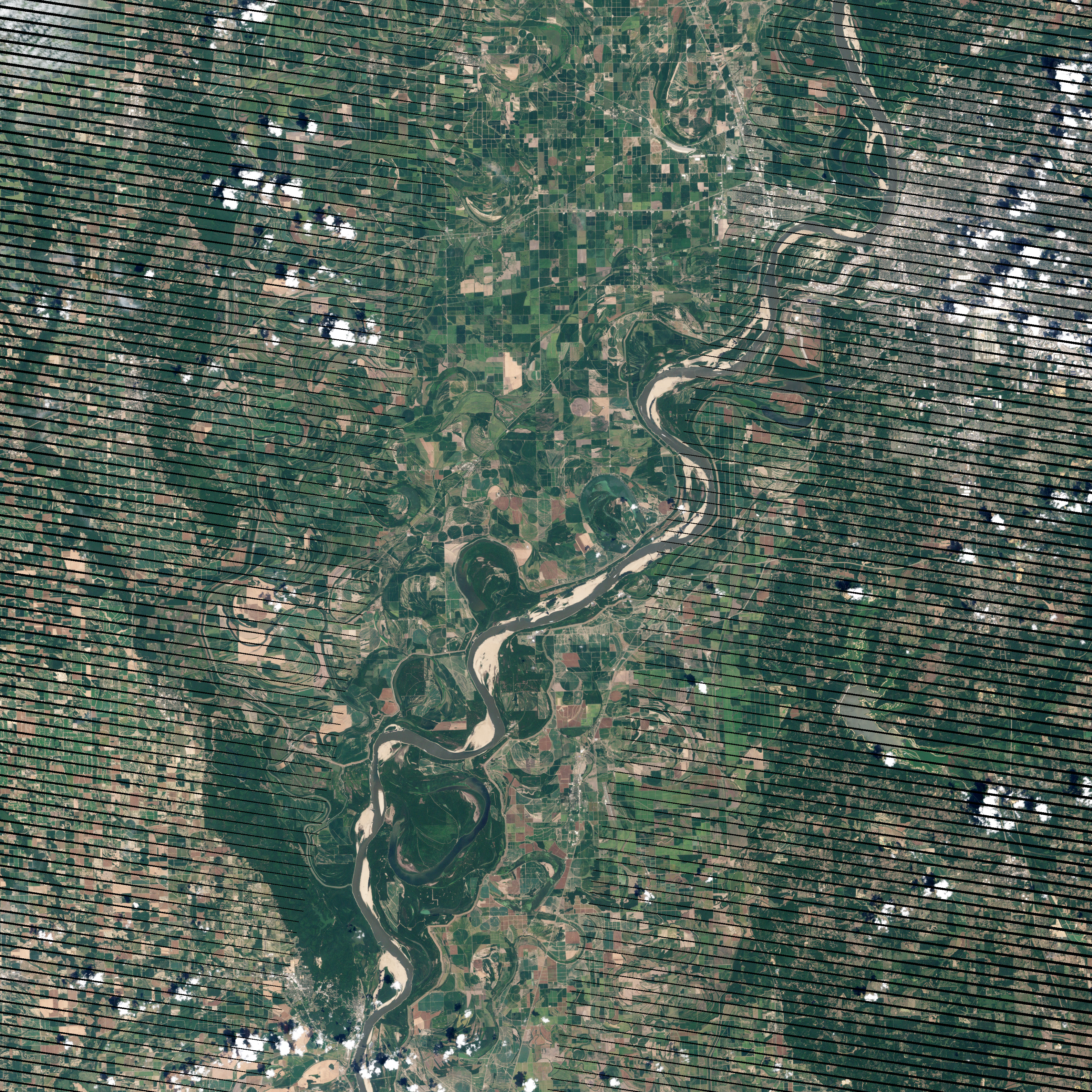
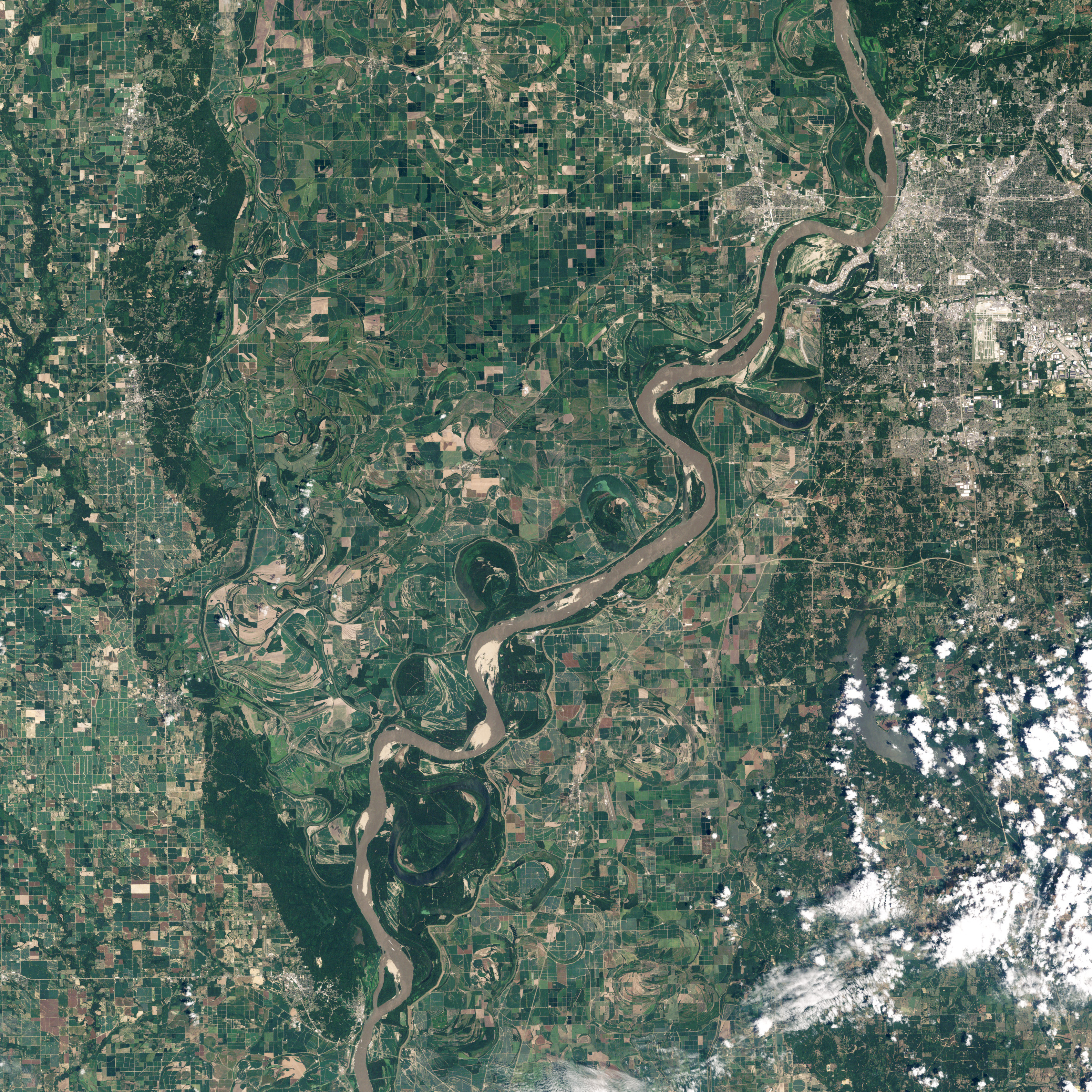
Mississippi River Well Below Normal : stretch of the river just south of Memphis, Tennessee

August 8, 2012

August 14, 2011

Show both images - Larger

acquired August 8, 2012 download large image (5 MB, JPEG, 3170x3170 - left)
acquired August 14, 2011 download large image (5 MB, JPEG, 3170x3170 - right)
acquired August 14, 2011 - August 8, 2012 download Google Earth file (KML) 

View Both Images

In the spring of 2011, the Mississippi River swelled to historic levels, rising out of its banks, rolling across a wide flood plain, and eating at flood barriers. The story in 2012 could not be more different: the river has reached record-low levels in places.

The contrast is illustrated in these two images, which show a stretch of the river just south of Memphis, Tennessee. Landsat 7 captured the top image on August 8, 2012, while Landsat 5 took the lower image on August 14, 2011. (The images are rotated so that north is to the left.) In the August 2011 image, the river was three months removed from the peak of the floods, and close to its normal level for the month. In August 2012, the river was several feet below the river stage for Memphis, and many sandbars were newly exposed or greatly expanded.

On August 17, 2012, water levels in the Memphis region were 2.4 to 8.3 feet below river stage. At the time of the August 2011 image (lower), the river was 11.7 feet above river stage. (In May 2011, the river peaked 56.6 feet above river stage in the same location.)

The Mississippi River is a major North American transit route, carrying goods to and from ports in New Orleans and Baton Rogue. The top image shows that low water levels have narrowed the river from a superhighway to a small road. The U.S. Army Corp of Engineers maintains a 9-foot shipping channel in the lower Mississippi and has dredges working around the clock to keep the channel clear. Not only are water levels low in 2012, but the floods of 2011 dropped a layer of sediment on the riverbed, reshaping previously open channels.

The reduced river flow in 2012 has translated into millions of dollars in extra shipping costs, as the loss of just one inch of draft means that a barge can carry 17 tons less than it otherwise would. The result is decreased shipping capacity.

Reduced water levels had one positive impact: The U.S. Army Corp of Engineers has been able to access and repair levees that were damaged in last year’s floods. The levees are the tan lines that surround the river in these images.

The low water levels followed record-setting temperatures and dry weather. By the end of July, 63 percent of the contiguous United States was in drought, affecting both crops and water supplies.

References
Advanced Hydrologic Prediction Service. (2012, August 17). Mississippi River at Memphis. NOAA National Weather Service. Accessed August 17, 2012.
Advanced Hydrologic Prediction Service. (2012, August 17). Mississippi River at Helena. NOAA National Weather Service. Accessed August 17, 2012.
American Waterways Operators. (2012, July 20). Nation’s waterways operators concerned about the impact of drought conditions, low water levels. Accessed August 17, 2012.
Mississippi National River and Recreation Area. (2012, August 1). Mississippi River Facts. National Park Service. Accessed August 17, 2012.
National Climate Data Center. (2012, August). State of the Climate National Overview for July 2012. NOAA. Accessed August 17, 2012.
U.S. Army Corps of Engineers. (2012, August 9). Communication, cooperation and coordination key to keeping Mississippi River open for commercial navigation. Accessed August 17, 2012.
U.S. Army Corps of Engineers. (2012, August 3). Mississippi-Ohio River confluence update. Accessed August 17, 2012.
Yang, J. (2012, August 15). Drought sends Mississippi into ‘uncharted territory.’ NBC News. Accessed August 17, 2012.

NASA Earth Observatory image created by Jesse Allen and Robert Simmon, using Landsat data provided by the United States Geological Survey. Caption by Holli Riebeek.

Aug 19, 2012

8 Reasons Not To Trust Monsanto With Your Food [Infographic] | Care2 Causes


Full Article: http://www.care2.com/causes/8-reasons-not-to-trust-monsanto-with-your-food-infographic.html
by Beth Buczynski
September 21, 2011

Here’s how Monsanto characterizes itself on its official Twitter profile:

“Monsanto is an agricultural company using innovation to help farmers produce more while conserving more.”

Sounds great, right?

What Monsanto doesn’t tell you is that their specialty is actually agricultural chemicals. Dangerous, untested chemicals. And genetic modification of food crops that’s been scientifically proven to be harmful to human health and the environment.

In the infographic below, artist Joe Mohr chronicles the company’s toxic and deadly past, and reasons why local, organic food should be the only thing gracing your cupboards and fridge.


More info on Monsanto’s past, present and future, including sources for this graphic, can be found here.

Related Reading:

Monsanto Corn At Farmers’ Markets?
Anonymous Activists Shut Down Monsanto Website
Research Links Monsanto’s Roundup To Root Fungus

Read more: agent orange, biotech, chemicals, ge, genetically modified, gmo, monsanto, organic

2012 US Biochar Conference | 2012 US Biochar Conference Presentations


These selected presentations are available for review. The work is owned by the authors and you should not repost the sildes without the premission of the author.

2012 Conference Presentations

Making Soils Smarter and Plants Happier with VermiChar Mike Flynn - Presentation File


Improving Soil Systems


High nitrogen supply alleviates reduced sugarbeet growth caused by hydrochar application Heinz-Josef Koch, Ph.D. - Presentation File


Biochar Use in Specialized Agricultural Settings


Biochar production by pyrolysis of lignocellulosic biomass in a conical spouted bed reactor Martin Olazar, Ph.D. - Presentation File


Mid-Sized Biochar Production Technologies


Make biochar for both public welfare and economic benefit Jun Meng, Ph.D. - Presentation File


Special Presentations by Chinese Delegation


Carbon Conservation for Home, Health, Energy & Climate Erich J. Knight - Presentation File


Carbon Conservation for Home, Health, Energy & Climate


Capturing Heat from a Small Biochar Production System Wayne S. Teel, Ph.D. - Presentation File


Small Biochar Production Technologies


Soil and Plant yield responses to Biochar application on temperate soils Stefanie Kloss - Presentation File


Biochar Use and Temperate Agriculture


Anaerobic Treatment of HTC Waste Water Benjamin Wirth - Presentation File


Special Issues in Biochar Use


Biochar, more than a soil amendment: Using Biochar to clean up flue gases in energy generation activities K. Thomas Klasson, Ph.D.


Reclamation Using Biochar: Mines and Industrial Sites


Conservation of Feedstock Nutrients in Pyrolysis Biochars Jatara Wise - Presentation File


Special Soil Effects II


Hydraulic Conductivity and Soil Water Retention of Soil-Biochar Mixtures Zuolin Liu - Presentation File


Biochar Science


Biochar Trials with Depleted Hawaiian Soils Adam Asquith, Ph.D. - Presentation File


Special Soil Effects I


Producing Backyard Biochar Dan McKenzie, PhD - Presentation File


Small Biochar Production Technologies


Northwest Perspective on Developing a Biochar Industry Presentation File


Biochar Remediated Reduction of Nitro Herbicides and Explosives Seok-Young Oh, Ph.D. - Presentation File


Non-Agricultural Uses of Biochar


Making biochar with specified properties Kelly Sveinson - Presentation File


Special Chars and Feedstocks


Using Lump Charcoal Byproducts as a Soil Amendment Michael Urban - Presentation File


Special Chars and Feedstocks


Biochar Application to Subarctic Soils Sunny Castillo - Presentation File


Improving Soil Systems


On-farm field experiment to investigate biochar effects on soil structure and N2O emissions Engil Isadora Pujol Pereira - Presentation File


Biochar Impacts on Nitrogen


Can biochar help save Sonoma County from climate change Alex Dolginow - Presentation File


Biochar 101


Stability and Safe Application of Fast Pyrolysis Biochar Bernardo del Campo - Presentation File


Char Characterization


Evaluation of sorbed PAH compounds on biochar Kurt Spokas, Ph.D. - Presentation File


Char Characterization


A survey of biochars: Interactions with dissolved ammonia and nitrate Kurt Spokas, Ph.D. - Presentation File


Biochar Impacts on Nitrogen


Impact of Biochar on Specialty Crop Production: Potential Positive and Negative Effects Kurt Spokas, Ph.D. - Presentation File


Biochar Use in Specialized Agricultural Settings


Biochar Industry Status Update Lopa Brunjes - Presentation File


Biochar Industry Status Update Presentation File

Farm Scale Skid Mounted Biochar Reactors in 2013 - Geoengineering: A Potential Biochar Application?

CHRIS MACHENS ON WEDNESDAY, 08 AUGUST 2012. POSTED IN CLIMATE SCIENCE, STUDY, CLIMATE STATE, NEWS

BIOCHAR CAN HELP TO COMBAT CLIMATE CHANGE

Could biochar potentially be used to fix nutrients to sustain and increase C Storage in thawing - decompositioning soils?

Higher temperature and decompo- sition rates can also increase nutrient availability, which often has a greater effect on plant growth than temperature (Chapin and Shaver 1996). Decomposition of soil C (in- cluding thawed permafrost C) with concomitant nutrient release could actually increase total ecosystem C storage if low C:N soil organic matter is replaced by higher C:N plant biomass (Shaver et al. 2000). http://www.aibs.org/bioscience-press-releases/resources/Schuur.pdf

SOIL AMENDMENTBiochar can be used as a soil amendment to improve yield, improve water quality, reduce soil emissions of greenhouse gases, reduce nutrient leaching, reduce soil acidity, and reduce irrigation and fertilizer requirementshttp://en.wikipedia.org/wiki/Biochar

The Intergovernmental Panel on Climate Change (IPCC) reported Biochar as a key technology for reaching low carbon dioxide atmospheric concentration targets. The negative emissions that can be produced by Bio-energy with carbon capture and storage (BECCS) has been estimated by the Royal Society to be equivalent to a 50 to 150 ppm decrease in global atmospheric carbon dioxide concentrations. Annual net emissions of carbon dioxide (CO2), methane and nitrous oxide could be reduced by a maximum of 1.8 Pg CO2-C equivalent (CO2-Ce) per year (12% of current anthropogenic CO2-Ce emissions; 1 Pg=1 Gt), and total net emissions over the course of a century by 130 Pg CO2-Ce, without endangering food security, habitat or soil conservation. WikipediaRelated Nitrous oxide emission reduction in temperate biochar-amended soil (2011) - Climate Change Mitigation from Pyrolysis- - Beaulieu and Tank suggest that reductions in nitrous oxide emissions from stream and river networks can be achieved through changes in urban and agricultural land use patterns, such as reduced agricultural fertilizer application.

RELATED ARTICLES
How biochar production could help climate change fight

ABOUT THE AUTHOR

CHRIS MACHENS
Editor in chief at Climate Progress Network.
info@climateprogress.net http://galaxymachine.de

COMMENTS (2)
ERICH J. KNIGHT
10 August 2012 at 03:07 | #
To review the broad scope of Biochar applications please read the text of my opening talk at the Sonoma Biochar conference.

If it intrigues you, you may hit the links and many citations, these cover the paleoclimatic rationale, the carbon conservation philosophy, many of the industrial practitioners and long-term academic programs & field trials.

If you are tantalized by the Biochar platform for biofuels, the cutting edge Big dog, Elephant in the room, at the Sonoma Biochar conference was CoolPlanet Energy Systems. In a nutshell, they have such control over carbon bonding in their thermal conversion process, they can squeeze out 75 gallons of bio- gasoline and 1/3 ton of Biochar from one ton of biomass.Their tag line; "The more you Drive… The Cleaner the Atmosphere". They state their production cost at $1.25/gallon, they turn a dial and can produce $2/gallon jet fuel. I can hear you saying this is too good to be true, however Google, GE, BP and Conoco believe it is true.
CoolPlanet Biofuel's CEO Explains his energy cycle:
http://www.youtube.com/watch?v=zkYVlZ9v_0o

This all leaves me very optimistic, for the CEO and Google share the same ethos, farm scale skid mounted reactors will be the first to production next year. This farmer friendly, scalable reactor, they plan to deploy at the village scale in the Third World and at the farmer scale here.

I believe this technology will allow the American public to have their carbon free energy lunch without paying a premium for it.

Cheers,

Erich
Erich J. Knight
Shenandoah Gardens
1047 Dave Berry Rd. McGaheysville, VA. 22840
540-289-9750 

In case you are having a problem finding my presentation PDF file with the PowerPoint slides, navigation is a little awkward, here is the link:
http://2012.biochar.us.com/299/2012-us-biochar-conference-presentations

--------

Carbon Conservation for Home, Health, Energy & Climate

CHRIS MACHENS
10 August 2012 at 12:00 | #
Thank you for this insightful comment Erich. I blogged about it here http://biochar.be and will later check out the conference presentations.

Cheers

+++++++++

Farm Scale Skid Mounted Biochar Reactors in 2013... Everyone who cares about a sustainable future should be excited!!!  Monte & Eileen Hines

Compliments of Monsanto "Roundup Ready" Pigweed - Weeds take root in crops, climate change, cuisine - CBS News


Compliments of Monsanto "Roundup Ready" Pigweed

"In 2012, we confirmed it in 76 Georgia counties, so we went from 500 acres to well over 2 million acres," Culpepper said.

How did it happen?

Ever hear of Roundup, yup that stuff that's advertised on TV.

Roundup, the commercial name for an herbicide called glyphosate, was marketed to farmers as a miracle weed killer. Monsanto, its manufacturer, genetically engineered cotton and soybean seeds so they were Roundup-resistant.

"Roundup used to be just a cure-all for everything," said farmer Harold Johnson.

Johnson farms 1,000 acres in Macon and neighboring Dooly counties. All he had to do was spray on Roundup. His Roundup-resistant crops lived. The pigweed died - until it didn't.

"Just all of a sudden, they would lay down, and then they'd stand right back up, and then it got to the point where they wouldn't even lay down," Johnson said.

The pigweed had genetically engineered itself and become Roundup-resistant too.

Now here's the terrifying part.

"This plant's gonna produce in excess of 500,000 seeds, one female plant," said Culpepper, "and if it survives, it produces a half-a-million seeds."

Desperate growers have deployed their own army against their enemy, like footsoldiers from another century, to hand-weed huge fields. And Dr. Pigweed has a warning.

"This plant has absolutely adapted to everything that we have done so far," Culpepper said.

Related Links:
http://hines.blogspot.com/2012/08/8-reasons-not-to-trust-monsanto-with.html

Welcome to the Rest of Our Lives - Global Warming - YouTube


Published on Jul 9, 2012 by greenman3610

Don't miss the Companion video at the Yale Forum on Climate Change & the Media
http://www.yaleclimatemediaforum.org/2012/07/sea-level-rise-focus-of-this-is-...

Dallas Hail Storm
http://www.msnbc.msn.com/id/47836374/ns/weather/t/dallas-hailstorms-pack-bill...
http://www.wfaa.com/news/local/Damage-from-hail-storm-may-exceed-400-million-...

http://www.wunderground.com/blog/JeffMasters/comment.html?entrynum=2123

Kevin Trenberth on PBS News hour
http://climatecrocks.com/2012/07/03/whats-causing-hot-temperatures-kevin-tren...

MIchael Oppenheimer on MSNBC
http://video.msnbc.msn.com/the-ed-show/48022172

Rex Tillerson speaking to the Council on Foreign Relations
http://www.youtube.com/watch?v=gj6cqbwfrYc

Peter Hoppe of Munich Re, Berlin 2011
http://www.youtube.com/watch?v=s1PCfaz30Rc

CNN expert on Derecho event
http://www.youtube.com/watch?v=K61qGvKltL8

Global Warming: 2012 Drought Update - YouTube


Published on Aug 19, 2012 by ClimateProgressWorld

A video edited by Peter Sinclair. The Drought of 2012 rivals the Great Dust Bowl years of the 30s and is coming at a time of melting arctic ice, shrinking ice sheets, and extreme events across the planet, matching the projections of Climate models for global warming.http://www.yaleclimatemediaforum.org/2012/07/sea-level-rise-focus-of-this-is-...

Don't miss the Companion video "Welcome to the Rest of Our Lives" - featuring Exxon CEO Rex Tillerson, who claims we can adapt...
http://www.youtube.com/watch?v=b0NrS2L6KcE&feature=plcp

Visit Peter Sinclair's blog "Climate Crocks"
http://climatecrocks.com

Following are video content links:

Dallas Hail Storm
http://www.msnbc.msn.com/id/47836374/ns/weather/t/dallas-hailstorms-pack-bill...
http://www.wfaa.com/news/local/Damage-from-hail-storm-may-exceed-400-million-...

http://www.wunderground.com/blog/JeffMasters/comment.html?entrynum=2123

Kevin Trenberth on PBS News hour
http://climatecrocks.com/2012/07/03/whats-causing-hot-temperatures-kevin-tren...

Michael Oppenheimer on MSNBC
http://video.msnbc.msn.com/the-ed-show/48022172

Rex Tillerson speaking to the Council on Foreign Relations
http://www.youtube.com/watch?v=gj6cqbwfrYc

Peter Hoppe of Munich Re, Berlin 2011
http://www.youtube.com/watch?v=s1PCfaz30Rc

CNN expert on Derecho event
http://www.youtube.com/watch?v=K61qGvKltL8

Heatwaves blamed on global warming
http://climatestate.com/pure-climate-science/item/heatwaves-blamed-on-global-...

For further coverage visit "Climate State" - documenting climate change.
http://climatestate.com

Biochar - Josiah Hunt on Vimeo


Josiah Hunt from Sonoma Biochar Initiative on Vimeo.

Related Videos: https://vimeo.com/user12930533/videos