What we have here is a completely new technology; it's a mobile batch pyrolysis plant. Pyrolysis is the low temperature thermal conversion of biomass to a product called biochar. So effectively we are cooking wood in a low oxygen environment at around 500 degrees in a very large slow combustion oven.
This spring students at the University of Illinois initiated a study of permaculture design at the Sustainable Student Farm on the South Farms of the Urbana, Illinois Campus. The study is called Restoration Agriculture, and the goal of the project is to compare the production of traditional corn and soy bean agricultural plots with plots that consist of woody perennials.
The restoration agriculture system is designed following the layers and niches of the oak savanna, which is a native ecosystem of much of the Upper Midwest, which includes Champaign-Urbana and the University of Illinois.
While much of the state of Illinois’ landscape is defined by miles and miles of corn and soybeans, Ron Revord and Kevin Wolz—the University of Illinois students collaborating on this project—seek to develop a system of agriculture that would return the Illinois landscape to trees, shrubs and grasses, while still accomplishing the task of producing enough food to feed the world.
The perennial woody plants this project utilizes to produce food are selected to replace the typical species found in the different layers of a native oak savanna. The oak tree, which represents the tallest canopy layer, is replaced with chestnut trees. The next layer of understory trees is typically occupied by Service Berries, Crab Apples, and Wild Cherries and Plum. The agricultural canopy employs select varieties of domestic apple trees that are disease resistant and cold hardy. The high shrub layer is naturally the hazelnut plant. Restoration Agriculture maintains the Hazelnut layer with a variety that is more cold hardy and produces larger nuts. The low shrub layer is then planted with productive varieties of current and raspberries and a vine layer is planted with table or wine grapes.
The key commodity crops of the Restoration Agriculture system are the Chestnut and the Hazelnut. Which nutritionally can replace corn and soybeans in our current industrial food system. In our current food system corn produces much of our carbohydrates and soybeans produce oils and proteins. When we compare the nutritional profiles of Chestnuts and Hazelnuts with Corn and Soybeans they are directly interchangeable. Chestnut it is almost identical with corn, as the majority of calories in Chestnuts are carbohydrates or sugars. Likewise, the nutritional profile of the hazelnut is primarily protein and oil, which is directly interchangeable for soy in our industrial food system.
By developing an agricultural model that mimics a native ecosystem, Revord and Wolz hope to restore ecosystem services, increase biodiversity and end dependence on fertilizers and pesticides.
Their study includes plots on the Sustainable Student Farm at the University of Illinois, Prairie Fruits Farms in Urbana Illinois and New Forest Farms in Viola Wisconsin.
Great to see Universities (in this case University of Illinois) getting involved in permaculture.
Resulting research facts can help to build a shift from our current destructive agricultural practices to biennial / polyculture / permaculture practices.
When I testified before the Senate in the hot summer of 1988 , I warned of the kind of future that climate change would bring to us and our planet. I painted a grim picture of the consequences of steadily increasing temperatures, driven by mankind’s use of fossil fuels.
But I have a confession to make: I was too optimistic.
My projections about increasing global temperature have been proved true. But I failed to fully explore how quickly that average rise would drive an increase in extreme weather.
... our analysis shows that, for the extreme hot weather of the recent past, there is virtually no explanation other than climate change.
In a new analysis of the past six decades of global temperatures, which will be published Monday, my colleagues and I have revealed a stunning increase in the frequency of extremely hot summers, with deeply troubling ramifications for not only our future but also for our present.
This is not a climate model or a prediction but actual observations of weather events and temperatures that have happened. Our analysis shows that it is no longer enough to say that global warming will increase the likelihood of extreme weather and to repeat the caveat that no individual weather event can be directly linked to climate change. To the contrary, our analysis shows that, for the extreme hot weather of the recent past, there is virtually no explanation other than climate change.
These weather events are not simply an example of what climate change could bring. They are caused by climate change. The odds that natural variability created these extremes are minuscule, vanishingly small. To count on those odds would be like quitting your job and playing the lottery every morning to pay the bills.
Twenty-four years ago, I introduced the concept of “climate dice” to help distinguish the long-term trend of climate change from the natural variability of day-to-day weather. Some summers are hot, some cool. Some winters brutal, some mild. That’s natural variability.
But as the climate warms, natural variability is altered, too. In a normal climate without global warming, two sides of the die would represent cooler-than-normal weather, two sides would be normal weather, and two sides would be warmer-than-normal weather. Rolling the die again and again, or season after season, you would get an equal variation of weather over time.
An clean energy economy ... is a simple, honest and effective solution.
But loading the die with a warming climate changes the odds. You end up with only one side cooler than normal, one side average, and four sides warmer than normal. Even with climate change, you will occasionally see cooler-than-normal summers or a typically cold winter. Don’t let that fool you.
Our new peer-reviewed study, published by the National Academy of Sciences, makes clear that while average global temperature has been steadily rising due to a warming climate (up about 1.5 degrees Fahrenheit in the past century), the extremes are actually becoming much more frequent and more intense worldwide.
When we plotted the world’s changing temperatures on a bell curve, the extremes of unusually cool and, even more, the extremes of unusually hot are being altered so they are becoming both more common and more severe.
The change is so dramatic that one face of the die must now represent extreme weather to illustrate the greater frequency of extremely hot weather events.
Such events used to be exceedingly rare. Extremely hot temperatures covered about 0.1 percent to 0.2 percent of the globe in the base period of our study, from 1951 to 1980. In the last three decades, while the average temperature has slowly risen, the extremes have soared and now cover about 10 percent of the globe.
This is the world we have changed, and now we have to live in it — the world that caused the 2003 heat wave in Europe that killed more than 50,000 people and the 2011 drought in Texas that caused more than $5 billion in damage. Such events, our data show, will become even more frequent and more severe.
There is still time to act and avoid a worsening climate, but we are wasting precious time. We can solve the challenge of climate change with a gradually rising fee on carbon collected from fossil-fuel companies, with 100 percent of the money rebated to all legal residents on a per capita basis. This would stimulate innovations and create a robust clean-energy economy with millions of new jobs. It is a simple, honest and effective solution.
Hines Farm Blog: Grow More Food & Fight Climate Change: Black... Mar 10, 2012 Bill McKibben "Biochar, produced in pyrolysis of residues from crops, forestry, and animal wastes, can be used to restore soil fertility while storing carbon for centuries to millennia."-- Dr. James Hansen (NASA climate scientist).
Hines Farm Blog: Top climate scientists warn Congress over ... Feb 13, 2012 James Hansen, Research Scientist, The International Research Institute for Climate and Society, The Earth Institute, Columbia University John Abraham, Associate Professor, School of Engineering, University of St. Thomas ...
Hines Farm Blog: Nine of the top ten warmest years in the modern... Jan 24, 2012 “We know the planet is absorbing more energy than it is emitting,” said GISS director James Hansen. “So we are continuing to see a trend toward higher temperatures. Even with the cooling effects of a strong La Niña influence ...
How to Solve the Climate Problem - by JAMES HANSEN Feb 15, 2010 How to Solve the Climate Problem - by JAMES HANSEN ... In summary, the backbone of a solution to the climate problem is a flat carbon emissions price applied across all fossil fuels at the source. This carbon price (fee, tax) ...
The Sophie Prize 2010 Goes to Dr. James E. Hansen Apr 07, 2010 Dr. James E. Hansen (born 1941) has played a key role in the development of our understanding of human impact on the climate for more than 30 years. He is a member of the National Academy of Sciences, an adjunct ...
Hines Farm Blog: Towards a Sustainable Economy - a knol by Sam ... Aug 22, 2011 Dr. James Hansen once calculated that reforestation of degraded land and improved agricultural practices that retain soil carbon together could draw down atmospheric carbon dixode by as much as 50 ppm, adding that this ...
Hines Farm Blog: Disarming the Biochar Wars | re:char Feb 17, 2010 We urge our readers to link to this article, as anti-biochar crusaders have resorted to unacceptable tactics such as spamming notable scientists like Dr. James Hansen and Prof. Johannes Lehmann. Read Whole Post ... Posted ...
Hines Farm Blog: Jason Aramburu on the Promise of Biochar ... Feb 17, 2010 Dr. James Hansen on Biochar and Storage of Carbon in Soil .....How to Solve the Climate Problem - by JAMES HANSEN... Sun or Moon Rise/Set Table for One Year · Whizbang Row Cover Hoop System · Biochar Overview ... Hines Farm Blog: Climate Change Contrarian Nonsense Apr 15, 2010 Several books that cut through the confusion are Storms of My Grandchildren by James Hansen, The Long Thaw, by David Archer, and The Rising Sea, by Orrin Pilkey and Rob Young. Posted by Monte at Thursday, April 15, ...
Hines Farm Blog: Brave Thinkers - Magazine - Atlantic Monthly Mar 11, 2010 The NASA climate expert James Hansen says that the carbon could be stored for “centuries to millennia.” Eprida hopes to use the biochar to soak up carbon dioxide at polluting factories and then bury it in areas with poor soil ...
Hines Farm Blog: BioChar Engineering :: Home Feb 17, 2010 According to NASA climate scientist Dr. James Hansen, biochar is one of the key ways to remove net carbon from the atmosphere. Biochar increases soil fertility and decreases net carbon in the atmosphere. The company is ...
Hines Farm Blog: Arrested at the White House: Acting as a Living... Aug 25, 2011 Now the question is: Will we do the same to the boreal forests of Canada. As NASA climatologist James Hansen has made all too clear, if we do so it's “essentially game over for the climate.” That message is getting through.
Hines Farm Blog: The lost civilization: Finding a reality-based frame ... Jun 27, 2010 And don't discount the informed, scientific warnings of James Hansen and others that we may be in the process of climatically snuffing out the entire circus, clowns and all. (Not that even this warning-of-all-warnings would ...
MSNBC Host and Editor-at-Large of The Nation Chris Hayes argues that the decline of meritocracy in U.S. leadership is resulting in elites that cannot help but fail. "We have a social model that is breaking down before our eyes," says Hayes, "a method of elite selection that is growing increasingly sclerotic, rigged, and corrupt."
After a series of court defeats over the past few years, Monsanto and friends are trying to use Congress to make an end-run around the courts and current law. Lawsuits brought by opponents of genetically engineered (GE) crops resulted in the temporary removal of two products -- Roundup Ready Alfalfa and Roundup Ready Sugarbeets -- from the market. If the biotechnology industry and the legislators they support have their way, future GE crops will not suffer the same fate.
Genetically engineered crops are plants that have had genes from other species inserted into their DNA. "Roundup Ready"crops like alfalfa and sugarbeets fall in a class of GE crops called "herbicide tolerant" crops, which are engineered to survive exposure to Monsanto's bestselling herbicide Roundup. Farmers spray their entire fields with Roundup, killing only the weeds. Monsanto profits by selling both the seeds and increased quantities of Roundup herbicide.
The "Big 6" pesticide and genetic engineering corporations -- BASF, Bayer, Dupont, Dow, Syngenta, andMonsanto -- have made millions while providing everyone else with questionable benefits and enormous risks. The riskiness of genetically engineered crops comes in part from their ability to cross-pollinate crops in other fields, spreading their genes far and wide. Once a new genetically engineered crop is introduced, the genie is out of the bottle, and those genes are in our food supply for good. Therefore, it's in everyone's interest (except for the biotech companies that stand to profit) to thoroughly examine any new crop before allowing it on the market.
GMOs Roll on Wheels Reagan Greased
The scene was initially set before the first genetically engineered crops existed, when the pro-industry Reagan administration crafted a lax regulatory framework (known as the "Coordinated Framework") requiring no new laws to regulate genetically engineered crops and animals, thus avoiding any public national debate on the issue. Instead, newly created GE plants would be treated as potential "pests" to other plants and reviewed by government agencies under stilted standards about whether the GE plants hurt other plants or protected animals like endangered species.
With the Coordinated Framework in place, the biotech industry had little to worry about. It had plenty of friends inside the USDA and the bar for "proving" its products were "not a pest" was not set terribly high. One after another, each genetically engineered crop was deregulated, allowing farmers to grow them commercially. Once they reached consumers, the products were not even labeled as "Genetically Modified Organisms" (GMOs), and many Americans had no idea their food had even changed.
Farmers and Consumer Groups Call a Halt in Court
Farmers vs Monsanto (Source: Food Democracy Now!)Everything was going along fine for industry, in fact, until the matter went to court. At issue was the deregulation of two crops, Roundup Ready alfalfa and Roundup Ready sugarbeets. Instead of completing an Environmental Impact Statement (EIS) prior to deregulating the crops, the USDA had only performed a more limited Environmental Assessment (EA). Performing an EA limits the level of public involvement in the assessment process as compared with an EIS, which can provide significant time for citizens to submit comments and concerns. For example, the USDA recently received 365,000 comments from citizens opposing the deregulation of Dow's GE "2,4-D corn" (2,4-D is an herbicide that was an ingredient in Agent Orange).
In both cases, Geertson Seed Farms v. Johanns and Center for Food Safety v. Vilsack, the courts ruled that the respective crops could not be deregulated until a full EIS was completed. Furthermore, the crops in question could not be planted until then -- even during the appeals process.
The USDA completed the required EIS's for both crops and, despite thousands of comments expressing concerns, approved the deregulation of Roundup Ready alfalfa in January 2011 and Roundup Ready sugarbeets in July 2012.
2012 "Ag Approps" Gives Props to the "Big 6"
This regulatory victory was not good enough for industry, however. Quietly, Rep. Jack Kingston (R-GA) wrote a gift to biotech companies into the 2013 agriculture appropriations ("Ag Approps") bill. Opponents of GMOs refer to this as the "Monsanto Protection Act." Beneficiaries of Kingston's "rider" to the bill (Section 733) -- such as Monsanto, which lobbied for it in the second quarter of 2012 -- refer to it as the "farmer assurance provision."
If the Ag Approps bill passes as written, if a court removes a GMO from the market after the USDA has deregulated it, the USDA will be required to grant a permit to plant that crop to any farmer who requests one, even if that crop's safety is in question or under review.
Buried Biotech Treasure in the 2012 Farm Bill
At the same time, another far-reaching provision favoring the biotech industry is in the works. Buried in the House version of the 2012 Farm Bill, sponsored by House Agriculture Committee chair Frank Lucas (R-OK), is an enormous gift to the biotech industry. The bill changes the Plant Protection Act (PPA) to limit the time and scope of future environmental assessments of GE crops.
The House farm bill as changed by Congressman Lucas alters the legal rules to cut corners on the environmental review by requiring only the more limited EA and by requiring the USDA to complete that review in a maximum period of a year and a half -- or else the GE crop is automatically approved. It also restricts the scope of that limited environmental review and forbids the spending of any money on any broader environmental analysis of the effect of the GMO.
The time limits set by Lucas make haste the official policy of the USDA. For details, see Biotech Riders in the 2012 Farm Bill on SourceWatch. As Dave Murphy, Executive Director of Food Democracy Now!, put it, the pro-biotech language hidden in the bill "will take the U.S. regulatory scheme on GMOs from farce to corporate fascism in one fell swoop."
How did this language find its way into the bill? Monsanto and others have been lobbying Congress on the "regulation of products of agricultural biotechnology under [the] Plant Protection Act and National Environmental Policy Act." Dow Chemical joined Monsanto, lobbying specifically on "deregulation of genetically modified organisms under the Plant Protection Act."
The public lobbying reports do not tell the full story of what Monsanto and Dow wanted specifically and how much money they have spent in the multitude of ways they seek to influence and pressure Congress, but -- as they say -- the proof is in the pudding. Which companies have submitted petitions to the USDA for deregulation of GMOs that would benefit most from the 90-day time limit written into the bill? Monsanto and Dow.
With the Future of Food on the Table, "Big 6" Play with "Weighty" Dice
With these measures buried in enormous bills that are considered "must pass" in order to fund government agencies and determine farm subsidies, the industry and its allies are continuing to avoid an open, honest, full national debate about the safety and risks of GMOs. Congress must pass bills to fund U.S. agriculture policy unless it decides to temporarily extend the terms of the Bush era farm bill.
Even though the USDA approved Monsanto's GMO beets and alfalfa over objections from organic farmers and other concerned citizens, the courts required a full EIS review that allowed the public to weigh in with an array of concerns that exist or are emerging about GE crops. But if the law is changed, as sought by Monsanto-friendly Congressmen like Kingston and Lucas and their buddies, the USDA -- already extremely favorable to biotech -- will lose the ability to do much more than rubberstamp GMO industry requests. More importantly, the courts will not be able to require more thorough environmental review, further opening the door to the haphazard introduction of new GE crops into our food supply, our farms, and our environment.
Jill Richardson is the founder of the blog "La Vida Locavore" and a member of the Organic Consumers Association policy advisory board. She is the author of Recipe for America: Why Our Food System Is Broken and What We Can Do to Fix It. She is a PRWatch guest contributor.
On April 5, the David Brower Center welcomed environmental scholar Wes Jackson as he discussed his recent book, "Consulting the Genius of the Place: An Ecological Approach to a New Agriculture" with Executive Director Amy Tobin. Jackson is the president and founder of The Land Institute, an organization committed to developing the field of Natural Systems Agriculture, which focuses on the ecological stability of systems.
Wes Jackson wisdom and knowledge on this subject is outstanding... Much too be learned in the short time required to watch this playlist... A must watch... These ideas are key to the future of humans on this planet... Monte Hines
No one sets out to get sunburned, but the pleasant distractions of summer—the long, sunny days, the beckoning beach, losing track of time in the garden—all make it easy to forget that extra coat of sunscreen, or the need to take a break in the shade. Of course, it’s best to avoid sunburn in the first place, given its ability to cause skin cancer and premature aging. Luckily, common foods in your kitchen possess sun-protection compounds to aid your current sun-protection routine. Others may not help prevent sunburn but offer surprising relief if you do accidentally catch too many rays.
Check out these natural food remedies to deal with—or prevent—summer sunburns:
1. Potatoes
Sunburn-fighting effect: Overindulging in potatoes may be a no-no if you’re trying to lose weight, but keep a few on hand in case a sunburn strikes. The potato’s starchy compounds will help take the sting out of sunburn.
Utilize it! Cut a raw potato into slices and rub a piece on your most painful sunburned spots. For a more intensive treatment, grate a cold raw potato and apply it as a poultice.
Sunburn-fighting effect: Green tea’s catechin compounds help protect against the sun’s harmful radiation; its tannic acid helps soothe sunburn pain.
Utilize it! Studies suggest drinking just two cups a day could help provide a bit of added sun protection. (You should still use other sun-protection methods, like nontoxic sunscreen, sun-protective clothing, and time in the shade.) If you’re suffering from a scorched face, soak two tea bags in cool water and apply them to your aching eyelids. Tea’s tannic acid will ease sunburn pain.
Sunburn-fighting effect: When your whole body is sunburned, oatmeal provides the best type of relief.
Utilize it! Grind up a cup of oatmeal in a food processor, add it to cool bathwater, and soak. You can also wrap dry oatmeal in cheesecloth or gauze, run cool water through it, and then toss the oatmeal and soak compresses in the liquid, applying every 2 to 4 hours.
Sunburn-fighting effect: Pomegranates are a rich source of ellagic acid, which can help protect your skin from UVA- and UVB-induced cell damage, according to research from the Department of Nutrition and Food Science at Texas A&M University.
Utilize it! Indulge in pomegranates during the summer months. The fruit’s anti-inflammatory and antioxidant properties could help add another layer of sun protection to your routine.
Sunburn-fighting effect: The berries' tannin content helps reduce the sting of a sunburn.
Utilize it! Mash a few ripened strawberries and slather on sunburns for natural relief. Rinse off after a few minutes. If you'd rather not go the fruit route to avoid stickiness, you can make a paste out of cornstarch and water and slather it over sunburned skin for relief, too.
Sunburn-fighting effect: Cucumbers offer sunburn relief on par with store-bought sunburn-relief products, without added with chemical preservatives and harmful fragrances.
Utilize it! If you’re already burned, mash a cucumber and apply it to your skin. Dian Dincin Buchman, Ph.D., author of The Complete Herbal Guide to Natural Health and Beauty, suggests cucumber can provide sun protection in a pinch, too. Grab an organic cucumber from the garden or farmers' market, peel and chop, and then squeeze the juice. Mix it with glycerin and rosewater for protection from the sun.
Sunburn-fighting effect: Lettuce’s natural pain-killing properties can help wipe away sunburn pain.
Utilize it! Boil lettuce leaves in water. Strain, then let the liquid cool for several hours in the refrigerator. Once chilled, dip cotton balls into the lettuce water and gently wipe over irritated skin.
Sunburn-fighting effect: An antioxidant-rich diet could help prep your skin for more potent sun protection before you even step foot outside. One guava contains about five times the amount of vitamin C, a skin-healing antioxidant, as a medium-sized orange.
Utilize it! Enjoy a guava here and there, but work more local vitamin-C-rich foods into your diet, too, including bell peppers, strawberries, and broccoli.
Sunburn-fighting effect: As if you need another reason to indulge in organic tomatoes from your farmers' market or garden. Turns out the red gems help protect your skin from sun damage. In one study, volunteers who ate 5 tablespoons of lycopene-rich tomato paste daily for 3 months enjoyed 25 percent more natural protection against sunburn.
Utilize it! Indulge in fresh tomatoes and add organic ketchup to meals for a lycopene burst.
Sunburn-fighting effect: Aloe is popular in many health drinks, but the succulent plant shows promise in sunburn relief, too.
Utilize it! Break off a leaf and apply the juice to your sunburned skin. (Test a small spot first to make sure you’re not allergic.) If you don’t have an aloe plant in the house, buy a bottle of pure aloe vera gel at a pharmacy, chill it in the fridge, and apply.
Sunburn-fighting effect: The milk creates a protein film on your skin that will help ease the discomfort of fresh sunburn.
Utilize it! Apply cool, not cold, milk to your skin using a clean cloth or gauze. Apply compresses for 15 to 20 minutes, and repeat every 2 to 4 hours.
Watch how to make a 5-star recipe for red beans and rice. Submitted by a Louisiana native, this recipe combines andouille sausage with kidney beans, serious Cajun seasonings, and the "holy trinity" of Louisiana cooking: onions, bell peppers, and celery. It's the perfect one-dish dinner.
Dr. James Hansen of NASA, says there is now enough evidence to connect global warming to some of the extreme weather events of the recent past. Hansen tells the Newshour that there is now a 1 in 10 chance of extreme heat events like the 2010 Texas/ Oklahoma droughts, the 2010 heat wave in Russia and possibly even the heat wave scorching the Midwest in 2012.
We should believe our "farm raised - truth to power - life long awarded scientists" instead of "politicians on the take" and big industry "paid lobbyist scientists". Time to wake up America and help make changes, before it is too late (may be too late already)... Monte & Eileen Hines
James Hansen has made key insights into our global climate -- and inspired a generation of activists and scientists.
Why you should listen to him:James Hansen is Adjunct Professor of Earth and Environmental Sciences at Columbia University’s Earth Institute. He was trained in physics and astronomy in the space science program of James Van Allen at the University of Iowa. His early research on the clouds of Venus helped identify their composition as sulfuric acid. Since the late 1970s, he has focused his research on Earth's climate, especially human-made climate change. Hansen is known for his testimony on climate change to congressional committees in the 1980s that helped raise broad awareness of the global warming issue. Hansen is recognized for speaking truth to power, for identifying ineffectual policies as greenwash, and for outlining the actions that the public must take to protect the future of young people and the other species on the planet. "The scientific excitement in comparing theory with data, and developing some understanding of global changes that are occurring, is what makes all the other stuff worth it."James Hansen
Quotes by James Hansen “Imagine a giant asteroid on a direct collision course with Earth. That is the equivalent of what we face now [with climate change], yet we dither.”
Watch this talk » “It would be immoral to leave young people with a climate system spiraling out of control.”
Hines Farm Blog: Grow More Food & Fight Climate Change: Black...
Mar 10, 2012
Bill McKibben "Biochar, produced in pyrolysis of residues from crops, forestry, and animal wastes, can be used to restore soil fertility while storing carbon for centuries to millennia."-- Dr. James Hansen (NASA climate scientist).
Hines Farm Blog: Top climate scientists warn Congress over ...
Feb 13, 2012
James Hansen, Research Scientist, The International Research Institute for Climate and Society, The Earth Institute, Columbia University John Abraham, Associate Professor, School of Engineering, University of St. Thomas ...
Hines Farm Blog: Nine of the top ten warmest years in the modern...
Jan 24, 2012
“We know the planet is absorbing more energy than it is emitting,” said GISS director James Hansen. “So we are continuing to see a trend toward higher temperatures. Even with the cooling effects of a strong La Niña influence ...
How to Solve the Climate Problem - by JAMES HANSEN
Feb 15, 2010
How to Solve the Climate Problem - by JAMES HANSEN ... In summary, the backbone of a solution to the climate problem is a flat carbon emissions price applied across all fossil fuels at the source. This carbon price (fee, tax) ...
The Sophie Prize 2010 Goes to Dr. James E. Hansen
Apr 07, 2010
Dr. James E. Hansen (born 1941) has played a key role in the development of our understanding of human impact on the climate for more than 30 years. He is a member of the National Academy of Sciences, an adjunct ...
Hines Farm Blog: Towards a Sustainable Economy - a knol by Sam ...
Aug 22, 2011
Dr. James Hansen once calculated that reforestation of degraded land and improved agricultural practices that retain soil carbon together could draw down atmospheric carbon dixode by as much as 50 ppm, adding that this ...
Hines Farm Blog: Disarming the Biochar Wars | re:char
Feb 17, 2010
We urge our readers to link to this article, as anti-biochar crusaders have resorted to unacceptable tactics such as spamming notable scientists like Dr. James Hansen and Prof. Johannes Lehmann. Read Whole Post ... Posted ...
Hines Farm Blog: Jason Aramburu on the Promise of Biochar ...
Feb 17, 2010
Dr. James Hansen on Biochar and Storage of Carbon in Soil .....How to Solve the Climate Problem - by JAMES HANSEN... Sun or Moon Rise/Set Table for One Year · Whizbang Row Cover Hoop System · Biochar Overview ... Hines Farm Blog: Climate Change Contrarian Nonsense
Apr 15, 2010
Several books that cut through the confusion are Storms of My Grandchildren by James Hansen, The Long Thaw, by David Archer, and The Rising Sea, by Orrin Pilkey and Rob Young. Posted by Monte at Thursday, April 15, ...
Hines Farm Blog: Brave Thinkers - Magazine - Atlantic Monthly
Mar 11, 2010
The NASA climate expert James Hansen says that the carbon could be stored for “centuries to millennia.” Eprida hopes to use the biochar to soak up carbon dioxide at polluting factories and then bury it in areas with poor soil ...
Hines Farm Blog: BioChar Engineering :: Home
Feb 17, 2010
According to NASA climate scientist Dr. James Hansen, biochar is one of the key ways to remove net carbon from the atmosphere. Biochar increases soil fertility and decreases net carbon in the atmosphere. The company is ...
Hines Farm Blog: Arrested at the White House: Acting as a Living...
Aug 25, 2011
Now the question is: Will we do the same to the boreal forests of Canada. As NASA climatologist James Hansen has made all too clear, if we do so it's “essentially game over for the climate.” That message is getting through.
Hines Farm Blog: The lost civilization: Finding a reality-based frame ...
Jun 27, 2010
And don't discount the informed, scientific warnings of James Hansen and others that we may be in the process of climatically snuffing out the entire circus, clowns and all. (Not that even this warning-of-all-warnings would ...
Steven Levitt, author of Freakonomics, recounts a story of talking economics and business practice with a prostitute while researching for SuperFreakonomics.
Very informative and entertaining... Steven Levitt full 50+ minute lecture was also very informative... economics from Levitt can be very insightful and interesting... Monte Hines
The pulser pump uses hydropower with no moving parts!
It is just pipes joined together. People have made pulser pumps and pulser pump models in Europe, Asia, and north America and posted them to youtube. Probably other places too.
( Please check out and make the pulser pump nano too. The nano began in 2011 as a suggestion from Virlusun on youtube) Nobody has ever made a pulser pump nano.
The one in the videos have worked for over 2 decades.
This idea was probably thought of and used (and lost) before I thought of it.
If you have ever seen a tromp powering an airlift pump to pump water (or reference to it), prior to 1986, please let me know. a entry, and more people will have confidence to use them.
The pulser pump began in 1988. This is a small one in Ireland. Thanks Wikipedia (june 08) for updating the definition for trompe at my request.
The Midwest: Most of the region registered above-normal temperatures for the period ending Tuesday morning. In fact, preliminary data show that July came in at 5-10 degrees above normal for the month of July. The region continues to be impacted not only by oppressive heat, but also by depleted soil moisture, desiccated pastures and widespread crop damages, livestock culling and elevated fire risk. ...
The discussion in the Looking Ahead section is simply a description of what the official national guidance from the National Weather Service (NWS) National Centers for Environmental Prediction is depicting for current areas of dryness and drought. The NWS forecast products utilized include the HPC 5-day QPF and 5-day Mean Temperature progs, the 6-10 Day Outlooks of Temperature and Precipitation Probability, and the 8-14 Day Outlooks of Temperature and Precipitation Probability, valid as of late Wednesday afternoon of the USDM release week. The NWS forecast web page used for this section is: http://www.cpc.ncep.noaa.gov/products/forecasts/.
The Northeast and Mid-Atlantic: Short-term dryness led to an introduction of D0 in eastern and northern Maine. Vermont, New Hampshire and eastern New York also shared in a slight reduction of D0 compared to last week. Moderate rains across a good portion of Pennsylvania led to 1-category improvements and this trend continued down into parts of northwestern Maryland, West Virginia and western Virginia. In the Carolinas, favorable rains improved the D1 along coastal South Carolina and led to a reduction of D0 in eastern North Carolina as well. Low streamflows and ground water levels have led to a slight expansion of D2 in the Delmarva Peninsula.
The Southeast: Good rains (3 to 5 inches) fell across most of Tennessee, and parts of central Alabama also shared in good rains last week, leading to widespread 1-category improvements this week. Alabama continues to be affected by the long-term nature of multi-year D2-D3 entrenched across the eastern half of the state. This pattern continues across the border into Georgia, which has not seen much rainfall of late either, leading to an expansion of D3 and D4 in north-central and northwestern locales.
The Midwest: Most of the region registered above-normal temperatures for the period ending Tuesday morning. In fact, preliminary data show that July came in at 5-10 degrees above normal for the month of July. The region continues to be impacted not only by oppressive heat, but also by depleted soil moisture, desiccated pastures and widespread crop damages, livestock culling and elevated fire risk. Recent concerns have now turned to soybeans and water supply as the drought’s duration persists. Some fared a bit better than others; southern Minnesota and southern and eastern Wisconsin benefitted the most from rains, leading to general 1-category improvements this week. Rains also fell across northern Indiana and southern Michigan, leaving things pretty much unchanged from last week. That said, there is a slight expansion of D3/D4 across western and central Indiana. Much of southern Ohio and eastern Kentucky also saw measurable improvement on the order of 1-category this week, pushing the drought to the west. Longer-term impacts still remain even given the short-term relief, but parts of eastern Kentucky and Ohio are seeing a rebound in streamflows, which is a good sign. In the western half of the region, things continue to worsen across Missouri and Arkansas, with continued deterioration and encroachment of D3 and even D4.
The Great Plains: Expansion is noted across most of the region this week as abnormally hot temperatures (5 to 10 degrees above normal) continue to plague the region, bringing stress to pastures, crops, livestock/wildlife, trees and humans alike. Rainfall during the last week was confined to small patches in the Black Hills and northeastern South Dakota and southeastern North Dakota. Those areas receiving the 2- to 3-inch rains were improved 1-category in the Dakotas. The same can’t be said to the rest of the region as D1-D3 continue to advance across more of eastern Nebraska, southeastern South Dakota, Kansas, Oklahoma and the Texas Panhandle. In Kansas and the Panhandles of Oklahoma and Texas, D4 has also expanded, given the intense conditions and extreme impacts being observed. These areas can’t seem to shake off last year’s drought and have now been dragged back into it this year, with the exception being southeastern Texas, which has continued to see a much more favorable wet pattern the past several months.
In addition to the large geographic footprint of this year’s drought, the quick onset and rapid ramping up of intensity, coupled with extreme temperatures and subsequent impacts, has really left an imprint on those affected and has set this drought apart from anything we have seen at this scale over the past several decades.
The West: The West remains relatively quiet in most parts, with the West Coast benefitting from below-normal temperatures last week as well. Warmer temperatures continue to plague the Rockies and Front Range while precipitation was mostly confined to Arizona and Colorado, where monsoon rains continue to bring relief. Changes this week on the map are marked by 1-category improvement (from D3 to D2) in north-central and southwestern Colorado as well as eastern Utah. The same can’t be said for southeastern Colorado, where D3 has now expanded to cover this region as well as northeastern New Mexico, western Kansas and the Oklahoma Panhandle. To the north, Montana has seen recent dryness as well, leading to a slight expansion of D0 across the northern tier counties.
Hawaii, Alaska and Puerto Rico: Most of the islands continue with the status quo this week, but deterioration is noted on both Kauai and Molokai this week, where lowland dryness continues to hinder pasture growth and is hampering livestock operations.
Alaska and Puerto Rico remain unchanged this week.
Looking Ahead: The 5-day forecast (August 1-6) calls for a mixed bag of potential, with the best chances of precipitation being located over western Colorado, the northern and Central Plains (including northwestern Minnesota), parts of the Upper Midwest, the Northeast and the Southeast. Temperatures are expected to be above normal in the Pacific Northwest, Northeast, and Southern Plains while the Northern Plains may come in a bit cooler than normal.
For the period August 7-11, a continuation of the recent pattern is expected to persist with above-normal temperatures dominating most of the country, the areas of exception being the West Coast and Florida. Below-normal precipitation appears likely in the southern and east-central Plains spreading into Missouri and northern Arkansas. Those areas projected to see a greater likelihood of precipitation are the Four Corners, Upper Great Lakes, Gulf Coast, Atlantic Seaboard and the northern tier states in the Northeast from New York to Maine.
Drought or Dryness Types
S ... Short-Term, typically <6 months (e.g. agricultural, grasslands)
L ... Long-Term, typically >6 months (e.g. hydrology, ecology)
On July 31st President Obama welcomed 96 winners of the Presidential Early Career Award for Scientists and Engineers (PECASE), the highest honor bestowed by the United States Government on science and engineering professionals in the early stages of their independent research careers. Hear, in their own words, what some of them are doing in the wide world of Science. Learn more on the White House website: http://www.whitehouse.gov/the-press-office/2012/07/23/president-obama-honors-...
Important and inspiring science work being recognized and funded so US can recapture our leadership role in the world of science... Monte & Eileen
“Discoveries in science and technology not only strengthen our economy, they inspire us as a people.” President Obama said. “The impressive accomplishments of today’s awardees so early in their careers promise even greater advances in the years ahead.”
The Presidential early career awards embody the high priority the Obama Administration places on producing outstanding scientists and engineers to advance the Nation’s goals, tackle grand challenges, and contribute to the American economy. The recipients are employed or funded by the following departments and agencies: Department of Agriculture, Department of Commerce, Department of Defense, Department of Education, Department of Energy, Department of Health and Human Services, Department of the Interior, Department of Veteran Affairs, Environmental Protection Agency, National Aeronautics and Space Administration, and the National Science Foundation, which join together annually to nominate the most meritorious scientists and engineers whose early accomplishments show the greatest promise for assuring America’s preeminence in science and engineering and contributing to the awarding agencies' missions.
The awards, established by President Clinton in 1996, are coordinated by the Office of Science and Technology Policy within the Executive Office of the President. Awardees are selected for their pursuit of innovative research at the frontiers of science and technology and their commitment to community service as demonstrated through scientific leadership, public education, or community outreach.
This year’s recipients are:
Department of Agriculture Joseph E. Jakes, U.S. Forest Service Ian Kaplan, Purdue University Christina L. Swaggerty, Agricultural Research Service
Department of Commerce Anthony Arguez, National Oceanic and Atmospheric Administration Ian Coddington, National Institute of Standards and Technology Frank W. DelRio, National Institute of Standards and Technology Jayne Billmayer Morrow, National Institute of Standards and Technology Kyle S. Van Houtan, National Oceanic and Atmospheric Administration Rebecca Washenfelder, National Oceanic and Atmospheric Administration
Department of Defense David M. Blei, Princeton University Ania Bleszynski Jayich, University of California, Santa Barbara Alejandro L. Briseno, University of Massachusetts, Amherst Lee R. Cambrea, Naval Air Research Intelligence Vincent Conitzer, Duke University Chiara Daraio, California Institute of Technology Craig J. Fennie, Cornell University Keith Edward Knipling, Naval Research Laboratory, Department of the Navy Wen Li, Wayne State University Timothy K. Lu, Massachusetts Institute of Technology Cindy Regal, University of Colorado Boulder Matthew B. Squires, Air Force Research Laboratory, Department of the Air Force Joseph E. Subotnik, University of Pennsylvania Ao Tang, Cornell University C. Shad Thaxton, Northwestern University Maria Laina Urso, U.S. Army Research Institute for Environmental Medicine
Department of Education Li Cai, University of California, Los Angeles
Department of Energy Stanley Atcitty, Sandia National Laboratories Jeffrey W. Banks, Lawrence Livermore National Laboratory Amy J. Clarke, Los Alamos National Laboratory Derek R. Gaston, Idaho National Laboratory Christopher Hirata, California Institute of Technology Heileen Hsu-Kim, Duke University Thomas Francisco Jaramillo, Stanford University Pablo Jarillo-Herrero, Massachusetts Institute of Technology John R. Kitchin, Carnegie Mellon University Peter Mueller, Argonne National Laboratory Daniel B. Sinars, Sandia National Laboratories Jesse Thaler, Massachusetts Institute of Technology Heather Whitley, Lawrence Livermore National Laboratory
Department of Health and Human Services Erez Lieberman Aiden, Harvard University Nihal Altan-Bonnet, Rutgers University Peter D. Crompton, National Institute of Allergy and Infectious Diseases Margherita R. Fontana, University of Michigan School of Dentistry Ervin Ray Fox, University of Mississippi Medical Center Valerie Horsley, Yale University Steven T. Kosak, Northwestern University Feinberg School of Medicine Erica N. Larschan, Brown University Daniel R. Larson, National Cancer Institute Krista M. Lisdahl, University of Wisconsin – Milwaukee Emanual M. Maverakis, University of California, Davis Biju Parekkadan, Massachusetts General Hospital and Harvard Medical School Jay Zachary Parrish, University of Washington Peter Philip Reese, University of Pennsylvania Niels Ringstad, Skirball Institute, New York University School of Medicine Pawan Sinha, Massachusetts Institute of Technology Georgios Skiniotis, University of Michigan Beth Stevens, F.M. Kirby Neurobiology Center, Boston Children's Hospital Justin Taraska, National Heart, Lung, and Blood Institute Jennifer Rabke Verani, National Center for Immunization and Respiratory Diseases Brendan M. Walker, Washington State University Lauren Bailey Zapata, National Center for Chronic Disease Prevention and Health Promotion
Department of the Interior Joseph P. Colgan, U.S. Geological Survey Karen R. Felzer, U.S. Geological Survey Justin J. Hagerty, U.S. Geological Survey
Department of Veterans Affairs Jeffrey R. Capadona, Louis Stokes Cleveland Veteran Affairs Medical Center Charlesnika T. Evans, Edward Hines Jr. Veterans Affairs Hospital Amy M. Kilbourne, Veterans Affairs Ann Arbor Healthcare System Kinh Luan Phan, Jesse Brown Veterans Affairs Medical Center
Environmental Protection Agency Adam P. Eisele, U.S. Environmental Protection Agency Mehdi Saeed Hazari, U.S. Environmental Protection Agency
National Aeronautics and Space Administration Morgan B. Abney, Marshall Space Flight Center Ian Gauld Clark, Jet Propulsion Laboratory and California Institute of Technology Temilola Fatoyinbo-Agueh, Goddard Space Flight Center Jessica E. Koehne, Ames Research Center Francis M. McCubbin, Institute of Meteoritics, University of New Mexico Yuri Y. Shprits, University of California, Los Angeles
National Science Foundation Baratunde Aole Cola, Georgia Institute of Technology Brady R. Cox, University of Arkansas Meghan A. Duffy, Georgia Institute of Technology Joshua S. Figueroa, University of California, San Diego Michael J. Freedman, Princeton University Erin Marie Furtak, University of Colorado Boulder B. Scott Gaudi, The Ohio State University Curtis Huttenhower, Harvard University Christopher A. Mattson, Brigham Young University David C. Noone, University of Colorado Boulder Parag A. Pathak, Massachusetts Institute of Technology Alice Louise Pawley, Purdue University Amy Lucía Prieto, Colorado State University Mayly C. Sanchez, Iowa State University and Argonne National Laboratory Sridevi Vedula Sarma, Johns Hopkins University Suzanne M. Shontz, Pennsylvania State University Mariel Vázquez, San Francisco State University Luis von Ahn, Carnegie Mellon University Brent R. Waters, University of Texas, Austin Jennifer Wortman Vaughan, University of California, Los Angeles
Why are we told a broken system that creates vast inequality is the only choice? Spain's amazing co-op is living proof otherwise
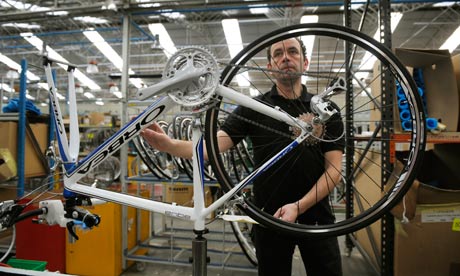
Dani Martinez, innovation director at Orbea bicycles, part of Mondragon Co-operative Corporation, in Mallabia, 2011. Photograph: Vincent West/Westphoto for the Guardian
There is no alternative ("Tina") to capitalism?
Really? We are to believe, with Margaret Thatcher, that an economic system with endlessly repeated cycles, costly bailouts for financiers and now austerity for most people is the best human beings can do? Capitalism's recurring tendencies toward extreme and deepening inequalities of income, wealth, and political and cultural power require resignation and acceptance – because there is no alternative?
I understand why such a system's leaders would like us to believe in Tina. But why would others?
Of course, alternatives exist; they always do. Every society chooses – consciously or not, democratically or not – among alternative ways to organize the production and distribution of the goods and services that make individual and social life possible.
Modern societies have mostly chosen a capitalist organization of production. In capitalism, private owners establish enterprises and select their directors who decide what, how and where to produce and what to do with the net revenues from selling the output. This small handful of people makes all those economic decisions for the majority of people – who do most of the actual productive work. The majority must accept and live with the results of all the directorial decisions made by the major shareholders and the boards of directors they select. This latter also select their own replacements.
Capitalism thus entails and reproduces a highly undemocratic organization of production inside enterprises. Tina believers insist that no alternatives to such capitalist organizations of production exist or could work nearly so well, in terms of outputs, efficiency, and labor processes. The falsity of that claim is easily shown. Indeed, I was shown it a few weeks ago and would like to sketch it for you here.
In May 2012, I had occasion to visit the city of Arrasate-Mondragon, in the Basque region of Spain. It is the headquarters of the Mondragon Corporation (MC), a stunningly successful alternative to the capitalist organization of production.
MC is composed of many co-operative enterprises grouped into four areas: industry, finance, retail and knowledge. In each enterprise, the co-op members (averaging 80-85% of all workers per enterprise) collectively own and direct the enterprise. Through an annual general assembly the workers choose and employ a managing director and retain the power to make all the basic decisions of the enterprise (what, how and where to produce and what to do with the profits).
As each enterprise is a constituent of the MC as a whole, its members must confer and decide with all other enterprise members what general rules will govern MC and all its constituent enterprises. In short, MC worker-members collectively choose, hire and fire the directors, whereas in capitalist enterprises the reverse occurs. One of the co-operatively and democratically adopted rules governing the MC limits top-paid worker/members to earning 6.5 times the lowest-paid workers. Nothing more dramatically demonstrates the differences distinguishing this from the capitalist alternative organization of enterprises. (In US corporations, CEOs can expect to be paid 400 times an average worker's salary – a rate that has increased 20-fold since 1965.)
Given that MC has 85,000 members (from its 2010 annual report), its pay equity rules can and do contribute to a larger society with far greater income and wealth equality than is typical in societies that have chosen capitalist organizations of enterprises. Over 43% of MC members are women, whose equal powers with male members likewise influence gender relations in society different from capitalist enterprises.
MC displays a commitment to job security I have rarely encountered in capitalist enterprises: it operates across, as well as within, particular cooperative enterprises. MC members created a system to move workers from enterprises needing fewer to those needing more workers – in a remarkably open, transparent, rule-governed way and with associated travel and other subsidies to minimize hardship. This security-focused system has transformed the lives of workers, their families, and communities, also in unique ways.
The MC rule that all enterprises are to source their inputs from the best and least-costly producers – whether or not those are also MC enterprises – has kept MC at the cutting edge of new technologies. Likewise, the decision to use of a portion of each member enterprise's net revenue as a fund for research and development has funded impressive new product development. R&D within MC now employs 800 people with a budget over $75m. In 2010, 21.4% of sales of MC industries were new products and services that did not exist five years earlier. In addition, MC established and has expanded Mondragon University; it enrolled over 3,400 students in its 2009-2010 academic year, and its degree programs conform to the requirements of the European framework of higher education. Total student enrollment in all its educational centers in 2010 was 9,282.
The largest corporation in the Basque region, MC is also one of Spain's top ten biggest corporations (in terms of sales or employment). Far better than merely surviving since its founding in 1956, MC has grown dramatically. Along the way, it added a co-operative bank, Caja Laboral (holding almost $25bn in deposits in 2010). And MC has expanded internationally, now operating over 77 businesses outside Spain. MC has proven itself able to grow and prosper as an alternative to – and competitor of – capitalist organizations of enterprise.
During my visit, in random encounters with workers who answered my questions about their jobs, powers, and benefits as cooperative members, I found a familiarity with and sense of responsibility for the enterprise as a whole that I associate only with top managers and directors in capitalist enterprises. The easy conversation (including disagreement), for instance, between assembly-line workers and top managers inside the Fagor washing-machine factory we inspected was similarly remarkable.
Our MC host on the visit reminded us twice that theirs is a co-operative business with all sorts of problems:
"We are not some paradise, but rather a family of co-operative enterprises struggling to build a different kind of life around a different way of working."
Nonetheless, given the performance of Spanish capitalism these days – 25% unemployment, a broken banking system, and government-imposed austerity (as if there were no alternative to that either) – MC seems a welcome oasis in a capitalist desert.
Jerry Enzler is being honored as a Champion of Change for his time and effort developing innovative ways to help grow and expand the transportation industry.
Our country was founded by river people, and still today hundreds of thousands of people owe their jobs to river borne commerce. The people who move the nation’s goods on our rivers today are the descendants of the early flat boat shippers, steamboat pilots, engineers, and towboat deckhands. RiverWorks Discovery (RWD), a nationally recognized education outreach program, tells this story to children and their families and shows how those who work the river are also concerned about river culture and conservation.
RWD brings together the for-profit industry, community leaders, museums, nature centers, educators, and the general public in recognition of the role our rivers have played and will continue to play in our nation's future. With 70 co-sponsors and 30 non-profit partners nationwide, RWD provides free educational materials and presentations to the public, reaching over 400,000 children and families through festivals, conferences, seminars, school presentations, and hands-on workshops.
RWD engages the public with the role of rivers in our nation's future and encourages people to develop a personal relationship with their local waterway. It widens community acceptance in support of safe, healthy, multi-use rivers in major metropolitan areas. The Who Works the Rivers career awareness program introduces older students to the opportunities for careers in our maritime river industry. Education about this often unknown or under-appreciated mode of transportation offers a more complete understanding of the history and importance of the inland shipping industry and multi-use waterways.
RWD inspires good environmental stewardship of our nation's waterways and watersheds. Our "Kids for Clean Rivers Pledge" outlines positive action steps for children and their families, and scouts can earn a patch for completing specific activities. RWD Programs correlate to state standards and are multi-disciplinary focusing on math, history, geography, and mapping.
RWD was the vision of, and championed by, Mark Knoy when he was president of AEP River Operations, and outstanding support continues with AEP River Operations president Keith Darling and other industry leaders. Developed by Mark Carr of AEP working with Errin Howard and others, RWD advanced substantially under the leadership of Teri Goodmann at the National Mississippi River Museum & Aquarium. Ginger Sakas, Errin Howard, Mark Wagner and others at the River Museum now manage the program and its upcoming RWD travelling exhibit. The Museum & Aquarium, a Smithsonian Affiliate, is the largest river museum in the country and is part of a $400 million riverfront development in Dubuque, Iowa. We are excited to continue with so many inspired partners to tell the big story of America’s rivers.
"...manufacturing giant Caterpillar was seeking major concessions during contract negotiations with striking workers, even as it was making billions in profits and giving its CEO a 60 percent pay boost. The New York Times' Steven Greenhouse added more details today, noting that the company wants to implement a six-year pay freeze and a pension freeze, at a time when it is making record profits...".* The Young Turks host Cenk Uygur breaks it down on The Young Turks.
Mississippi River at Davenport, Iowa Photo 1 - May 1931
Low water looking northeast from Arsenal Island towards Iowa shoreline. In the early years before navigation improvements, the Mississippi River experienced wide fluctuations of high and low water. Backwater fish and wildlife habitat was limited prior to lock and dam construction and pooling of the River. During many summer seasons, low water completely stopped traffic on the Mississippi. Oftentimes, water levels were low enough to walk across the River from Iowa to Illinois. Here, three residents walk on the floor of the Mississippi.
Glad we have a government operated lock and dam system on the Upper Mississippi River to maintain water levels and provide for fish and wildlife and human resources. As climate change impacts become more apparent, we are fortunate to have this resource in "our backyard"... Monte & Eileen Hines
Fraternities, sororities and football, along with other outsized athletic programs, have decimated most major American universities. Scholarship, inquiry, self-criticism, moral autonomy and a search for artistic and esoteric forms of expression—in short, the world of ethics, creativity and ideas—are shouted down by the drunken chants of fans in huge stadiums, the pathetic demands of rich alumni for national championships, and the elitism, racism and rigid definition of gender roles of Greek organizations. These hypermasculine systems perpetuate a culture of conformity and intolerance. They have inverted the traditional values of scholarship to turn four years of college into a mindless quest for collective euphoria and athletic dominance. Read more
I was raised on a small farm in Illinois. My wife, Eileen and I and family have worked together hand and hand on this farm (and adjoining land we bought) since 1966. I attended and graduated University of Illinois, Champaign-Urbana, IL. I received a Bachelor of Science Degree (Cum Laude)in Agricultural Engineering in 1970.
I worked as a registered Professional Engineer for the Rock Island District, US Army Corps of Engineers for 33 years, before retiring. I held several supervisory positions while at Corps: Chief, Regulatory Branch, Assistant Chief of Operations Division, Chief of the Lock and Dam Branch, and Mississippi River Project Manager. One highlight of my career was developing NIC (Google "NIC - Navigation Information Connection") during the early 90's, in a joint effort, with the District's Information Management personnel and Navigation Industry Representatives.
My wife and I have 2 grown children and 4 grandchildren. We have businesses associated with farming, "live edge" furniture making, vegetable produce, and graphics. We enjoy pursuing our hobby interests.




 Posts


