Nov 24, 2011

Occupy, Tea Party, and the Politics of Less | SmartPlanet

By Chris Nelder | November 23, 2011


Beneath the complex narratives of the Occupy and Tea Party movements, and beneath the unfolding collapse of our complex global financial system, is a simpler narrative about energy. Yet this narrative continues to elude most observers, because they don’t understand the fundamental relationship between energy and the real economy. This week I’ll attempt to tell a simple version of that story, in the plainest possible terms, and explain the Occupy and Tea Party movements in that context.


Let’s begin with some economic history.


For nearly all of U.S. history up through the late 1960s, the production of energy, especially oil, had grown continuously. And economic activity, as measured by GDP, grew right along with it.


At the same time, the U.S. dollar was pinned to gold, first under a gold standard requiring the Federal Reserve to maintain 40 percent of its outstanding paper currency in gold reserves, and then under the Bretton Woods Agreement of 1944, which created the International Monetary Fund (IMF) and set exchange rates for various national currencies in terms of US dollars, which in turn were convertible to gold at the rate of $35 an ounce.


Thus the growth of the U.S. economy was pinned to oil and to gold, both hard assets. It helped to keep inflation and deficit spending under control, but it also checked economic growth.


By 1971, however, the costs of the Vietnam War and the end of the post-war infrastructure building spree had stalled economic growth, and spending began to exceed revenues. Growth was further stymied by U.S. oil production, which had peaked in the previous year and begun to decline.


Source: EIA


This was intolerable, because the U.S. had debt, which is a claim on future productivity. Without growth, debt cannot be repaid, making growth an economic imperative.


President Nixon’s solution was to abandon the virtual gold standard entirely, ending the convertibility of dollars into gold and effectively placing the world’s monetary system on a fiat basis denominated in U.S. dollars. Thus in 1971 we entered a new era, in which organic growth driven by increasing energy supply and actual productivity was replaced by artificial growth fueled by debt.


Source: Reading Nature’s Signals


At the time, the expectation of continued growth justified the departure from the gold peg, and oil supply wasn’t yet recognized as a concern. Crude from the Middle East was cheap and abundant, and the largest oil field in North America had just been discovered in 1968. Analysts of the day would have had little reason to fear that debt would run away from the real economy.


But as we can see, that’s exactly what happened. GDP continued to rise at roughly its historical rate, outpacing the faltering growth of energy supply, but it was at the expense of a burgeoning debt load, as shown in this close-up of the years 1965 to 2007:


Source: Sudden Debt


The obvious result of the debt explosion was a debasement of the dollar, in real terms, and a declining net surplus to society. Average working households experienced this as household debt exceeding real disposable income, starting around 1983. In order to thwart the resulting “stagflation,” we loosened financial regulation and borrowing restrictions, which permitted us to blow more bubbles: first the dot-com bubble, then the housing bubble, and then the debt bubble:


Source: San Francisco Fed, marked up by Dave Cohen


The ultimate result was the blow-off of the debt bubble in 2008 and subsequent economic decline as we began the long process of debt deleveraging.


The same cycle, operating over somewhat different time frames and scales, has been happening to most of the world, led first by the demands of remaining competitive in a globalized economy with a major actor becoming a major debtor and currency debaser, then by the flattening-out of world oil supply, starting in 2005. In the pithy formulation of my colleague Gregor Macdonald, “In the old oil cycle, such sovereign debt problems were merely a function of profligacy. In the new oil cycle, a debt crisis is no longer solvable with growth.”


The end of the growth acid trip


We now find ourselves with a global financial regime that is literally teetering on the brink of the abyss. The debt crisis in Europe is an echo of the banking crisis we had in the U.S. in 2008, with MF Global (leveraged 40 to 1 on European debt to equity) playing the part of Lehman Brothers (leveraged 30 to 1 on toxic mortgage debt), and Greece, Italy and Spain playing the uncreditworthy borrowers, Fannie Mae and Freddie Mac. Except in this go-round, France and Germany (playing the part of the US public) and the ECB (playing the part of the Fed) aren’t going along with the script. Rather than monetizing the European debt to infinity and beyond and socializing the losses, they are thinking about skipping out the backstage exit door for a drink and a smoke, and just letting the rest of the players sort out the rest of Act III for themselves: worst case, a global plunge into a deflationary vortex, wiping out most of the financial “wealth” in the developed world.


The fundamental problem from a theoretical standpoint, as I discussed a few weeks ago in “Economic theory and the Real Great Contraction,” is that economic theorists are, in the words of sociologist John Bradford, “unaware of the essential role that energy played in the creation and maintenance of the [economic] order.” (He has a good argument, and I encourage economics geeks to explore that link.) The apparent decoupling of energy from economic growth in the U.S. has emboldened some optimists to claim that energy intensity has increased, and that economic growth has cast off its shackles to primary energy supply. But that illusion vanishes too, after adjusting for offshoring of manufacturing over the last 30 years, and the drawdown of capital stocks. As Gail Tverberg showed this week, on a global basis, energy intensity has remained flat. Economic growth is essentially and unequivocally inseparable from energy growth.


During periods of plenty, laissez-faire economics mainly functions as a way of calling forth supply (of energy, food, and other essentials), but during periods of less, they mainly ration demand: if you can’t pay, you don’t get any. Periods of energy surplus beget positive feedback loops, in which higher demand calls forth greater supply, more debt, and more peace. But periods of energy deficit beget negative feedback loops, where declining energy return on investment (EROI) leads to declining surplus, debt deflation, less peace, less freedom, and ultimately a decline in production and trade.

Source: “Revisiting the Limits to Growth After Peak Oil,” Hall, Day, American Scientist May-June 2009


The declining surplus of real economic wealth, as underpinned by energy and other hard assets like food production and water, has been masked by hallucinatory, debt-driven wealth. But like the tenth hour of a technicolor acid trip at the most decadent party in human history, the hallucination of wealth is now beginning to wear off, and the cold, gray light of dawn is revealing some ugly shadows.


In the growing gap between real wealth and hallucinated wealth, those with the most wealth were able to game the system and capture more of the declining surplus available to society via various mechanisms: cuts in taxes on capital gains and dividends (which don’t figure in the incomes of average people), cuts in the marginal tax rates of the top income earners, shifting a greater share of the income to corporate structures, and floating individually to the top of globalized companies that continued to grow even as the center of the domestic economy was being hollowed out.


Source: Alan de Smet


The Politics of Less


This brings us to the heart of the Occupy and Tea Party movements. While I would give neither movement undue credit for having an intellectual grasp on the details of economics or energy that brought us to this point, both movements are essentially a response to the declining net surplus available to society. And this is making the banks very nervous. As a memo from the lobbying firm Clark Lytle Geduldig Cranford to the American Bankers Association, recently exposed by Chris Hayes at MSNBC, said:


“Well-known Wall Street companies stand at the nexus of where OWS protestors and the Tea Party overlap on angered populism. Both the radical left and the radical right are channeling broader frustration about the state of the economy and share a mutual anger over TARP and other perceived bailouts.”


They may not fully understand how it happened, or why, but the average Occupy or Tea Party protestor understands one thing: they are getting poorer. The rest of the debate is about the tactics of what to do about it: redistributing the remaining surplus, or shrinking the slice of that surplus consumed by government. Shall we cut the “entitlement programs” of surplus—Medicare and Social Security—or redistribute the wealth to allow them to continue? To reframe it another way, the Occupy movement is the “Help Me Party,” and the Tea Partiers are the “Help Yourself Party.”


The failure of the so-called Supercommittee to come to any agreement on how to cut a mere $1.2 trillion from the federal budget reflects how difficult it is to come to grips with the declining surplus, or as a hedge fund manager friend of mine (I’ll call him Mr. X) puts it: the Politics of Less.


The historical script for the Politics of Less is clear, as Mr. X reminds me constantly: “The period 1770-1815 was marked by bank runs, currency collapse and sovereign defaults. The politics of less led to revolution. So did the great ‘Victorian’ depression 1873-1905. Humans have had social cohesion, or non-coercion, but not both. And certainly not in times of scarcity. The Old Law will return. Cry havoc and loose the dogs of war.” Heavy-handed crackdowns on protesters, surveillance of subversive elements, mass withdrawals from banks, and sovereign debt defaults are all part of the standard story arc.


The political and economic systems that worked in the age of surplus can no longer produce social cohesion. Measured in hard assets, it becomes a fight to maintain one’s standard of living; measured in currency, it becomes a global race to the bottom (currency devaluation).


On a purely mathematical basis, absent a massive redistribution of wealth and a transition to a renewably-powered economy, we are now on a descent trajectory that will bring us to the point where the resource base times the efficiency of production equals consumption times population. That equation suggests a global population of around 1.5 billion or less by the end of this century, or a loss of about five-sixths of the world’s population from peak (circa 2020) to trough (circa 2100).


This leads us to some very fundamental, even existential, questions. Faced with the Politics of Less, can we stomach coerced wealth redistribution, or will we simply let the system collapse? Do you bet on a global expansion of consciousness such that we recognize we are all One and link arms, singing Kumbaya? Or do you get busy on your hilltop doomstead, equipped with backup energy, food, water, ammunition, and gold? Do you join your brothers and sisters in the streets, or do you withdraw to your tribe and erect a security fence on the perimeter?


There are no quick fixes to this challenge. It has evolved over roughly half a century, through Democratic and Republican regimes alike, and we have roughly half a century to respond to it, starting right now. Any response that doesn’t address the fundamental issue of declining net energy is doomed to fail. I like to think we can respond intelligently, and I would never short human ingenuity and compassion. On the other hand, it’s hard to argue against a reversion to the mean of human history.


What’s your bet?


Photo: Occupy Wall Street (david_shankbone/Flickr)

Nov 23, 2011

Peplers In Rye: CS32 Medium Tree Felling chainsaw course - felling oaks


Good blog post on tree felling... Monte

I've had some time off work this week to do the CS32 Felling Medium Trees (380-760mm) chainsaw course. Our instructor is David Rossney of Esus Forestry Training - Tracy and I did the coppice harvesting efficiency course with him a few years ago too. Basically, after this course, and exam, I'll be qualified to fell trees up to 30" diameter.

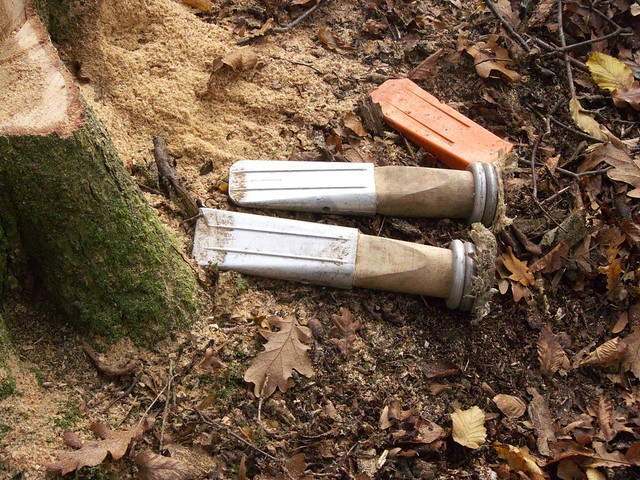
There's some felling videos to come in a moment, but first a few pictures. We've been learning about properly removing the buttresses of the trees:


How to make an accurate gob cut when the tree is wider than the chainsaw bar:
 

and also about high-lift felling wedges:
 

and how to use them:


Esus Forestry Training - training videos

Nov 22, 2011

Charlie Rose - Dov Seidman


Dov Seidman on his book "How: Why How We Do Anything Means Everything”

Outstanding... Worth viewing...  Monte

Dov Seidman’s professional career has focused on how companies and their people can operate in both a principled and profitable way. He is the founder and CEO of LRN and author of HOW: Why How We Do Anything Means Everything (Wiley; Foreword by Bill Clinton), recognized as a best business book by the Wall Street Journal and BusinessWeek. The HOW philosophy is prominently featured in Thomas L. Friedman’s books The World is Flat and Hot, Flat and Crowded.

Since 1994, LRN has helped hundreds of companies simultaneously navigate complex legal and regulatory environments and foster ethical cultures. In 2008, LRN acquired environmental innovation firm GreenOrder. Today, LRN operates globally and reaches, works with, and helps shape winning organizational cultures inspired by sustainable values in hundreds of companies with over 20 million people working in more than 100 countries around the world. Fortune magazine called Dov the “hottest advisor on the corporate virtue circuit” and he was also named one of the “Top 60 Global Thinkers of the Last Decade” by the Economic Times. Dov became the exclusive corporate sponsor of the Elie Wiesel Foundation for Humanity Prize in Ethics in 2008.

Among his recent speaking engagements are The World Economic Forum, The World Business Forum, Clinton Global Initiative annual meeting, 92nd Street Y, The National Press Club and The Aspen Ideas Festival.

He is a Harvard Law School graduate who also earned a bachelor’s and master’s degree in moral philosophy from UCLA and a BA with honors in philosophy, politics, and economics from Oxford University.

Arctic Refuge: Citizen vs. Bully Congressman


Douglas Brinkley won't be bullied by Alaska congressman on the Arctic National Wildlife Refuge
===========================
Rep. Don Young is a idiot... Monte
===========================
A video of Rep. Don Young every American should see
By Don Shelby

On Nov. 18 the celebrated historian, Dr. Douglas Brinkley, testified before the U.S. House Natural Resources Committee. The committee was taking testimony on another congressional effort to open the Arctic National Wildlife Refuge (ANWR) to oil exploration and drilling.

Brinkley was there to suggest that the ANWR be designated a national monument, preserved and protected. Brinkley knows about conservation. Among his award-winning publications and best-selling books is "Wilderness Warrior" about Theodore Roosevelt's environmental policies. His most recent book, "The Quiet World," traces the history of Alaska's wilderness. He's currently writing a new history on the conservation movement in America.

After Brinkley delivered his testimony, Rep. Don Young, R-Alaska, walked into the hearing late.

By way of full disclosure, Dr. Brinkley is a friend of mine, but had Dr. Brinkley been a stranger to me, I would still be mortified that a United States congressman would treat a guest of the House in such a fashion. I hope this piece of video is seen by as many Americans as possible. I shouldn't like people in other countries to see it. We still have an image to uphold in the world. Young makes it look like the most powerful nation on earth is run by the inmates of the asylum.

You may also notice that Dr. Brinkley doesn't suffer fools gladly. I talked to him about the confrontation. He told me: "I felt like I needed to hold my own against them. I feel good about it."

He continued: "I'm a historian and I read a lot of testimony. It is important to me to have an accurate record. I thought I needed to set the record straight for CongressmanYoung. My name is not Dr. Rice, it is Dr. Brinkley."

That is certainly part of it. It is likely, as well, that Brinkley had studied the history of Congressman Young before he arrived at the hearing. Brinkley told me he knew that Congressman Young, at another hearing, had waved a walrus penis bone at Mollie Beattie, the incoming chief of the Fish and Wildlife Service. Brinkley may have read the Rolling Stone article about Young that quotes the congressman as saying, "Environmentalists are a self-centered bunch of waffle-stomping, Harvard-graduating, intellectual idiots." The quote continues, "[They] are not Americans, never have been Americans and never will be Americans."

I don't think Congressman Young would have dared say such a thing to Teddy Roosevelt's face.

Missed votes
Brinkley should not have been surprised that Congressman Young showed up late and missed the bulk of the historian's testimony. Young is often cited as the congressman missing more votes than any other member of the House. Brinkley would have known that Young was the co-sponsor, with discredited Alaska Sen. Ted Stevens, of the bill to pay for the infamous "bridge to nowhere."

Brinkley told me: "Everyone knows that Young is just a menacing blowhard. He has a history of being rude, he browbeats and he's snotty toward anyone who cares about the environment."

I asked Brinkley if he was surprised that Committee Chair Doc Hastings took Young's side and continued lecturing the historian. "No," said Brinkley. "They are tied together at the hip. They are both oil company factotums. They are a tag team."

Had Young been in the room for Brinkley's testimony, he would have heard an interesting history lesson. Brinkley told those present that President Dwight D. Eisenhower had set aside the ANWR, and protected it the same way Ike had protected Antarctica. Brinkley is proposing that President Obama set aside the ANWR as a national monument using the 1906 Antiquities Act.

Dr. Douglas Brinkley

"Eisenhower created it as a refuge," Brinkley said.

So Brinkley suggests a new name and new status for ANWR. "I think it should be called the Dwight Eisenhower National Monument," he said.

But what about the oil?

According to the United States Geological Survey, there is a good deal of oil beneath the coastal plains of the ANWR. But there is, in relative terms, very little when compared to world demand. Pump it dry and it would be emptied in less than a year.

Another Republican congressman, Roscoe Bartlett of Maryland, always votes against drilling the ANWR. It makes him unpopular in the caucus room. But the old biology teacher-turned congressman doesn't object to drilling on environmental grounds. Bartlett told me that he votes against draining it now. He thinks it is smarter to save it for future generations who might need it, and use it more efficiently.

Bartlett doesn't think it is wise to pump the ANWR dry just to consume it in highly inefficient cars and trucks. Bartlett drives a Prius, which is another thing that drives the caucus a little crazy.

Same argument
Young chided Brinkley by saying that no one ever goes to the ANWR. Brinkley told me, "They used the same argument when considering whether to set aside the Grand Canyon. 'Nobody ever goes there,' they said."

The Grand Canyon is back up for debate, by the same forces who wish to open the ANWR for oil drilling. Congress is considering bills to open up areas near the Grand Canyon for uranium mining. It was being rushed through until someone noticed that the company doing the mining was from Russia, and no one had checked whether there were any safeguards preventing Grand Canyon uranium from going into Iranian nukes.

"Our park lands, our treasured areas are under attack," Brinkley told me. "We fought hard to protect these wild places and that makes the United States unique. China is destroying its landscape. We have a history of preserving ours."

Brinkley believes Young and his ilk have another reasons for going into the ANWR, and it has nothing to do with oil. "I think they believe," he said, "if they can open up the ANWR, molest it piece by piece, they will demoralize the whole environmental movement."

Brinkley believes, as Young has made clear, there are members of Congress who see people who would protect wild places as the enemy of the country. "The Coastal Plain of the ANWR has an unbelievably rich marine environment," Brinkley said. "It is where the caribou calve. It is where the polar bear den."

To Congressman Don Young's ears, such talk borders on treason.

Brinkley has a ready response. "Congressman Don Young is a low-grade Joseph McCarthy."

Nov 21, 2011

"The REAL Public Nuisance"


Robert Reich breaks some knowledge on the REAL public nuisance. OCCUPY DEMOCRACY.

Nov 20, 2011

Officers Put on Leave After Pepper Spraying Protesters | Truthout

The University of California, Davis, said on Sunday that two police officers had been placed on administrative leave after using pepper spray on seated protesters in a widely recorded encounter on Friday afternoon.

Reflecting widespread anger over the police behavior, the university chancellor, Linda P.B. Katehi, said Sunday that she would insist that the investigation be completed in 30 days. A day earlier, she had said it would take 90 days.

Meanwhile, students and others affiliated with the Occupy U.C. Davis movement planned for a Monday-afternoon protest on campus. A Facebook page for the protest asked attendees to call for Ms. Katehi’s resignation and to “show solidarity and support to the students who were beaten and sprayed by U.C. Davis police in riot gear.”

The Facebook page also promoted a way for sympathizers to donate tents and pizza for the rally. The Amazon.com page set up for donations indicated that more than 70 tents had already been donated by Sunday morning.

The use of pepper spray came after students and other protesters set up tents on campus, an occupation tactic that has been used in cities and towns across the country. As police officers took down the tents, some protesters linked arms and refused to stand up from a sidewalk on the campus quad, even when police officers tried to pick them up to arrest them.

In one of the many YouTube videos of the spraying, bystanders chant, “Don’t shoot students” before an officer shakes a red pepper spray canister and sprays a line of the protesters with orange-tinted pepper spray. The protesters’ faces and clothes are quickly covered in the pepper spray. Some protesters are heard screaming and crying as they are arrested. One bystander is heard screaming: “These are children. These are children.”

Eleven protesters were treated after being pepper-sprayed. Two were sent to the hospital. Ten protesters were arrested, cited and released on misdemeanor charges of unlawful assembly and failure to disperse, according to the university.

After the episode, a police official suggested that the police officers felt threatened and encircled by the protesters. The videos, however, do not show evidence of threats.

The University said Sunday in a statement that two police officers had been “suspended,” but the university later clarified that the officers had been placed on administrative leave with pay pending the investigation, a common procedure in cases like this one.

The university did not identify the two officers, but they were well known to students on the campus. The home and cellphone numbers for one officer was widely distributed on the Web, and that officer’s voicemail box was full by midday Saturday.

The university said that it had been flooded with comments, as well.

Reached by telephone on Sunday, Mitchel Belson, the associate vice chancellor for university communications, said, “We’ve been inundated with people sending messages.” He added, “It literally brought down our servers.”

In her statement on Sunday, Ms. Katehi said: “I spoke with students this weekend, and I feel their outrage. I have also heard from an overwhelming number of students, faculty, staff and alumni from around the country. I am deeply saddened that this happened on our campus, and as chancellor, I take full responsibility for the incident. However, I pledge to take the actions needed to ensure that this does not happen again.”

She also said: “These past few days our campus has been confronted with serious questions, which will challenge us for many months and years to come. We have created great universities which are challenged in their capacity to accommodate our human needs of expression, anger, frustration and even civil disobedience together with the need to feel safe. We need to find a way to change that while at the same time remaining true to our mission of teaching, research and service. We need to think hard and together on how to accomplish this.”

Ms. Katehi held a news conference on Saturday afternoon where she resisted calls for her resignation. Students and other protesters gathered outside the news conference location, and for a time afterward she did not come out of the building. The protesters decided to clear a pathway for her to exit; they sat down and watched in silence as she walked to her car.

Something has shifted in this country! Maybe greed and buying influence are not so fashionable anymore... Maybe a positive tide for reason and restoring a true democracy is beginning to build from the grassroots...

UC Davis Chancellor Katehi walks to her car

On Friday, police officers at the University of California, Davis doused students with pepper spray for sitting together with locked arms. This act was perceived as a “threat,” according to the officers. Last night, students lined the way between UC Davis Chancellor Katehi’s office and her car, and sat in silence as she walked out of the building to go home. The silence is deafening in the video


It has been both incredibly moving and saddening to see the polarized reactions on this message board. I am shocked and disheartened at the hate speech that people carelessly flick around. I hope that the people who are touched by this personal and vulnerable film also express themselves and I hope that the people understand the pain that was inflicted that day was also emotional. This was the first time I have witnessed violence in this form. This is the first time I have felt this helpless. I have never screamed in horror before- this is what you are hearing here.

I was horrified, I was helpless, my friends were being assaulted by the people (the police) who I always trusted to protect us.

They (The police and the administration) claim that public health and safety was a risk by setting up the tents, they say that we are at risk because of our Health and Safety if we were camping, they say that they cannot "watch over us" if we live on campus in a tent.

The police department and the UC Davis administration say all this and yet they are the ones who injure us.

We created a community and protected it, we protected each other, we sat together, ate together, spoke together, cared for each other, made music, laughed, educated one another, held workshops on social justice, held workshops on the politics of OW, held one another in respect and compassion. This camp was a space for addressing and discussing the complicated systemic issues that we are all facing. This was a space for listening to everyone.

We are not all given equal opportunities to speak as our race, gender, nationality, physical ability and sexual orientation often prevent us from being heard. This is why I want this film to be public. I want everyone to see what happened. I am not interested in debating or arguing the points of OWS or commenting on why we were protesting a proposed 81% fee increase in the UC System. If you are interested in understanding the damaging effects that privatizing the University will have, please search for "Wendy Brown: Saving the University Part 6"

Here is what matters: I am interested in creating community spaces on college campuses or elsewhere, where everyone has an opportunity to speak and all of our voices are heard because together we are stronger.

I am disgusted by this violence, I am disgusted that UC Davis administration allowed this to happen, I am disgusted that people sitting in the comfort of their homes can write such hateful messages, I am disgusted by this entire situation.

============
See also:
http://www.alternet.org/story/153136/ows_continues_to_dominate_the_zeitgeist%3A_outcry_over_abuse_of_students_at_uc_davis_grows%2C_right-wing_plan_to_smear_protests_exposed?page=entire

http://www.salon.com/2011/11/20/the_roots_of_the_uc_davis_pepper_spraying/ - The roots of the UC-Davis pepper-spraying BY GLENN GREENWALD


Something has shifted in this country! Maybe greed and buying influence are not so fashionable anymore... Maybe a positive tide for reason and restoring a true democracy is beginning to build from the grassroots...
Hope so...   Monte

Nov 18, 2011

Farmland Values Make Biggest Jump in Decades | AGWEB.com

NOVEMBER 17, 2011
By: Sara Schafer, AgWeb.com Business and Crops Online Editor


RELATED STORIES
Nebraska Cropland Up a Staggering 38% to 41%!
Corn Belt Cropland Values Up 25%
Trends in Farmland Values

While your farmland may look about the same as it did last year, it’s now worth a whole lot more. Around 25% more if you live in the Corn Belt states.

This week, the Federal Reserve Banks of Chicago and Kansas City, district 7 and 10, released its third quarter farmland data. Both districts saw some of the strongest farmland value gains since the late 1970s.

The Chicago Fed bank, which serves the northern two-thirds of Illinois, Indiana, Iowa, the lower Peninsula of Michigan and southeastern Wisconsin, reports favorable credit conditions and interest rates for agricultural producers boosted values.

The Chicago Fed states that further strengthening of agricultural credit conditions during the fall and winter was anticipated by their survey respondents.

The Kansas City Fed bank, which serves Kansas, northwest Missouri, Nebraska, Oklahoma and the Mountain States of Colorado, Wyoming and northern New Mexico, also cited a positive financial environment. District farm incomes were higher than year-ago levels, despite the extensive drought seen in much of the area.

Other key value drivers, the Fed notes, were strong competition for the limited of farms for sale in the growing season and robust livestock demand.

Here’s an overview of the farmland value gains by state. (Percent change from previous year).

The Federal Reserve System

Distric 7 (red) and District 10 (purple) saw record farmland value increases this year.


Watch out for a busted bubble to occur... !!! Monte

Nov 17, 2011

Making Biochar With Scrap Wood - YouTube


http://www.michiganbiochar.com Mark shows in this first of two videos how to take scrap wood and make biochar that can be used as a soil supplement.

In this video, we show you the finishing steps to making biochar from scrap wood.

Nov 16, 2011

Criticism, Violence and Roosting Chickens | Truthout

Wednesday 16 November 2011
by: Richard D. Wolff, Truthout | Op-Ed

Protesters with the Occupy Wall Street movement in Zuccotti Park in New York, Nov. 15, 2011. (Photo: Marcus Yam / The New York Times)

The 99 percent offered criticism of the 1 percent. They exposed and made clear what most Americans know. They struggled peacefully to inform and mobilize public opinion. They won huge numbers of hearts and minds. The 1 percent in the US did what their counterparts in Tunisia, Egypt, Bahrain, and so on did earlier this year. First, they tried to deny the 99 percent the media access needed to reach the people. That failed. Then, they tried scattered police intimidation and pressure to stop the criticism. That failed. Then, Democratic Party operatives tried to convert the Occupiers to become Obama enthusiasts for next year's election. That failed, too.

So now, the weapon of criticism wielded by the 99 percent suffers the counter criticism of violence by servants of the 1 percent. No one will miss which side resorted to organized, massive violence so early and so unnecessarily in this conflict. As in Iraq, Afghanistan, and elsewhere, having failed to win hearts and minds, US government agencies cover their failure by resorting to violence. Chickens raised abroad return home to roost as they often do. Consider the image: New York Police Department machines and personnel destroy the free library that had functioned so well in Zuccotti Park.

New York has acquired newly renamed mayor: Mubarak Bloomberg. Situated atop the 1 percent, he gave the order to "clear and clean" Zuccotti Park. This mayor, who presides over some of the world's filthiest tunnels and stations - that daily threaten the public health of millions of subway riders - suddenly acquired an obsession with cleanliness in the small Zuccotti Park. This mayor - whose city handles garbage by piling it in bags on the street that forever break and scatter their contents across the streets - wants us to believe he is concerned about public safety.

Will the failures that renamed New York's mayor spread to yield a Mubarak Obama too? Or will the Arab Spring - so blithely praised by Secretary of State Clinton as "freedom struggles" - resurface here to confront the Clintons with their hypocritical complicity in repression policies at home?

The deepening economic inequality, the moneyed corruption of politics and the collapsing fortunes and prospects of the mass of Americans: none of those basic conditions and causes of Occupy Wall Street have been addressed by Bloomberg or Obama. Instead, they seek to repress those who expose and oppose those conditions.

Meanwhile, the system that keeps reproducing those conditions - a capitalism becoming increasingly intolerable - loses more bases of support. In times like these, the criticism of weapons risks losing to the weapon of criticism. Will the Arab Spring be reborn as the American Winter?

Justin Hall-Tipping: Freeing energy from the grid | Video on TED.com


What would happen if we could generate power from our windowpanes? In this moving talk, entrepreneur Justin Hall-Tipping shows the materials that could make that possible, and how questioning our notion of 'normal' can lead to extraordinary breakthroughs.

Amazing science... Inspiring talk... Monte

Nov 15, 2011

Should NCAA Athletes Be Paid? - YouTube


The NCAA is making billions of dollars off of college sports, should college athletes be paid?

Roland Martin talks with Taylor Branch, civil rights historian, about his new book The Cartel: Inside the Rise and Imminent Fall of the NCAA.

Big Money, Big Controversy Surround College Sports - YouTube


Historian Taylor Branch joins Hari Sreenivasan to discuss his "The Atlantic" cover story "The Shame of College Sports," which calls for a complete overhaul of the way college athletics works.

Penn State, my final loss of faith - Guest Voices - The Washington Post

By Thomas L. Day

I’m 31, an Iraq war veteran, a Penn State graduate, a Catholic, a native of State College, acquaintance of Jerry Sandusky’s, and a product of his Second Mile foundation.

And I have fully lost faith in the leadership of my parents’ generation.


Penn State football coach Joe Paterno arrives home Wednesday, Nov. 9, 2011, in State College, Pa. (Matt Rourke - AP)

(Read Day’s follow up to this post in his chat Monday with readers here. )

I was never harmed by Sandusky, but I could have been. When I was 15, my mother, then looking for a little direction for her teenage son, introduced me to the Second Mile’s Friend Fitness program. It was a program resembling Big Brother, Big Sister with a weekly exercise regimen.

Instead of Sandusky’s care, I was sent to a group of adults, many of whom were in their 20s. They took me from a C-student to the University of Chicago, where I’m a master’s student now. They took the football team’s waterboy and made a 101st Airborne Division soldier.

I was one of the lucky ones. My experience with Second Mile was a good one. I should feel fortunate, blessed even, that I was never harmed. Yet instead this week has left me deeply shaken, wondering what will come of the foundation, the university, and the community that made me into a man.

One thing I know for certain: A leader must emerge from Happy Valley to tie our community together again, and it won’t come from our parents’ generation.

They have failed us, over and over and over again.


I speak not specifically of our parents -- I have two loving ones -- but of the public leaders our parents’ generation has produced. With the demise of my own community’s two most revered leaders, Sandusky and Joe Paterno, I have decided to continue to respect my elders, but to politely tell them, “Out of my way.”

They have had their time to lead. Time’s up. I’m tired of waiting for them to live up to obligations.

Think of the world our parents’ generation inherited. They inherited a country of boundless economic prosperity and the highest admiration overseas, produced by the hands of their mothers and fathers. They were safe. For most, they were endowed opportunities to succeed, to prosper, and build on their parents’ work.

For those of us in our 20s and early 30s, this is not the world we are inheriting.

We looked to Washington to lead us after September 11th. I remember telling my college roommates, in a spate of emotion, that I was thinking of enlisting in the military in the days after the attacks. I expected legions of us -- at the orders of our leader -- to do the same. But nobody asked us. Instead we were told to go shopping.

The times following September 11th called for leadership, not reckless, gluttonous tax cuts. But our leaders then, as now, seemed more concerned with flattery. Then -House Majority Leader and now-convicted felon Tom Delay told us, “nothing is more important in the face of a war than cutting taxes.” Not exactly Churchillian stuff.

Those of us who did enlist were ordered into Iraq on the promise of being “greeted as liberators,” in the words of our then-vice president. Several thousand of us are dead from that false promise.

We looked for leadership from our churches, and were told to fight not poverty or injustice, but gay marriage. In the Catholic Church, we were told to blame the media, not the abusive priests, not the bishops, not the Vatican, for making us feel that our church has failed us in its sex abuse scandal and cover-up.

Our parents’ generation has balked at the tough decisions required to preserve our country’s sacred entitlements, leaving us to clean up the mess. They let the infrastructure built with their fathers’ hands crumble like a stale cookie. They downgraded our nation’s credit rating. They seem content to hand us a debt exceeding the size of our entire economy, rather than brave a fight against the fortunate and entrenched interests on K Street and Wall Street.

Now we are asking for jobs and are being told we aren’t good enough, to the tune of 3.3 million unemployed workers between the ages of 25 and 34.

This failure of a generation is as true in the halls of Congress as it is at Penn State.

Perhaps the most vivid illustration this week of our leaderless culture came with the riots in State College that followed Paterno’s dismissal. The display resembled Lord of the Flies. Without revered figures from the older generation to lead them, thousands of students at one of the country’s best state universities acted like children home alone.

This week the world found the very worst of human nature in my idyllic Central Pennsylvania home. I found that a man my community had anointed a teacher and nurturer of children, instead reportedly had them hiding in his basement. The anger and humiliation were more than I could bear. I can’t wait for my parents’ generation’s Joshua any longer. They’ve lost my faith.

Thomas Day is a graduate student at the Harris School of Public Policy at the University of Chicago.

Nov 14, 2011

Up with Chris Hayes drops systemic analysis on Penn State

Visit msnbc.com for breaking news, world news, and news about the economy

Dave Zirin: Were Paterno and Penn State “Too Big to Fail?” | Dylan Ratigan


When it came to the money behind Penn State and Joe Paterno, were they “Too Big to Fail?” This term today is synonymous with powerful financial institutions, but has money started to control our institutions of higher education as well? Dave Zirin, sports editor for The Nation, discussed it today with Dylan.

The NCAA, always eager to demonstrate their toughness when dealing with recruitment violations and even the hint of money in athletics, has been noticeably absent from the fallout in the Penn State scandal. If it is their responsibility to uphold the integrity of college athletics, where have they been?

“The NCAA is nowhere on the ethics of anything,” says Zirin. “It is not an ethical organization. It’s all built on the basis of revenue-producing sports, particularly basketball and football.”

Which suddenly lends a little clarity to the NCAA’s radio silence on the Joe Paterno scandal. While NCAA president Mark Emmert collects a salary of $2 million a year – along with 14 vice presidents of the organization sitting around $400,000 a year – student-athletes responsible for those salaries and the other revenue can face harsh punishments for selling their game jerseys.

So was it all about the money that Joe Paterno brought in to Penn State through his fame and image?

“Too many people had a vested interest in his legend. And that meant cover-up. That meant, at all costs, the fiction of Joe Paterno’s Penn State had to survive and allegations of horrible, horrible child abuse had to be hidden,” continues Zirin.

And hence we discover that the moral basement for these schools that generate a high percentage of revenue from sports – 60% at Penn State – does not really exist. In order to protect their institution they will go to any length and sacrifice anyone that stands in their way.

Isn’t it time “Too Big to Fail” stops failing the people at every turn? Watch the segment from today, and let us know what you think:
Did the fact that so much money is involved with Penn State football make “Too Big To Fail?”

Fan Culture, Rape Culture, and the World Joe Paterno Made


Joe Paterno Statue at Penn State flickr image By happy via

Meet John Matko. John Matko is a 34-year-old Penn State class of 2000 alumnus, distraught by the recent revelations that legendary Coach Joe Paterno and those in charge allegedly shielded a serial child rapist, assistant Jerry Sandusky. He was livid that students chose to riot on campus this week, more upset about Paterno's dismissal than anything else. He was disgusted that the Board of Trustees decided to go ahead as planned with Saturday's Nebraska game just days after the revelations became public. John Matko felt angry and was compelled to act. He stood outside Saturday's Penn State-Nebraska game in Happy Valley and held up two signs. One read, "Put abused kids first." The other said, "Don't be fooled, they all knew. Tom Bradley, everyone must go." [Tom Bradley is the interim head coach.]

The response to Matko gives lie to the media portrayal of last Saturday's game. We were told the atmosphere was "somber", "sad" and "heart-rending", as "the focus returned to the children." The crowd was swathed in blue, because, we were told, that is the color to awareness of child abuse (also the Penn State colors) The team linked arms emerging from the tunnel. They dropped to a knee with their Nebraska opponents at midfield before the game. Once again, broadcasters told us, "the players were paying tribute to the victims of child abuse." We were told all of this, and I wish to God it was true.

I don't doubt the emotions in Happy Valley are genuine. I don't doubt the searing shock and pain that must be coursing through campus. But this is the pain of self-pity not reflection. It's the pain of the exposed not the penitent. Let's go back to John Matko. Matko stood with his signs behind a pair of sunglasses. He wasn't soapboxing, or preaching: just bearing silent witness. It was an admirable act but no one bought him a beer. Instead, beer was poured on his head. His midsection was slapped with an open hand. Expletives were rained upon him. His signs were also kicked to the ground and stomped.

As the Washington Times wrote, "Abuse flew at Matko from young and old, students and alumni, men and women. No one intervened. No one spoke out against the abuse."
One disapproving student said, "Not now, man. This is about the football players."

And with those nine words, we see the truth about Saturday's enterprise. It was about the football program, not the children. It was morbid theater where people were mourning the death of a jock culture that somewhere along the line, mutated into malignancy. It's a malignancy that deprioritized rape victims in the name of big-time football.

The signs of this malignancy did not emerge overnight. Looking backward, there are moments that speak of the scandals to come. In 2003, less than one year after Paterno was told that Sandusky was raping children, he allowed a player accused of rape to suit up and play in a bowl game. Widespread criticism of this move was ignored. In 2006, Penn State's Orange Bowl opponent Florida State, sent home linebacker A.J. Nicholson, after accusations of sexual assault. Paterno's response, in light of recent events, is jaw-dropping. He said, "There's so many people gravitating to these kids. He may not have even known what he was getting into, Nicholson. They knock on the door; somebody may knock on the door; a cute girl knocks on the door. What do you do? Geez. I hope -- thank God they don't knock on my door because I'd refer them to a couple of other rooms."

Joanne Tosti-Vasey, president of Pennsylvania's National Organization for Women in Pennsylvania, was not amused. With chilling unintentional prescience, Tosti-Vasey responded, "Allegations of sexual assault should never be taken lightly Making light of sexual assault sends the message that rape is something to be expected and accepted." They called for Paterno's resignation and short of that, asked to dialogue with Paterno and the team. Neither Paterno nor anyone in the power at Penn State accepted the invitation.

This is the world Joe Pa made. It's a world where libraries, buildings, and statues bear his name It's a world where the school endowment now stands at over $1 billion dollars. It's a company town where moral posturing acted as a substitute for actual morality. In such an atmosphere, seeing the players and fans gather to bow their heads and mourn Saturday wasn't "touching" or "somber" or anything of the sort. It was just sad. It was sad because they still don't get it.

One PSU student, named Emily wrote the following to si.com's Peter King, "Truth is, if not for Paterno's philanthropy and moral code (until his fatal lapse of judgment), I and thousands of others wouldn't be here right now. If not for Paterno ".Pennsylvania State might still be an agriculture school and State College might be lucky if there were a Wal-Mart within a 30-mile radius. Paterno made a huge mistake, but that doesn't mean he's not a good man."

Bullshit. Emily's words ring as false as the apologists for the Vatican, Wall Street, the military command at Abu Ghraib and any industry deemed "too big to fail." The same moral code that Emily praises just can't be the same moral code that covers up child rape. To do so is to make the very notion of morality meaningless. Emily's gratitiude that her school isn't "30 miles from the nearest Wal-Mart" can't justify defending Paterno. To do so, makes you complicit in the crimes and the cover-up. It also ensures that such a thing could happen again.

On Saturday, while Matko endured physical and verbal rage of the PSU faithful, hundreds gathered around the Paterno statue outside the stadium, laying down flowers and gifts. The pain might run deeply in Happy Valley but the cancer runs deeper. To really move forward, the malignancy must be removed. Fire everyone. Shut down Happy Valley football for a year. Do whatever you have to do to make sure that the world Joe Paterno made has seen its last day.

Nov 12, 2011

Taking a Stantis: Current Affairs

Joe Pa


Nittany Lyin'


Two institutions with sad and sick leaders that care more about losing their "cash cow" and "power" then doing what is moral and right... Monte

Nov 11, 2011

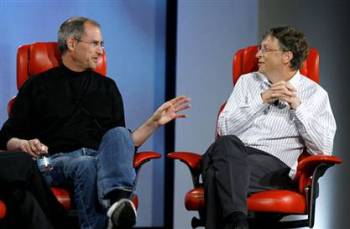
Harvard Business Review: Gates, Not Jobs, Deserves Recognition | PCWorld

Analysis: Steve Jobs has received well-deserved public acclaim, but Bill Gates might be a businessperson to admire, and the model for our children to emulate.


Since his death, Steve Jobs has received an enormous amount of well-deserved public acclaim. But a piece in the Harvard Business Review argues that Bill Gates, not Steve Jobs, should be the businessperson we most admire, and be the model for our children to emulate.

The piece was written by Maxwell Wessel, who is a researcher at the Harvard Business School's think tank that focuses on innovation, the Forum for Growth and Innovation.

His central argument is that although Steve Jobs was a visionary and likely "our generation's most important leader in the world of business," Bill Gates was a better model for us as complete people. He says:

While Jobs should be who MBAs and industrial designers try to emulate, I'm not sure he's who we should idolize. That respect should be bestowed on someone we talk less and less about, Bill Gates.

His argument is simple: Bill Gates sees his ultimate legacy as helping others and changing the world via philanthropy, while Steve Jobs saw his ultimate legacy as building a great company. He quotes from a note that Gates sent to the Harvard community: "I hope you will reflect on what you’ve done with your talent and energy. I hope you will judge yourselves not on your professional accomplishments alone, but also on how well you work to address the world’s deepest inequities, on how well you treat people a world away who have nothing in common with you but their humanity."

Then Wessel concludes:

As much as I love Apple, Inc, I would happily give up my iPhone to put food on the plates of starving children. Steve Jobs turned his company into a decade long leader in the truly new space of mobile computing. Bill Gates decided to eliminate malaria. Who do you think we should be putting up on a pedestal for our children to emulate?

Not to take anything away from Steve Jobs, but I absolutely concur with Wessel's conclusion.

Chainsaw Saw Milling - Slabbing Logs - Hines Farm

Stated slabbing a few logs today with mill... it went well...


Larger Photo


Related Links:
http://www.permies.com/t/12861/woodland-care/anyone-ever-rip-cross-cut#118094

David Crosby & Graham Nash at Occupy Wall Street; Echoes of Woodstock | Open Culture


First came Willie Nelson, Pete Seeger, and Arlo Guthrie, and now Crosby & Nash (sans Stills). Playing 11-8-2011 at Occupy Wall Street, their short set included Military Madness, What Are Their Names, They Want It All, Teach Your Children (above), and Long Time Gone, which they sang during their heyday at Woodstock more than 40 years ago. A long time gone, indeed.

http://en.wikipedia.org/wiki/Teach_Your_Children - About this great song... Monte


Teach Your Children

You, who are on the road
Must have a code
That you can live by.
And so, become yourself
Because the past
Is just a goodbye.

Teach, your children well
Their father's hell
Did slowly go by
And feed them on your dreams
The one they pick's
The one you'll know by.
Don't you ever ask them why
If they told you, you would die
So just look at them and sigh
And know they love you.

And you (Can you hear and)
Of tender years (Do you care and)
Can't know the fears (Can you see we)
That your elders grew by (Must be free to)
And so please help (Teach your children)
Them with your youth (You believe and)
They seek the truth (Make a world that)
Before they can die (We can live in)

Teach your parents well
Their children's hell
Will slowly go by
And feed them on your dreams
The one they pick's
The one you'll know by.

Don't you ever ask them why
If they told you, you would cry
So just look at them and sigh
And know they love you.


Fall on Hines Farm

Home grown, flowers, pumpkins, ducks, and wood...


Larger Photo


Larger Photo


Larger Photo

Penn State and Berkeley: A Tale of Two Protests - Edge of Sports

By Dave Zirin

Last night, two proud universities saw student demonstrations that spiraled into violence. On the campus of Penn State University in State College Pennsylvania, several hundred students rioted in anger after the firing of legendary 84-year-old head football coach Joe Paterno. At the University of California at Berkeley, 1,000 students, part of the Occupy USA movement, attempted to maintain their protest encampment in the face of police orders to clear them out.

At Penn State, students overturned a media truck, hit an ESPN reporter in the head with a rock and made every effort at arson, attempting to set aflame the very heart of their campus. They raised their fists in defense of a man fired for allegedly covering up the actions of a revered assistant who doubled as a serial child rapist. The almost entirely male student mob was given the space by police to seethe and destroy without restraint.

At Berkeley, the police had a much different response. Defenseless students were struck repeatedly with batons, as efforts were made to disperse their occupation by Sproul Hall, the site of the famed Mario Savio–led free speech battles of the 1960s.

Two coasts and two riots: a frat riot and a cop riot. Each riot, an indelible mark of shame on their respective institutions.

The difference is that at Berkeley, the Occupiers—a diverse assemblage of students, linking arms—pushed back and displayed true courage in the face of state violence. They would not be moved. These students are a credit to their school and represent the absolute best of a young generation who are refusing to accept the world as it is.

At Penn State, we saw the worst of this generation: the flotsam and the fools; the dregs and the Droogs; young men of entitlement who rage for the machine.

No matter how many police officers raised their sticks, the students of Berkeley stood their ground, empowered by a deeper set of commitments to economic and social justice.

No matter how many children come forward to testify how Joe Paterno’s dear friend Jerry Sandusky brutally sodomized them on their very campus, the students at Penn State stood their ground. They stood committed to a man whose statue adorns their campus, whose salary exceeds $1.5 million and whose name for years was whispered to them like he was a benevolent Russian czar and they were the burgeoning Black Hundreds.

Theirs was a tragic statement that proud Penn State has become little more than a company town that’s been in the lucrative business of nursing Joe Paterno’s legend for far too long.

I spoke this morning to a student who was at Sproul Hall and another resident who was a bystander at State College. The word that peppered both of their accounts was “fear:” fear that those with the space and means to be violent—the police at Berkeley and the rioters at Penn State—would take it to, as Anne, a Berkeley student said to me, “a frightening point of no return.”

I would argue that this “point of no return” has now actually been reached, spurred by Wednesday night’s study in contrasts.

November 9 was a generational wake-up call to every student on every campus in this country. Which side are you on? Do you defend the ugliest manifestations of unchecked power or do you fight for a better world with an altogether different set of values? Do you stand with the Thugs of Penn State or do you stand with Occupiers of Berkeley? It’s fear vs. hope, and the stakes are a hell of a lot higher than a BCS bowl.

Nov 10, 2011

Growth Has an Expiration Date


Growth Has an Expiration Date from Compass Summit on FORA.tv

Tom Murphy: The Fossil Fuel Joyride Is Over

Complete video at: http://fora.tv/conference/compass_summit_2011

Tom Murphy, associate physics professor at the University of California San Diego, projects energy needs for future enerations to argue that current ways of living are unsustainable. Disputing the argument that technology can save humanity from a peak oil crisis, Murphy states, "the fossil fuel joyride that we have experienced has clouded our judgment."

RETHINKING SUSTAINABILITY

Growth has an Expiration Date

Tom Murphy, Associate Professor of Physics, University of California San Diego

Compass Summit, a forum for true interaction and exchange, examines some of today's most pressing problems through the lens of global citizenship, recognizing that human ingenuity is an unlimited resource.

Nov 8, 2011

Knocking on Heaven's Door


Knocking on Heaven's Door from Compass Summit on FORA.tv

Are Politicians More Willing to Talk God Than Science?
Complete video at: http://fora.tv/2011/10/25/Knocking_on_Heavens_Door

Are politicians more comfortable discussing religion than science? Harvard physicist Lisa Randall discusses the role that scientists play in public discourse, stressing the importance of their participation.

The Story of Broke


The United States isn’t broke; we’re the richest country on the planet and a country in which the richest among us are doing exceptionally well. But the truth is, our economy is broken, producing more pollution, greenhouse gasses and garbage than any other country. In these and so many other ways, it just isn’t working. But rather than invest in something better, we continue to keep this ‘dinosaur economy’ on life support with hundreds of billions of dollars of our tax money. The Story of Broke calls for a shift in government spending toward investments in clean, green solutions—renewable energy, safer chemicals and materials, zero waste and more—that can deliver jobs AND a healthier environment. It’s time to rebuild the American Dream; but this time, let’s build it better.

Nov 7, 2011

Perennials VS Annuals: The battle to end all wars!


Wes Jackson and crew at The Land Institute take us through the differences between perennial and annual plants and how they affect our world and croplands.