


Mar 7, 2011
Family Farm Defenders

Cows Join Protest in Support of Workers at WI State Capitol 3/5/1
Next week, farmers from across the dairyland will bring tractors and solidarity to the WI capitol to fight for labor rights and a just state budget. Rural communities will be disproportionately hurt by the cuts to education and BadgerCare, as well as Gov. Walker’s decision to eliminate funding for other sustainable agriculture initiatives such as the Buy Local Buy Wisconsin program.
Family farmers in Wisconsin stand with state workers, and all working and middle class families in the state. An injury to one is an injury to all! The event is sponsored by Family Farm Defenders, Wisconsin Farmers Union and Land Stewardship Project, among many others. All farmers and eaters welcome and encouraged to come!
You can also sign up for this event and spread the word through Facebook:
http://www.facebook.com/event.php?eid=191135844260755
Mar 6, 2011
Hull-Oaks Sawmill - last steam-powered commercial saw mill in the country
by GARY KATZ on FEBRUARY 25, 2011
Hull-Oakes Lumber may be the last steam-powered commercial saw mill in the country, and they’re one of the few mills capable of cutting large timbers up to 85 ft. long. The mill has been on the National Register of Historic Places since 1996. Large long timbers are still used in railroad trestles, the restoration of historic structures, and for the spars and masts of ships. By coincidence, the day I arrived the mill was cutting an 80-ft. long timber for the restoration of the C.A. Thayer, an early 20th century three-masted schooner used to transport lumber along the West Coast.
In 1934 Ralph Hull went into the sawmill business by leasing a mill which had been closed since the beginning of the Depression. Hull started building a plant on the current site in 1938. Right up until he passed away, in May 2002, he continued to check in on operations, but his grandson, Todd Nystrom, now runs the mill, located about fifteen miles south of Corvallis, OR.
Rest of photos and story at http://www.thisiscarpentry.com/2011/02/25/hull-oaks-sawmill/
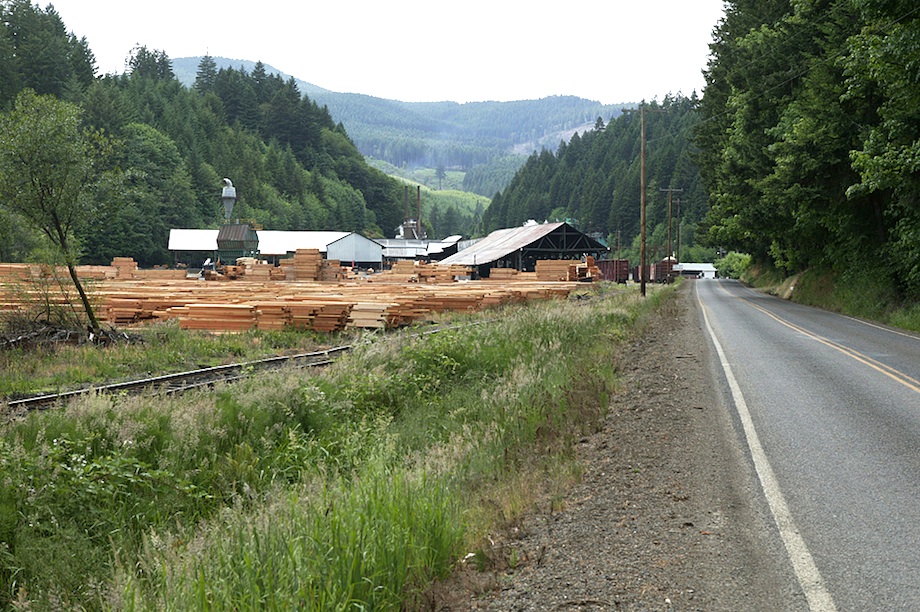
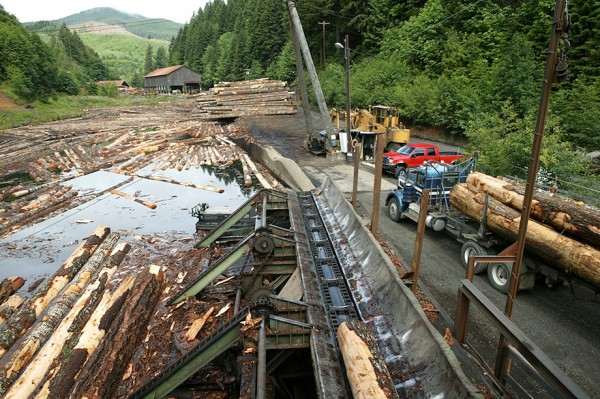
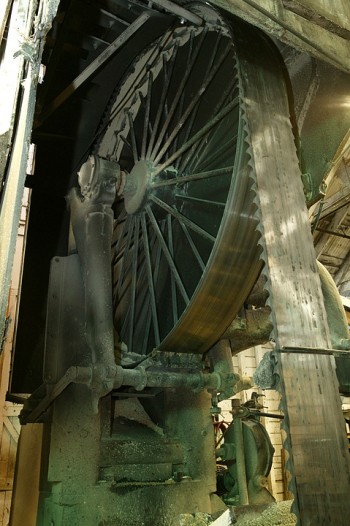
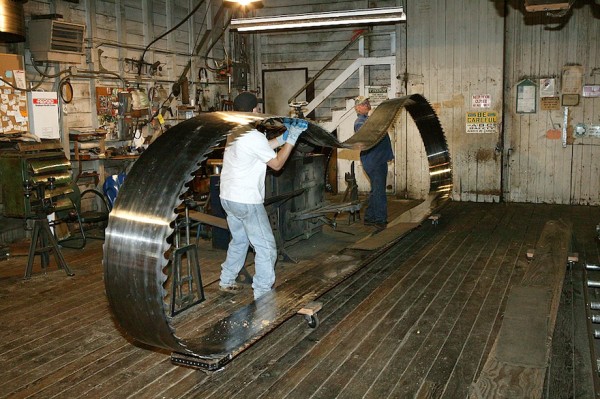
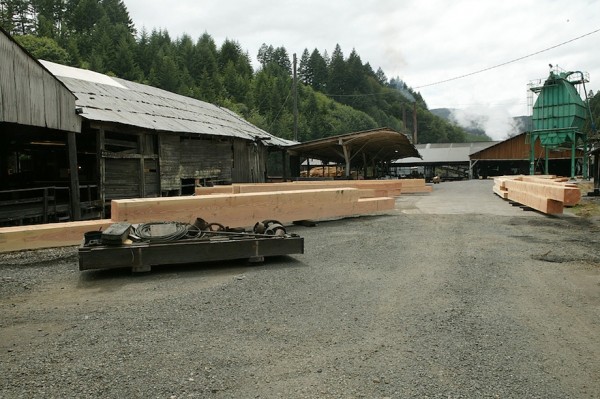
Hull-Oakes Lumber may be the last steam-powered commercial saw mill in the country, and they’re one of the few mills capable of cutting large timbers up to 85 ft. long. The mill has been on the National Register of Historic Places since 1996. Large long timbers are still used in railroad trestles, the restoration of historic structures, and for the spars and masts of ships. By coincidence, the day I arrived the mill was cutting an 80-ft. long timber for the restoration of the C.A. Thayer, an early 20th century three-masted schooner used to transport lumber along the West Coast.
In 1934 Ralph Hull went into the sawmill business by leasing a mill which had been closed since the beginning of the Depression. Hull started building a plant on the current site in 1938. Right up until he passed away, in May 2002, he continued to check in on operations, but his grandson, Todd Nystrom, now runs the mill, located about fifteen miles south of Corvallis, OR.
Rest of photos and story at http://www.thisiscarpentry.com/2011/02/25/hull-oaks-sawmill/
Mar 3, 2011
Rajat Gupta and Goldman Sachs: SEC After Big Fish? | Rolling Stone Politics | Taibblog | Matt Taibbi on Politics and the Economy
I've been getting a lot of calls about the recent decision by the SEC to pursue insider trading charges against Rajat Gupta, a Goldman Sachs board member who was also the former head of McKinsey, one of the most important corporate consulting firms in the world.
It's been very interesting to watch the media reaction to this case. The spin, overwhelmingly, has been that this is proof that the SEC is more serious than ever. Business Week came out with an article whose headline blared, "The SEC Goes After Big Game." CNBC's take was "Rajat Gupta: Bigger than Madoff?" I'm sure by the time this news cycle ends, Rajat Gupta will be the single most important figure in the history of Wall Street.
There's no doubt that Gupta is a big fish and this is a good case. The evidence is remarkable and is eerily similar to the non-case that was non-made against Morgan Stanley chairman John Mack years ago. In that case, a hedgie named Art Samberg bought the hell out of a company called Heller Capital shortly after a call from Mack, who had just had a meeting with CSFB, Heller's investment banker, which was in a position to know that Heller was about the bought by GE.
In this case, Gupta, among other things, telephoned his buddy Raj Rajaratnam less than one minute -- literally -- after learning in a Goldman board meeting that Goldman was about to receive a $5 billion capital injection from Warren Buffet's Berkshire-Hathaway company in 2008. In September 2008, Gupta disconnected from a Board conference call, in which he learned about the Buffet deal, at 3:56 p.m. By 3:57, he was on the phone with Rajaratnam, who in turn waited less than a minute to buy 175,000 additional shares in Goldman.
It's great that the SEC is moving against a figure like Gupta. But I'll be a little disappointed if he's the top of the food chain here. If the Gupta/Hathaway case is the only one they make with regard to the rampant insider trading that went on during that critical bailout period, it won't be enough, unfortunately. How many of the executives and officials involved with the various rescues and bailouts made investment decisions based upon information they got during those negotiations?
My sense of what happened in 2008-2009 -- and many of the Wall Street people I talk to regularly say the same thing -- is that all the big banks were trading massively on inside information about bailouts, interest rate changes, and announcements about government programs like the PPIP and the TALF. In a way, the whole rearranging of the economy behind closed doors -- the backroom deals in which companies like Merrill and AIG and Bear and Washington Mutual and so on were wedded to buyers in taxpayer-aided shotgun weddings -- this was all one giant insider trade. Clearly there were individuals who knew about these deals and acted on them before the rest of the world's investors did. If you look at it like that, one lonely Rajat Gupta isn't going to cut it, I don't think.
Meet Stoyek | re:char


 Stoyek Okumo is a small farmer in Bungoma County in Kenya’s Western District. Like the millions of other farmers in Western Kenya, Stoyek farms approximately one acre of land. He grows beans, maize and kale to provide food for his family, and generate a bit of income. Life for small farmers in Kenya is challenging. They rely on simple farming implements and must do everything by hand. Recently, climate change has caused delays in the onset of the rainy season, which these farmers depend on for survival.
However, Stoyek is different from many other small farmers– he has taken a risk and experimented with biochar. Three months ago Stoyek dedicated a portion of his farm to testing biochar in Kenyan soil. After one season of application, the results are stunning:
Stoyek’s maize grown in biochar and manure demonstrated a nearly 2X improvement in yield when compared to maize grown in Diammonium Phosphate (DAP), a common chemical fertilizer. In a region where poor harvests can mean famine, Stoyek’s results are incredibly encouraging and promising. In a few days Stoyek will plant maize for the long rain season. Now, nearly half of his farm has been amended with biochar. Over the coming months, Stoyek and many other local farmers will utilize re:char technology to produce additional biochar and green charcoal from their waste. As this work progresses, we will keep you updated.
Eric Sorensen: Haiti's Future Hinges on New Ideas, Sustainable Agriculture and the Rural Environment
The many challenges that face Haiti and its people have been chronicled over the last year in newspapers and on television, in blog posts and radio reports. Haiti has been portrayed as a land devastated by a crippling mix of political instability, economic stagnation, and natural disaster. Its subtitle that's repeated in nearly every news report in the media -- "the poorest country in the Western Hemisphere" -- rings even truer now than it did during the first days of 2011. But after all the devastation wrought upon Haiti over the last year (decades, really), a country that was once the "Pearl of the Caribbean" stands at a crossroads of opportunity: continue its stagnation, or show the world the power of Haitian ingenuity and the promise of a sustainable global future.
Since the quake, billions of dollars have been pledged to the relief effort (important nuance: pledged) and Haiti, which has long been dubbed "a republic of NGOs," has experienced an influx of even more foreign aid organizations. Relief efforts -- which are absolutely essential -- are ongoing in Port-au-Prince's tent cities and the ramshackle camps that have sprouted along the shadeless hillsides outside the capital. However, over a year into the post-quake relief effort, too little foreign aid money has actually been delivered and too little attention is being paid to areas outside the quake's radius of destruction. Given the overcrowding in Port-au-Prince, and the almost complete lack of any growth industry in the city, the rebuilding of Haiti must be heavily focused on sustainable rural development. Economic revitalization efforts should be aimed at the environmentally devastated countryside to protect and rebuild the environment, and provide jobs that will discourage migration to city slums. And it is crucial that aid money be steered toward projects that clearly contribute to an environmentally sustainable future for Haiti.
Haiti's tragic history of mismanagement and strife has had resulted in a poverty rate that climbs over 80 percent, while the land is over 98 percent deforested and the topsoil washes away to the sea. But Haiti's dismal industry and infrastructure might now be capitalized upon, if the monies that foreign governments and regular working Americans pledged are spent to put Haitians to work in jobs that exist in harmony with their struggling natural environment. In a country whose status quo has been ineffectual for so long, people are eager and willing to embrace new ideas that go beyond making baseballs. I've seen how adaptable the Haitian people are, and how hopeful they are for a future economy that might value the act of preserving the environment to grow food over its destruction for fuel.
With the goal of sustainable agricultural development and job creation, in 2010 I co-founded a nonprofit called Carbon Roots International, which works with farmers in a remote valley in the Haitian highlands called La Coupe. We introduced biochar and other sustainable farming methods to help subsistence farmers increase their food harvest, revitalize their soils, stop deforestation, and combat climate change.
Although those goals might sound like the stuff of fantasy, biochar has the potential to achieve huge improvements through modest means, using a little modern engineering paired with ancient practices.
Biochar is essentially sustainably produced charcoal that is used as a soil amendment. Small-scale charcoal production has come at huge environmental costs in Haiti--there are virtually no forests left in the entire country. The widespread deforestation has had a domino effect: floods are more common, most of the topsoil and nutrients have been washed away, the local climate has become hotter, and food production has cratered. Biochar presents a new and exciting way to sustainably rebuild Haiti, starting with the rural areas and food production. For a country starved for trees and not able to feed itself these are essential building blocks, upon which a national green economy might be formed.
In Haiti, Carbon Roots International enables farmers to turn agricultural leftovers into charcoal, and then educates them about the benefits of adding it to their soils. When charcoal made from crop leftovers is put in the ground, some amazing things happen: crop yields rise, soil fertility increases, water retention improves so less irrigation is needed, and carbon is sequestered in the ground. Ancient Amazonian peoples knew this -- they were practicing biochar farming hundreds, even thousands, of years ago.
Incredibly, this process is carbon negative, meaning we can actually remove carbon dioxide and other greenhouse gases from the atmosphere by enabling Haitian farmers to grow more food and rejuvenate their environment. If done on a large scale, across the developing world, biochar could help feed the hungry and provide income for many poor farmers, and help to significantly mitigate global warming. We at Carbon Roots International see great potential in this approach to development, and we're not alone.
There are many organizations in Haiti that are finding new and creative ways to help rebuild a country in dire need of new and creative ideas. They are building composting toilets to use human waste in urban gardens, or developing clean energy stores that provide green products at local rates. We are all small organizations that are thinking big, envisioning a future Haiti that is economically and environmentally sustainable, and trying new approaches that foresee an economy that looks beyond the garment industry, or the tourism industry, or, yes, the baseball industry.
To find out more about Carbon Roots International and get involved, check out: www.carbon-roots.org
Since the quake, billions of dollars have been pledged to the relief effort (important nuance: pledged) and Haiti, which has long been dubbed "a republic of NGOs," has experienced an influx of even more foreign aid organizations. Relief efforts -- which are absolutely essential -- are ongoing in Port-au-Prince's tent cities and the ramshackle camps that have sprouted along the shadeless hillsides outside the capital. However, over a year into the post-quake relief effort, too little foreign aid money has actually been delivered and too little attention is being paid to areas outside the quake's radius of destruction. Given the overcrowding in Port-au-Prince, and the almost complete lack of any growth industry in the city, the rebuilding of Haiti must be heavily focused on sustainable rural development. Economic revitalization efforts should be aimed at the environmentally devastated countryside to protect and rebuild the environment, and provide jobs that will discourage migration to city slums. And it is crucial that aid money be steered toward projects that clearly contribute to an environmentally sustainable future for Haiti.
Haiti's tragic history of mismanagement and strife has had resulted in a poverty rate that climbs over 80 percent, while the land is over 98 percent deforested and the topsoil washes away to the sea. But Haiti's dismal industry and infrastructure might now be capitalized upon, if the monies that foreign governments and regular working Americans pledged are spent to put Haitians to work in jobs that exist in harmony with their struggling natural environment. In a country whose status quo has been ineffectual for so long, people are eager and willing to embrace new ideas that go beyond making baseballs. I've seen how adaptable the Haitian people are, and how hopeful they are for a future economy that might value the act of preserving the environment to grow food over its destruction for fuel.
With the goal of sustainable agricultural development and job creation, in 2010 I co-founded a nonprofit called Carbon Roots International, which works with farmers in a remote valley in the Haitian highlands called La Coupe. We introduced biochar and other sustainable farming methods to help subsistence farmers increase their food harvest, revitalize their soils, stop deforestation, and combat climate change.
Although those goals might sound like the stuff of fantasy, biochar has the potential to achieve huge improvements through modest means, using a little modern engineering paired with ancient practices.
Biochar is essentially sustainably produced charcoal that is used as a soil amendment. Small-scale charcoal production has come at huge environmental costs in Haiti--there are virtually no forests left in the entire country. The widespread deforestation has had a domino effect: floods are more common, most of the topsoil and nutrients have been washed away, the local climate has become hotter, and food production has cratered. Biochar presents a new and exciting way to sustainably rebuild Haiti, starting with the rural areas and food production. For a country starved for trees and not able to feed itself these are essential building blocks, upon which a national green economy might be formed.
In Haiti, Carbon Roots International enables farmers to turn agricultural leftovers into charcoal, and then educates them about the benefits of adding it to their soils. When charcoal made from crop leftovers is put in the ground, some amazing things happen: crop yields rise, soil fertility increases, water retention improves so less irrigation is needed, and carbon is sequestered in the ground. Ancient Amazonian peoples knew this -- they were practicing biochar farming hundreds, even thousands, of years ago.
Incredibly, this process is carbon negative, meaning we can actually remove carbon dioxide and other greenhouse gases from the atmosphere by enabling Haitian farmers to grow more food and rejuvenate their environment. If done on a large scale, across the developing world, biochar could help feed the hungry and provide income for many poor farmers, and help to significantly mitigate global warming. We at Carbon Roots International see great potential in this approach to development, and we're not alone.
There are many organizations in Haiti that are finding new and creative ways to help rebuild a country in dire need of new and creative ideas. They are building composting toilets to use human waste in urban gardens, or developing clean energy stores that provide green products at local rates. We are all small organizations that are thinking big, envisioning a future Haiti that is economically and environmentally sustainable, and trying new approaches that foresee an economy that looks beyond the garment industry, or the tourism industry, or, yes, the baseball industry.
To find out more about Carbon Roots International and get involved, check out: www.carbon-roots.org
Warren Buffett - Mid-America - His Utility Company is #1 Wind Power Company in USA


Buffett Quietly Became King of Wind Power
Warren Buffett has been in the news a lot lately for all kinds of things, but the media has mostly overlooked the fact that the uber-investor is also making big green moves. While T. Boone Pickens has been screaming about wind power from the rooftops, Buffett, through his MidAmerican utility (which he owns via his Berkshire Hathaway holding company), has been making big investments in wind power, enough to become the #1 utility in the U.S. when it comes to wind.
Buffett wrote in his annual shareholder letter:
MidAmerican will have 2,909 megawatts of wind generation in operation by the end of 2011, more than any other regulated electric utility in the country. The total amount that MidAmerican has invested or committed to wind is a staggering $5.4 billion. We can make this sort of investment because MidAmerican retains all of its earnings, unlike other utilities that generally pay out most of what they earn.
In 2010, the U.S. had about 40,000 MW of installed wind power capacity, according to the Office of Energy Efficiency and Renewable Energy. Iowa, where MidAmerican has most of its installations, comes second only after Texas for wind power.
Long-Term Energy Thinking
Buffett makes a good financial point: Most utilities could make much bigger investments in clean energy if they retained more of their earnings instead of paying them out as dividends. In the short term, this might reduce their stock prices a big (as investors are chasing dividends), but in the long-term, it'll make them much better prepared to face a low-carbon future.
Organic Biochar Development » The GIBBR project

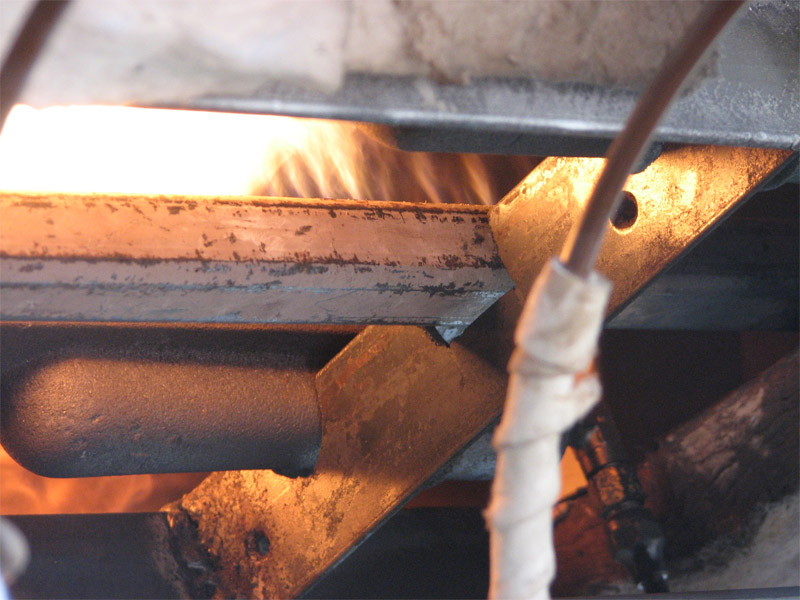
GIBBR project (Gas Ignition Biochar Batch Reactor)
This is an open source style of project. Please read the warning at the bottom of this page. If you have any issue with this design or claim ownership, contact me directly by comment below.
Project overview: I wanted to develop a safe(ish) way to produce Biochar in a vessel around the size of a 44 gallon drum, it needed to be mobile so I could wheel it into place, it needed to be able to produce enough Biochar for my 2000m2 permaculture food forest, I wanted a system which would not spark and produce any smoke because of our long dry seasons and fire bans, it needed to accept logs, branches and chunky feed stock. It was to use LPG gas for ignition. Feedstock has to have a low moisture content, fresh green waste is not suitable for this style of system as I have discovered.
Development of this system has come about from a lot of trial and error, cutting the system up and rebuilding, I’m always open to positive feedback and suggestions and I’m sure a lot of refinement will continue into the future. If your serious about developing a GIBBR style system feel free to message me.
Note: the photos in the plan are slightly different, the reaction chamber exhaust pipe should travel down next to the reaction chamber reducing wood smoke condensation.
The syn-gas produced by the system vents directly inside the powerburner flames, the reason for this is to vaporise all early stage smoke, as this early stage smoke has quite a high moisture content and is not very flammable, once the exothermic reaction occurs the LPG gas burners can be shut down as the produced syn-gases are highly flammable and the system will fuel itself until finished.
Please read this warning: This system runs super hot (650+ degrees Celsius), it produces extremely flammable gases, touching any mental part of the machine when running or for hours after operation will burn skin, all exhaust gases are toxic so operation outside is important. Blocking or jamming the exhaust pipe out of the reaction chamber will cause the system to possibility explode, killing or burning anyone near by. The reaction chamber should be at normal atmosphere with a slight increase in pressure when the system goes exothermic. Much care and respect needs to be taken around this system, children should never ever be allowed near the system when running. The ground around the system should be clear as grass will catch fire from radiant heat produced. Never put sealed containers inside the running reactor. Always wear thick leather gloves, safety glasses, with all skin and hair covered. Once the system has gone exothermic it is extremely difficult and dangerous to try and stop. You need to stay with the system during operation and access to a water hose to dampen the ground is important. I accept NO responsibility for any damage you or your system creates. This system is not suitable for small backyards sorry, try looking up ‘biochar gasifier stove’. Check with your council and maybe just let your local fire department know what you’re up too.
Gene Logsdon: Roundup Ready Alfalfa — Monsanto’s Big Goof?
by Gene Logsdon
I don’t know how to jigger genes around to make biotech alfalfa or anything else, but I do know a thing or two about making alfalfa hay. Whether Monsanto’s Roundup Ready alfalfa is harmful to health or not I don’t know either and wonder if anyone does for sure. But the majority of scientists, after much study, have pronounced RR alfalfa safe to feed and to eat. I have to assume (I guess) that most of the people involved sincerely believe that their findings are reliable and that they are not being paid off by Monsanto to fudge the results. Maybe I’m wrong about that too, but in the long run, who can you trust if not the conclusions of science, imperfect as they often are.
I think RR alfalfa is a big mistake for another reason. Weeds are rarely a problem in alfalfa cut for hay, so who needs the stuff. Alfalfa seed is expensive enough as it is. If biotech alfalfa seed goes up horrendously in price like biotech seed corn has, who would want to buy it?
If I had a dime for every bale of alfalfa I’ve handled, I’d have a very nice nest egg in the bank right now not drawing any interest. Before farming went to the corn, soybeans, and Florida rotation where I live, weeds were not nearly as problematical as they are now. The rotation then was corn, oats/wheat, and two or more years of hay. If the hay was alfalfa, it meant that for those years it was cut three times a summer, sometimes four. A good stand of alfalfa over four years of regularly cutting quashed almost all weed growth very effectively.
Sometimes in the first year that a field is seeded to alfalfa, weeds can be problematical but the alfalfa will grow right along with them if growing conditions are normal. The stand might look bad for a little while, but after the first cutting for hay, the alfalfa will spring back faster than the weeds. After the second cutting, the alfalfa grows back strongly again and the weeds diminish. By the second year’s second cutting, weeds are mostly gone. I just watched my brother-in-law’s field down the road go through this transformation over the past four years. The alfalfa looked so weedy at first that we cringed every time another farmer ventured past to see the mess, but now it looks magnificent and ought to last two more years anyway. And another thing: during the time that weeds might be bad in this situation, with multiple cuttings all summer they will be mostly in a good vegetative state when cut and make good nutritional feed too.
So why RR alfalfa? As far as I can figure, the commercial alfalfa seed growers in the West must have a weed problem because when harvesting for seed, they are not cutting their alfalfa so frequently. Seems to me the money they save by not growing seed the old way they will spend buying the new biotech seed. Then if the weeds grow immune to herbicides anyway, like they have already started to do, who has gained?
Organic growers have a good way to solve the problem of biotech alfalfa contaminating their hay crop. Switch to red or white clovers. I did thirty years ago because on my heavy clay soils, alfalfa doesn’t grow as well as red clover. Also red clover does not frost-heave as badly as alfalfa and is immune to the alfalfa weevil which is a problem here. Red clovers and some whites are fairly easy to sow by frost seeding, certainly better than alfalfa, which alone was reason enough for me to switch. And we can grow our own red clover seed in the humid eastern half of the country, not true of alfalfa. If half the haymakers quit growing alfalfa, even though it produces more tonnage if you spend the money to fertilize it heavily, the commercial seed growers would be the ones to suffer. Of course, I suppose if we all go that route, Monsanto will rush in to save us with an RR red clover. I wonder if agribusiness will eventually RR everything in nature and charge us a fee to gather hickory nuts.
Read the original article on The Contrary Farmer.
 | Gene Logsdon is the author of, most recently, Holy Shit: Managing Manure to Save Mankind. |
Vissesonce: Turning Wood
Vissesonce: The entire visual essence of an object including it's surface and it's depth. A beautiful way to demonstrate the art of turning, and to appreciate the grains of wood which serve as the turners canvas.
Subscribe to:
Posts (Atom)

 Posts
Posts


