
 |
 |
|
 |
 |
 |
 |
 |
 |
|
|
 |
 |
 |
 |
 |
|
|
 |
 |
|
|
 |
 |
 |
|
|
 |
 |
|
|
 |
 |
 |
 |
 |
|
|
 |
 |
|
|
 |
|
|
Jan 5, 2011
Hot Cars by Hans Tore Tangerud
Wonderful web site link on cars and trucks, old and new, sent to me by my friend, Mike Smith! I especially like the Brochures of US Cars and Trucks. Its's Comprehensive! ... Monte


Reflecting on the "early days" of sustainable agriculture research and education - world.edu
 Today, many public universities including my own promote their research and educational efforts in support of a more sustainable agriculture. It wasn’t always this way. The end of the year seems like a good time for reflection – to see what we can learn from our past. So lets look back to the “early days” of sustainable agriculture, the late 1980′s, when a loosely organized contingency of farmers invented an idea they called “sustainable agriculture.”
The early advocates of sustainable agriculture were mostly farmers. They generally managed mid-sized farms, but there was no consistent pattern, no typical type of farm that led the way into sustainable agriculture. Some were organic, others not. The unifying characteristic among these early advocates was that all had weathered the severe financial stress of the mid-1980′s – and they were still farming.
 In the late 1980′s, the concept of sustainable agriculture was poorly defined and much debated. It received immediate and vocal support from the environmental community – resulting in immediate and vocal distrust from mainstream agricultural institutions. The cries of the environmentalists generally reflected a poor understanding of agriculture. The response from agricultural commodity groups, agribusiness, and public universities ranged from confused to openly hostile.
But these farmer-driven and farmer managed sustainable agriculture organizations persisted. Perhaps uneasy with much of the debate, they simply got down to work and began doing research and education on their own. Some of the farmer-led sustainable agriculture organizations became well established, and began calling for assistance from their public research and educational institutions.
The response from the public university system to their call for help was at best mixed and at worst loaded with animosity, derision and ridicule. Some faculty reacted to the call for help with respect and curiosity, and these individuals were initially marginalized by most mainstream faculty and college leadership. This was a lonely time for the early advocates of sustainable agriculture within the university system. But this had to change, as the signs that “modern farming” was in trouble were becoming increasingly obvious to anyone willing to look. Remember….
- In the late 80′s we were emerging from a farm crisis that had accelerated the rate in which farmers were leaving the farm.
- The public had been frightened by two major media events causing us to worry about pesticides on our food, one concerning the safety of apples, the other concerning grapes from Chile.
- Pesticide residues were being found in rural wells, surface waters, snowfall, windblown soil and fog.
- Soil erosion made the front page of the Chicago Tribune and the CEO of Archer Daniels, Midland Co. claimed that soil loss was more dangerous a threat than nuclear war.
Overtime, more faculty and administrators came to look on sustainable agriculture as an opportunity rather than a threat. When public funding became available through theU.S.D.A. Low-input Sustainable Agriculture program, university scientists began to pay more attention. At first cautious but eventually more enthusiastic partnerships between the universities and the non-profit organizations (which were required for public funding) emerged. Today, public research and education in sustainable agriculture is almost “mainstream”. But this transition took time.
 Most Americans probably assume that public institutions have an obligation to serve the public good. And how better for a public land grant university to serve the public than to address the continued degradation of the land that provides our sustenance? Solving important public problems is what public university science shouldbe all about. But in the 1980′s many agricultural scientists could not admit there was a problem.
 Reports that only 5% of rural wells had traces of pesticide andonly 12% of rural wells had high nitrate levels were not viewed as a problem by apologists for industrial agriculture inside and outside the university. During the winter of 1989-90, an analysis of every major snowfall event across the corn belt found only traces of the commonly used corn herbicide, Atrazine. This was declared simply the cost of doing business – the “price of bounty.”
Even once we acknowledged evidence that all was not right, the debate continued as to whether the problem was indeed worth our attention. The scientists inside the public university system who had invested so much in the development of industrial agriculture remained reluctant to accept that something might be wrong. It took public groups to bring pressure on the university system to begin to address these problems. In a democracy, the public must be involved. While science can help define the problem, community values and public debate must help determine where public resources are focused.
 As a young scientist deeply engaged in the sustainable agriculture controversy, I found the response of some of my colleagues disappointing. Somehow I expected scientists to respond with more curiosity to the claims being made by farmers and environmentalists that something was not right with American agriculture.
  Today, most university agricultural programs are willing to address the environmental degradation and resource depletion associated with modern agriculture. But new ideas are often stillmet with skepticism, and some of the most interesting work being done in sustainable food and farming is not initiated inside the university, but by creative practitioners. New ideas that came from outside the university, and deserving of our attention are:
- permaculture and forest gardening,
- rotational grazing and seasonal dairying,
- food sovereignty,
- carbon farming,
- urban agriculture, and
- edible landscapes….
We still need to face some unpleasant truths about the public university system.
 We will likely continue to be skeptics, as that is the nature of science. But I hope we can learn to be more open to innovation and creativity when it comes from outside the institution. Many farmers have criticized the public land grant universities as being reluctant to consider new ideas generated in the field (the “not invented here” syndrome).
There is some truth to this critique.
If we are to learn from the “early days” of sustainable agriculture, we must recognize that criticism from outside the institution should be welcomed. It says that someone cares about what we do and how we are doing it. And if we are willing to listen, the criticism helps us focus on what we should be doing. It keeps us sharp – and it pushes us to do better.
Please don’t stop caring and criticizing YOUR public university.
==============================================================================
I’d appreciate it if you would share this post with your friends. And for more ideas, videos and challenges along these lines, please join my Facebook Group; Just Food Now. And go here for more of my World.edu posts.
Free Online Tool for Farm Mapping - farm-file.com
Farm-File provides a simple way to accurately make a farm map. Via the website you can map your farm, mark out and measure areas and produce professional working farm maps.The basic plan is free to sign up for. Here’s a short video showing how it works: Great free tool... Monte
Jan 4, 2011
8 Shops to Buy Rustic Reclaimed Wood Furniture From | BarefootFloor.com
I’m sold on rustic decor and its use of sustainable reclaimed wood furniture. If you aren’t yet, take my word for it until you see the photos or get up to speed with my first post in the series. The short story is that adding country-inspired furniture and accents is a fun new trend, reclaimed wood is eco friendly, and it lets you keep family heirlooms without going for totally country decor. This post is dedicated to the best places to window-shop for rustic furniture, in no particular order since I like them all.


Bees in freefall as study shows sharp US decline | Environment | The Guardian
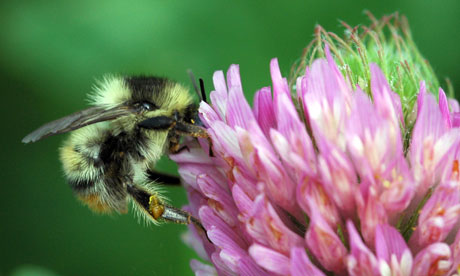 Bumblebees are important pollinators of wild plants and crops around the world. Photograph: RSPB/PA
The abundance of four common species of bumblebee in the US has dropped by 96% in just the past few decades, according to the most comprehensive national census of the insects. Scientists said the alarming decline, which could have devastating implications for the pollination of both wild and farmed plants, was likely to be a result of disease and low genetic diversity in bee populations.
Bumblebees are important pollinators of wild plants and agricultural crops around the world including tomatoes and berries thanks to their large body size, long tongues, and high-frequency buzzing, which helps release pollen from flowers.
Bees in general pollinate some 90% of the world's commercial plants, including most fruits, vegetables and nuts. Coffee, soya beans and cotton are all dependent on pollination by bees to increase yields. It is the start of a food chain that also sustains wild birds and animals.
But the insects, along with other crucial pollinators such as moths and hoverflies, have been in serious decline around the world since the last few decades of the 20th century. It is unclear why, but scientists think it is from a combination of new diseases, changing habitats around cities, and increasing use of pesticides.
Sydney Cameron, an entomologist at the University of Illinois, led a team on a three-year study of the changing distribution, genetic diversity and pathogens in eight species of bumblebees in the US.
By comparing her results with those in museum records of bee populations, she showed that the relative abundance of four of the sampled species (Bombus occidentalis, B. pensylvanicus, B. affinis andB. terricola) had declined by up to 96% and that their geographic ranges had contracted by 23% to 87%, some within just the past two decades.
Cameron's findings reflect similar studies across the world. According to the Centre for Ecology and Hydrology in the UK, three of the 25 British species of bumblebee are already extinct and half of the remainder have shown serious declines, often up to 70%, since around the 1970s. Last year, scientists inaugurated a £10m programme, called the Insect Pollinators Initiative, to look at the reasons behind the devastation in the insect population.
Cameron's team also showed that declining species of bee had higher infection levels of a pathogen called Nosema bombi and lower genetic diversity compared with the four species of bee that were not in decline –B. bifarius, B. vosnesenskii, B. impatiens and B. bimaculatus.
The N. bombi pathogen is commonly found in bumblebees throughout Europe but until now has been largely unstudied in North America. The infection reduces the lifespans of individual bees and also results in smaller colony sizes.
The reduction in genetic diversity seen in the declining bees means that they are less able to fight off any new pathogens or resist pollution or predators. "Higher pathogen prevalence and reduced genetic diversity are, thus, realistic predictors of these alarming patterns of decline in north America, although cause and effect remain uncertain," Cameron wrote today in Proceedings of the National Academy of Sciences.
Insects such as bees, moths and hoverflies pollinate around a third of the crops grown worldwide. If all of the UK's insect pollinators were wiped out, the drop in crop production would cost the UK economy up to £440m a year, equivalent to around 13% of the UK's income from farming.
The collapse in the global bee population is a major threat to crops. It is estimated that a third of everything we eat depends upon pollination by bees, which means they contribute some £26bn to the global economy.
Other identified causes of bee decline include parasites such as the bloodsucking varroa mite and viral and bacterial infections, pesticides and poor nutrition stemming from intensive farming methods.
"Pollinator decline has become a worldwide issue, raising increasing concerns over impacts on global food production, stability of pollination services, and disruption of plant-pollinator networks," wrote Cameron. "In accordance with the goals of the United Nations convention on biological diversity to reduce the rate of species loss by 2010, such efforts to elucidate the causes and ecological impacts of bumble bee decline, in co-ordination with informed conservation strategies, will go a long way to mitigating further losses."
A walk in the greenhouse « The Farming Engineers
One of our experiments this winter has been growing produce in the ground in our unheated greenhouse. We first learned about this idea from Eliot Coleman’s writings, and got many more specifics from several of John Bierbaum’s presentations at the MOSES conference last winter.
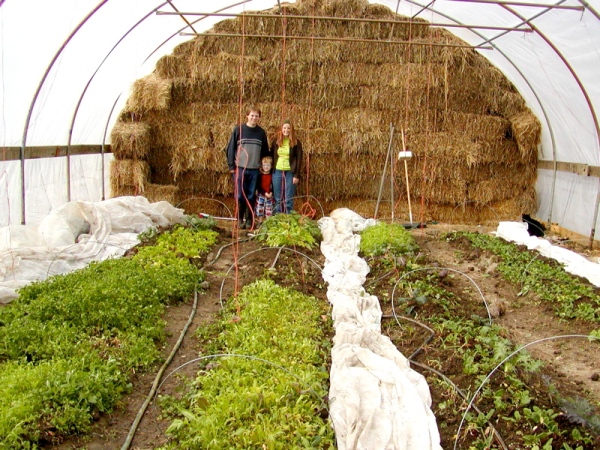
Spinach, kale, lettuces, arugula, chard, cilantro, and a few assorted mustard greens are growing right now. We’re standing in front of a hay bale wall. Later on in the spring, we’ll pull down the bales to build tables for our seed starting flats.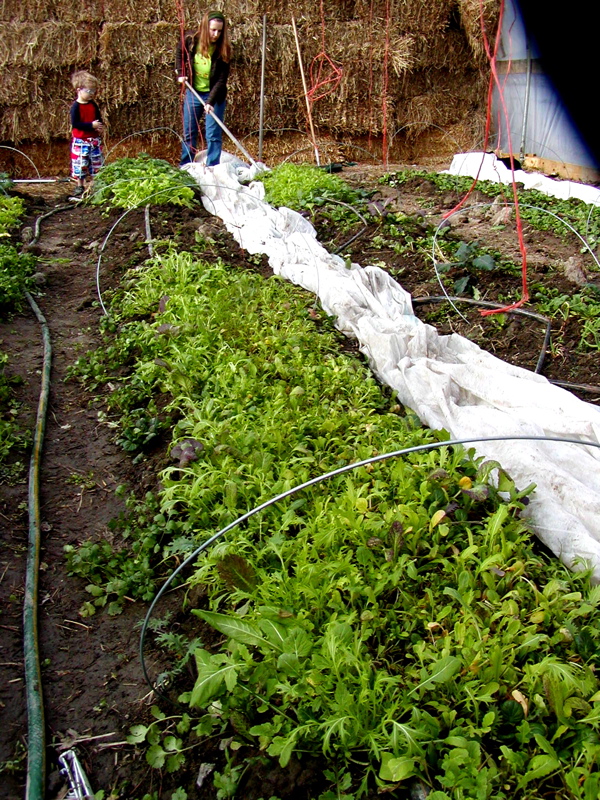
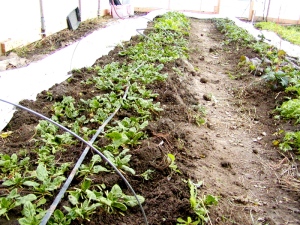
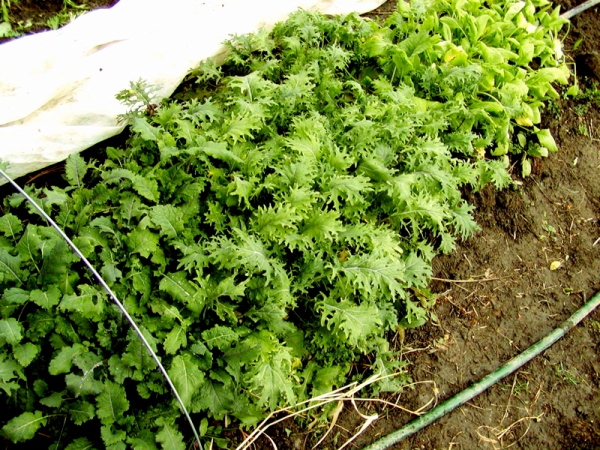
The whole idea of keeping vegetables of any kind alive all winter in central Indiana without supplemental heat when it’s below zero outside may seem a little crazy.. but what’s starting to seem crazy now is leaving the greenhouse empty in the winter! Take a look inside of our hoophouse, as of today.

Spinach, kale, lettuces, arugula, chard, cilantro, and a few assorted mustard greens are growing right now. We’re standing in front of a hay bale wall. Later on in the spring, we’ll pull down the bales to build tables for our seed starting flats.

Between the rows, that white stuff is polyester row cover. We put two layers of it on the wire hoops over the rows. Sometimes we use old greenhouse plastic instead, which is stiffer. Greenhouse plastic handles better when frozen and/or wet, but we don’t have enough of it yet for all of the beds.
Watering is kind of a hassle, but we don’t have to water very often during the winter. We have an outdoor spigot about 100 feet away from the hoophouse. When there’s a sunny day above freezing, we haul a hose out to the spigot, hook it up, uncover the greens, and do the watering. Then we unhook the hose, haul all the hose back into the hoophouse, and let the leaves dry off before covering the plants back up. We try to water every 10 days or so. The plants stay pretty moist with the two layers of row cover on.
With this arrangement, the limiting factor in growing greens becomes day length. Right now, in early January, days are very short and everything is growing very slowly. Greens grown for cut & come again use just don’t grow back very fast. We’re planning to put up a second hoophouse during the 2011 growing season that is twice as long, so that we can have more greens and other items available throughout the fall & winter.
There are definite limits on what can be grown this way- notice that we are growing cold-tolerant leafy greens. We had radishes and salad turnips in the beds earlier, which also did well. Certainly nothing is in the beds that can’t handle a frost.

Spinach anyone? It gets sweeter after every cold spell. The sugars are a natural form of antifreeze.

However, kale is what will really get you to live forever.
Quarter-Sawn Lumber - Woodworking Tips - What is Quarter-Sawn Lumber?
Quarter-sawing is a method of milling trees into lumber. Quarter-sawn lumber is highly sought after, particularly in certain species such as oak or maple, where look of the grain in the wood is accentuated by the method of cutting the tree. While rip-sawing is the most efficient (and common) method of milling, quarter-sawing is more difficult to cut but yields much more stable lumber. Because it is more difficult to cut and there is more waste, quarter-sawn lumber is considerably more expensive than rip-sawn material.
Why Quarter-Saw Lumber?:
Quarter-sawn lumber is more stable, because it is cut in a manner that attempts to get as much of the end grain of the wood perpendicular to the face of the board as possible. Without having grain running parallel to the face of the board, there is far less chance of the board twisting or cupping as it dries, or worse, when in use in a project. The more square the end grain is to the face of the board, the more stable that board will likely be over the course of its life in the project.
Additionally, quarter-sawn lumber of a variety of species has a look that is unmatched by a rip-sawn board. Oak is a prime example: the grain of oak is much more wavy and displays medullary ray flecks that are far more unlikely to be visible if the board is rip-sawn. Because of these qualities, quarter-sawn oak was the primary type of wood used to create authentic Arts and Crafts era pieces of furniture.
How is a Tree Quarter-Sawn?:
There are a few methods of quarter-sawing a tree, but the most common is for the mill to cut the round tree into four quarters along the long axis of the tree, much like four 90-degree wedges of pie. These wedges are then placed with the center point facing upwards, and boards are ripped off of the wedge. As you might expect, the widest board will be from the center of the wedge, with very narrow boards from the edges. By cutting the tree in this manner, the growth rings (which form the grain of the wood) are going to be closer to square to the face of the board than on most of the boards from a rip-sawn tree.
How Does Quarter-Sawn Lumber Move?:
Properly quarter-sawn lumber will certainly move, just like all other cuts, based on fluctuations in humidity in the environment that the board is used. However, by cutting with the grain square to the face of the board, a quarter-sawn board will swell primarily across the face (making the board wider), whereas a rip-sawn board may grow in width and height (and very likely will twist or cup as it swells). Knowing how the wood will adjust to moisture changes should be considered when laying out the boards for your project.
Why Quarter-Saw Lumber?:
Quarter-sawn lumber is more stable, because it is cut in a manner that attempts to get as much of the end grain of the wood perpendicular to the face of the board as possible. Without having grain running parallel to the face of the board, there is far less chance of the board twisting or cupping as it dries, or worse, when in use in a project. The more square the end grain is to the face of the board, the more stable that board will likely be over the course of its life in the project.
Additionally, quarter-sawn lumber of a variety of species has a look that is unmatched by a rip-sawn board. Oak is a prime example: the grain of oak is much more wavy and displays medullary ray flecks that are far more unlikely to be visible if the board is rip-sawn. Because of these qualities, quarter-sawn oak was the primary type of wood used to create authentic Arts and Crafts era pieces of furniture.
How is a Tree Quarter-Sawn?:
There are a few methods of quarter-sawing a tree, but the most common is for the mill to cut the round tree into four quarters along the long axis of the tree, much like four 90-degree wedges of pie. These wedges are then placed with the center point facing upwards, and boards are ripped off of the wedge. As you might expect, the widest board will be from the center of the wedge, with very narrow boards from the edges. By cutting the tree in this manner, the growth rings (which form the grain of the wood) are going to be closer to square to the face of the board than on most of the boards from a rip-sawn tree.
How Does Quarter-Sawn Lumber Move?:
Properly quarter-sawn lumber will certainly move, just like all other cuts, based on fluctuations in humidity in the environment that the board is used. However, by cutting with the grain square to the face of the board, a quarter-sawn board will swell primarily across the face (making the board wider), whereas a rip-sawn board may grow in width and height (and very likely will twist or cup as it swells). Knowing how the wood will adjust to moisture changes should be considered when laying out the boards for your project.
Suggested Reading
The Basics of Biochar : A Natural Soil Amendment
PDF file showing benefits of adding biochar to soil. ... Monte
Dec 31, 2010
Energy Related Charts of The Year 2010

A picture says a thousand words. In this post you will find many charts and graphs conveying important points from the world of energy 2010. Click header and get a wealth of factual charts... Monte
Dec 28, 2010
Build an Easy Drill Press Guide
This is a short video about how to made a Drill Press guide for a work shop. It consists of a BASE PLATE, A FENCE that pivots on a quarter inch bolt, and a STOP BLOCK to make uniform holes. It is very easy to make.
Dec 21, 2010
Don't Miss The Boat On Biochar!
The EcoTechnologies Group, having become smitten with the powerful promise of biochar, the pyrolysis technologies that create it and its potentials for sustainable agriculture, traveled to Northern Brazil to see the original biochar, called Terra Preta, in action. The journey would become more than expected, and what I would see would convince me of those professed potentials.
A DV camera first hand experience.
We have all read and heard about Terra Preta; now we have a great video experience seeing it... Monte
A DV camera first hand experience.
We have all read and heard about Terra Preta; now we have a great video experience seeing it... Monte
Dec 16, 2010
Hines Farm - Moxon's Double-screw Vise
Inspired by Christopher Schwarz, Woodworking Magazine articles on building Moxon's Double-screw Vise (Joseph Moxon's Double-screw Vise May 25, 2010 and Declaring Victory with the Double-screw Vise), I just built my own from Oak on the Hines Farm. I utilized, a Beall threader to make 1-1/2" vise screws. This portable vise should come in handy for our woodworking projects. Vise is pictured holding a 3 inch diameter dowel in it's jaws.

Front View

Back View
Front View
Back View
Dec 15, 2010
Beautiful Quartersawn White and Red Oak Boards

Quartersawn white and red oak are my favorite woods. The vertical lines on the end grain in the photo above are the growth rings, and the thin, almost horizontal lines are the medullary rays that radiate from the center of the tree out to the edge. When a ray crosses the surface of a board, the flaked figure appears. Quartersawn logs are more stable and are less likely to shrink, expand, and warp.
Quarter-sawing maximizes the beauty of Medullary Rays and Growth Rings of White and Red Oak. Above is an animation of the quarter-sawing process and the beautiful wood grain characteristics of the quartered and rift boards that result.
Credits: http://blogs.popularwoodworking.com/editorsblog/Frank+Miller+Lumber+Road+Trip.aspx
Dec 14, 2010
Our Reliance on Plants is Increasing


download GeoTIFF file (115 MB, TIFF)
Take a look around you: Chances are good that you’re touching at least one thing that came from a plant. We build our homes, furniture, and other structures from wood products; we use plants like cotton and flax (linen) to make cloth for clothing, towels, bedding, and more; we eat a variety of plants and cook with wood; some of our vehicles run on biofuels; and we rely on animals that eat plants for food, transportation (in some places), and other products like wool and leather. Much of what we use every day comes from plants, and new research led by Marc Imhoff at NASA Goddard Space Flight Center is showing that our reliance on plants is increasing.Between 1995 and 2005, the global demand for plant matter went up about five percent. In 1995, we required 20.3 percent of the plant material Earth currently produces (the photosynthetic capacity of the land). By 2005, that number increased to 25.6 percent both because each person is using more plant products and because there are more of us. Imhoff and his team reached these conclusions by comparing the rate at which people require plant products, in terms of carbon, to the rate that the Earth can produce plant carbon.
This map shows the comparison for 2005. The colors represent the ratio between the amount of carbon people require and the amount of carbon Earth produced. At the top of the scale (dark red), the population needs at least ten times more plants than are grown locally. At the lower end of the scale (dark green), the land produces more vegetation that the local population needs. Gray areas are places where people in the area use less than 10 percent of the vegetation growing there. In the center of the scale (pale yellow) people use most of the vegetation.
In general, the greatest use of plant products occurs in highly populated regions, like Asia and large cities, and places that can not produce enough to support the population’s requirements for plants, such as the African Sahel. Because these places use everything they grow and still need vegetation from elsewhere, they are very vulnerable to changes in climate that would reduce production and disruption in transportation that would make it more difficult to bring food and other plant products from other places.
The map shows the pressure on local ecosystems, but not per capita use. For example, in the United States, each person uses 5.94 metric tons of carbon (vegetation) per year, while in South-central Asia, people use 1.23 metric tons per year. However, the United States produces more than it requires, so the ratio between usage and vegetation is low. South-central Asia, on the other hand, uses less per person, but it has a high population that collectively require more carbon than the land produces, and so must import products from other regions.
“What we’re realizing is the biosphere doesn’t care whether you have a lot of people consuming a little or a few people consuming a lot. It’s the total amount or rate relative to what can be produced that is important,” says Imhoff. “Right now, humans are increasing both population and per capita consumption.” For this reason, it is important to monitor vegetation and land use on a global scale.
The vegetation measurements used to produce the map (net primary productivity) are a measure of the amount of carbon plants convert into plant matter (biomass) as recorded by the Moderate Resolution Imaging Spectroradiometer (MODIS) on NASA’s Terra and Aqua satellites. (Earlier research from 1995 used measurements from another sensor, AVHRR.)
The researchers measured the requirement for plant products by using statistics from the United Nations Food and Agriculture Organization, which reports how much food, livestock, and wood products each country produces, imports, and exports. They calculated usage by first determining what each country produces and imports and then subtracting exports. They calculated the amount of plant material (carbon) required to support such usage by using models that translate between final products, like flour, beef, or paper, and the amount of plant material required to produce the products. Finally, they divided by the population of the country to figure out how many plant products each person in the country uses on average. In the map, the requirement for plant products is mapped by population distribution.
When comparing carbon requirements and production for 2005 to earlier figures from 1995, Imhoff found that people were using about five percent more of Earth’s vegetation in 2005. “People worry about that percentage. If, in future scenarios, it’s going to go up to something like 50 percent, we’re looking at a very high demand for land management at all levels on the landscape. We would be heading toward a place where the planet would be very carefully managed, from end to end.”
To see an interview with Dr. Imhoff and to read more about this work, see How hard are we pushing the land? on the NASA web site.
References
Imhoff, M., Bounoua, L., and Zhang, P. (2010, December 15). Satellite supported estimates of human rate of NPP carbon use on land: Challenges ahead (pdf). Presented at the Fall Meeting of the American Geophysical Union.
Lynch, P. (2010, December 14). How hard are we pushing the land? NASA. Accessed December 14, 2010.
NASA image provided courtesy of Trent Schindler, Scientific Visualization Studio, using data provided by Marc Imhoff (NASA Goddard Space Flight Center). Caption by Holli Riebeek.
Instrument:
Terra - MODIS
Woodworking for engineers
 Woodgears.ca is a wonderful site for woodworkers. Lots of great ideas and ingenious plans for tools. Matthias Wandel is a 2nd generation woodworker who is also an engineer. He shares his plans and projects. I especially like his pages on his father's beginnings and his ideas, equipment, ..., and works (My dad's sawmill & My dad's woodworking workshop). If you are interested in woodworking, get ready to spend some time on this great site! ... Monte
Subscribe to:
Posts (Atom)

 Posts
Posts


